



8888 R.E.News TECHNICAL INSIDE
 November 2026-FR-English-NL-footer
R.E.News TECHNICAL INSIDE
ARTICLE 1 • MICRO-PELLES • CONCEPTION • TECHNOLOGIE
Cat 301 CR : la puissance au service des espaces les plus exigus
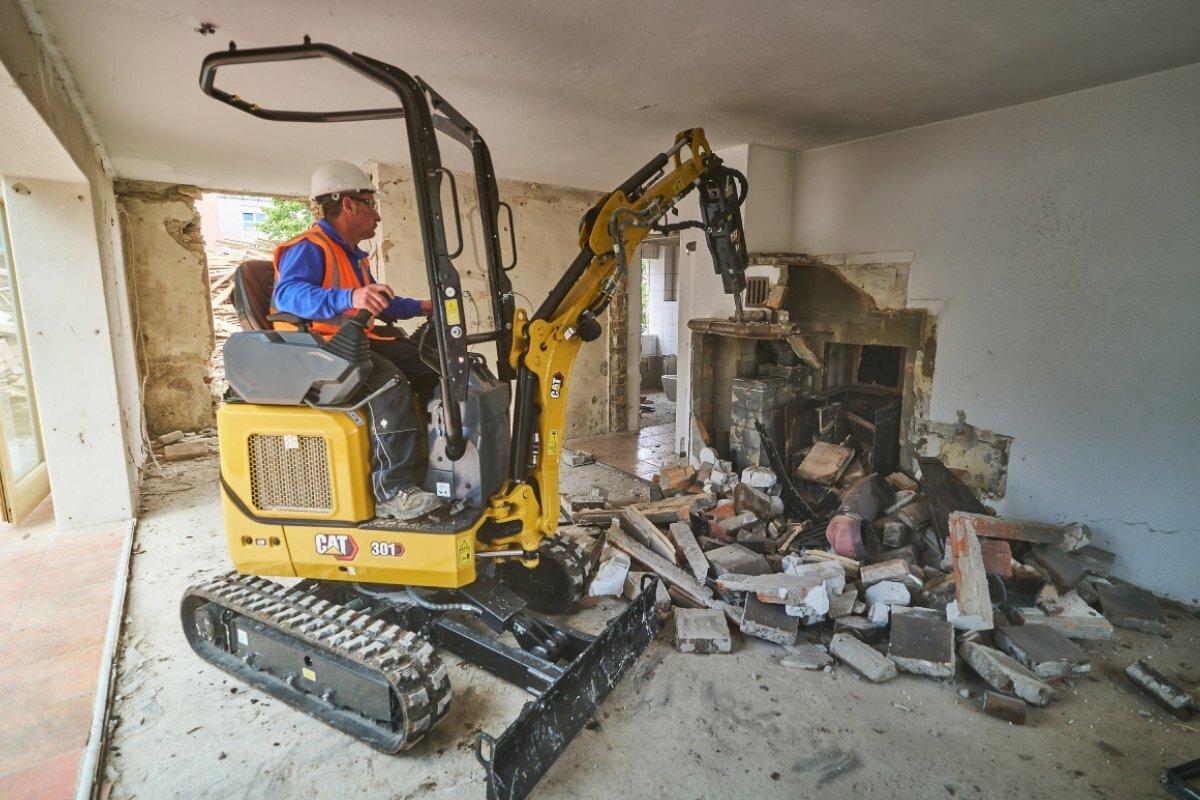 Image-CAT
Pour cette première édition de TECHNICAL INSIDE, nous vous proposons de découvrir la Cat 301 CR, une micro-pelle qui démontre comment l’ingénierie moderne peut concilier compacité, stabilité et performances sur les chantiers les plus contraints.
L’objectif de cet article est de présenter la machine, ses principales innovations et les solutions techniques qui la distinguent. Le deuxième volet, ENGINEERING & PERFORMANCE, approfondira l’analyse de son hydraulique, de ses forces d’excavation et de sa capacité de levage.
ENGINEERING & PERFORMANCE
Cat 301 CR : dans les coulisses de l’ingénierie, comment une micro-pelle transforme sa compacité en performance
Une tonne de technologie, des forces d’excavation optimisées et un châssis capable de changer de largeur : décryptage des solutions techniques qui permettent à la Cat 301 CR de travailler là où l’espace devient une contrainte majeure.
Dans le monde des engins de chantier, réduire les dimensions d’une machine ne suffit pas. Il faut préserver sa stabilité, transmettre efficacement les efforts d’excavation et garantir une précision de mouvement dans des conditions parfois difficiles. C’est précisément sur cet équilibre que repose la nouvelle Cat 301 CR de Caterpillar.
Avec une masse opérationnelle maximale annoncée de 1 230 kg, cette micro-pelle adopte plusieurs évolutions par rapport à la 300.9D. Son châssis extensible, ses forces de travail renforcées et son système de rotation en boucle fermée illustrent une approche d’ingénierie dans laquelle chaque composant doit contribuer à la productivité.
1. Le châssis extensible : la stabilité à la demande
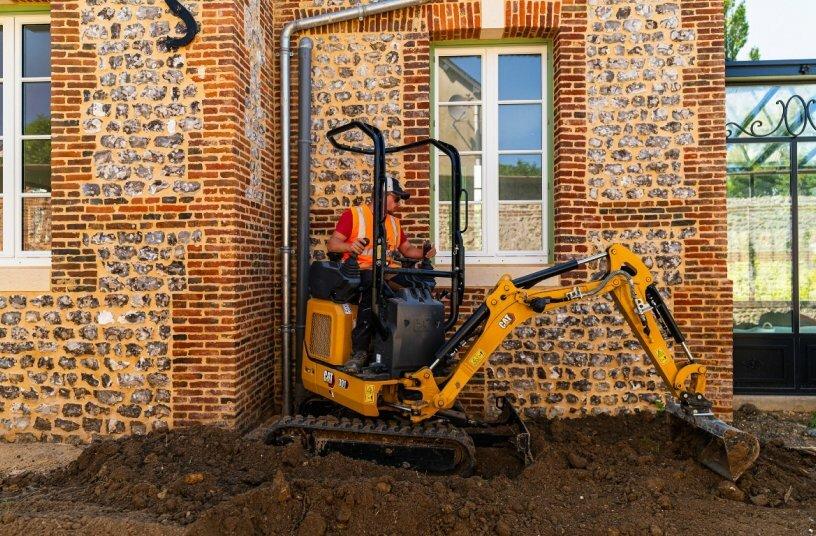 Image CAT
Le premier élément déterminant se trouve sous la machine. Le train de chenilles peut passer d’une largeur de 730 mm à 1 100 mm, soit une augmentation de 370 mm.
Cette variation répond à deux besoins contradictoires : réduire l’encombrement pour franchir un passage étroit, puis élargir la base d’appui lorsque les conditions de travail nécessitent davantage de stabilité.
Les chiffres du châssis
Voie rétractée
730 mm
Accès aux zones étroites
Voie déployée
1 100 mm
Assise élargie au travail
Sur le plan mécanique, l’élargissement de la voie augmente la base de sustentation transversale. Cela peut améliorer la résistance au basculement latéral et faciliter les opérations de levage, sous réserve de la position de la flèche, de la nature du sol et de la répartition des charges.
Caterpillar annonce une largeur de train de roulement déployé supérieure de 26 % à celle de la 300.9D et une capacité de levage accrue de plus de 80 %. Ces deux évolutions sont complémentaires : une capacité de levage supérieure n’a de valeur opérationnelle que si la stabilité de la machine et les conditions de travail permettent de l’exploiter en sécurité
2. Forces d’excavation : comprendre le rôle du balancier et du godet
La performance d’une pelle ne dépend pas uniquement de la puissance de son moteur. Elle résulte également de la transmission de l’énergie hydraulique aux vérins, de la géométrie des bras et des rapports de levier entre les articulations.
Sur la Cat 301 CR, les chiffres annoncés sont les suivants :
Force au balancier
6,2 kN
+38 % par rapport à la 300.9D
Force au godet
9,6 kN
+8 % par rapport à la 300.9D
Le balancier contribue notamment à ramener le godet vers la machine, tandis que le mouvement de fermeture du godet permet de pénétrer dans le matériau et de le remplir. Les forces disponibles influencent la capacité à travailler dans des sols résistants, mais elles ne suffisent pas à déterminer seules la productivité.
La géométrie de l’outil, la nature du terrain, la profondeur de travail et la synchronisation des mouvements jouent également un rôle majeur.
Pour un opérateur, l’enjeu consiste donc à exploiter efficacement la force disponible sans provoquer de mouvements brusques ni solliciter inutilement la structure. C’est là que la conception mécanique et la maîtrise des commandes se rejoignent.
3. Hydraulique et rotation : la qualité du mouvement compte autant que la force
L’hydraulique constitue le système nerveux de la micro-pelle. Elle transforme l’énergie fournie par le moteur en mouvements contrôlés de la flèche, du balancier, du godet et des équipements auxiliaires.
Caterpillar annonce pour la 301 CR un système de rotation en boucle fermée, destiné à accélérer les cycles, améliorer l’efficacité énergétique et réduire la production de chaleur par rapport à la 300.9D.
Pourquoi est-ce important ?
Sur un chantier, le cycle de travail ne se limite pas à creuser. Il faut orienter l’équipement, déplacer le matériau, repositionner la machine et recommencer. La fluidité de la rotation peut donc avoir une incidence directe sur le temps nécessaire à chaque cycle.
La réduction des pertes énergétiques et de la chaleur produite peut également contribuer à l’efficacité globale du système. Il convient toutefois de distinguer les bénéfices annoncés par le constructeur des gains mesurés dans des conditions réelles : Caterpillar ne fournit pas, dans sa présentation de lancement, de pourcentage chiffré de réduction de consommation pour cette fonction.
Autre point important : la machine peut recevoir une seconde ligne hydraulique auxiliaire en option. Elle élargit les possibilités d’utilisation d’outils mécaniques compatibles, selon leur débit, leur pression et les exigences de raccordement.
La polyvalence dépend ainsi autant du circuit hydraulique et de ses capacités que du choix de l’accessoire.
4. Capacité de levage : lire les chiffres avec précision
Caterpillar annonce une capacité de levage maximale de 394 kg à 0,91 m de hauteur et 1,83 m de portée vers l’avant.
Cette donnée doit être interprétée avec prudence. La capacité réelle d’une pelle varie selon la position de la charge, l’orientation de la tourelle, la configuration de la flèche, l’état du sol et les conditions de stabilité.
Il ne faut donc jamais considérer les 394 kg comme une capacité universelle applicable à toutes les positions de travail.
La largeur du train de roulement, la position de la lame et la distance entre la charge et le centre de rotation influencent directement les conditions de levage. Plus la charge s’éloigne, plus le moment de renversement peut augmenter.
Pour les professionnels, le document essentiel reste le tableau de levage correspondant à la configuration exacte de la machine. Les limites du constructeur doivent être respectées, sans extrapolation à partir d’une valeur maximale isolée.
5. Mobilité et accès : la compacité devient un avantage opérationnel
La Cat 301 CR est conçue pour franchir des ouvertures d’environ 762 mm de largeur sur 1 981 mm de hauteur, sous réserve de la configuration et des conditions d’accès.
Son arceau de sécurité ROPS rabattable permet de réduire la hauteur de passage lorsqu’il est abaissé. Il doit être relevé et correctement verrouillé pour assurer la protection prévue pendant le travail.
La vitesse de déplacement atteint 3,6 km/h, soit le double de celle annoncée pour la 300.9D. Sur un chantier où la machine doit se repositionner fréquemment, cette évolution peut réduire le temps consacré aux déplacements de courte distance.
Le rayon arrière compact contribue également à limiter le débordement de la tourelle à proximité des murs et des obstacles. Cette caractéristique est particulièrement intéressante pour les rénovations intérieures, les travaux paysagers et les interventions dans des espaces confinés.
6. Maintenance et outils : concevoir pour une utilisation quotidienne
Une machine productive doit aussi être facile à entretenir. La Cat 301 CR dispose d’un siège basculant qui facilite l’accès au compartiment moteur et aux principaux points de maintenance.
L’attache rapide Pin Puller permet de changer certains accessoires sans recourir à des outils, ce qui peut simplifier les transitions entre différentes opérations. La gamme d’équipements comprend notamment une tarière A13, un marteau B1 compatible ainsi que différents godets de creusement et de curage.
La compatibilité doit néanmoins être vérifiée pour chaque outil : masse, géométrie, raccordements et caractéristiques hydrauliques déterminent si l’ensemble fonctionne dans les limites prévues.
Enfin, VisionLink permet aux propriétaires et exploitants d’accéder à certaines informations de la machine, notamment les heures de fonctionnement et sa localisation. Ces données peuvent contribuer au suivi du parc et à la planification des opérations d’entretien.
Fiche technique — Cat 301 CR
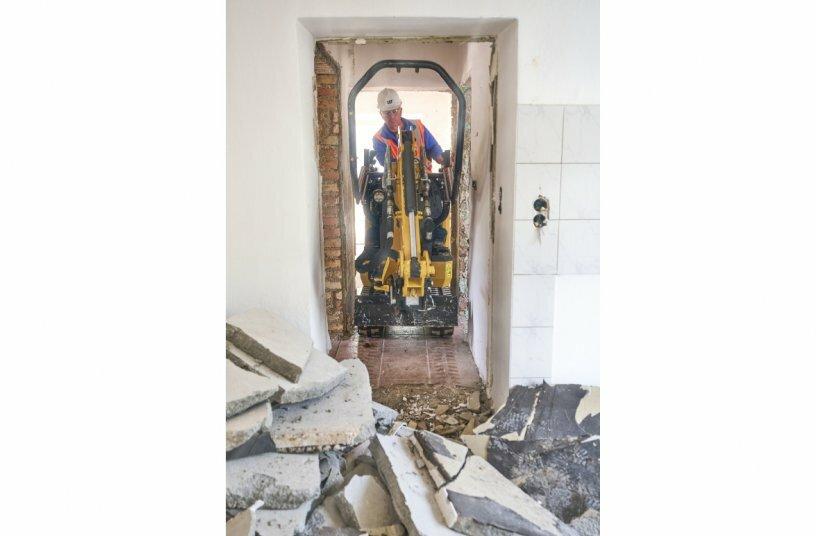
Image-CAT
Cat 301 CR
Micro-pelle hydraulique à rayon arrière compact
Données annoncées par Caterpillar
Masse opérationnelle maximale
1 230 kg
Largeur du train de roulement
730–1 100 mm
Vitesse maximale de déplacement
3,6 km/h
Force au balancier
6,2 kN
Force au godet
9,6 kN
Capacité de levage annoncée
394 kg*
*À 0,91 m de hauteur et 1,83 m de portée vers l’avant. Les valeurs dépendent de la configuration et des conditions d’utilisation.
L’analyse R.E.News : une question d’équilibre mécanique
La Cat 301 CR illustre une tendance importante dans la conception des petits engins : la performance ne se résume pas à la puissance moteur. Elle repose sur l’interaction entre la géométrie du châssis, les forces hydrauliques, la stabilité, la cinématique des équipements et la facilité d’utilisation.
Son train de roulement extensible constitue l’une des évolutions les plus significatives, car il répond directement au compromis entre accès et stabilité. Les améliorations annoncées des forces d’excavation et du système de rotation complètent cette approche.
Pour les passionnés de mécanique, la véritable question reste celle de la performance en conditions réelles : comment ces améliorations se traduisent-elles selon le terrain, l’outil monté et le cycle de travail ? Une comparaison instrumentée avec la 300.9D serait nécessaire pour quantifier précisément les gains de productivité et d’efficacité énergétique.
R.E.News TECHNICAL INSIDE — Comprendre la technologie, analyser la mécanique, décrypter la performance.
NJC.© Sources techniques : présentation officielle de Caterpillar et publications spécialisées citées dans l’article.
-------------------------------------------------------------------------------------------------------------
November 2026 — English
R.E.News TECHNICAL INSIDE
ARTICLE 1 • MICRO-EXCAVATORS • DESIGN • TECHNOLOGY
Cat 301 CR: Power in the Tightest Spaces

For the first edition of TECHNICAL INSIDE, we take a closer look at the Cat 301 CR, a micro-excavator that demonstrates how modern engineering can combine compact dimensions, stability and performance on the most demanding jobsites.
The aim of this article is to introduce the machine, its key innovations and the technical solutions that set it apart. The second feature, ENGINEERING & PERFORMANCE, will take a deeper look at its hydraulics, digging forces and lifting capacity.
ENGINEERING & PERFORMANCE
Cat 301 CR: Inside the Engineering — How a Micro-Excavator Turns Compact Dimensions into Performance
One tonne of technology, optimised digging forces and an undercarriage that changes width: a closer look at the engineering solutions that enable the Cat 301 CR to operate where space becomes a major constraint.
In the world of construction equipment, reducing a machine’s dimensions is not enough. Stability must be maintained, digging forces must be transmitted efficiently, and movements must remain precise, even in challenging conditions. This is precisely the balance behind Caterpillar’s new Cat 301 CR.
With a maximum operating weight of 1,230 kg, this micro-excavator incorporates several improvements over the 300.9D. Its expandable undercarriage, increased digging forces and closed-loop swing system illustrate an engineering approach in which every component contributes to productivity.
1. Expandable Undercarriage: Stability on Demand

One of the machine’s most important features is found beneath the upper structure. The track width can be adjusted from 730 mm to 1,100 mm, an increase of 370 mm.
This adjustment addresses two opposing requirements: reducing the machine’s width to pass through narrow openings, then widening its footprint when working conditions demand greater stability.
Undercarriage at a Glance
Retracted track width
730 mm
Access to narrow spaces
Extended track width
1,100 mm
A wider footprint for working stability
From a mechanical perspective, widening the track stance increases the transverse support base. This can improve resistance to lateral tipping and support lifting operations, depending on boom position, ground conditions and load distribution.
Caterpillar states that the fully extended undercarriage is 26% wider than that of the 300.9D, while lifting capacity has increased by more than 80%. These improvements complement each other: greater lifting capacity has practical value only when machine stability and working conditions allow the load to be handled safely.
2. Digging Forces: Understanding the Role of the Stick and Bucket
Excavator performance depends on more than engine power. It also results from the transmission of hydraulic energy to the cylinders, boom and stick geometry, and the leverage ratios between the machine’s joints.
For the Cat 301 CR, Caterpillar publishes the following figures:
Stick force
6.2 kN
38% higher than the 300.9D
Bucket force
9.6 kN
8% higher than the 300.9D
The stick helps draw the bucket towards the machine, while the bucket-curling movement allows it to penetrate the material and fill. Available forces influence the machine’s ability to work in resistant soils, but they are not sufficient on their own to determine productivity.
Attachment geometry, ground conditions, digging depth and the coordination of movements also play major roles.
For the operator, the challenge is to use the available force efficiently without creating abrupt movements or placing unnecessary stress on the structure. This is where mechanical design and operator control come together.
3. Hydraulics and Swing: Movement Quality Matters as Much as Force
The hydraulic system is the micro-excavator’s nervous system. It converts energy supplied by the engine into controlled movements of the boom, stick, bucket and auxiliary attachments.
Caterpillar specifies a closed-loop swing system for the 301 CR, designed to deliver faster cycles, improve energy efficiency and generate less heat than the 300.9D.
Why does this matter?
On a construction site, the working cycle involves more than digging. The operator must swing the attachment, move material, reposition the machine and repeat the process. Smooth swing performance can therefore directly affect the time required to complete each cycle.
Reduced energy losses and heat generation can also contribute to overall system efficiency. However, manufacturer-stated benefits should be distinguished from measured results under real working conditions. Caterpillar has not provided a quantified percentage reduction in fuel consumption for this function in its launch announcement.
Another important feature is the optional second auxiliary hydraulic circuit. It expands the range of compatible mechanical attachments that can be operated, depending on their flow, pressure and connection requirements.
Versatility therefore depends as much on hydraulic system capacity as on the attachment itself.
4. Lifting Capacity: Reading the Figures Correctly
Caterpillar specifies a maximum lifting capacity of 394 kg at a height of 0.91 m and a forward reach of 1.83 m.
This figure must be interpreted carefully. The actual lifting capacity of an excavator varies according to load position, upper-structure orientation, boom configuration, ground conditions and stability.
The 394 kg figure must therefore not be treated as a universal lifting capacity applicable to every working position.
Track width, blade position and the distance between the load and the swing centre all influence lifting conditions. As the load moves farther away, the overturning moment can increase.
For professionals, the essential reference remains the lifting chart corresponding to the machine’s exact configuration. Manufacturer limits must be respected, without extrapolating from a single maximum figure.
5. Mobility and Access: Compact Dimensions Become an Operational Advantage
The Cat 301 CR is designed to pass through openings approximately 762 mm wide and 1,981 mm high, subject to machine configuration and access conditions.
Its foldable Roll Over Protective Structure (ROPS) reduces the machine’s height when lowered. It must be raised and properly secured during operation to provide the intended operator protection.
Travel speed reaches 3.6 km/h, twice the figure stated for the 300.9D. On jobsites where the machine must frequently reposition itself, this improvement can reduce the time spent travelling short distances.
The compact-radius design also helps limit rear overhang when working close to walls and obstacles. This is particularly useful for indoor renovation, landscaping and operations in confined spaces.
6. Maintenance and Attachments: Designed for Everyday Operation
A productive machine must also be easy to maintain. The Cat 301 CR features a tilt-up seat that improves access to the engine compartment and key service points.
The Pin Puller Coupler allows compatible attachments to be changed without tools, simplifying transitions between different tasks. Available equipment includes the A13 auger, the compatible B1 hammer, and a range of digging and ditch-cleaning buckets.
Compatibility must nevertheless be checked for every attachment. Weight, geometry, hydraulic connections and operating requirements determine whether the complete setup operates within the specified limits.
Finally, VisionLink allows owners and operators to access selected machine information, including operating hours and location. These data can support fleet monitoring and maintenance planning.
Technical Specifications — Cat 301 CR

Cat 301 CR
Compact-radius hydraulic micro-excavator
Specifications published by Caterpillar
Technical specification
Value
Maximum operating weight
1,230 kg
Undercarriage width
730–1,100 mm
Maximum travel speed
3.6 km/h
Stick force
6.2 kN
Bucket force
9.6 kN
Published lifting capacity
394 kg*
At a height of 0.91 m and a forward reach of 1.83 m. Values depend on machine configuration and operating conditions.
R.E.News Analysis: A Question of Mechanical Balance
The Cat 301 CR illustrates an important trend in compact equipment design: performance is not determined by engine power alone. It depends on the interaction between undercarriage geometry, hydraulic forces, stability, attachment kinematics and ease of operation.
Its expandable undercarriage is one of the most significant developments because it directly addresses the compromise between access and stability. The stated improvements in digging forces and swing performance complement this approach.
For machinery enthusiasts, the real question is how these improvements translate into actual working conditions. How do performance levels vary with ground type, attachment choice and operating cycle? An instrumented comparison with the 300.9D would be needed to quantify productivity and energy-efficiency gains precisely.
R.E.News TECHNICAL INSIDE — Understanding Technology. Analysing Mechanics. Decoding Performance.
NJC. © Technical sources: Caterpillar’s official product information and specialist publications cited in the article.
----------------------------------------------------------------------------------------------------------------
November 2026-NL
R.E.News TECHNICAL INSIDE
ARTIKEL 1 • MICROGRAAFMACHINES • ONTWERP • TECHNOLOGIE
Cat 301 CR: kracht in de kleinste ruimtes
Voor de eerste editie van TECHNICAL INSIDE laten we u kennismaken met de Cat 301 CR, een micrograafmachine die aantoont hoe moderne engineering compactheid, stabiliteit en prestaties kan combineren op de meest veeleisende bouwplaatsen.
Dit artikel introduceert de machine, haar belangrijkste innovaties en de technische oplossingen die haar onderscheiden. In het tweede artikel, ENGINEERING & PERFORMANCE, gaan we dieper in op de hydrauliek, de graafkrachten en het hefvermogen.
ENGINEERING & PERFORMANCE
Cat 301 CR: achter de schermen van de techniek — hoe een micrograafmachine compactheid omzet in prestaties
Eén ton technologie, geoptimaliseerde graafkrachten en een onderwagen waarvan de breedte kan worden aangepast: een nadere blik op de technische oplossingen waarmee de Cat 301 CR kan werken op plaatsen waar ruimte een belangrijke beperking vormt.
In de wereld van bouwmachines volstaat het niet om een machine kleiner te maken. De stabiliteit moet behouden blijven, graafkrachten moeten efficiënt worden overgebracht en bewegingen moeten nauwkeurig blijven, zelfs onder moeilijke omstandigheden. Precies dat evenwicht vormt de basis van de nieuwe Cat 301 CR van Caterpillar.
Met een maximaal bedrijfsgewicht van 1.230 kg beschikt deze micrograafmachine over verschillende verbeteringen ten opzichte van de 300.9D. De uitschuifbare onderwagen, de verhoogde graafkrachten en het gesloten zwenksysteem illustreren een engineeringbenadering waarbij elk onderdeel bijdraagt aan de productiviteit.
1. Uitschuifbare onderwagen: stabiliteit wanneer nodig
Image-CAT
Het eerste belangrijke kenmerk bevindt zich onder de machine. De breedte van de rupsonderwagen kan worden aangepast van 730 mm tot 1.100 mm, een toename van 370 mm.
Deze aanpassing beantwoordt aan twee tegengestelde behoeften: de machine smaller maken om door nauwe doorgangen te rijden en vervolgens de steunbasis verbreden wanneer de werkomstandigheden meer stabiliteit vereisen.
De cijfers van de onderwagen
Kenmerk
Waarde
Ingeschoven spoorbreedte
730 mm
Uitgeschoven spoorbreedte
1.100 mm
Mechanisch gezien vergroot een bredere spoorstand de zijdelingse steunbasis. Dit kan de weerstand tegen zijdelings kantelen verbeteren en hijswerkzaamheden ondersteunen, afhankelijk van de positie van de giek, de bodemgesteldheid en de verdeling van de belasting.
Volgens Caterpillar is de volledig uitgeschoven onderwagen 26% breder dan die van de 300.9D. Het hefvermogen is bovendien met meer dan 80% toegenomen. Deze verbeteringen vullen elkaar aan: een hoger hefvermogen heeft alleen praktische waarde wanneer de stabiliteit van de machine en de werkomstandigheden veilig gebruik toelaten.
2. Graafkrachten: de rol van de lepelsteel en de bak begrijpen
De prestaties van een graafmachine hangen niet uitsluitend af van het motorvermogen. Ze worden ook bepaald door de overdracht van hydraulische energie naar de cilinders, de geometrie van de giek en lepelsteel en de hefboomverhoudingen tussen de scharnierpunten.
Voor de Cat 301 CR vermeldt Caterpillar de volgende waarden:
Technisch kenmerk
Cat 301 CR
Verschil met de 300.9D
Graafkracht lepelsteel
6,2 kN
+38%
Graafkracht bak
9,6 kN
+8%
De lepelsteel helpt de bak naar de machine toe te trekken, terwijl de bakrotatie ervoor zorgt dat de bak in het materiaal dringt en zich vult. De beschikbare krachten beïnvloeden het vermogen om in harde grond te werken, maar bepalen op zichzelf niet de productiviteit.
Ook de geometrie van het werktuig, de bodemgesteldheid, de graafdiepte en de coördinatie van de bewegingen spelen een belangrijke rol.
Voor de machinist bestaat de uitdaging erin de beschikbare kracht efficiënt te benutten zonder abrupte bewegingen te veroorzaken of de constructie onnodig te belasten. Hier komen mechanisch ontwerp en nauwkeurige bediening samen.
3. Hydrauliek en zwenken: de kwaliteit van de beweging is even belangrijk als de kracht
Image-CAT
Het hydraulische systeem vormt het zenuwstelsel van de micrograafmachine. Het zet de door de motor geleverde energie om in gecontroleerde bewegingen van de giek, lepelsteel, bak en hulpstukken.
Caterpillar voorziet de 301 CR van een gesloten zwenksysteem, dat snellere cyclustijden, een betere energie-efficiëntie en minder warmteontwikkeling moet opleveren dan bij de 300.9D.
Waarom is dit belangrijk?
Op een bouwplaats bestaat een werkcyclus uit meer dan alleen graven. De machinist moet de uitrusting draaien, materiaal verplaatsen, de machine herpositioneren en de cyclus herhalen. Een vloeiende zwenkbeweging kan daardoor rechtstreeks invloed hebben op de tijd die nodig is om een cyclus af te werken.
Minder energieverlies en warmteontwikkeling kunnen eveneens bijdragen aan de algemene efficiëntie van het systeem. Het is echter belangrijk om de voordelen die de fabrikant vermeldt te onderscheiden van meetresultaten onder reële werkomstandigheden. Caterpillar heeft in de aankondiging geen concreet percentage gepubliceerd voor de brandstofbesparing die deze functie oplevert.
Een tweede optioneel hydraulisch hulpcircuit vergroot bovendien de mogelijkheden om compatibele mechanische hulpstukken te bedienen. De toepasbaarheid hangt af van het vereiste debiet, de werkdruk en de aansluitingen.
De veelzijdigheid wordt dus zowel bepaald door de capaciteit van het hydraulische systeem als door de keuze van het hulpstuk.
4. Hefvermogen: de cijfers correct interpreteren
Caterpillar vermeldt een maximaal hefvermogen van 394 kg bij een hoogte van 0,91 m en een reikwijdte van 1,83 m naar voren.
Dit cijfer moet zorgvuldig worden geïnterpreteerd. Het werkelijke hefvermogen varieert naargelang de positie van de last, de oriëntatie van de bovenwagen, de configuratie van de giek, de bodemgesteldheid en de stabiliteit.
De waarde van 394 kg mag daarom niet worden beschouwd als een universeel hefvermogen dat in iedere werkpositie geldt.
De breedte van de onderwagen, de positie van het dozerblad en de afstand tussen de last en het zwenkmiddelpunt beïnvloeden de hefomstandigheden. Naarmate de last verder van de machine komt, kan het kantelmoment toenemen.
Voor professionals blijft de juiste hijstabel voor de exacte machineconfiguratie het belangrijkste referentiedocument. De limieten van de fabrikant moeten worden gerespecteerd; één maximale waarde mag niet zonder meer naar andere werkposities worden vertaald.
5. Mobiliteit en toegankelijkheid: compactheid als operationeel voordeel
De Cat 301 CR is ontworpen om doorgangen van ongeveer 762 mm breed en 1.981 mm hoog te passeren, afhankelijk van de machineconfiguratie en de omstandigheden ter plaatse.
De neerklapbare ROPS-veiligheidsbeugel maakt het mogelijk de doorgangshoogte te verminderen wanneer deze is neergeklapt. Tijdens het werk moet de beugel omhoog staan en correct vergrendeld zijn om de bedoelde bescherming van de machinist te bieden.
De maximale rijsnelheid bedraagt 3,6 km/u, tweemaal de opgegeven snelheid van de 300.9D. Op bouwplaatsen waar de machine zich regelmatig moet verplaatsen, kan deze verbetering de tijd voor korte verplaatsingen beperken.
Het compacte achterzwaaiprofiel helpt bovendien om de overhang van de bovenwagen naast muren en obstakels te beperken. Dat is bijzonder nuttig bij renovaties binnenshuis, landschapswerken en werkzaamheden in beperkte ruimtes.
6. Onderhoud en hulpstukken: ontworpen voor dagelijks gebruik
Image-CAT
Een productieve machine moet ook gemakkelijk te onderhouden zijn. De Cat 301 CR beschikt over een opklapbare stoel die de toegang tot het motorcompartiment en belangrijke onderhoudspunten vergemakkelijkt.
Met de Pin Puller-snelwisselaar kunnen compatibele hulpstukken zonder gereedschap worden verwisseld. Dit vereenvoudigt de overgang tussen verschillende werkzaamheden. Het beschikbare aanbod omvat onder meer de A13-grondboor, de compatibele B1-hamer en verschillende graaf- en slootbakken.
De compatibiliteit moet voor ieder hulpstuk worden gecontroleerd. Gewicht, geometrie, hydraulische aansluitingen en bedrijfsvereisten bepalen of de combinatie binnen de voorgeschreven grenzen functioneert.
Via VisionLink kunnen eigenaars en machinisten bepaalde machinegegevens raadplegen, waaronder draaiuren en locatie. Deze informatie kan bijdragen aan vlootbeheer en de planning van onderhoudswerkzaamheden.
Technische fiche — Cat 301 CR
Cat 301 CR
Hydraulische micrograafmachine met compact achterzwaaiprofiel.
Specificaties zoals gepubliceerd door Caterpillar.
Technische specificatie
Waarde
Maximaal bedrijfsgewicht
1.230 kg
Breedte van de onderwagen
730–1.100 mm
Maximale rijsnelheid
3,6 km/u
Graafkracht lepelsteel
6,2 kN
Graafkracht bak
9,6 kN
Opgegeven hefvermogen
394 kg*
Bij een hoogte van 0,91 m en een reikwijdte van 1,83 m naar voren. De waarden zijn afhankelijk van de machineconfiguratie en de werkomstandigheden.
R.E.News-analyse: alles draait om mechanisch evenwicht
De Cat 301 CR illustreert een belangrijke trend in het ontwerp van compacte machines: prestaties worden niet uitsluitend bepaald door het motorvermogen. Ze zijn het resultaat van de wisselwerking tussen de geometrie van de onderwagen, hydraulische krachten, stabiliteit, de kinematica van de uitrusting en gebruiksgemak.
De uitschuifbare onderwagen is een van de belangrijkste ontwikkelingen, omdat deze rechtstreeks inspeelt op het compromis tussen toegankelijkheid en stabiliteit. De aangekondigde verbeteringen van de graafkrachten en de zwenkprestaties vullen deze aanpak aan.
Voor echte machine- en mechaniekliefhebbers blijft de belangrijkste vraag hoe deze verbeteringen zich vertalen naar de praktijk. Hoe verschillen de prestaties naargelang de bodem, het gemonteerde hulpstuk en de werkcyclus? Alleen een instrumentele vergelijking met de 300.9D kan de winst in productiviteit en energie-efficiëntie nauwkeurig kwantificeren.
R.E.News TECHNICAL INSIDE — Technologie begrijpen. Mechanica analyseren. Prestaties doorgronden.
NJC. © Technische bronnen: officiële productinformatie van Caterpillar en de in het artikel vermelde vakpublicaties.
-------------------------------------------------------------------------------------------------------------
Date de dernière mise à jour : 20/10/2026