



Atlas Expands Driverless Truck Fleet to Build the Digital Oilfield Supply Chain
 01/09/26-FR-English-NL-footer
Le jour où les camions ont cessé d’attendre le conducteur
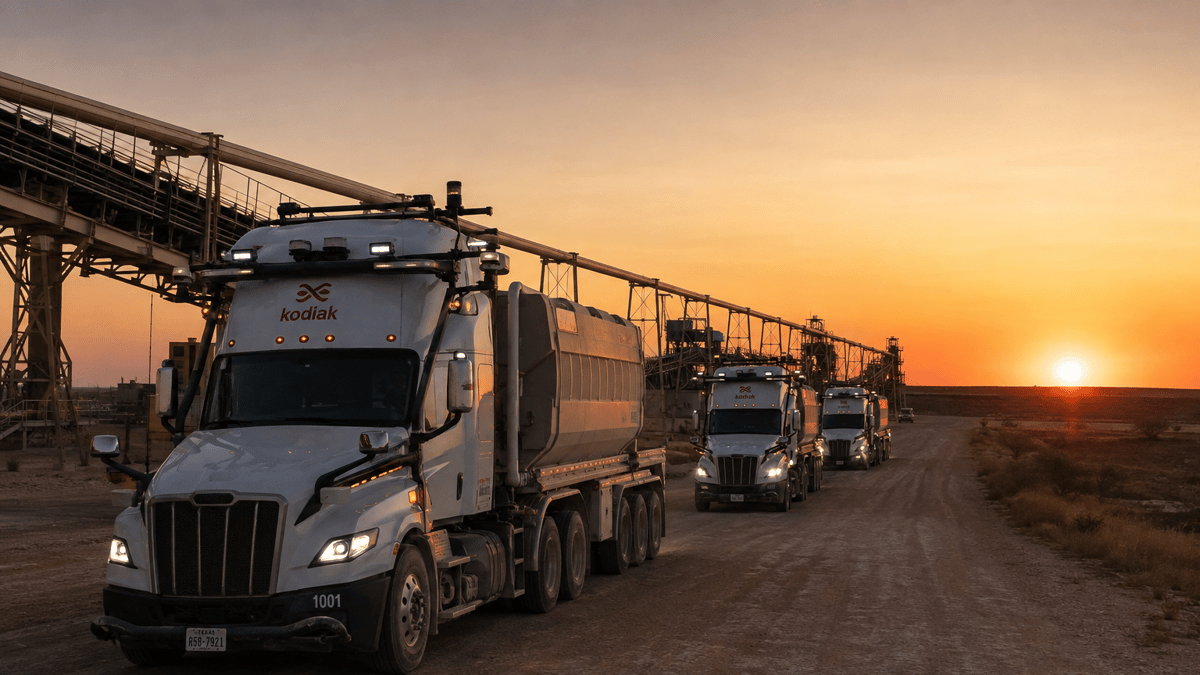 Image- creation R.E.News© via chat GPT
Dans le désert industriel du Permien, au Texas, une révolution avance sans bruit.
Pas de démonstration spectaculaire sur une autoroute. Pas de prototype futuriste sous les projecteurs. Simplement des semi-remorques chargés de sable de fracturation qui roulent, jour et nuit, sans conducteur, entre les installations pétrolières.
C’est ici, sur les pistes privées de l’un des plus grands bassins pétroliers américains, que Atlas Energy Solutions et Kodiak AI sont en train d’écrire l’un des chapitres les plus concrets de l’histoire du camion autonome.
La flotte compte déjà 28 véhicules. Elle doit atteindre 100 camions d’ici mi-2027, avant une étape autrement plus symbolique : leur arrivée sur les routes publiques, prévue début 2027 sous réserve des autorisations et validations nécessaires.
Le chiffre impressionne. Mais c’est surtout ce qu’il raconte qui mérite l’attention.
Depuis une décennie, l’industrie du véhicule autonome rêve d’autoroutes sans chauffeurs. Le Permien vient peut-être de démontrer que le véritable point de départ était ailleurs.
La route la plus importante n’était pas l’autoroute
Le problème du camion autonome n’a jamais été uniquement technologique. Il était économique.
Une autoroute américaine impose des milliers de situations imprévisibles : circulation, météo, travaux, comportements humains, réglementations différentes. À l’inverse, le transport de sable dans le Permien offre exactement le terrain dont une technologie naissante a besoin : des trajets répétitifs, une forte fréquence, des itinéraires connus et un opérateur qui contrôle à la fois les véhicules, les infrastructures et la demande.
Atlas possède ses camions. Atlas contrôle une grande partie de la chaîne logistique. Et Kodiak fournit l'intelligence qui permet aux véhicules de travailler sans conducteur.
L’équation est presque idéale : celui qui investit dans l’autonomie est aussi celui qui en récupère directement les bénéfices.
Depuis 2024, cette flotte a déjà réalisé environ 7 000 chargements sur 15 itinéraires, transportant plus de 450 000 tonnes de sable. Au premier trimestre 2026, les camions ont accumulé plus de 23 500 heures de conduite autonome. Le 20 juillet, ils ont atteint un record de 176 chargements en une seule journée.
À ce stade, il devient difficile de parler simplement d’un projet pilote.
Le camion n’est que le dernier maillon
La véritable innovation se trouve peut-être moins dans le camion que dans ce qui se trouve derrière lui.
Atlas a construit le Dune Express, un convoyeur électrique de 42 miles reliant sa mine de Kermit, au Texas, à une installation située près de la frontière du Nouveau-Mexique.
Le principe est élégant : faire voyager le sable par convoyeur pendant l’essentiel du parcours, plutôt que par camion, puis automatiser le dernier segment jusqu’au puits.
Moins de kilomètres routiers. Moins de trafic. Moins d’émissions. Moins de dépendance à la disponibilité des chauffeurs.
Le convoyeur peut transporter environ 13 millions de tonnes de proppant par an, tandis que ses installations disposent de plus de 84 000 tonnes de stockage vertical.
L’autonomie ne vient donc pas remplacer un système existant. Elle vient achever un système déjà pensé comme une chaîne logistique intégrée.
C’est là que l’histoire devient particulièrement intéressante pour les industries lourdes.
Deux points de chargement, une nouvelle géographie
Atlas vient d’ajouter un deuxième point de chargement simultané, situé à environ 90 minutes du premier.
Cette décision paraît technique. Elle est en réalité stratégique.
Au lieu de servir une zone à la fois, la flotte autonome peut désormais alimenter plusieurs sites de forage simultanément, au moment précis où les équipes de fracturation en ont besoin.
Dans le Permien, quelques heures d’attente peuvent coûter cher. Une opération de fracturation peut absorber des centaines de chargements et plusieurs milliers de tonnes de sable.
Le véritable avantage du camion autonome n’est donc pas nécessairement de rouler plus vite.
C’est de ne jamais s’arrêter.
Une flotte capable de fonctionner autour de l’horloge transforme la disponibilité du transport en avantage industriel.
Kodiak joue désormais une partie beaucoup plus grande
Pour Kodiak, l’enjeu dépasse largement le sable.
L’entreprise, fondée en 2018 par Don Burnette, ancien ingénieur du programme de conduite autonome de Google, est entrée au Nasdaq en 2025 après une fusion SPAC valorisant l’opération autour de 2,5 milliards de dollars.
Son modèle repose sur une idée simple : développer une même architecture autonome capable de servir plusieurs marchés.
Transport longue distance. Logistique industrielle. Défense.
Le partenariat avec Atlas fournit surtout ce que les investisseurs et les industriels recherchent désormais : des kilomètres réels, des chargements réels et une utilisation commerciale réelle.
Kodiak reste toutefois une entreprise en phase d’investissement lourd. Au premier trimestre 2026, elle affichait une perte opérationnelle de 37,9 millions de dollars pour 1,8 million de dollars de revenus.
La promesse se mesure donc moins dans les bénéfices actuels que dans la capacité à transformer une technologie coûteuse en infrastructure déployable à grande échelle.
Deux chemins vers le même futur
La concurrence raconte une autre partie de l’histoire.
Aurora Innovation a choisi la voie inverse : les autoroutes publiques du Texas, avec des corridors reliant notamment Dallas, Houston, El Paso et Phoenix.
Atlas et Kodiak ont commencé dans un environnement contrôlé. Aurora a voulu démontrer directement que l’autonomie pouvait fonctionner dans le trafic réel.
Deux stratégies, deux terrains d’essai.
Mais les deux chemins commencent à converger.
Car l’industrie découvre progressivement une vérité simple : l’autonomie devient commercialement intéressante lorsque le camion cesse d’être une expérience technologique et devient un actif productif.
Et le pétrole n’est peut-être que le premier chapitre.
Le modèle pourrait dépasser le pétrole
Imaginez maintenant le même principe dans une mine.
Une carrière.
Un terminal portuaire.
Une centrale.
Un chantier de grande infrastructure.
Partout où les mêmes camions parcourent les mêmes itinéraires, chargent les mêmes matériaux et reviennent des centaines de fois, le modèle Atlas-Kodiak devient pertinent.
Agrégats, minerais, matériaux de construction, transport entre carrière et usine : ces environnements possèdent précisément les caractéristiques qui ont permis au camion autonome de trouver son premier véritable terrain commercial.
Le Permien pourrait ainsi devenir bien davantage qu’un laboratoire pétrolier.
Il pourrait être le prototype d’une nouvelle logistique industrielle.
Le véritable test commence en 2027
La prochaine étape sera la plus difficile.
Lorsque les camions d’Atlas quitteront les routes privées pour rejoindre les routes publiques, ils entreront dans un monde beaucoup moins prévisible.
Circulation mixte. Conditions météorologiques variables. Interactions avec des conducteurs humains. Réglementations et autorisations.
C’est là que le projet devra prouver qu’une autonomie éprouvée dans un environnement industriel peut survivre au désordre du monde réel.
Mais une chose a déjà changé.
Le débat n’est plus : « Un camion peut-il rouler sans conducteur ? »
Dans le Permien, cette question appartient presque au passé.
La nouvelle question est beaucoup plus ambitieuse :
Combien de camions autonomes une chaîne logistique peut-elle absorber ?
Avec 100 véhicules en ligne de mire, Atlas et Kodiak sont sur le point d’apporter une première réponse.
Et dans le silence poussiéreux du désert texan, le futur du camionnage pourrait bien avoir commencé par un chargement de sable.
NJC.© Info https://kodiak.ai/ https://www.atlas.energy/
---------------------------------------------------------------------------------------------------------
01/09/26-English
The Day Trucks Stopped Waiting for Drivers
Image- creation R.E.News© via chat GPT
In the Permian Desert of Texas, a revolution is quietly unfolding.
No spectacular demonstrations on a highway. No futuristic prototypes under the spotlights. Simply semi-trailers loaded with fracking sand driving day and night, driverless, between oil installations.
It is here, on the private roads of one of the largest American oil basins, that Atlas Energy Solutions and Kodiak AI are writing one of the most tangible chapters in the history of the autonomous truck.
The fleet already numbers 28 vehicles. It is expected to reach 100 trucks by mid-2027, before a far more symbolic milestone: their arrival on public roads, planned for early 2027, subject to the necessary permits and approvals.
The number is impressive. But it is above all what it represents that deserves attention.
For a decade, the autonomous vehicle industry has dreamed of driverless highways. The Permian Desert may have just demonstrated that the real starting point lies elsewhere.
The most important road wasn't the highway.
The problem with autonomous trucks has never been solely technological. It was economic.
An American highway presents thousands of unpredictable situations: traffic, weather, construction, human behavior, and varying regulations. Conversely, transporting sand in the Permian Desert offers exactly the terrain a nascent technology needs: repetitive journeys, high frequency, known routes, and an operator who controls the vehicles, the infrastructure, and the demand.
Atlas owns its trucks. Atlas controls a large part of the supply chain. And Kodiak provides the intelligence that allows the vehicles to operate without a driver.
The equation is almost perfect: whoever invests in autonomy is also the one who directly reaps the benefits.
Since 2024, this fleet has already completed approximately 7,000 loads across 15 routes, transporting over 450,000 tons of sand. In the first quarter of 2026, the trucks accumulated over 23,500 hours of autonomous driving. On July 20, they achieved a record 176 loads in a single day.
At this point, it becomes difficult to simply call it a pilot project.
The truck is just the final link.
The real innovation may lie less in the truck itself than in what lies behind it.
Atlas built the Dune Express, a 42-mile electric conveyor belt connecting its Kermit, Texas, mine to a facility near the New Mexico border.
The principle is elegant: transport the sand by conveyor belt for most of the journey, rather than by truck, and then automate the final segment to the pit.
Fewer road miles. Less traffic. Fewer emissions. Less dependence on driver availability.
The conveyor can transport approximately 13 million tons of proppant per year, while its facilities offer over 84,000 tons of vertical storage.
Autonomy, therefore, doesn't replace an existing system. It completes a system already designed as an integrated supply chain.
This is where the story becomes particularly interesting for heavy industry.
Two loading points, a new geography
Atlas has just added a second simultaneous loading point, located about 90 minutes from the first.
This decision may seem technical, but it is actually strategic.
Instead of serving one area at a time, the autonomous fleet can now supply several drilling sites simultaneously, precisely when the fracking crews need it.
In the Permian, a few hours of waiting can be costly. A fracking operation can absorb hundreds of loads and several thousand tons of sand.
The real advantage of autonomous trucks isn't necessarily faster.
It's never stopping.
A fleet capable of operating around the clock transforms transport availability into an industrial advantage.
Kodiak is now playing a much bigger game.
For Kodiak, the stakes go far beyond sand.
The company, founded in 2018 by Don Burnette, a former engineer on Google's self-driving program, went public on the Nasdaq in 2025 after a SPAC merger valuing the deal at around $2.5 billion.
Its model is based on a simple idea: developing a single autonomous architecture capable of serving multiple markets.
Long-haul transport. Industrial logistics. Defense.
The partnership with Atlas primarily provides what investors and manufacturers are now looking for: real-world mileage, real-world loads, and real-world commercial use.
Kodiak, however, remains a company in a phase of heavy investment. In the first quarter of 2026, it posted an operating loss of $37.9 million on revenues of $1.8 million.
The promise, therefore, lies less in current profits than in the ability to transform expensive technology into a scalable infrastructure.
Two paths to the same future
The competition tells another part of the story.
Aurora Innovation chose the opposite path: Texas's public highways, with corridors connecting cities including Dallas, Houston, El Paso, and Phoenix.
Atlas and Kodiak started in a controlled environment. Aurora wanted to demonstrate directly that autonomy could work in real-world traffic.
Two strategies, two testing grounds.
But the two paths are beginning to converge.
Because the industry is gradually discovering a simple truth: autonomy becomes commercially viable when the truck ceases to be a technological experiment and becomes a productive asset.
And oil may only be the first chapter.
The model could extend beyond oil.
Now imagine the same principle in a mine.
A quarry.
A port terminal.
A power plant.
A major infrastructure construction site.
Wherever the same trucks travel the same routes, load the same materials, and return hundreds of times, the Atlas-Kodiak model becomes relevant.
Aggregates, ores, construction materials, transport between quarry and plant: these environments possess precisely the characteristics that allowed the autonomous truck to find its first real commercial market.
The Permian could thus become much more than an oil laboratory.
It could be the prototype for a new industrial logistics system.
The real test begins in 2027.
The next step will be the most difficult.
When Atlas trucks leave private roads and join public roads, they will enter a much less predictable world.
Mixed traffic. Variable weather conditions. Interactions with human drivers. Regulations and permits.
This is where the project will have to prove that autonomy tested in an industrial environment can survive the chaos of the real world.
But one thing has already changed.
The debate is no longer: “Can a truck drive itself?”
In the Permian Desert, that question is practically a thing of the past.
The new question is much more ambitious:
How many autonomous trucks can a supply chain handle?
With 100 vehicles in their sights, Atlas and Kodiak are on the verge of providing an initial answer.
And in the dusty silence of the Texas desert, the future of trucking may well have begun with a load of sand.
NJC.© Info https://kodiak.ai/ https://www.atlas.energy/
-------------------------------------------------------------------------------------------------------------
01/09/26-NL
De dag dat vrachtwagens niet meer op chauffeurs hoefden te wachten
Image- creation R.E.News© via chat GPT
In de Permian Desert van Texas voltrekt zich in stilte een revolutie.
Geen spectaculaire demonstraties op een snelweg. Geen futuristische prototypes in de schijnwerpers. Gewoon opleggers vol frackingzand die dag en nacht, zonder chauffeur, tussen olie-installaties rijden.
Het is hier, op de privéwegen van een van de grootste Amerikaanse oliebekkens, dat Atlas Energy Solutions en Kodiak AI een van de meest tastbare hoofdstukken in de geschiedenis van de autonome vrachtwagen schrijven.
De vloot telt al 28 voertuigen. Naar verwachting zal dit aantal medio 2027 oplopen tot 100 vrachtwagens, voordat een veel symbolischer mijlpaal wordt bereikt: hun intrede op de openbare weg, gepland voor begin 2027, mits de benodigde vergunningen en goedkeuringen worden verkregen.
Het aantal is indrukwekkend. Maar het is vooral wat het vertegenwoordigt dat de aandacht verdient.
Al tien jaar droomt de autonome voertuigindustrie van zelfrijdende snelwegen. De Permian Desert heeft wellicht net aangetoond dat het echte startpunt elders ligt.
De belangrijkste weg was niet de snelweg.
Het probleem met autonome vrachtwagens was nooit alleen technologisch. Het was economisch.
Een Amerikaanse snelweg kent duizenden onvoorspelbare situaties: verkeer, weer, wegwerkzaamheden, menselijk gedrag en wisselende regelgeving. Het transport van zand in de Permwoestijn biedt daarentegen precies het terrein dat een opkomende technologie nodig heeft: herhaalde ritten, hoge frequentie, bekende routes en een operator die de voertuigen, de infrastructuur en de vraag beheert.
Atlas is eigenaar van zijn vrachtwagens. Atlas beheert een groot deel van de toeleveringsketen. En Kodiak levert de intelligentie die de voertuigen in staat stelt om zonder chauffeur te rijden.
De formule is bijna perfect: wie investeert in autonomie, plukt er ook direct de vruchten van.
Sinds 2024 heeft deze vloot al ongeveer 7.000 ladingen over 15 routes vervoerd, met meer dan 450.000 ton zand. In het eerste kwartaal van 2026 hadden de vrachtwagens al meer dan 23.500 uur autonoom gereden. Op 20 juli behaalden ze een record van 176 ladingen op één dag.
Op dit punt is het lastig om het simpelweg een pilotproject te noemen.
De vrachtwagen is slechts de laatste schakel.
De echte innovatie zit hem misschien minder in de vrachtwagen zelf dan in wat erachter schuilgaat.
Atlas bouwde de Dune Express, een 67 kilometer lange elektrische transportband die hun mijn in Kermit, Texas, verbindt met een faciliteit nabij de grens met New Mexico.
Het principe is elegant: het zand wordt grotendeels per transportband vervoerd in plaats van per vrachtwagen, en het laatste traject naar de groeve wordt geautomatiseerd.
Minder kilometers. Minder verkeer. Minder uitstoot. Minder afhankelijkheid van de beschikbaarheid van chauffeurs.
De transportband kan ongeveer 13 miljoen ton proppant per jaar vervoeren, terwijl de faciliteiten meer dan 84.000 ton verticale opslagcapaciteit bieden.
Autonomie vervangt dus geen bestaand systeem. Het completeert een systeem dat al is ontworpen als een geïntegreerde toeleveringsketen.
Dit is waar het verhaal bijzonder interessant wordt voor de zware industrie.
Twee laadpunten, een nieuwe geografische spreiding
Atlas heeft zojuist een tweede laadpunt voor gelijktijdig laden toegevoegd, op ongeveer 90 minuten rijden van het eerste.
Deze beslissing lijkt misschien technisch, maar is in feite strategisch.
In plaats van één gebied tegelijk te bedienen, kan de autonome vloot nu meerdere boorlocaties tegelijk bevoorraden, precies wanneer de frackingteams het nodig hebben.
In het Permian Basin kunnen een paar uur wachten kostbaar zijn. Een frackingoperatie kan honderden ladingen en duizenden tonnen zand verbruiken.
Het echte voordeel van autonome vrachtwagens is niet per se de snelheid.
Het is continu in bedrijf.
Een vloot die 24 uur per dag kan opereren, transformeert de beschikbaarheid van transport in een industrieel voordeel.
Kodiak speelt nu een veel groter spel.
Voor Kodiak gaat het om veel meer dan alleen zand.
Het bedrijf, opgericht in 2018 door Don Burnette, een voormalig ingenieur van Google's programma voor zelfrijdende auto's, ging in 2025 naar de Nasdaq-beurs na een SPAC-fusie die de deal waardeerde op ongeveer 2,5 miljard dollar.
Het bedrijfsmodel is gebaseerd op een eenvoudig idee: het ontwikkelen van één autonome architectuur die meerdere markten kan bedienen.
Langeafstandstransport. Industriële logistiek. Defensie.
De samenwerking met Atlas biedt investeerders en fabrikanten vooral wat ze nu zoeken: realistische kilometerstanden, realistische ladingen en realistisch commercieel gebruik.
Kodiak bevindt zich echter nog steeds in een fase van zware investeringen. In het eerste kwartaal van 2026 boekte het bedrijf een operationeel verlies van $ 37,9 miljoen bij een omzet van $ 1,8 miljoen.
De belofte ligt daarom minder in de huidige winst dan in het vermogen om dure technologie om te zetten in een schaalbare infrastructuur.
Twee wegen naar dezelfde toekomst
De concurrentie vertelt een ander deel van het verhaal.
Aurora Innovation koos de tegenovergestelde weg: de openbare snelwegen van Texas, met corridors die steden als Dallas, Houston, El Paso en Phoenix met elkaar verbinden.
Atlas en Kodiak begonnen in een gecontroleerde omgeving. Aurora wilde direct aantonen dat autonomie in het echte verkeer kon werken.
Twee strategieën, twee testterreinen.
Maar de twee wegen beginnen samen te komen.
Omdat de industrie geleidelijk een simpele waarheid ontdekt: autonomie wordt commercieel levensvatbaar wanneer de vrachtwagen geen technologisch experiment meer is, maar een productief middel wordt.
En olie is misschien slechts het eerste hoofdstuk.
Het model zou zich ook buiten de oliesector kunnen uitstrekken.
Stel je nu hetzelfde principe voor in een mijn.
Een steengroeve.
Een haven.
Een energiecentrale.
Een grote bouwplaats voor infrastructuurprojecten.
Overal waar dezelfde vrachtwagens dezelfde routes afleggen, dezelfde materialen laden en honderden keren terugkeren, wordt het Atlas-Kodiak-model relevant.
Aggregatten, ertsen, bouwmaterialen, transport tussen groeve en fabriek: deze omgevingen bezitten precies de kenmerken die de autonome vrachtwagen in staat stelden zijn eerste echte commerciële markt te vinden.
Het Permbekken zou dus veel meer kunnen worden dan een olielaboratorium.
Het zou het prototype kunnen zijn voor een nieuw industrieel logistiek systeem.
De echte test begint in 2027.
De volgende stap zal de moeilijkste zijn.
Wanneer Atlas-vrachtwagens de privéwegen verlaten en de openbare weg oprijden, betreden ze een veel minder voorspelbare wereld.
Gemengd verkeer. Wisselende weersomstandigheden. Interacties met menselijke chauffeurs. Regelgeving en vergunningen.
Hier moet het project bewijzen dat autonomie, getest in een industriële omgeving, de chaos van de echte wereld kan doorstaan.
Maar één ding is al veranderd.
Het debat gaat niet langer over: "Kan een vrachtwagen zichzelf besturen?"
In de Permwoestijn is die vraag praktisch verleden tijd.
De nieuwe vraag is veel ambitieuzer:
Hoeveel autonome vrachtwagens kan een toeleveringsketen aan?
Met 100 voertuigen in het vizier staan Atlas en Kodiak op het punt een eerste antwoord te geven.
En in de stoffige stilte van de Texaanse woestijn is de toekomst van het vrachtvervoer wellicht begonnen met een lading zand.
NJC.© Info https://kodiak.ai/ https://www.atlas.energy/
----------------------------------------------------------------------------------------------------------
Date de dernière mise à jour : 31/08/2026