













DAIMLER Trucks Defining the new fuel cell standard in heavy-duty applications: cellcentric unveils BZA375
 27/04/26-FR-English-NL-footer
Hydrogène à pleine puissance : cellcentric redéfinit les standards du lourd avec le BZA375
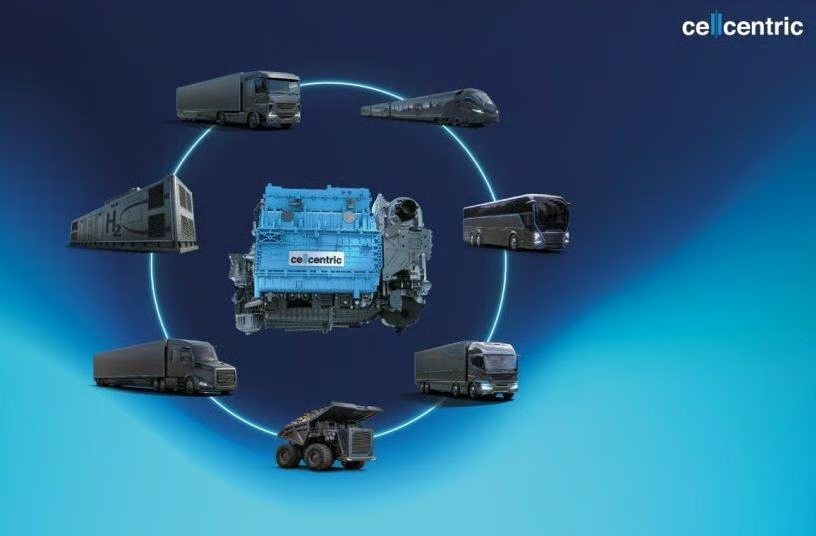
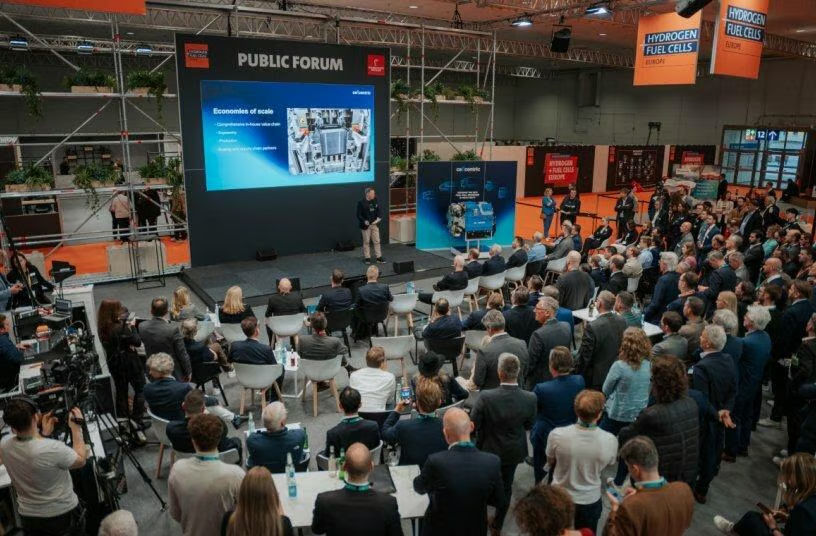 Defining the new fuel cell standard in heavy-duty applications: cellcentric unveils BZA375
IMAGE SOURCE: Daimler Truck AG
Dans la course à la décarbonation du transport lourd, un nouveau cap vient d’être franchi. Avec le lancement du BZA375, cellcentric GmbH & Co. KG introduit une génération de pile à combustible pensée non plus comme une alternative expérimentale, mais comme une véritable concurrente du diesel.
Conçu pour les poids lourds longue distance, ce système s’impose déjà comme une plateforme énergétique polyvalente, capable d’alimenter aussi bien camions, trains, engins miniers que solutions stationnaires.
Une rupture industrielle, pas seulement technologique
Le BZA375 ne se contente pas d’améliorer les performances : il redéfinit les règles du jeu. Avec une puissance continue de 375 kW, un poids inférieur à 500 kg et une durée de vie de 25 000 heures, il s’aligne directement sur les standards des motorisations thermiques modernes — un seuil longtemps considéré comme inaccessible pour l’hydrogène.
Mais c’est sur le terrain économique que la rupture est la plus stratégique. En réduisant la consommation d’hydrogène d’environ 20 % et en simplifiant l’architecture système de 40 %, cellcentric cible un objectif clé : rendre la pile à combustible compétitive en coût total de possession (TCO).
Une architecture pensée pour l’intégration
L’une des avancées majeures réside dans l’abandon des architectures doubles au profit d’un système unique, plus compact et plus facile à intégrer. Le BZA375 a été conçu pour s’insérer dans des compartiments moteurs initialement développés pour des blocs diesel 13 litres.
Résultat :
densité de puissance en hausse de 40 %,
réduction significative des besoins de refroidissement,
intégration simplifiée pour les constructeurs.
Pour les OEM, cela change tout. La transition vers l’hydrogène ne nécessite plus de repenser entièrement les plateformes véhicules, ce qui accélère considérablement le passage à l’échelle industrielle.
Au cœur de la stratégie des géants du transport
Derrière cellcentric, on retrouve deux poids lourds de l’industrie : Daimler Truck AG et Volvo Group. Pour eux, le BZA375 représente bien plus qu’un produit — c’est un levier stratégique.
Karin Rådström (Daimler Truck) le résume clairement : la décarbonation passera par une double approche, combinant batterie et hydrogène. Même constat chez Volvo, qui voit dans cette technologie une base concrète pour un transport longue distance zéro émission.
Une plateforme multi-applications
Si le long-haul trucking reste la cible prioritaire, le BZA375 s’inscrit dans une logique plus large : celle d’un produit unique pour plusieurs industries. Cette approche permet d’atteindre des économies d’échelle essentielles pour faire baisser les coûts.
Les cas d’usage sont multiples :
transport routier longue distance (autonomie > 1 000 km),
autocars longue distance,
trains non électrifiés,
engins miniers opérant 24/7,
production d’énergie stationnaire (data centers, industrie).
Cette polyvalence renforce la viabilité économique de la technologie, en mutualisant les volumes et les investissements.
L’équation clé : la montée en puissance de l’hydrogène
Aussi performant soit-il, le BZA375 dépend d’un facteur externe déterminant : l’écosystème hydrogène. Pour atteindre les objectifs européens à horizon 2030, environ 2 000 stations de ravitaillement pour poids lourds devront être déployées.
cellcentric ne s’y trompe pas et s’implique activement dans les initiatives européennes, notamment via le Sustainable Transport Forum. L’enjeu dépasse la technologie : il s’agit de structurer une filière complète, de la production à la distribution.
Vers un nouveau standard énergétique
Avec le BZA375, l’hydrogène quitte progressivement le domaine des démonstrateurs pour entrer dans celui de l’industrialisation. Plus compact, plus efficient, plus durable, ce système incarne une évolution attendue depuis longtemps par le secteur.
Le message est clair : la transition énergétique du transport lourd ne reposera pas sur une solution unique, mais sur un équilibre entre batteries et hydrogène.
Et dans cet équilibre, le BZA375 pourrait bien devenir une référence.
Sur route, sur rail ou au fond des mines, une chose se précise : le futur du heavy-duty ne sera pas seulement électrique — il sera aussi hydrogène.
NJC.© Info DAIMLER Trucks AG
----------------------------------------------------------------------------------------------------------------
27/04/26-English
Hydrogen at Full Power: cellcentric Redefines Heavy-Duty Standards with the BZA375
Defining the new fuel cell standard in heavy-duty applications: cellcentric unveils BZA375
IMAGE SOURCE: Daimler Truck AG
In the race to decarbonize heavy-duty transport, a new milestone has been reached. With the launch of the BZA375, cellcentric GmbH & Co. KG introduces a new generation of fuel cell designed not as an experimental alternative, but as a true competitor to diesel.
Designed for long-haul trucks, this system is already establishing itself as a versatile energy platform, capable of powering trucks, trains, mining equipment, and stationary solutions alike.
An Industrial, Not Just Technological, Breakthrough
The BZA375 doesn't just improve performance: it redefines the rules of the game. With a continuous power output of 375 kW, a weight of less than 500 kg, and a lifespan of 25,000 hours, it directly matches the standards of modern internal combustion engines—a threshold long considered unattainable for hydrogen.
But it is in the economic sphere that the breakthrough is most strategic. By reducing hydrogen consumption by approximately 20% and simplifying the system architecture by 40%, Cellcentric is targeting a key objective: making the fuel cell competitive in terms of total cost of ownership (TCO).
An architecture designed for integration
One of the major advances lies in abandoning dual architectures in favor of a single, more compact, and easier-to-integrate system. The BZA375 was designed to fit into engine compartments initially developed for 13-liter diesel engines.
Result:
40% increase in power density,
significant reduction in cooling requirements,
simplified integration for manufacturers.
For OEMs, this changes everything. The transition to hydrogen no longer requires a complete redesign of vehicle platforms, which considerably accelerates the move to industrial scale.
At the Heart of the Transport Giants' Strategy
Behind cellcentric are two industry heavyweights: Daimler Truck AG and Volvo Group. For them, the BZA375 represents much more than a product—it's a strategic lever.
Karin Rådström (Daimler Truck) sums it up clearly: decarbonization will require a dual approach, combining batteries and hydrogen. Volvo shares this view, seeing this technology as a concrete foundation for zero-emission long-haul transport.
A Multi-Application Platform
While long-haul trucking remains the primary target, the BZA375 is part of a broader strategy: a single product for multiple industries. This approach enables the economies of scale essential for reducing costs.
The use cases are numerous:
long-distance road transport (range > 1,000 km),
long-distance coaches,
non-electrified trains,
mining equipment operating 24/7,
stationary power generation (data centers, industry).
This versatility strengthens the technology's economic viability by pooling volumes and investments.
The key equation: the rise of hydrogen
However efficient it may be, the BZA375 depends on a crucial external factor: the hydrogen ecosystem. To meet European targets by 2030, approximately 2,000 refueling stations for heavy goods vehicles will need to be deployed.
Cellcentric is well aware of this and is actively involved in European initiatives, particularly through the Sustainable Transport Forum. The challenge goes beyond technology: it involves structuring a complete supply chain, from production to distribution.
Towards a New Energy Standard
With the BZA375, hydrogen is gradually moving from the realm of demonstration projects to that of industrialization. More compact, more efficient, and more sustainable, this system embodies a long-awaited evolution for the sector.
The message is clear: the energy transition for heavy transport will not rely on a single solution, but on a balance between batteries and hydrogen.
And within this balance, the BZA375 could well become a benchmark.
On the road, on the rails, or deep in mines, one thing is becoming clear: the future of heavy-duty will not only be electric—it will also be hydrogen-powered.
NJC.© Info DAIMLER Trucks AG
-------------------------------------------------------------------------------------------------------------------
27/04/26-NL
Waterstof op volle kracht: cellcentric herdefinieert de normen voor zwaar transport met de BZA375
Defining the new fuel cell standard in heavy-duty applications: cellcentric unveils BZA375
IMAGE SOURCE: Daimler Truck AG
In de race naar decarbonisatie van zwaar transport is een nieuwe mijlpaal bereikt. Met de lancering van de BZA375 introduceert cellcentric GmbH & Co. KG een nieuwe generatie brandstofcellen, niet ontworpen als experimenteel alternatief, maar als een serieuze concurrent voor diesel.
Dit systeem, ontworpen voor vrachtwagens voor lange afstanden, bewijst zich nu al als een veelzijdig energieplatform dat vrachtwagens, treinen, mijnbouwapparatuur en stationaire oplossingen van stroom kan voorzien.
Een industriële, niet alleen technologische, doorbraak
De BZA375 verbetert niet alleen de prestaties: hij herdefinieert de spelregels. Met een continu vermogen van 375 kW, een gewicht van minder dan 500 kg en een levensduur van 25.000 uur, evenaart hij direct de normen van moderne verbrandingsmotoren – een drempel die lange tijd onbereikbaar werd geacht voor waterstof.
Maar het is vooral op economisch gebied dat de doorbraak strategisch belangrijk is. Door het waterstofverbruik met circa 20% te verlagen en de systeemarchitectuur met 40% te vereenvoudigen, streeft Cellcentric naar een belangrijk doel: de brandstofcel concurrerend maken op het gebied van totale eigendomskosten (TCO).
Een architectuur ontworpen voor integratie
Een van de belangrijkste vooruitgangen is het afstappen van twee architecturen ten gunste van één compacter en eenvoudiger te integreren systeem. De BZA375 is ontworpen om te passen in motorruimtes die oorspronkelijk ontwikkeld waren voor 13-liter dieselmotoren.
Resultaat:
40% hogere vermogensdichtheid,
aanzienlijke vermindering van de koelingsbehoefte,
vereenvoudigde integratie voor fabrikanten.
Voor OEM's verandert dit alles. De overstap naar waterstof vereist niet langer een complete herontwerp van voertuigplatformen, wat de overgang naar industriële schaal aanzienlijk versnelt.
In het hart van de strategie van de transportgiganten
Achter Cellcentric staan twee zwaargewichten in de industrie: Daimler Truck AG en Volvo Group. Voor hen is de BZA375 veel meer dan een product – het is een strategisch instrument.
Karin Rådström (Daimler Truck) vat het treffend samen: decarbonisatie vereist een dubbele aanpak, waarbij batterijen en waterstof worden gecombineerd. Volvo deelt deze visie en ziet deze technologie als een concrete basis voor emissievrij langeafstandstransport.
Een multifunctioneel platform
Hoewel langeafstandstransport de primaire doelgroep blijft, maakt de BZA375 deel uit van een bredere strategie: één product voor meerdere sectoren. Deze aanpak maakt de schaalvoordelen mogelijk die essentieel zijn voor kostenbesparing.
De toepassingsmogelijkheden zijn talrijk:
langeafstandstransport over de weg (actieradius > 1.000 km),
langeafstandsbussen,
niet-geëlektrificeerde treinen,
mijnbouwapparatuur die 24/7 in bedrijf is,
stationaire energieopwekking (datacenters, industrie).
Deze veelzijdigheid versterkt de economische levensvatbaarheid van de technologie door volumes en investeringen te bundelen.
De sleutelformule: de opkomst van waterstof
Hoe efficiënt de BZA375 ook mag zijn, hij is afhankelijk van een cruciale externe factor: het waterstofecosysteem. Om de Europese doelstellingen voor 2030 te halen, moeten er ongeveer 2.000 tankstations voor zware vrachtwagens worden gebouwd.
Cellcentric is zich hiervan terdege bewust en is actief betrokken bij Europese initiatieven, met name via het Sustainable Transport Forum. De uitdaging gaat verder dan technologie: het gaat om het structureren van een complete toeleveringsketen, van productie tot distributie.
Op weg naar een nieuwe energiestandaard
Met de BZA375 maakt waterstof geleidelijk de overstap van demonstratieprojecten naar industrialisatie. Compactere, efficiëntere en duurzamere systemen vertegenwoordigen een langverwachte evolutie voor de sector.
De boodschap is duidelijk: de energietransitie voor zwaar transport zal niet afhangen van één enkele oplossing, maar van een evenwicht tussen batterijen en waterstof.
En binnen dit evenwicht zou de BZA375 wel eens een benchmark kunnen worden.
Op de weg, op het spoor of diep in de mijnen, één ding wordt duidelijk: de toekomst van zwaar transport zal niet alleen elektrisch zijn, maar ook waterstofgedreven.
NJC.© Info DAIMLER Trucks AG
----------------------------------------------------------------------------------------------------------------
Date de dernière mise à jour : 24/04/2026