



Helium-3 hunt helps develop astronautic excavation tech
 06/05/26-FR-English-NL-footer
À la conquête de l’hélium-3 : quand l’excavation terrestre s’invente un futur lunaire
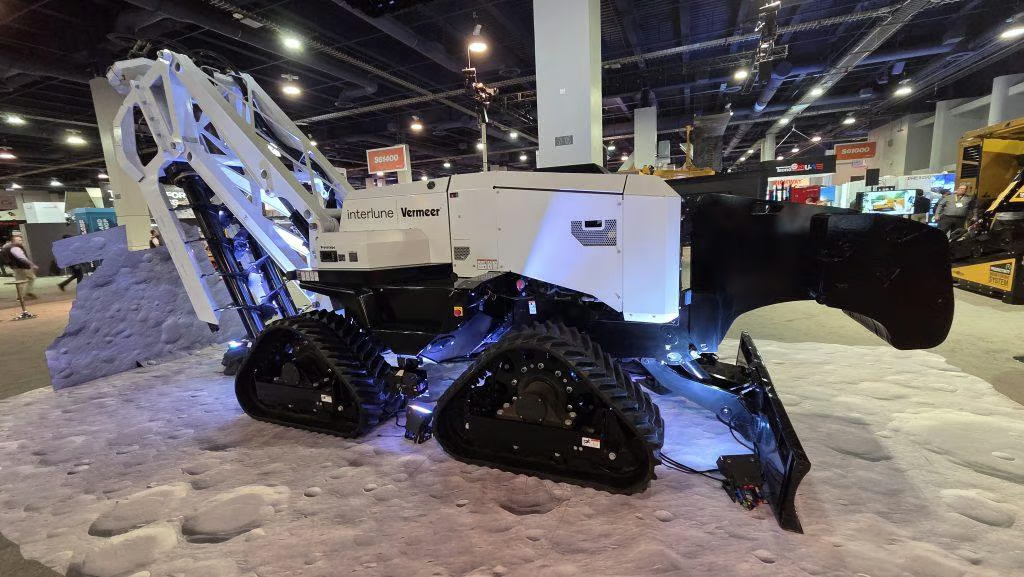 A full-scale prototype of the Interlune excavator, which was developed in partnership with Vermeer. Testing as shown was done with auxiliary components. Final Interlune excavator hardware will be integrated with the Interlune Harvester. (PRNewsfoto/Interlune)
Dans le silence glacé de l’espace, là où la gravité s’efface et où la poussière devient trésor, une nouvelle ruée vers l’or est en marche — version cosmique. Au cœur de cette aventure, Vermeer relève un défi inédit : creuser la Lune.
Tout commence par une question presque simple, mais aux implications vertigineuses : comment excaver sans gravité ? Pour Jason Andringa, passé par le Jet Propulsion Laboratory, la réponse ne pouvait être qu’audacieuse. Sollicitée par Interlune, l’entreprise s’est lancée dans la conception d’une technologie capable d’extraire l’un des matériaux les plus convoités de notre époque : l’hélium-3.
Sur Terre, cet isotope non radioactif est rarissime. Sur la Lune, en revanche, il s’accumule depuis des millénaires sous l’effet des vents solaires, piégé dans le régolithe — cette poussière grise qui recouvre sa surface. Une ressource stratégique, recherchée pour ses applications en imagerie médicale, en informatique quantique, en énergie de fusion et en sécurité nationale. Sa valeur ? Jusqu’à 30 millions de dollars le kilogramme.
Pour atteindre ce Graal, Vermeer a imaginé une machine hors norme : l’Interlune excavator. Un prototype capable d’absorber 100 tonnes de sol lunaire par heure, dans un mouvement continu. Un exploit technique, quand on sait que l’absence d’atmosphère, les contraintes thermiques et la faible gravité transforment chaque opération en défi extrême.
Le pari technologique repose sur une approche ingénieuse : une tête de coupe de type vis sans fin, capable de s’ancrer dans le sol pour compenser le manque de poids. Sur la Lune, où la machine ne pèserait qu’un sixième de sa masse terrestre, il faut littéralement “se visser” dans le sol pour avancer. Résultat : moins de consommation d’énergie, moins de poussière, et une efficacité accrue.
Mais cette innovation n’est qu’une pièce d’un puzzle plus vaste. L’excavation constitue la première étape d’un système en quatre phases : extraire, trier, séparer — et, in fine, exploiter les ressources spatiales à l’échelle industrielle.
Dernier chapitre en date : l’alliance entre Interlune et Astrolab. Ensemble, ils ambitionnent d’intégrer cette technologie au rover FLEX rover, un véhicule conçu pour opérer sur plusieurs planètes. Des tests sont déjà en préparation à Houston, où des simulations de sol lunaire permettent d’affiner chaque détail.
Au-delà de la prouesse technique, c’est une nouvelle frontière économique qui se dessine. Une industrie où pelleteuses et rovers remplacent les pioches, et où l’avenir des ressources pourrait bien s’écrire… au-delà de la Terre.
NJC.© Info Vermeer
----------------------------------------------------------------------------------------------------------------
06/05/26-English
The Quest for Helium-3: When Terrestrial Excavation Invents a Lunar Future
A full-scale prototype of the Interlune excavator, which was developed in partnership with Vermeer. Testing as shown was done with auxiliary components. Final Interlune excavator hardware will be integrated with the Interlune Harvester. (PRNewsfoto/Interlune)
In the icy silence of space, where gravity disappears and dust becomes treasure, a new gold rush is underway—cosmic version. At the heart of this adventure, Vermeer is taking on an unprecedented challenge: digging on the Moon.
It all begins with a seemingly simple question, yet one with dizzying implications: how do you excavate without gravity? For Jason Andringa, formerly of the Jet Propulsion Laboratory, the answer could only be audacious. Approached by Interlune, the company embarked on the design of a technology capable of extracting one of the most coveted materials of our time: helium-3.
On Earth, this non-radioactive isotope is extremely rare. On the Moon, however, it has been accumulating for millennia under the influence of solar winds, trapped in the regolith—the gray dust that covers its surface. A strategic resource, sought after for its applications in medical imaging, quantum computing, fusion energy, and national security. Its value? Up to $30 million per kilogram.
To reach this holy grail, Vermeer conceived an extraordinary machine: the Interlune excavator. A prototype capable of absorbing 100 tons of lunar soil per hour, in a continuous motion. A technical feat, considering that the absence of an atmosphere, thermal constraints, and low gravity transform each operation into an extreme challenge.
The technological gamble rests on an ingenious approach: a screw-type cutting head, capable of anchoring itself to the ground to compensate for its lack of weight. On the Moon, where the machine would weigh only one-sixth of its mass on Earth, it literally has to "screw itself" into the soil to move forward. The result: less energy consumption, less dust, and increased efficiency.
But this innovation is just one piece of a larger puzzle. Excavation is the first step in a four-phase system: extract, sort, separate—and ultimately, exploit space resources on an industrial scale.
The latest chapter: the alliance between Interlune and Astrolab. Together, they aim to integrate this technology into the FLEX rover, a vehicle designed to operate on multiple planets. Tests are already underway in Houston, where lunar soil simulations are being used to refine every detail.
Beyond the technical feat, a new economic frontier is emerging. An industry where excavators and rovers replace pickaxes, and where the future of resources could well be written… beyond Earth.
NJC.© Info Vermeer
------------------------------------------------------------------------------------------------------------------
06/05/26-NL
De zoektocht naar helium-3: wanneer aardse opgravingen een maantoekomst creëren
Image-A full-scale prototype of the Interlune excavator, which was developed in partnership with Vermeer. Testing as shown was done with auxiliary components. Final Interlune excavator hardware will be integrated with the Interlune Harvester. (PRNewsfoto/Interlune)
In de ijzige stilte van de ruimte, waar de zwaartekracht verdwijnt en stof een schat wordt, is een nieuwe goudkoorts aan de gang – een kosmische variant. Centraal in dit avontuur staat Vermeer, die een ongekende uitdaging aangaat: graven op de maan.
Het begint allemaal met een ogenschijnlijk simpele vraag, maar met duizelingwekkende implicaties: hoe graaf je zonder zwaartekracht? Voor Jason Andringa, voorheen werkzaam bij het Jet Propulsion Laboratory, kon het antwoord alleen maar gewaagd zijn. Interlune benaderde het bedrijf en begon met het ontwerpen van een technologie die in staat is om een van de meest begeerde materialen van onze tijd te winnen: helium-3.
Op aarde is dit niet-radioactieve isotoop extreem zeldzaam. Op de maan heeft het zich echter millennia lang opgehoopt onder invloed van de zonnewind, gevangen in de regoliet – het grijze stof dat het oppervlak bedekt. Een strategische grondstof, gewild vanwege de toepassingen in medische beeldvorming, kwantumcomputing, fusie-energie en nationale veiligheid. De waarde ervan? Tot wel 30 miljoen dollar per kilogram.
Om deze heilige graal te bereiken, bedacht Vermeer een buitengewone machine: de Interlune-graafmachine. Een prototype dat in staat is om 100 ton maangrond per uur te verwerken, in een continue beweging. Een technisch hoogstandje, gezien het feit dat de afwezigheid van een atmosfeer, thermische beperkingen en lage zwaartekracht elke operatie tot een extreme uitdaging maken.
De technologische gok berust op een ingenieuze aanpak: een schroefvormige snijkop die zich in de grond kan verankeren om het gebrek aan gewicht te compenseren. Op de maan, waar de machine slechts een zesde van zijn massa op aarde zou wegen, moet hij zich letterlijk in de grond "schroeven" om vooruit te komen. Het resultaat: minder energieverbruik, minder stof en een hogere efficiëntie.
Maar deze innovatie is slechts een klein onderdeel van een groter geheel. Opgraving is de eerste stap in een systeem van vier fasen: winnen, sorteren, scheiden – en uiteindelijk het op industriële schaal exploiteren van grondstoffen uit de ruimte.
Het nieuwste hoofdstuk: de samenwerking tussen Interlune en Astrolab. Samen willen ze deze technologie integreren in de FLEX-rover, een voertuig dat ontworpen is om op meerdere planeten te opereren. Tests zijn al aan de gang in Houston, waar simulaties van maanbodem worden gebruikt om elk detail te verfijnen.
Naast de technische prestatie ontstaat er een nieuwe economische grens. Een industrie waar graafmachines en rovers de houwelen vervangen, en waar de toekomst van grondstoffen wel eens geschreven zou kunnen worden… buiten de aarde.
NJC.© Info Vermeer
----------------------------------------------------------------------------------------------------------------
Date de dernière mise à jour : 05/05/2026