







Manitou Group LIFT 2030: When Sustainability Becomes the New Industrial Powerhouse
 13/03/26-FR-English-NL-footer
Manitou Group LIFT 2030 : quand la durabilité devient la nouvelle puissance industrielle
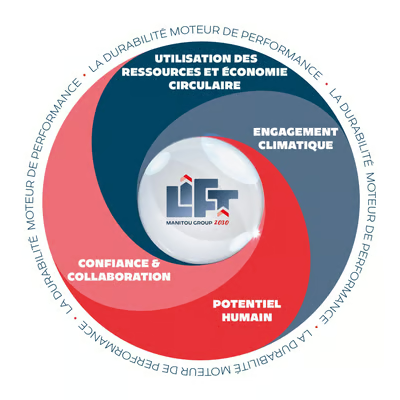 Image-MANITOU
Dans un monde industriel en pleine transformation, où la performance ne se mesure plus uniquement en tonnes soulevées ou en mètres gagnés en hauteur, Manitou Group redéfinit les règles du jeu. Le spécialiste mondial de la manutention, de l’élévation de personnes et du terrassement vient de dévoiler les engagements RSE de sa stratégie LIFT 2030, une vision ambitieuse qui place la durabilité au cœur même de la performance industrielle.
Pour le groupe français, la transition écologique et sociale n’est plus un simple impératif réglementaire : elle devient le moteur même de la compétitivité future.
Face à un environnement marqué par les bouleversements climatiques, les tensions géopolitiques, les mutations technologiques et la raréfaction des talents, Manitou choisit d’anticiper plutôt que de subir.
Une stratégie globale : la durabilité comme levier de croissance
Au cœur de la stratégie LIFT, Manitou Group affirme une conviction forte : l’avenir de l’industrie se construira à travers un équilibre entre performance économique, responsabilité environnementale et progrès humain.
La nouvelle feuille de route RSE 2026-2030, baptisée CSR Lens, a été conçue en collaboration avec l’ensemble des parties prenantes du groupe : collaborateurs, partenaires industriels, concessionnaires, fournisseurs et clients.
Cette approche permet de regarder l’activité industrielle à travers le prisme de la durabilité, ouvrant de nouvelles perspectives pour imaginer des modèles économiques plus résilients et plus responsables.
Depuis plus de dix ans, Manitou mène déjà des initiatives importantes dans ce domaine : décarbonation des machines, innovation technologique, implication de la chaîne de valeur et mobilisation des équipes.
La stratégie LIFT 2030 marque désormais une nouvelle étape, destinée à transformer ces avancées en véritable avantage compétitif.
Quatre piliers pour transformer l’industrie
La feuille de route repose sur quatre axes stratégiques majeurs, conçus pour créer une valeur durable pour l’ensemble de l’écosystème du groupe.
Le potentiel humain : la force motrice de la transformation
Pour Manitou Group, la transformation industrielle commence par celles et ceux qui la rendent possible.
Dans un contexte de pénurie de talents et de mutation profonde des attentes professionnelles, le groupe place ses collaborateurs au cœur de sa stratégie.
L’objectif est clair :
accompagner l’évolution des compétences
renforcer l’employabilité
garantir un environnement de travail sûr et stimulant
protéger la santé physique et mentale des équipes
En faisant de l’humain la première richesse de l’entreprise, Manitou veut bâtir une organisation capable d’innover durablement.
Ressources et économie circulaire : repenser le cycle de vie des machines
Deuxième pilier de la stratégie : accélérer la transition vers une économie circulaire.
L’objectif est de réduire la dépendance au modèle industriel linéaire traditionnel — produire, utiliser, jeter — pour adopter une approche intégrée sur l’ensemble du cycle de vie des machines.
Concrètement, cela signifie :
intégrer l’économie circulaire dès la conception des équipements
réduire la pression sur les ressources naturelles
prolonger la durée de vie des machines
développer des programmes de remise à neuf, de reconditionnement et de rétrofit
En collaboration avec ses concessionnaires et partenaires, Manitou veut ainsi transformer la gestion de la fin de vie des équipements en nouvelle source de valeur durable.
Engagement climatique : accélérer la décarbonation
Face à l’urgence climatique, Manitou Group entend également renforcer sa trajectoire de décarbonation.
Déjà engagé dans l’initiative internationale SBTi (Science Based Targets initiative), le groupe poursuit la réduction de ses émissions de gaz à effet de serre sur l’ensemble de ses activités :
Scope 1 : émissions directes
Scope 2 : consommation énergétique
Scope 3 : cycle de vie complet des machines
La stratégie repose notamment sur :
l’accélération de l’électrification des gammes
l’optimisation énergétique des machines
la réduction du coût total de possession pour les utilisateurs
la transparence des données d’impact environnemental
L’objectif : concilier performance industrielle et réduction massive de l’empreinte carbone.
Confiance et collaboration : construire une chaîne de valeur responsable
Enfin, la réussite de cette transformation repose sur un principe clé : **la coopération.
Manitou Group souhaite bâtir une chaîne de valeur plus responsable en travaillant étroitement avec l’ensemble de ses partenaires industriels.
Le groupe s’engage à partager des standards éthiques et environnementaux avec ses fournisseurs et concessionnaires afin de favoriser :
l’évolution des pratiques industrielles
la transparence des opérations
la co-construction de solutions durables
Dans un monde industriel de plus en plus interconnecté, la performance devient collective.
Des objectifs mesurables pour piloter la transformation
Pour garantir la crédibilité de cette trajectoire, Manitou Group a mis en place 18 indicateurs de pilotage, dont quatre sont considérés comme stratégiques et feront l’objet d’un suivi annuel.
Les objectifs fixés pour 2030 illustrent l’ambition du groupe :
Sécurité au travail : taux de fréquence des accidents réduit à TF2 de 10
Émissions carbone :
15 047 tonnes de CO₂ pour les scopes 1 et 2
13,7 kg de CO₂ par heure d’utilisation des machines pour le scope 3
Produits durables : chiffre d’affaires multiplié par 5,5
Chaîne de valeur responsable : 90 % des partenaires engagés dans des standards éthiques et durables
Ces indicateurs permettront de mesurer concrètement les progrès réalisés et de garantir la transparence vis-à-vis de l’ensemble de l’écosystème.
Une nouvelle vision de l’industrie
Avec la stratégie LIFT 2030, Manitou Group affirme une vision claire : l’industrie du futur sera durable, collaborative et technologiquement avancée.
Pour Michel Denis, directeur général du groupe, cette feuille de route marque un tournant stratégique :
« Cette feuille de route est une nouvelle façon de regarder l’existant. Nous abordons l’horizon 2030 avec une détermination renouvelée. Pour Manitou Group, l’excellence opérationnelle et la durabilité sont désormais indissociables : elles constituent le socle de notre croissance et notre contribution à un monde en mouvement plus durable. »
L’industrie de demain se construit aujourd’hui
Dans un secteur en pleine mutation — entre transition énergétique, révolution numérique et nouvelles attentes sociétales — Manitou Group entend jouer un rôle moteur.
En faisant de la durabilité le catalyseur central de sa performance, le constructeur français ne se contente pas d’adapter son modèle : il ambitionne de redéfinir les standards de toute une industrie.
Et dans ce monde en mouvement, une chose devient de plus en plus évidente : les machines du futur ne soulèveront pas seulement des charges lourdes — elles porteront aussi les ambitions d’une industrie plus responsable.
NJC.© Info MANITOU
---------------------------------------------------------------------------------------------------------------------
13/03/26-English
Manitou Group LIFT 2030: When Sustainability Becomes the New Industrial Powerhouse
Image-MANITOU
In a rapidly transforming industrial world, where performance is no longer measured solely in tons lifted or meters gained in height, Manitou Group is redefining the rules of the game. The global specialist in materials handling, personnel lifting, and earthmoving has just unveiled the CSR commitments of its LIFT 2030 strategy, an ambitious vision that places sustainability at the very heart of industrial performance.
For the French group, the ecological and social transition is no longer simply a regulatory requirement: it is becoming the driving force behind future competitiveness.
Faced with an environment marked by climate change, geopolitical tensions, technological shifts, and a skills shortage, Manitou is choosing to anticipate rather than react.
A comprehensive strategy: sustainability as a driver of growth
At the heart of its LIFT strategy, Manitou Group affirms a strong conviction: the future of industry will be built on a balance between economic performance, environmental responsibility, and human progress.
The new 2026-2030 CSR roadmap, called CSR Lens, was developed in collaboration with all of the Group's stakeholders: employees, industrial partners, dealers, suppliers, and customers.
This approach allows us to view industrial activity through the lens of sustainability, opening up new perspectives for envisioning more resilient and responsible business models.
For over ten years, Manitou has already been leading significant initiatives in this area: decarbonizing machines, technological innovation, engaging the entire value chain, and mobilizing its teams.
The LIFT 2030 strategy now marks a new stage, designed to transform these advances into a genuine competitive advantage.
Four Pillars for Transforming Industry
The roadmap is based on four major strategic pillars, designed to create sustainable value for the entire ecosystem of the group.
Human Potential: The Driving Force of Transformation
For Manitou Group, industrial transformation begins with those who make it possible.
In a context of talent shortages and profound changes in professional expectations, the group places its employees at the heart of its strategy.
The objective is clear:
to support skills development
to strengthen employability
to guarantee a safe and stimulating work environment
to protect the physical and mental health of teams
By making people the company's greatest asset, Manitou aims to build an organization capable of sustainable innovation.
Resources and the Circular Economy: Rethinking the Machine Lifecycle
Second pillar of the strategy: accelerating the transition to a circular economy.
The goal is to reduce reliance on the traditional linear industrial model—produce, use, discard—and adopt an integrated approach across the entire machine lifecycle.
In concrete terms, this means:
integrating the circular economy from the equipment design stage
reducing pressure on natural resources
extending machine lifespan
developing refurbishment, reconditioning, and retrofit programs
In collaboration with its dealers and partners, Manitou aims to transform end-of-life equipment management into a new source of sustainable value.
Climate Commitment: Accelerating Decarbonization
Faced with the climate emergency, the Manitou Group also intends to strengthen its decarbonization trajectory.
Already committed to the international Science Based Targets (SBTi) initiative, the group is continuing to reduce its greenhouse gas emissions across all its activities:
Scope 1: Direct emissions
Scope 2: Energy consumption
Scope 3: Complete machine lifecycle
The strategy is based in particular on:
accelerating the electrification of product lines
optimizing the energy efficiency of machines
reducing the total cost of ownership for users
ensuring transparency of environmental impact data
The objective: to reconcile industrial performance with a significant reduction in carbon footprint.
Trust and collaboration: building a responsible value chain
Finally, the success of this transformation rests on a key principle: **cooperation.
Manitou Group aims to build a more responsible value chain by working closely with all of its industrial partners.
The group is committed to sharing ethical and environmental standards with its suppliers and dealers to promote:
the evolution of industrial practices
transparency in operations
the collaborative development of sustainable solutions
In an increasingly interconnected industrial world, performance is becoming a collective endeavor.
Measurable objectives to guide the transformation
To ensure the credibility of this trajectory, Manitou Group has established 18 key performance indicators, four of which are considered strategic and will be monitored annually.
The objectives set for 2030 illustrate the Group's ambition:
Workplace safety: reduced accident frequency rate (TF2) of 10
Carbon emissions:
15,047 tonnes of CO₂ for Scopes 1 and 2
13.7 kg of CO₂ per hour of machine operation for Scope 3
Sustainable products: 5.5 times increase in revenue
Responsible value chain: 90% of partners committed to ethical and sustainable standards
These indicators will allow for concrete measurement of progress and ensure transparency for the entire ecosystem.
A new vision for industry
With the LIFT 2030 strategy, Manitou Group affirms a clear vision: the industry of the future will be sustainable, collaborative, and technologically advanced.
For Michel Denis, CEO of the group, this roadmap marks a strategic turning point:
“This roadmap is a new way of looking at the current situation. We are approaching the 2030 horizon with renewed determination. For Manitou Group, operational excellence and sustainability are now inseparable: they form the foundation of our growth and our contribution to a more sustainable, dynamic world.”
The industry of tomorrow is being built today
In a rapidly changing sector—between the energy transition, the digital revolution, and new societal expectations—Manitou Group intends to play a leading role.
By making sustainability the central driver of its performance, the French manufacturer is not simply adapting its model: it aims to redefine the standards of an entire industry.
And in this dynamic world, one thing is becoming increasingly clear: the machines of the future will not only lift heavy loads—they will also embody the ambitions of a more responsible industry.
NJC.© Info MANITOU
------------------------------------------------------------------------------------------------------------
13/03/26-NL
Manitou Group LIFT 2030: Wanneer duurzaamheid de nieuwe industriële motor wordt
Image-MANITOU
In een snel veranderende industriële wereld, waar prestaties niet langer alleen worden gemeten in getilde tonnen of gewonnen hoogtemeters, herdefinieert Manitou Group de spelregels. De wereldwijde specialist in materiaalbehandeling, personenheffen en grondverzet heeft zojuist de MVO-verplichtingen van zijn LIFT 2030-strategie onthuld, een ambitieuze visie die duurzaamheid centraal stelt in industriële prestaties.
Voor de Franse groep is de ecologische en sociale transitie niet langer slechts een wettelijke verplichting: het wordt de drijvende kracht achter toekomstig concurrentievermogen.
Geconfronteerd met een omgeving die wordt gekenmerkt door klimaatverandering, geopolitieke spanningen, technologische verschuivingen en een tekort aan geschoolde arbeidskrachten, kiest Manitou ervoor om te anticiperen in plaats van te reageren.
Een allesomvattende strategie: duurzaamheid als motor voor groei
In de kern van zijn LIFT-strategie bevestigt Manitou Group een sterke overtuiging: de toekomst van de industrie zal gebouwd worden op een evenwicht tussen economische prestaties, milieuverantwoordelijkheid en menselijke vooruitgang.
De nieuwe MVO-routekaart 2026-2030, genaamd CSR Lens, is ontwikkeld in samenwerking met alle stakeholders van de Groep: medewerkers, industriële partners, dealers, leveranciers en klanten.
Deze aanpak stelt ons in staat om industriële activiteiten te bekijken vanuit een duurzaamheidsperspectief, waardoor nieuwe mogelijkheden ontstaan voor het ontwikkelen van veerkrachtigere en verantwoordelijkere bedrijfsmodellen.
Manitou loopt al meer dan tien jaar voorop met belangrijke initiatieven op dit gebied: het koolstofvrij maken van machines, technologische innovatie, het betrekken van de gehele waardeketen en het mobiliseren van haar teams.
De LIFT 2030-strategie markeert nu een nieuwe fase, bedoeld om deze vooruitgang om te zetten in een echt concurrentievoordeel.
Vier pijlers voor de transformatie van de industrie
De routekaart is gebaseerd op vier belangrijke strategische pijlers, ontworpen om duurzame waarde te creëren voor het gehele ecosysteem van de groep.
Menselijk potentieel: de drijvende kracht achter transformatie
Voor de Manitou Groep begint industriële transformatie bij de mensen die het mogelijk maken.
In een context van tekorten aan talent en ingrijpende veranderingen in professionele verwachtingen, plaatst de groep haar medewerkers centraal in haar strategie.
Het doel is duidelijk:
het ondersteunen van de ontwikkeling van vaardigheden
het versterken van de inzetbaarheid
het garanderen van een veilige en stimulerende werkomgeving
het beschermen van de fysieke en mentale gezondheid van teams
Door mensen tot de grootste troef van het bedrijf te maken, wil Manitou een organisatie bouwen die in staat is tot duurzame innovatie.
Bronnen en de circulaire economie: de levenscyclus van machines heroverwegen
Tweede pijler van de strategie: het versnellen van de transitie naar een circulaire economie.
Het doel is om de afhankelijkheid van het traditionele lineaire industriële model – produceren, gebruiken, weggooien – te verminderen en een geïntegreerde aanpak te hanteren voor de gehele levenscyclus van machines.
Concreet betekent dit:
integratie van de circulaire economie vanaf de ontwerpfase van de apparatuur
vermindering van de druk op natuurlijke hulpbronnen
verlenging van de levensduur van machines
ontwikkeling van programma's voor revisie, opknappen en moderniseren
In samenwerking met haar dealers en partners streeft Manitou ernaar om het beheer van afgedankte apparatuur om te zetten in een nieuwe bron van duurzame waarde.
Klimaatverbintenis: Versnelling van de decarbonisatie
Geconfronteerd met de klimaatcrisis wil de Manitou Groep ook haar decarbonisatietraject versterken.
De groep, die zich al heeft gecommitteerd aan het internationale Science Based Targets (SBTi)-initiatief, blijft haar broeikasgasemissies in al haar activiteiten reduceren:
Scope 1: Directe emissies
Scope 2: Energieverbruik
Scope 3: Volledige levenscyclus van machines
De strategie is met name gebaseerd op:
het versnellen van de elektrificatie van productielijnen
het optimaliseren van de energie-efficiëntie van machines
het verlagen van de totale eigendomskosten voor gebruikers
het waarborgen van transparantie van gegevens over de milieu-impact
Het doel: industriële prestaties combineren met een aanzienlijke reductie van de CO2-voetafdruk.
Vertrouwen en samenwerking: het bouwen van een verantwoorde waardeketen
Het succes van deze transformatie berust uiteindelijk op één kernprincipe: **samenwerking.**
De Manitou Group streeft ernaar een meer verantwoorde waardeketen op te bouwen door nauw samen te werken met al haar industriële partners.
De groep streeft ernaar ethische en milieunormen te delen met haar leveranciers en dealers om het volgende te bevorderen:
de evolutie van industriële praktijken
transparantie in de bedrijfsvoering
de gezamenlijke ontwikkeling van duurzame oplossingen
In een steeds meer onderling verbonden industriële wereld wordt prestatie een collectieve inspanning.
Meetbare doelstellingen om de transformatie te sturen
Om de geloofwaardigheid van dit traject te waarborgen, heeft Manitou Group 18 belangrijke prestatie-indicatoren vastgesteld, waarvan er vier als strategisch worden beschouwd en jaarlijks worden gemonitord.
De doelstellingen voor 2030 illustreren de ambitie van de Groep:
Veiligheid op de werkplek: een verlaging van het ongevalsfrequentiecijfer (TF2) met 10
Koolstofuitstoot:
15.047 ton CO₂ voor Scope 1 en 2
13,7 kg CO₂ per uur machinegebruik voor Scope 3
Duurzame producten: een omzetstijging van 5,5 keer
Verantwoorde waardeketen: 90% van de partners zet zich in voor ethische en duurzame normen
Deze indicatoren maken een concrete meting van de vooruitgang mogelijk en zorgen voor transparantie binnen het gehele ecosysteem.
Een nieuwe visie voor de industrie
Met de LIFT 2030-strategie bevestigt de Manitou Groep een duidelijke visie: de industrie van de toekomst zal duurzaam, samenwerkend en technologisch geavanceerd zijn.
Voor Michel Denis, CEO van de groep, markeert deze routekaart een strategisch keerpunt:
“Deze routekaart is een nieuwe manier om naar de huidige situatie te kijken. We gaan de horizon van 2030 met hernieuwde vastberadenheid tegemoet. Voor Manitou Group zijn operationele excellentie en duurzaamheid nu onlosmakelijk met elkaar verbonden: ze vormen de basis van onze groei en onze bijdrage aan een duurzamere, dynamische wereld.”
De industrie van morgen wordt vandaag gebouwd
In een snel veranderende sector – met de energietransitie, de digitale revolutie en nieuwe maatschappelijke verwachtingen – wil Manitou Group een leidende rol spelen.
Door duurzaamheid centraal te stellen in haar prestaties, past de Franse fabrikant niet zomaar haar model aan: ze wil de normen van een hele industrie herdefiniëren.
En in deze dynamische wereld wordt één ding steeds duidelijker: de machines van de toekomst zullen niet alleen zware lasten tillen, ze zullen ook de ambities van een meer verantwoordelijke industrie belichamen.
NJC.© Info MANITOU
--------------------------------------------------------------------------------------------------------------
Date de dernière mise à jour : 12/03/2026