



999 MASON BLACK - OFF ROAD SECTION 2 - THE LAST LIFT New York
 October 2026 Off ROAD SECTION 2 - FR-English- NL- footer
Chaque mois, une nouvelle histoire, un pays différent, des machines différente
MASON BLACK LE DERNIER LEVAGE
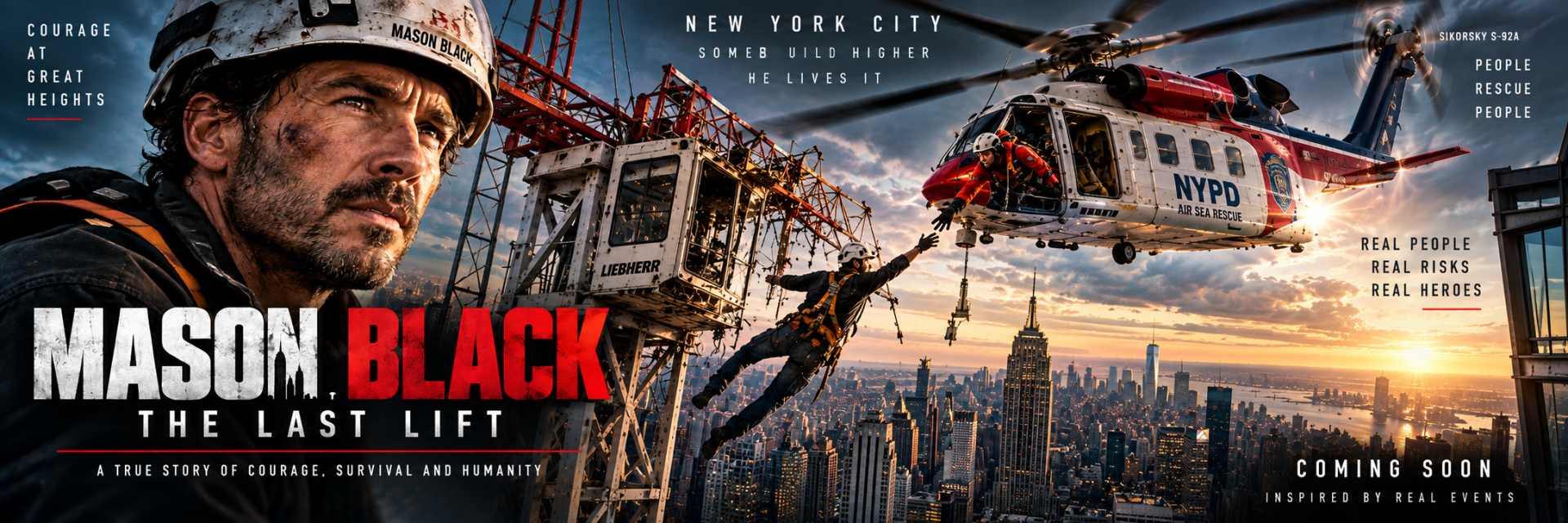 New York — 320 mètres au-dessus de Manhattan
Le soleil se levait sur New York.
Entre les gratte-ciel de Manhattan, la MoMA Tower dominait la ville. À plus de 300 mètres au-dessus des rues, le vent s'engouffrait entre les structures métalliques.
Au 45e étage, Mason Black était seul dans la cabine de sa Liebherr 710 HC-L.
Depuis des années, Mason travaillait là-haut.
Il connaissait chaque bruit de sa machine.
Chaque vibration.
Chaque mouvement de la flèche.
Chaque changement du vent.
Pour lui, une grue n'était pas seulement une machine.
C'était un partenaire.
Ce matin-là, pourtant, quelque chose allait changer.
60e étage
Une immense poutre métallique devait être déplacée depuis les niveaux supérieurs.
Mason surveillait la charge.
— Encore un peu… doucement…
La poutre avançait.
Puis soudain…
CRAAAAC !
Mason leva les yeux.
Au-dessus de lui, une structure venait de céder.
Une poutre du 60e étage bascula.
Pendant une fraction de seconde, elle resta suspendue dans le vide.
Puis elle partit.
DROIT SUR LA GRUE.
— Oh non…
BOOOOM !
L'impact fut gigantesque.
La cabine trembla.
Les vitres vibrèrent.
La flèche se tordit brutalement.
Des morceaux de métal tombèrent dans le vide.
Les alarmes hurlèrent.
Mason fut projeté contre son siège.
Puis…
silence.
Il regarda autour de lui.
La partie supérieure de la grue était gravement endommagée.
La flèche avait été arrachée de sa position.
La structure entière était désormais en déséquilibre.
La grue était devenue…
une gigantesque structure en porte-à-faux au-dessus de Manhattan.
Mason regarda vers le bas.
Sous lui…
plus de 200 mètres de vide.
MAYDAY
Il saisit immédiatement sa radio.
— Mayday ! Mayday ! Ici grue 710 ! Impact majeur ! La flèche est endommagée ! La structure est instable !
La réponse arriva quelques secondes plus tard.
— Mason, reste dans la cabine. Les secours sont en route.
Mason regarda la structure.
Un morceau de métal se détacha.
Il tomba pendant plusieurs secondes avant de disparaître entre les immeubles.
Mason comprit.
Il ne pouvait pas attendre.
L'arrivée du Sikorsky
Au loin, un grondement apparut.
Puis un hélicoptère surgit entre les buildings.
Un Sikorsky S-92A de sauvetage.
Un appareil massif, équipé d'un treuil latéral et transportant une équipe spécialisée.
À bord :
un pilote, un copilote et deux sauveteurs hélitreuillistes.
Le S-92 approcha lentement de la grue.
Mais à cette hauteur, le vent était brutal.
Le pilote tenta de maintenir l'appareil en stationnaire.
Les pales du rotor frappaient l'air avec une violence impressionnante.
L'hélicoptère avançait…
puis reculait.
Avançait…
puis dérivait.
— Vent latéral trop fort !
Le pilote interrompit l'approche.
— On reprend.
Le S-92 s'éloigna.
Mason regarda l'appareil disparaître.
Puis il entendit derrière lui :
KRRRRR…
La grue venait encore de bouger.
Première tentative
Le Sikorsky revint.
Le sauveteur ouvrit la porte latérale.
Le treuil se mit en marche.
Vrrrrrrrrrrr…
Le câble descendit lentement.
Puis le vent le saisit.
Le câble se mit à osciller.
À gauche.
À droite.
Puis brutalement vers Mason.
Le sauveteur tenta de contrôler la ligne.
— Encore deux mètres !
Mason tendit les bras.
Le câble passa devant lui.
Trop loin.
— Abort !
Le S-92 remonta.
Mason resta seul.
Le vent devenait plus violent.
Deuxième tentative
Le pilote reprit son approche.
Cette fois, l'hélicoptère arriva presque au niveau de la cabine.
Le rotor tournait à quelques dizaines de mètres de la structure.
Le bruit était assourdissant.
Le câble descendit.
Mason sortit de la cabine.
Un pied sur la passerelle.
Puis l'autre.
Il s'accrocha à la structure.
Le vent lui frappait le visage.
Le sauveteur cria :
— Mason ! Attends mon signal !
Le câble arriva.
Mason tendit la main.
Il allait l'attraper.
Mais une rafale frappa le S-92.
L'appareil dériva brutalement.
Le câble partit sur le côté.
Impossible.
— Pull up! Pull up!
Le pilote remonta immédiatement.
Deuxième échec.
La grue commence à céder
Mason entendit un nouveau bruit.
CLANG !
Il se retourna.
Une pièce métallique venait de se détacher.
Puis une deuxième.
La structure vibrait.
La radio grésilla.
— Mason, tu dois sortir maintenant.
Il regarda la ville.
Puis l'hélicoptère.
— Je suis prêt.
Il ouvrit complètement la porte.
Le vent entra dans la cabine.
Mason s'avança.
Derrière lui…
la grue grinçait.
Devant lui…
le vide.
Troisième tentative
Le S-92 arriva une nouvelle fois.
Cette fois, le pilote vola presque contre le vent.
Les pales du rotor maintenaient l'appareil à quelques mètres de la structure.
Le sauveteur descendit avec le câble.
Le treuil hurlait.
Le câble tournait dans le vent.
Mason attendait.
— Maintenant !
Mason se lança.
Ses doigts touchèrent le câble.
Il le rata.
— Encore !
Le câble remonta.
Le S-92 s'éloigna.
Mason resta figé.
Une seconde.
Deux secondes.
Puis il entendit :
BOUM.
Une partie de la grue venait de bouger.
Mason comprit.
C'était maintenant ou jamais.
LE SAUT
Le S-92 revint.
Le pilote cria dans la radio :
— On a dix secondes !
Le câble descendit.
Il tournait dans le vent comme un serpent.
Mason courut sur la passerelle.
Le sauveteur cria :
— SAUTE !
Mason sauta.
Pendant une fraction de seconde…
il fut complètement dans le vide.
Ses doigts cherchèrent le câble.
Ils le touchèrent.
Puis…
IL L'ATTRAPA.
— JE L'AI !
Le treuil commença à remonter.
Mais le vent frappa le S-92.
Mason se mit à tourner dans le vide.
Une rotation.
Deux.
Trois.
Le câble oscillait violemment.
— Stabilise !
Le pilote lutta sur les commandes.
Le copilote surveillait les instruments.
Les deux sauveteurs tentaient de contrôler Mason.
— Encore cinq mètres !
Mason tournait toujours.
Il regarda en dessous.
New York était devenue minuscule.
Les voitures ressemblaient à des points.
Les rues semblaient être des lignes.
Il ferma les yeux.
Puis sentit une main attraper son harnais.
Le deuxième sauveteur venait de l'atteindre.
— Je te tiens !
Le câble remonta encore.
Mason fut tiré vers la porte.
Un sauveteur attrapa son bras.
Puis son épaule.
Puis son harnais.
Ils le firent entrer dans l'hélicoptère.
Mason s'effondra sur le plancher.
Le treuil s'arrêta.
Pendant quelques secondes…
personne ne parla.
On entendait seulement le rotor du S-92.
Le silence après la peur
Mason respirait difficilement.
Le sauveteur posa une main sur son épaule.
— Tu es avec nous.
Mason regarda par la porte.
Au loin, la Liebherr était toujours suspendue au-dessus de la ville.
Sa grue.
Son poste de travail.
Son quotidien.
Tout ce qu'il croyait connaître.
Il regarda ensuite Manhattan.
Des millions de personnes continuaient leur journée.
Personne dans les rues ne savait ce qui venait de se passer.
Mason murmura :
— Je pensais que mon travail consistait à construire des choses qui touchent le ciel.
Le sauveteur le regarda.
Mason continua :
— Aujourd'hui, j'ai compris qu'avant de construire toujours plus haut… il faut apprendre à protéger ceux qui sont là-haut.
Quelques semaines plus tard
Mason retourna à New York.
Il s'arrêta au pied de la MoMA Tower.
Il leva les yeux.
Pendant longtemps, il resta silencieux.
Puis il sourit.
Il savait qu'il remonterait un jour dans une cabine.
Mais quelque chose avait changé.
Il ne regarderait plus jamais une grue de la même manière.
Parce qu'à plus de 200 mètres au-dessus de Manhattan, Mason Black avait découvert une vérité que personne ne lui avait jamais enseignée :
Une machine peut construire une tour.
Un homme peut prendre des risques pour la construire.
Mais ce sont les hommes qui sauvent les hommes.
Et parfois…
la plus grande réussite d'une journée de travail n'est pas d'avoir construit quelque chose.
C'est simplement de rentrer chez soi.
Section Mason Black NJC.©
Vos series complète depuis Septembre 2026 "Section Mason Black" clic 
LES GÉANTS D'ACIER DE MANHATTAN
À New York, les grues à tour ne sont pas de simples machines de chantier.
Elles font partie du paysage.
Entre les gratte-ciel, les façades de verre et les rues étroites de Manhattan, ces géants d'acier travaillent parfois à plusieurs centaines de mètres au-dessus du sol. Leur mission : déplacer des tonnes d'acier, de béton et d'équipements dans un environnement où chaque centimètre compte.
Dans cette ville verticale, les grues à flèche relevable — luffing jib — sont particulièrement adaptées aux chantiers urbains très denses. Leur capacité à travailler dans des espaces confinés permet de limiter l'encombrement de la flèche au-dessus des immeubles voisins.
Parmi les constructeurs qui ont marqué l'histoire récente des grands chantiers new-yorkais, plusieurs noms reviennent avec force.
1. FAVELLE FAVCO — L'ADN DES GRANDS CHANTIERS NEW-YORKAIS
S'il existe une marque qui possède une relation particulière avec les gratte-ciel de New York, c'est bien Favelle Favco.
La signature du constructeur malaisien est intimement liée à certains des projets les plus emblématiques de Manhattan.
En 2013, deux Favelle Favco M760E ont joué un rôle majeur dans la construction et le top-out du One World Trade Center, culminant à 541 mètres.
Deux machines au cœur d'un chantier historique.
Deux silhouettes d'acier travaillant au-dessus de Manhattan alors qu'une nouvelle icône de New York prenait forme.
Mais l'histoire ne s'arrête pas là.
Favelle Favco a également fourni des machines de forte capacité pour d'autres grands projets urbains. La gamme du constructeur comprend notamment les M600D, M760D, M860D, M900D, M1060D et M1280D, des grues conçues pour les opérations de levage lourd et les environnements exigeants.
Favelle Favco, à New York, c'est l'image de la puissance.
2. LIEBHERR — LA PRÉCISION AU CŒUR DE MANHATTAN
Autre acteur majeur : Liebherr.
Et pour comprendre la présence de la marque à New York, il suffit de regarder vers 53 West 53rd Street, au pied du Museum of Modern Art.
Pour construire la MoMA Tower, haute d'environ 320 mètres, deux Liebherr 710 HC-L à flèche relevable ont été utilisées.
La tour comptait 76 étages et les grues ont été intégrées au processus de construction d'un bâtiment dont la structure exigeait une précision exceptionnelle.
La performance de ces machines est à la hauteur du projet.
La 710 HC-L pouvait travailler avec un rayon allant jusqu'à 60 mètres et atteindre une hauteur de travail de 320 mètres dans cette configuration de chantier. Sa capacité maximale annoncée atteignait 64 tonnes, avec une flèche pouvant atteindre environ 65 mètres.
À Manhattan, où chaque mètre carré est précieux, la conception compacte et la flèche relevable de la 710 HC-L étaient particulièrement adaptées à l'environnement urbain dense.
Liebherr, c'est la précision allemande suspendue au-dessus de New York.
3. KROLL — LA FORCE DES LEVAGES EXTRÊMES
Dans l'univers des grues à tour de très forte capacité, Kroll occupe également une place particulière.
Ses machines sont associées aux opérations nécessitant une capacité de levage importante, là où les charges deviennent gigantesques et où la marge d'erreur se réduit à presque rien.
Sur les grands chantiers américains, ces grues représentent une autre philosophie de la construction :
plus lourd, plus haut, plus complexe.
4. POTAIN, WOLFFKRAN, TEREX/COMEDIL…
Le paysage new-yorkais ne se limite évidemment pas à deux constructeurs.
Potain, Wolffkran et Terex/Comedil font également partie de l'univers des grues à tour utilisées ou étudiées pour les projets urbains complexes.
Cette diversité reflète la particularité du marché new-yorkais : chaque chantier doit trouver une solution adaptée à son environnement, à la hauteur du bâtiment, au rayon de travail, aux charges à déplacer et surtout à la proximité des constructions voisines.
NEW YORK
LA VILLE QUI NE DORT JAMAIS
New York n'est pas simplement une ville. C'est un monde à elle seule.
Avec 8,58 millions d'habitants en 2025, New York est la ville la plus peuplée des États-Unis. Elle s'étend sur environ 300 miles² de terres, soit près de 777 km², et rassemble cinq grands boroughs : Manhattan, Brooklyn, Queens, The Bronx et Staten Island.
Mais New York doit aussi son caractère unique à l'eau.
La ville possède environ 520 miles de côtes, soit près de 837 kilomètres, bordées par l'océan Atlantique, l'Hudson River, l'East River, le Harlem River, le Long Island Sound et de nombreuses baies et voies navigables.
Ici, l'eau accompagne presque chaque horizon.
Elle sépare Manhattan de Brooklyn.
Elle longe les gratte-ciel.
Elle ouvre la ville sur l'Atlantique.
Et lorsque le soleil descend derrière Manhattan, les façades de verre se transforment en miroirs dorés.
UNE VILLE, CINQ MONDES
Manhattan, avec Times Square, Central Park, Broadway, Rockefeller Center, l'Empire State Building et la Statue de la Liberté, représente l'image mythique de New York. Mais la ville ne s'arrête pas à Manhattan.
À Brooklyn, les quartiers historiques côtoient les nouvelles architectures et offrent des vues spectaculaires sur Manhattan.
Dans le Queens, la ville devient plus internationale encore, avec une extraordinaire diversité culturelle.
Le Bronx possède ses propres quartiers, parcs et institutions culturelles.
Et Staten Island offre une autre perspective sur la métropole, notamment depuis le front de mer.
UNE VILLE POSÉE SUR L'EAU
New York possède l'un des systèmes de voies navigables les plus complexes des États-Unis.
Le Hudson River, l'East River, le New York Harbor, le Long Island Sound, Jamaica Bay et les différentes baies et détroits forment un immense réseau autour des cinq boroughs. La ville considère même symboliquement ses voies d'eau comme un « sixième borough ».
C'est cette rencontre entre l'eau, les ponts, les immeubles et les gratte-ciel qui donne à New York son paysage incomparable.
UNE VILLE QUI ATTIRE LE MONDE
En 2025, New York a accueilli environ 65 millions de visiteurs. Le tourisme a généré 84,7 milliards de dollars d'impact économique, dont 55,6 milliards de dollars de dépenses directes.
NJC.©
------------------------------------------------------------------------------------------------------------
October 2026 OFF ROAD Section 2 - English
Each month, a new story, a different country, different machines
MASON BLACK THE LAST LIFT
New York — 320 metres above Manhattan
The sun was rising over New York.
Between the skyscrapers of Manhattan, the MoMA Tower dominated the city. More than 300 metres above the streets, the wind swept through the steel structures.
On the 45th floor, Mason Black was alone inside the cab of his Liebherr 710 HC-L.
Mason had worked up there for years.
He knew every sound his machine made.
Every vibration.
Every movement of the jib.
Every change in the wind.
To him, a tower crane was not simply a machine.
It was a partner.
But that morning, everything was about to change.
60th Floor
A massive steel beam had to be moved from the upper levels.
Mason watched the load carefully.
— Just a little more… easy…
The beam was moving.
Then suddenly…
CRAAAACK!
Mason looked up.
Above him, part of the structure had given way.
A beam from the 60th floor began to fall.
For a fraction of a second, it hung suspended in the void.
Then it dropped.
STRAIGHT TOWARD THE CRANE.
— Oh no…
BOOOOM!
The impact was enormous.
The cab shook violently.
The windows rattled.
The jib twisted brutally.
Pieces of steel plunged into the void.
The alarms screamed.
Mason was thrown against his seat.
Then…
silence.
He looked around.
The upper section of the crane was severely damaged.
The jib had been torn from its position.
The entire structure was now dangerously unbalanced.
The crane had become…
a gigantic cantilever hanging over Manhattan.
Mason looked down.
Beneath him…
more than 200 metres of empty space.
MAYDAY
He immediately grabbed his radio.
— Mayday! Mayday! Crane 710! Major impact! The jib is damaged! The structure is unstable!
The answer came seconds later.
— Mason, stay inside the cab. Rescue is on the way.
Mason looked at the structure.
A piece of steel broke loose.
It fell for several seconds before disappearing between the buildings.
Mason understood.
He could not wait.
The Sikorsky Arrives
A distant rumble appeared.
Then a helicopter emerged between the buildings.
A Sikorsky S-92A rescue helicopter.
A massive aircraft equipped with a side-mounted rescue hoist and carrying a specialized rescue team.
On board:
a pilot, a co-pilot and two rescue hoist specialists.
The S-92 slowly approached the crane.
But at that altitude, the wind was brutal.
The pilot tried to hold the aircraft in a hover.
The rotor blades hammered through the air with incredible force.
The helicopter moved forward…
then backward.
Forward…
then drifted sideways.
— Crosswind too strong!
The pilot aborted the approach.
— We go again.
The S-92 moved away.
Mason watched it disappear.
Then he heard something behind him:
KRRRRR…
The crane moved again.
First Attempt
The Sikorsky returned.
The rescuer opened the side door.
The hoist began to operate.
Vrrrrrrrrrrr…
The cable slowly descended.
Then the wind caught it.
The cable began to swing.
Left.
Right.
Then violently toward Mason.
The rescuer tried to control the line.
— Two more metres!
Mason reached out.
The cable swept past him.
Too far.
— Abort!
The S-92 climbed away.
Mason was alone again.
The wind was getting stronger.
Second Attempt
The pilot began another approach.
This time, the helicopter reached almost the same level as the cab.
The rotor was only a few dozen metres from the structure.
The noise was deafening.
The cable descended.
Mason stepped out of the cab.
One foot onto the walkway.
Then the other.
He held tightly to the structure.
The wind slammed into his face.
The rescuer shouted:
— Mason! Wait for my signal!
The cable came closer.
Mason reached for it.
He was about to grab it.
Then a powerful gust struck the S-92.
The aircraft suddenly drifted.
The cable swung away.
Impossible.
— Pull up! Pull up!
The pilot immediately climbed.
Second attempt failed.
The Crane Begins to Give Way
Mason heard another sound.
CLANG!
He turned around.
A piece of metal had broken loose.
Then another.
The structure was vibrating.
The radio crackled.
— Mason, you have to get out now.
He looked at the city.
Then at the helicopter.
— I'm ready.
He opened the door completely.
The wind exploded into the cab.
Mason stepped forward.
Behind him…
the crane was groaning.
In front of him…
the void.
Third Attempt
The S-92 returned once again.
This time, the pilot flew almost directly into the wind.
The rotor blades fought to keep the aircraft only a few metres from the structure.
The rescuer descended with the cable.
The hoist screamed.
The cable twisted in the wind.
Mason waited.
— Now!
Mason jumped.
His fingers touched the cable.
He missed it.
— Again!
The cable was pulled back up.
The S-92 moved away.
Mason stood frozen.
One second.
Two seconds.
Then he heard:
BOOM.
Part of the crane shifted.
Mason understood.
This was now or never.
THE JUMP
The S-92 came back.
The pilot shouted over the radio:
— We've got ten seconds!
The cable descended.
It twisted in the wind like a snake.
Mason ran across the walkway.
The rescuer shouted:
— JUMP!
Mason jumped.
For a fraction of a second…
he was completely suspended in mid-air.
His fingers searched for the cable.
They touched it.
Then…
HE GOT IT.
— I'VE GOT IT!
The hoist began pulling him upward.
But the wind slammed into the S-92.
Mason began spinning in the void.
One rotation.
Two.
Three.
The cable swung violently.
— Stabilize!
The pilot fought the controls.
The co-pilot monitored the instruments.
The two rescuers fought to control Mason's body.
— Five more metres!
Mason was still spinning.
He looked down.
New York had become tiny.
Cars looked like dots.
The streets looked like lines.
He closed his eyes.
Then he felt a hand grab his harness.
The second rescuer had reached him.
— I've got you!
The cable rose again.
Mason was pulled toward the helicopter door.
One rescuer grabbed his arm.
Then his shoulder.
Then his harness.
They pulled him inside the helicopter.
Mason collapsed onto the floor.
The hoist stopped.
For several seconds…
nobody spoke.
Only the sound of the S-92's rotor could be heard.
The Silence After the Fear
Mason was breathing heavily.
The rescuer placed a hand on his shoulder.
— You're with us.
Mason looked through the open door.
In the distance, the Liebherr was still hanging above the city.
His crane.
His workplace.
His everyday life.
Everything he thought he knew.
Then he looked at Manhattan.
Millions of people were continuing with their day.
Nobody down there knew what had just happened.
Mason whispered:
— I thought my job was about building things that reach the sky.
The rescuer looked at him.
Mason continued:
— Today I learned that before we build higher and higher… we have to learn how to protect the people working up there.
Several Weeks Later
Mason returned to New York.
He stopped at the foot of the MoMA Tower.
He looked up.
For a long time, he stood there in silence.
Then he smiled.
He knew he would climb back into a crane cab one day.
But something had changed.
He would never look at a tower crane the same way again.
Because more than 200 metres above Manhattan, Mason Black had discovered a truth nobody had ever taught him:
A machine can build a tower.
A man can risk his life to build it.
But it is people who save people.
And sometimes…
the greatest achievement of a working day is not building something.
It is simply making it home.
R.E.News© Section Mason Black NJC.
Your complete series since September 2026 "Section Mason Black" (click).
THE STEEL GIANTS OF MANHATTAN
In New York, tower cranes are far more than construction machines.
They are part of the skyline.
Between skyscrapers, glass façades and the narrow streets of Manhattan, these giants of steel operate hundreds of metres above the ground.
Their mission is simple in principle, but extraordinary in execution: lifting tonnes of steel, concrete and equipment in an environment where every centimetre matters.
In this vertical city, luffing-jib tower cranes are particularly suited to the most confined urban construction sites. Their ability to raise the jib allows them to operate in extremely tight spaces while reducing the amount of airspace occupied above neighbouring buildings.
Among the manufacturers that have left their mark on New York's most ambitious construction projects, several names stand out.
1. FAVELLE FAVCO — THE DNA OF NEW YORK'S GREAT CONSTRUCTION SITES
If one manufacturer has a particularly strong connection with New York's skyscraper construction, it is Favelle Favco.
The Malaysian manufacturer is closely associated with some of Manhattan's most iconic projects.
In 2013, two Favelle Favco M760E cranes played a major role in the construction and top-out of One World Trade Center, which rises to 541 metres.
Two machines at the heart of a historic construction project.
Two steel giants operating above Manhattan as a new symbol of New York was taking shape. Favelle Favco
But the story did not end there.
Favelle Favco has also supplied high-capacity machines for other major urban projects. Its range includes models such as the M600D, M760D, M860D, M900D, M1060D and M1280D, designed for heavy lifting operations and demanding construction environments. Favelle Favco Tower Cranes
In New York, Favelle Favco represents power.
2. LIEBHERR — PRECISION AT THE HEART OF MANHATTAN
Another major name is Liebherr.
And to understand the company's presence in New York, look toward 53 West 53rd Street, beside the Museum of Modern Art.
To build the MoMA Tower, approximately 320 metres high, two Liebherr 710 HC-L luffing-jib cranes were used.
The tower rises 76 storeys above Manhattan, and the cranes were integrated into the construction of a building where structural precision was critical.
The performance of these machines matched the scale of the project.
The 710 HC-L was configured to operate at a radius of up to 60 metres and reached a working height of approximately 320 metres on the project. Its maximum lifting capacity was rated at 64 tonnes, with a jib extending to around 65 metres.
In Manhattan, where every square metre is precious, the compact design and luffing-jib configuration of the 710 HC-L were particularly well suited to the dense urban environment.
Liebherr represents precision suspended above New York.
3. KROLL — POWER FOR THE MOST DEMANDING LIFTS
In the world of very high-capacity tower cranes, Kroll also occupies a distinctive position.
Its machines are associated with operations requiring substantial lifting capacity, where loads become enormous and the margin for error becomes extremely small.
On major North American construction projects, these cranes represent another philosophy of construction:
heavier, higher, more complex.
4. POTAIN, WOLFFKRAN, TEREX/COMEDIL…
New York's tower-crane landscape is, of course, not limited to two manufacturers.
Potain, Wolffkran and Terex/Comedil are also part of the world of tower cranes used or considered for complex urban projects.
This diversity reflects the particular nature of the New York market.
Every project requires a solution adapted to its environment, building height, working radius, lifting requirements and, above all, the proximity of neighbouring structures.
NEW YORK
THE CITY THAT NEVER SLEEPS
New York is not simply a city. It is a world of its own.
With 8.58 million inhabitants in 2025, New York is the most populous city in the United States. It covers approximately 300 square miles of land, or nearly 777 km², and brings together five major boroughs: Manhattan, Brooklyn, Queens, The Bronx and Staten Island.
But New York also owes much of its unique character to water.
The city has approximately 520 miles of coastline, or nearly 837 kilometres, bordered by the Atlantic Ocean, the Hudson River, the East River, the Harlem River, Long Island Sound and countless bays and waterways.
Here, water is part of almost every horizon.
It separates Manhattan from Brooklyn.
It flows alongside the skyscrapers.
It opens the city toward the Atlantic.
And when the sun sinks behind Manhattan, the glass façades of the towers become golden mirrors reflecting the last light of the day.
ONE CITY, FIVE WORLDS
Manhattan, with Times Square, Central Park, Broadway, Rockefeller Center, the Empire State Building and the Statue of Liberty, represents the legendary image of New York.
But the city does not end in Manhattan.
In Brooklyn, historic neighbourhoods stand alongside bold new architecture, offering spectacular views across the Manhattan skyline.
In Queens, New York becomes even more international, with an extraordinary cultural diversity shaped by communities from around the world.
The Bronx has its own distinctive neighbourhoods, parks and cultural institutions.
And Staten Island offers another perspective on the metropolis, particularly from its waterfront, with breathtaking views back toward Manhattan.
A CITY BUILT AROUND WATER
New York possesses one of the most complex networks of waterways in the United States.
The Hudson River, the East River, New York Harbor, Long Island Sound, Jamaica Bay and the city's numerous bays, channels and waterways form a vast network surrounding the five boroughs.
The city has even come to regard its waterways, symbolically, as a “sixth borough.”
It is this extraordinary meeting of water, bridges, buildings and skyscrapers that gives New York its unmistakable landscape.
A CITY THAT ATTRACTS THE WORLD
In 2025, New York welcomed approximately 65 million visitors.
Tourism generated an estimated $84.7 billion in economic impact, including $55.6 billion in direct visitor spending.
But statistics only tell part of the story.
People come to New York to walk beneath the skyscrapers, cross its legendary bridges, discover Central Park, experience Broadway, explore its museums, watch the sunset over the Hudson and see the Statue of Liberty rising from the harbour.
NJC.©
-------------------------------------------------------------------------------------------------------------
October 2026 OFF ROAD SECTION 2 - NL
MASON BLACK DE LAATSTE HIJS
New York — 320 meter boven Manhattan
De zon kwam op boven New York.
Tussen de wolkenkrabbers van Manhattan domineerde de MoMA Tower de skyline. Meer dan 300 meter boven de straten joeg de wind tussen de stalen constructies door.
Op de 45e verdieping zat Mason Black alleen in de cabine van zijn Liebherr 710 HC-L.
Mason werkte hier al jaren.
Hij kende elk geluid van zijn machine.
Elke trilling.
Elke beweging van de giek.
Elke verandering van de wind.
Voor hem was een torenkraan niet zomaar een machine.
Het was een partner.
Maar die ochtend zou alles veranderen.
60e verdieping
Een enorme stalen balk moest vanaf de hogere verdiepingen worden verplaatst.
Mason hield de last nauwlettend in de gaten.
— Nog een klein stukje… rustig…
De balk bewoog.
Toen plotseling…
CRAAAACK!
Mason keek omhoog.
Boven hem had een deel van de constructie het begeven.
Een balk van de 60e verdieping begon te vallen.
Een fractie van een seconde bleef hij in de leegte hangen.
Toen stortte hij naar beneden.
RECHT OP DE KRAAN AF.
— O nee…
BOOOOM!
De inslag was enorm.
De cabine schudde hevig.
De ruiten trilden.
De giek boog met geweld.
Stukken staal vielen de diepte in.
De alarmen loeiden.
Mason werd tegen zijn stoel geslingerd.
Toen…
stilte.
Hij keek om zich heen.
Het bovenste deel van de kraan was zwaar beschadigd.
De giek was uit zijn positie gerukt.
De hele constructie was uit balans geraakt.
De kraan was veranderd in…
een gigantische constructie die als een overhang boven Manhattan hing.
Mason keek naar beneden.
Onder hem…
meer dan 200 meter leegte.
MAYDAY
Hij greep onmiddellijk zijn radio.
— Mayday! Mayday! Hier kraan 710! Zware impact! De giek is beschadigd! De constructie is instabiel!
Een paar seconden later kwam het antwoord.
— Mason, blijf in de cabine. De hulpdiensten zijn onderweg.
Mason keek naar de constructie.
Een stuk staal brak los.
Het viel enkele seconden voordat het tussen de gebouwen verdween.
Mason begreep het.
Hij kon niet wachten.
De Sikorsky arriveert
In de verte klonk een dreunend geluid.
Toen verscheen een helikopter tussen de gebouwen.
Een Sikorsky S-92A reddingshelikopter.
Een groot toestel, uitgerust met een zijlier en een gespecialiseerd reddingsteam aan boord.
Aan boord:
een piloot, een copiloot en twee reddingsspecialisten.
De S-92 naderde langzaam de kraan.
Maar op die hoogte was de wind meedogenloos.
De piloot probeerde het toestel stil te houden.
De rotorbladen sloegen met enorme kracht door de lucht.
De helikopter bewoog vooruit…
en vervolgens achteruit.
Vooruit…
en toen dreef hij plotseling zijwaarts weg.
— Te sterke zijwind!
De piloot brak de nadering af.
— We proberen het opnieuw.
De S-92 verwijderde zich.
Mason keek hoe het toestel verdween.
Toen hoorde hij achter zich:
KRRRRR…
De kraan bewoog opnieuw.
Eerste poging
De Sikorsky keerde terug.
De redder opende de zijdeur.
De lier begon te werken.
Vrrrrrrrrrrr…
De kabel daalde langzaam.
Toen greep de wind hem.
De kabel begon heen en weer te slingeren.
Links.
Rechts.
En toen plotseling recht naar Mason.
De redder probeerde de kabel onder controle te houden.
— Nog twee meter!
Mason strekte zijn armen uit.
De kabel schoot langs hem heen.
Te ver.
— Abort!
De S-92 trok op.
Mason bleef alleen achter.
De wind werd steeds sterker.
Tweede poging
De piloot zette opnieuw de nadering in.
Deze keer kwam de helikopter bijna op gelijke hoogte met de cabine.
De rotor draaide op slechts enkele tientallen meters van de constructie.
Het geluid was oorverdovend.
De kabel daalde.
Mason stapte uit de cabine.
Eén voet op de loopbrug.
Toen de andere.
Hij hield zich stevig vast aan de constructie.
De wind sloeg recht in zijn gezicht.
De redder riep:
— Mason! Wacht op mijn signaal!
De kabel kwam dichterbij.
Mason strekte zijn hand uit.
Hij stond op het punt hem te grijpen.
Toen sloeg een krachtige windstoot tegen de S-92.
Het toestel dreef plotseling weg.
De kabel zwaaide opzij.
Onmogelijk.
— Pull up! Pull up!
De piloot trok onmiddellijk op.
Tweede poging mislukt.
De kraan begint te bezwijken
Mason hoorde opnieuw een geluid.
CLANG!
Hij draaide zich om.
Een stuk metaal was losgeraakt.
Toen nog één.
De constructie trilde.
De radio kraakte.
— Mason, je moet er nu uit.
Hij keek naar de stad.
Toen naar de helikopter.
— Ik ben er klaar voor.
Hij opende de deur volledig.
De wind stormde de cabine binnen.
Mason stapte naar voren.
Achter hem…
kreunde de kraan.
Voor hem…
de leegte.
Derde poging
De S-92 kwam opnieuw.
Deze keer vloog de piloot bijna recht tegen de wind in.
De rotorbladen vochten om het toestel op slechts enkele meters van de constructie te houden.
De redder daalde af met de kabel.
De lier gierde.
De kabel draaide in de wind.
Mason wachtte.
— Nu!
Mason sprong.
Zijn vingers raakten de kabel.
Hij miste hem.
— Nog een keer!
De kabel werd weer omhooggetrokken.
De S-92 verwijderde zich.
Mason stond roerloos.
Eén seconde.
Twee seconden.
Toen hoorde hij:
BOEM.
Een deel van de kraan verschoof.
Mason begreep het.
Dit was nu of nooit.
DE SPRONG
De S-92 kwam terug.
De piloot schreeuwde door de radio:
— We hebben tien seconden!
De kabel daalde.
Hij draaide in de wind als een slang.
Mason rende over de loopbrug.
De redder schreeuwde:
— SPRING!
Mason sprong.
Een fractie van een seconde…
hing hij volledig boven de leegte.
Zijn vingers zochten naar de kabel.
Ze raakten hem.
Toen…
HIJ HAD HEM.
— IK HEB HEM!
De lier begon hem omhoog te trekken.
Maar de wind sloeg tegen de S-92.
Mason begon rond te draaien in de leegte.
Eén keer.
Twee keer.
Drie keer.
De kabel zwaaide hevig.
— Stabiliseer!
De piloot vocht met de besturing.
De copiloot hield de instrumenten nauwlettend in de gaten.
De twee redders probeerden Mason onder controle te krijgen.
— Nog vijf meter!
Mason bleef ronddraaien.
Hij keek naar beneden.
New York was klein geworden.
Auto's leken stippen.
De straten leken lijnen.
Hij sloot zijn ogen.
Toen voelde hij een hand die zijn harnas greep.
De tweede redder had hem bereikt.
— Ik heb je!
De kabel ging verder omhoog.
Mason werd naar de deur van de helikopter getrokken.
Een redder greep zijn arm.
Toen zijn schouder.
Toen zijn harnas.
Ze trokken hem de helikopter in.
Mason zakte neer op de vloer.
De lier stopte.
Enkele seconden lang…
zei niemand iets.
Alleen het geluid van de rotor van de S-92 was hoorbaar.
De stilte na de angst
Mason ademde zwaar.
De redder legde een hand op zijn schouder.
— Je bent bij ons.
Mason keek door de open deur.
In de verte hing de Liebherr nog steeds boven de stad.
Zijn kraan.
Zijn werkplek.
Zijn dagelijkse leven.
Alles wat hij dacht te kennen.
Daarna keek hij naar Manhattan.
Miljoenen mensen gingen gewoon door met hun dag.
Niemand beneden wist wat er zojuist was gebeurd.
Mason fluisterde:
— Ik dacht dat mijn werk erin bestond dingen te bouwen die de hemel bereiken.
De redder keek hem aan.
Mason ging verder:
— Vandaag heb ik geleerd dat we, voordat we steeds hoger bouwen… eerst moeten leren hoe we de mensen daarboven beschermen.
Enkele weken later
Mason keerde terug naar New York.
Hij stopte aan de voet van de MoMA Tower.
Hij keek omhoog.
Lange tijd bleef hij stil staan.
Toen glimlachte hij.
Hij wist dat hij op een dag weer in een kraancabine zou stappen.
Maar er was iets veranderd.
Hij zou nooit meer op dezelfde manier naar een torenkraan kijken.
Want meer dan 200 meter boven Manhattan had Mason Black een waarheid ontdekt die niemand hem ooit had geleerd:
Een machine kan een toren bouwen.
Een mens kan zijn leven riskeren om hem te bouwen.
Maar het zijn mensen die mensen redden.
En soms…
is de grootste prestatie van een werkdag niet dat je iets hebt gebouwd.
Het is gewoon dat je weer veilig thuiskomt.
R.E.News© Section MASON BLACK NJC.
Uw complete serie sinds september 2026 "Sectie Mason Black" (click).
DE STALEN REUZEN VAN MANHATTAN
In New York zijn torenkranen veel meer dan alleen bouwmachines.
Ze maken deel uit van de skyline.
Tussen wolkenkrabbers, glazen gevels en de smalle straten van Manhattan werken deze stalen reuzen honderden meters boven de grond.
Hun opdracht lijkt eenvoudig, maar is buitengewoon complex: tonnen staal, beton en materieel verplaatsen in een omgeving waar elke centimeter telt.
In deze verticale stad zijn torenkranen met een verstelbare giek — luffing jib — bijzonder geschikt voor de meest beperkte stedelijke bouwplaatsen. Door de giek omhoog te kunnen brengen, kunnen ze werken in extreem krappe ruimtes en tegelijkertijd het luchtruim boven aangrenzende gebouwen zo veel mogelijk vrijhouden.
Onder de fabrikanten die hun stempel hebben gedrukt op de meest ambitieuze bouwprojecten van New York, springen verschillende namen eruit.
1. FAVELLE FAVCO — HET DNA VAN DE GROTE BOUWPLAATSEN VAN NEW YORK
Als één fabrikant een bijzonder sterke band heeft met de bouw van wolkenkrabbers in New York, dan is het Favelle Favco.
De Maleisische fabrikant is nauw verbonden met enkele van de meest iconische projecten van Manhattan.
In 2013 speelden twee Favelle Favco M760E-kranen een belangrijke rol bij de bouw en het bereiken van het hoogste punt (top-out) van One World Trade Center, dat een hoogte van 541 meter bereikt.
Twee machines in het hart van een historisch bouwproject.
Twee stalen reuzen die boven Manhattan werkten terwijl een nieuw symbool van New York vorm kreeg. Favelle Favco
Maar het verhaal eindigt daar niet.
Favelle Favco leverde ook machines met een groot hefvermogen voor andere grote stedelijke projecten. Het gamma omvat onder meer de M600D, M760D, M860D, M900D, M1060D en M1280D, ontworpen voor zware hijswerkzaamheden en veeleisende bouwomstandigheden. Favelle Favco Tower Cranes
In New York staat Favelle Favco voor kracht.
2. LIEBHERR — PRECISIE IN HET HART VAN MANHATTAN
Een andere grote naam is Liebherr.
Om de aanwezigheid van het bedrijf in New York te begrijpen, hoeven we alleen maar naar 53 West 53rd Street, naast het Museum of Modern Art, te kijken.
Voor de bouw van de MoMA Tower, ongeveer 320 meter hoog, werden twee Liebherr 710 HC-L-luffingjibkranen ingezet.
De toren telt 76 verdiepingen boven Manhattan en de kranen werden geïntegreerd in een bouwproces waarbij structurele precisie van essentieel belang was.
De prestaties van deze machines pasten bij de schaal van het project.
De 710 HC-L werd voor dit project geconfigureerd voor een werkbereik tot ongeveer 60 meter en bereikte een werkhoogte van circa 320 meter. Het maximale hefvermogen bedroeg 64 ton, met een giek die ongeveer 65 meter lang kon zijn.
In Manhattan, waar elke vierkante meter kostbaar is, waren het compacte ontwerp en de luffing-jibconfiguratie van de 710 HC-L bijzonder geschikt voor de dichtbebouwde stedelijke omgeving.
Liebherr staat voor precisie, hoog boven New York.
3. KROLL — KRACHT VOOR DE ZWAARSTE HIJSKLUSSEN
In de wereld van torenkranen met een zeer groot hefvermogen neemt Kroll eveneens een bijzondere plaats in.
De machines van het merk worden geassocieerd met werkzaamheden waarbij een zeer groot hefvermogen vereist is — situaties waarin de lasten enorm worden en de foutenmarge vrijwel nihil is.
Op grote Noord-Amerikaanse bouwprojecten vertegenwoordigen deze kranen een andere visie op bouwen:
zwaarder, hoger, complexer.
4. POTAIN, WOLFFKRAN, TEREX/COMEDIL…
Het landschap van torenkranen in New York beperkt zich uiteraard niet tot twee fabrikanten.
Ook Potain, Wolffkran en Terex/Comedil maken deel uit van de wereld van torenkranen die worden ingezet of overwogen voor complexe stedelijke projecten.
Deze diversiteit weerspiegelt het bijzondere karakter van de New Yorkse markt.
Elk project vereist een oplossing die is aangepast aan de omgeving, de hoogte van het gebouw, de werkstraal, de te hijsen lasten en vooral de nabijheid van andere gebouwen.
NEW YORK
DE STAD DIE NOOIT SLAAPT
New York is niet zomaar een stad. Het is een wereld op zich.
Met 8,58 miljoen inwoners in 2025 is New York de dichtstbevolkte stad van de Verenigde Staten. De stad beslaat ongeveer 300 vierkante mijl land, bijna 777 km², en bestaat uit vijf grote stadsdelen: Manhattan, Brooklyn, Queens, The Bronx en Staten Island.
Maar New York dankt zijn unieke karakter ook aan het water.
De stad beschikt over ongeveer 520 mijl kustlijn, bijna 837 kilometer, langs de Atlantische Oceaan, de Hudson River, de East River, de Harlem River, Long Island Sound en talloze baaien en waterwegen.
Hier maakt water deel uit van bijna elke horizon.
Het scheidt Manhattan van Brooklyn.
Het stroomt langs de wolkenkrabbers.
Het opent de stad naar de Atlantische Oceaan.
En wanneer de zon achter Manhattan zakt, veranderen de glazen gevels van de torens in gouden spiegels die het laatste licht van de dag weerkaatsen.
ÉÉN STAD, VIJF WERELDEN
Manhattan, met Times Square, Central Park, Broadway, Rockefeller Center, het Empire State Building en het Vrijheidsbeeld, vertegenwoordigt het legendarische beeld van New York.
Maar de stad eindigt niet bij Manhattan.
In Brooklyn staan historische wijken naast gedurfde moderne architectuur, met spectaculaire uitzichten op de skyline van Manhattan.
In Queens wordt New York nog internationaler, met een buitengewone culturele diversiteit die is gevormd door gemeenschappen uit alle delen van de wereld.
The Bronx heeft zijn eigen karakteristieke wijken, parken en culturele instellingen.
En Staten Island biedt een ander perspectief op de metropool, vooral vanaf de waterkant, met indrukwekkende uitzichten over Manhattan.
EEN STAD ROND HET WATER GEBOUWD
New York beschikt over een van de meest complexe netwerken van waterwegen in de Verenigde Staten.
De Hudson River, de East River, New York Harbor, Long Island Sound, Jamaica Bay en de vele baaien, kanalen en waterwegen van de stad vormen samen een enorm netwerk rond de vijf stadsdelen.
De stad beschouwt haar waterwegen zelfs symbolisch als een “zesde borough”.
Het is precies die uitzonderlijke combinatie van water, bruggen, gebouwen en wolkenkrabbers die New York zijn onmiskenbare skyline geeft.
EEN STAD DIE DE WERELD AANTREKT
In 2025 verwelkomde New York ongeveer 65 miljoen bezoekers.
Het toerisme genereerde naar schatting 84,7 miljard dollar economische impact, waaronder 55,6 miljard dollar aan directe uitgaven van bezoekers.
NJC.©
--------------------------------------------------------------------------------------------------------------
Date de dernière mise à jour : 01/10/2026