



Europe’s housebuilding recovery will have to wait until 2029
 28/10/26-FR-English-NL-footer
Construction en Europe : le véritable rebond du logement repoussé à 2029
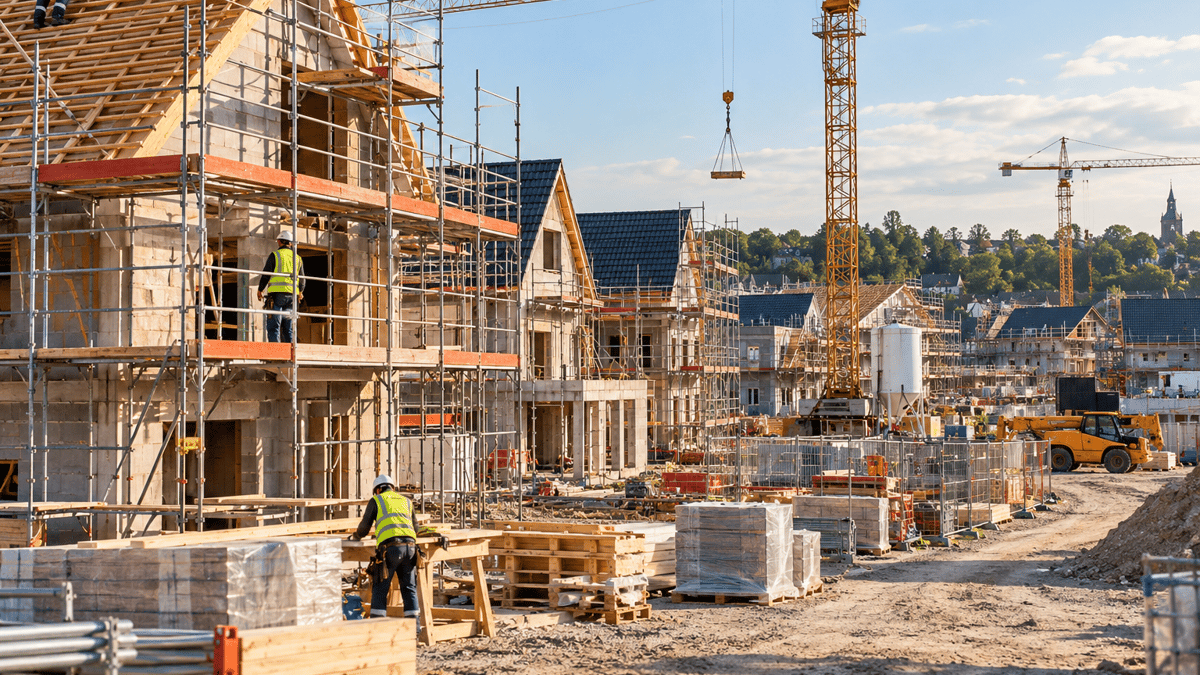 Image-creation R.E.News© via IA chat GPT
Malgré une demande structurelle considérable, la construction résidentielle européenne devra patienter avant de retrouver une croissance soutenue. Selon les prévisions de Bain & Company, la reprise complète du logement neuf ne devrait pas se concrétiser avant 2029, freinée par les coûts élevés, les difficultés d’accès au crédit et les incertitudes économiques.
Après plusieurs années difficiles, le secteur européen de la construction s’est stabilisé en 2026. Les investissements publics dans les infrastructures, les centres de données et les projets industriels soutiennent l’activité, mais le redémarrage du logement neuf reste plus lent qu’espéré. La hausse des taux directeurs de la Banque centrale européenne en juin et septembre, conjuguée aux tensions géopolitiques et à l’inflation, continue de peser sur les décisions d’investissement.
Un déficit de logements qui s’aggrave
Le paradoxe est frappant : l’Europe aurait besoin de 650 000 logements supplémentaires par an pendant dix ans, en plus des quelque 1,6 million construits annuellement aujourd’hui. Pourtant, dans plusieurs marchés européens, le prix des logements dépasse six fois le revenu annuel des ménages, limitant leur capacité d’achat et freinant les nouveaux projets.
Pour Marc Jeker, associé chez Bain & Company, la reprise est bien engagée, mais les entreprises doivent se préparer à une progression graduelle plutôt qu’à un redémarrage rapide.
Des trajectoires contrastées selon les marchés
Pays nordiques et Pays-Bas : les perspectives sont favorables, soutenues par les objectifs publics de construction, l’assouplissement des conditions de crédit et les besoins en logements. Dans les pays nordiques, l’activité globale pourrait progresser de 2 à 4 % par an entre 2026 et 2029.
France : la construction résidentielle pourrait enregistrer une croissance annuelle de 3 à 5 % jusqu’en 2029, mais la faiblesse des investissements dans les infrastructures limiterait la progression globale du secteur.
Allemagne : les investissements dans les infrastructures, notamment grâce au fonds spécial de 500 milliards d’euros, devraient soutenir une croissance annuelle de 2 à 4 %. Le logement neuf reste toutefois confronté aux problèmes d’accessibilité financière.
Royaume-Uni : les infrastructures et la rénovation devraient soutenir le marché, tandis que la construction de nouveaux logements resterait peu dynamique jusqu’en 2029.
Italie : la croissance devrait demeurer limitée, entre 0 et 2 % par an, notamment en raison du ralentissement progressif des projets liés au plan national de relance.
Les infrastructures en première ligne
À court terme, les infrastructures, les projets énergétiques, les centres de données et les investissements industriels constituent les principaux moteurs du secteur. Pour les constructeurs de machines, les loueurs et les entreprises de travaux publics, ces marchés offrent des relais de croissance alors que le résidentiel peine à retrouver son rythme.
Le défi européen sera donc double : accélérer la production de logements pour répondre aux besoins des ménages et maintenir les investissements nécessaires à la modernisation des infrastructures. La reprise est amorcée, mais le retour à une véritable dynamique du logement neuf s’annonce progressif, avec 2029 comme horizon de référence dans les prévisions de Bain & Company.
NJC.© Info Marc Jeker, a partner at Bain & Company
--------------------------------------------------------------------------------------------------------------------
28/10/26-English
Construction in Europe: Real Housing Rebound Delayed to 2029
Image-creation R.E.News© via IA chat GPT
Despite considerable structural demand, European residential construction will have to wait before returning to sustained growth. According to forecasts by Bain & Company, a full recovery in new housing is not expected before 2029, hampered by high costs, difficulties in accessing credit, and economic uncertainties.
After several challenging years, the European construction sector stabilized in 2026. Public investment in infrastructure, data centers, and industrial projects is supporting activity, but the recovery in new housing remains slower than expected. The European Central Bank's interest rate hikes in June and September, combined with geopolitical tensions and inflation, continue to weigh on investment decisions.
A Worsening Housing Shortage
The paradox is striking: Europe would need 650,000 additional homes per year for ten years, on top of the approximately 1.6 million built annually today. Yet, in several European markets, housing prices exceed six times household annual income, limiting purchasing power and hindering new projects.
According to Marc Jeker, a partner at Bain & Company, the recovery is well underway, but businesses should prepare for gradual progress rather than a rapid rebound.
Contrasting Trajectories Across Markets
Nordic countries and the Netherlands: the outlook is favorable, supported by public construction targets, easing credit conditions, and housing needs. In the Nordic countries, overall activity could grow by 2% to 4% annually between 2026 and 2029.
France: Residential construction could see annual growth of 3% to 5% until 2029, but weak infrastructure investment would limit the sector's overall growth.
Germany: Infrastructure investment, particularly through the €500 billion special fund, is expected to support annual growth of 2% to 4%. However, new housing continues to face affordability challenges.
United Kingdom: Infrastructure and renovation should support the market, while new housing construction is expected to remain sluggish until 2029.
Italy: Growth is expected to remain limited, between 0% and 2% annually, primarily due to the gradual slowdown of projects related to the national stimulus plan.
Infrastructure at the Forefront
In the short term, infrastructure, energy projects, data centers, and industrial investments are the main drivers of the sector. For machinery manufacturers, rental companies, and public works firms, these markets offer growth opportunities while the residential sector struggles to regain momentum.
The European challenge will therefore be twofold: accelerating housing production to meet household needs and maintaining the investments necessary for infrastructure modernization. The recovery has begun, but the return to a truly dynamic new housing market is expected to be gradual, with 2029 as the benchmark in Bain & Company's forecasts.
NJC.© Info Marc Jeker, a partner at Bain & Company
------------------------------------------------------------------------------------------------------------------------
28/10/26-NL
Bouwsector in Europa: Herstel van de woningmarkt uitgesteld tot 2029
Image-creation R.E.News© via IA chat GPT
Ondanks een aanzienlijke structurele vraag zal de Europese woningbouw nog even moeten wachten op een duurzame groei. Volgens prognoses van Bain & Company wordt een volledig herstel van de nieuwbouw niet vóór 2029 verwacht, belemmerd door hoge kosten, moeilijkheden bij het verkrijgen van krediet en economische onzekerheden.
Na een aantal uitdagende jaren stabiliseerde de Europese bouwsector zich in 2026. Publieke investeringen in infrastructuur, datacenters en industriële projecten ondersteunen de activiteit, maar het herstel van de nieuwbouw blijft trager dan verwacht. De renteverhogingen van de Europese Centrale Bank in juni en september, in combinatie met geopolitieke spanningen en inflatie, blijven de investeringsbeslissingen beïnvloeden.
Een toenemend woningtekort
De paradox is treffend: Europa zou de komende tien jaar jaarlijks 650.000 extra woningen nodig hebben, bovenop de circa 1,6 miljoen die er nu jaarlijks worden gebouwd. Toch liggen de huizenprijzen in verschillende Europese markten hoger dan zes keer het jaarlijkse huishoudinkomen, wat de koopkracht beperkt en nieuwe projecten belemmert.
Volgens Marc Jeker, partner bij Bain & Company, is het herstel al goed op gang, maar bedrijven moeten zich voorbereiden op geleidelijke vooruitgang in plaats van een snelle opleving.
Verschillende ontwikkelingen in de verschillende markten
Noordse landen en Nederland: de vooruitzichten zijn gunstig, ondersteund door publieke bouwdoelstellingen, versoepelende kredietvoorwaarden en de vraag naar woningen. In de Noordse landen zou de totale activiteit tussen 2026 en 2029 jaarlijks met 2% tot 4% kunnen groeien.
Frankrijk: De woningbouw zou tot 2029 een jaarlijkse groei van 3% tot 5% kunnen laten zien, maar zwakke investeringen in infrastructuur zouden de algehele groei van de sector beperken.
Duitsland: Investeringen in infrastructuur, met name via het speciale fonds van € 500 miljard, zullen naar verwachting een jaarlijkse groei van 2% tot 4% ondersteunen. De betaalbaarheid van nieuwe woningen blijft echter een probleem.
Verenigd Koninkrijk: Infrastructuur en renovatie zouden de markt moeten ondersteunen, terwijl de nieuwbouw naar verwachting tot 2029 traag zal blijven.
Italië: De groei zal naar verwachting beperkt blijven, tussen 0% en 2% per jaar, voornamelijk als gevolg van de geleidelijke vertraging van projecten die verband houden met het nationale stimuleringsplan.
Infrastructuur voorop
Op korte termijn zijn infrastructuur, energieprojecten, datacenters en industriële investeringen de belangrijkste drijfveren van de sector. Voor machinefabrikanten, verhuurbedrijven en openbare werken bieden deze markten groeimogelijkheden, terwijl de woningbouwsector moeite heeft om weer op gang te komen.
De Europese uitdaging zal daarom tweeledig zijn: de woningproductie versnellen om aan de behoeften van huishoudens te voldoen en de noodzakelijke investeringen voor de modernisering van de infrastructuur handhaven. Het herstel is ingezet, maar de terugkeer naar een echt dynamische nieuwbouwmarkt zal naar verwachting geleidelijk verlopen, met 2029 als referentiepunt in de prognoses van Bain & Company.
NJC.© Info Marc Jeker, partner bij Bain & Company
------------------------------------------------------------------------------------------------------------------
Date de dernière mise à jour : 27/10/2026