



R.E.News future Technology-NEURA Robotics Brings Touch, Sound and Memory to Physical AI
 09/11/26-FR-English-NL-footer
NEURA Robotics : des robots capables de voir, toucher, entendre et mémoriser pour révolutionner l'industrie
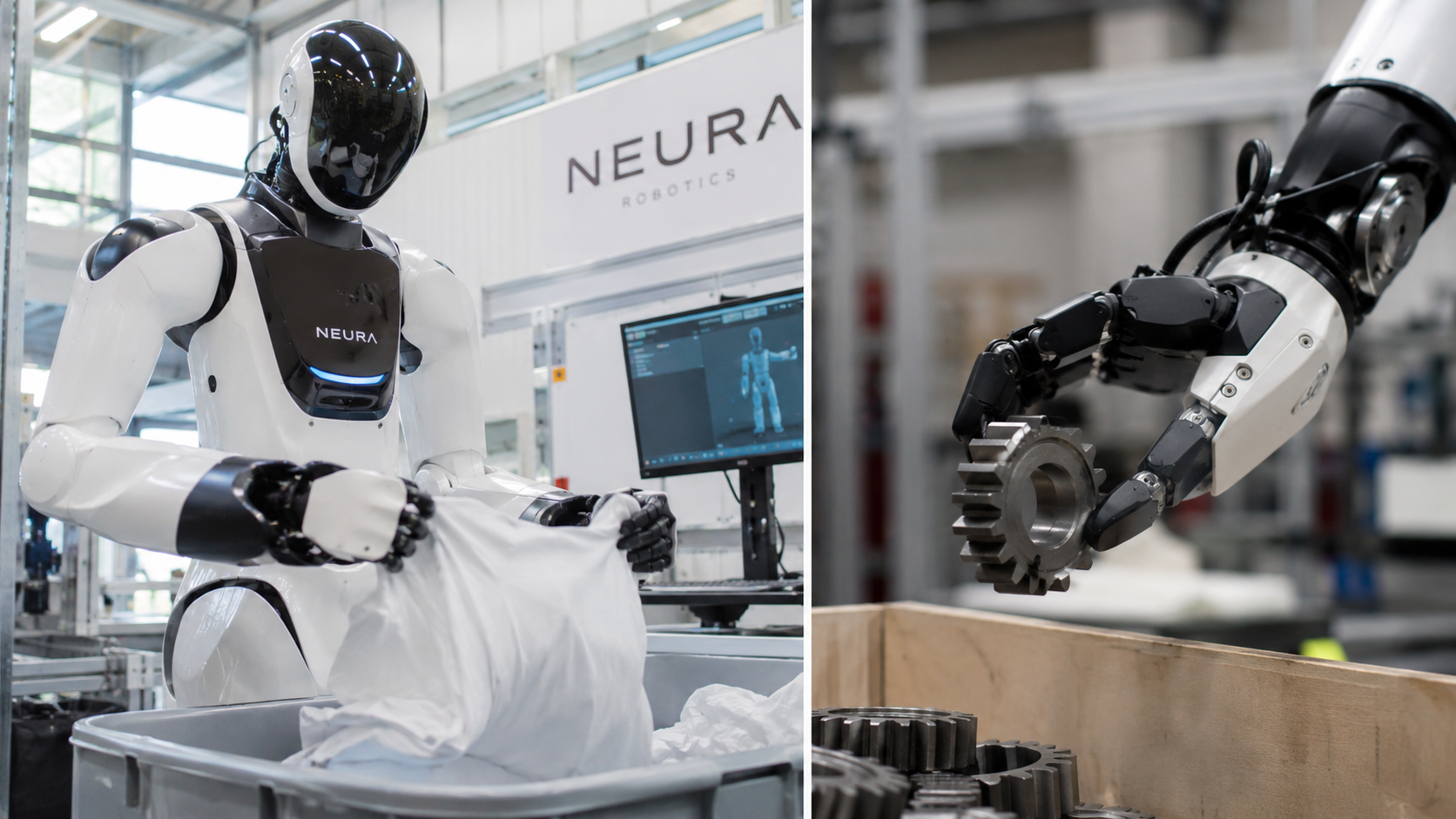 Image-creation R.E.News© via IA chat GPT
Et si les robots de demain ne se contentaient plus de regarder leur environnement, mais pouvaient également ressentir le contact, reconnaître un bruit, mémoriser leurs gestes et apprendre de leurs erreurs ? C'est l'ambition de NEURA Robotics avec Neuron AI, une nouvelle intelligence artificielle conçue pour rapprocher les machines des capacités d'adaptation humaines.
Dans un atelier industriel, un robot peut parfaitement reconnaître une pièce grâce à ses caméras. Mais sait-il réellement si celle-ci est correctement assemblée ? Peut-il détecter qu'un connecteur est verrouillé, comprendre qu'un objet lui a échappé ou retrouver un élément momentanément dissimulé derrière un autre ?
C'est précisément à ces défis que s'attaque le constructeur allemand NEURA Robotics, avec Neuron AI, un modèle d'intelligence artificielle développé à son siège de Metzingen, en Allemagne.
Son ambition : donner aux robots une perception beaucoup plus complète de leur environnement en associant vision, toucher, force, audition, mouvement et mémoire au sein d'un même système intelligent.
Une nouvelle génération de perception robotique
Baptisée Perception-Language-Action (PLA), l'architecture de Neuron AI combine différentes sources d'informations pour permettre au robot de comprendre une situation avant d'agir.
Les caméras analysent l'environnement en trois dimensions, tandis que les capteurs tactiles et de force renseignent la machine sur les contacts et les résistances rencontrées. Les informations sonores et les données relatives aux mouvements complètent cette perception.
Concrètement, lors d'une opération d'assemblage, le robot ne se contente plus de vérifier visuellement la position d'une pièce. Il peut également exploiter la résistance ressentie pendant son insertion ou les informations acoustiques produites pendant l'opération.
Cette approche pourrait améliorer considérablement les opérations de montage, de manipulation, de soudage et de maintenance industrielle.
La mémoire : ne plus perdre le fil d'une opération
L'une des particularités de Neuron AI réside dans sa capacité à conserver des informations sur les objets et les actions précédentes.
Un robot qui dépose une pièce dans un conteneur doit pouvoir continuer son travail même lorsque celle-ci disparaît de son champ de vision. Il doit également savoir si l'objet a glissé, changé de position ou si l'opération s'est réellement déroulée comme prévu.
Cette mémoire permettrait de mieux coordonner les différentes étapes d'un travail et d'adapter les mouvements en fonction des événements rencontrés.
Pour David Reger, fondateur et CEO de NEURA Robotics, l'objectif est de développer un véritable cerveau pour le monde physique, capable de transformer l'expérience et les connaissances humaines en compétences que les robots pourront apprendre et réutiliser.
Cinq plateformes robotiques pour apprendre ensemble
NEURA développe Neuron AI à partir de trois sources complémentaires : les opérations réalisées par de véritables robots, les environnements de simulation et les démonstrations effectuées par des humains équipés de combinaisons à capteurs.
Les données recueillies dans les centres d'entraînement NEURA Gyms permettent d'analyser les interactions physiques et d'améliorer progressivement les capacités du système.
Le constructeur souhaite déployer cette intelligence sur cinq configurations robotiques différentes, équipées de mains et de systèmes de préhension variés.
L'objectif est ambitieux : permettre à un robot d'acquérir une compétence et de pouvoir la transférer, avec les adaptations nécessaires, vers une autre plateforme.
Neuraverse : une intelligence distribuée dans les flottes
Pour accompagner cette évolution, NEURA a développé Neuraverse, une plateforme destinée au déploiement, à la mise à jour et à l'amélioration des capacités robotiques.
Les entreprises pourront adapter les compétences des robots à leurs propres opérations et conserver certaines applications en environnement privé, ou partager leurs développements pour contribuer à l'évolution du système.
Autre élément important : Neuron AI est conçu pour effectuer ses calculs directement sur le robot, sans nécessiter une connexion permanente au cloud. Cette approche réduit la dépendance aux réseaux extérieurs et peut limiter les délais de communication.
Une démonstration spectaculaire avec le robot humanoïde 4NE1
Lors du salon NVIDIA GTC Berlin 2026, organisé du 20 au 22 octobre à Station-Berlin, NEURA avait annoncé une démonstration de son robot humanoïde 4NE1.
Le scénario prévu consistait à réaliser une opération complète de traitement du linge pendant onze minutes sans intervention humaine : trier les vêtements, charger une machine à laver, fermer puis rouvrir le hublot, décharger le linge et transférer les articles dans un sèche-linge.
Un exercice particulièrement intéressant, car manipuler du tissu représente une difficulté importante pour la robotique : les matériaux sont souples, se déforment et changent constamment de position.
Cette démonstration devait illustrer la capacité de Neuron AI à coordonner perception, mémoire, planification et mouvements successifs.
Vers une nouvelle génération de machines industrielles
Pour l'industrie, l'intérêt de cette technologie dépasse largement la seule robotique humanoïde. La possibilité d'apprendre de nouvelles opérations avec moins de programmation pourrait ouvrir la voie à une automatisation plus flexible, notamment dans les productions où les tâches changent fréquemment.
Dans le secteur des équipements de construction, ces avancées pourraient également présenter un intérêt à terme pour la manutention, l'assemblage mécanique, l'entretien des machines et certaines opérations complexes réalisées dans des environnements variables.
NEURA n'annonce toutefois pas encore de déploiement spécifique de Neuron AI sur les chantiers.
Le véritable défi reste désormais de démontrer la fiabilité de cette intelligence dans des conditions industrielles réelles, avec des résultats mesurables en matière de productivité, de précision et de temps d'apprentissage.
Une chose devient évidente : le robot industriel de demain ne sera peut-être plus simplement une machine programmée pour répéter un mouvement. Il pourra observer, ressentir, mémoriser et apprendre de son expérience. Avec Neuron AI, NEURA Robotics entend franchir une nouvelle étape vers cette robotique intelligente et adaptable.
NJC.© Info https://neura-robotics.com/
----------------------------------------------------------------------------------------------------------
09/11/26-English
NEURA Robotics: Robots Capable of Seeing, Touching, Hearing, and Remembering to Revolutionize Industry
Image-creation R.E.News© via IA chat GPT
What if tomorrow's robots could do more than just observe their surroundings, but could also sense touch, recognize sounds, remember their movements, and learn from their mistakes? This is the ambition of NEURA Robotics with Neuron AI, a new artificial intelligence designed to bring machines closer to human adaptive capabilities.
In an industrial workshop, a robot can perfectly recognize a part thanks to its cameras. But does it really know if it's correctly assembled? Can it detect that a connector is locked, understand that an object has slipped from its grasp, or find an element temporarily hidden behind another?
It is precisely these challenges that the German manufacturer NEURA Robotics is tackling with Neuron AI, an artificial intelligence model developed at its headquarters in Metzingen, Germany.
Its ambition: to give robots a much more complete perception of their environment by combining vision, touch, force, hearing, movement, and memory within a single intelligent system.
A new generation of robotic perception
Dubbed Perception-Language-Action (PLA), Neuron AI's architecture combines different sources of information to allow the robot to understand a situation before acting.
Cameras analyze the environment in three dimensions, while touch and force sensors inform the machine about the contacts and resistances encountered. Auditory information and movement data complete this perception.
In practical terms, during an assembly operation, the robot no longer simply verifies the position of a part visually. It can also utilize the resistance felt during insertion or the acoustic information produced during the operation.
This approach could significantly improve assembly, handling, welding, and industrial maintenance operations.
Memory: Never Lose Track of an Operation
One of Neuron AI's key features is its ability to retain information about previous objects and actions.
A robot that places a part into a container must be able to continue its work even when the part disappears from its field of vision. It must also know if the object has slipped, changed position, or if the operation actually proceeded as planned.
This memory would allow for better coordination of the different stages of a task and for adapting movements based on encountered events.
For David Reger, founder and CEO of NEURA Robotics, the goal is to develop a true brain for the physical world, capable of transforming human experience and knowledge into skills that robots can learn and reuse.
Five Robotic Platforms for Learning Together
NEURA develops Neuron AI using three complementary sources: operations performed by real robots, simulation environments, and demonstrations conducted by humans wearing sensor suits.
The data collected in NEURA Gyms training centers allows for the analysis of physical interactions and the progressive improvement of the system's capabilities.
The manufacturer plans to deploy this intelligence across five different robotic configurations, equipped with various hands and gripping systems.
The objective is ambitious: to enable a robot to acquire a skill and transfer it, with the necessary adaptations, to another platform.
Neuraverse: Distributed Intelligence Across Fleets
To support this evolution, NEURA has developed Neuraverse, a platform designed for the deployment, updating, and improvement of robotic capabilities.
Companies will be able to adapt the robots' skills to their own operations and keep certain applications in a private environment, or share their developments to contribute to the system's evolution.
Another important element: Neuron AI is designed to perform its calculations directly on the robot, without requiring a permanent connection to the cloud. This approach reduces reliance on external networks and can minimize communication delays. A spectacular demonstration with the 4NE1 humanoid robot
At NVIDIA GTC Berlin 2026, held from October 20 to 22 at Station Berlin, NEURA announced a demonstration of its 4NE1 humanoid robot.
The planned scenario involved performing a complete laundry processing operation in eleven minutes without human intervention: sorting clothes, loading a washing machine, closing and reopening the door, unloading the laundry, and transferring the items to a dryer.
This exercise was particularly interesting because manipulating fabric presents a significant challenge for robotics: the materials are flexible, deformable, and constantly change position.
This demonstration was designed to illustrate Neuron AI's ability to coordinate perception, memory, planning, and successive movements.
Toward a New Generation of Industrial Machines
For industry, the benefits of this technology extend far beyond humanoid robotics. The ability to learn new operations with less programming could pave the way for more flexible automation, particularly in production processes where tasks change frequently.
In the construction equipment sector, these advancements could also be beneficial in the long term for handling, mechanical assembly, machine maintenance, and certain complex operations performed in varying environments.
However, NEURA has not yet announced any specific deployments of Neuron AI on construction sites.
The real challenge now lies in demonstrating the reliability of this intelligence under real-world industrial conditions, with measurable results in terms of productivity, accuracy, and learning time.
One thing is becoming clear: the industrial robot of tomorrow may no longer be simply a machine programmed to repeat a movement. It will be able to observe, sense, memorize, and learn from experience. With Neuron AI, NEURA Robotics intends to take a new step toward this intelligent and adaptable robotics.
NJC.© Info https://neura-robotics.com/
-------------------------------------------------------------------------------------------------------------------
09/11/26-NL
NEURA Robotics: Robots die kunnen zien, voelen, horen en onthouden – een revolutie voor de industrie
Image-creation R.E.News© via IA chat GPT
Wat als de robots van morgen meer zouden kunnen dan alleen hun omgeving observeren, maar ook aanraking zouden kunnen voelen, geluiden zouden kunnen herkennen, hun bewegingen zouden kunnen onthouden en van hun fouten zouden kunnen leren? Dat is de ambitie van NEURA Robotics met Neuron AI, een nieuwe kunstmatige intelligentie die is ontworpen om machines dichter bij de menselijke aanpassingsvermogens te brengen.
In een industriële werkplaats kan een robot dankzij zijn camera's een onderdeel perfect herkennen. Maar weet hij ook echt of het correct is gemonteerd? Kan hij detecteren dat een connector vastzit, begrijpen dat een object uit zijn greep is geglipt of een onderdeel vinden dat tijdelijk achter een ander verborgen zit?
Precies deze uitdagingen pakt de Duitse fabrikant NEURA Robotics aan met Neuron AI, een model voor kunstmatige intelligentie dat is ontwikkeld op het hoofdkantoor in Metzingen, Duitsland.
De ambitie: robots een veel completere perceptie van hun omgeving geven door zicht, aanraking, kracht, gehoor, beweging en geheugen te combineren in één intelligent systeem.
Een nieuwe generatie robotperceptie
De architectuur van Neuron AI, genaamd Perception-Language-Action (PLA), combineert verschillende informatiebronnen waardoor de robot een situatie kan begrijpen voordat hij actie onderneemt.
Camera's analyseren de omgeving in drie dimensies, terwijl aanraak- en krachtsensoren de machine informeren over de contacten en weerstanden die worden ondervonden. Auditieve informatie en bewegingsgegevens completeren deze perceptie.
In de praktijk betekent dit dat de robot tijdens een assemblageproces niet langer alleen de positie van een onderdeel visueel controleert. Hij kan ook gebruikmaken van de weerstand die hij voelt tijdens het inbrengen of de akoestische informatie die tijdens de bewerking wordt geproduceerd.
Deze aanpak zou assemblage-, handling-, las- en industriële onderhoudswerkzaamheden aanzienlijk kunnen verbeteren.
Geheugen: Nooit meer een bewerking kwijtraken
Een van de belangrijkste kenmerken van Neuron AI is het vermogen om informatie over eerdere objecten en acties te onthouden.
Een robot die een onderdeel in een container plaatst, moet zijn werk kunnen voortzetten, zelfs als het onderdeel uit zijn gezichtsveld verdwijnt. Hij moet ook weten of het object is verschoven, van positie is veranderd of dat de bewerking daadwerkelijk volgens plan is verlopen.
Dit geheugen zou een betere coördinatie van de verschillende fasen van een taak mogelijk maken en bewegingen aanpassen op basis van waargenomen gebeurtenissen.
Voor David Reger, oprichter en CEO van NEURA Robotics, is het doel om een echt brein voor de fysieke wereld te ontwikkelen, dat in staat is menselijke ervaring en kennis om te zetten in vaardigheden die robots kunnen leren en hergebruiken.
Vijf robotplatforms voor gezamenlijk leren
NEURA ontwikkelt Neuron AI met behulp van drie complementaire bronnen: handelingen uitgevoerd door echte robots, simulatieomgevingen en demonstraties uitgevoerd door mensen in sensorpakken.
De gegevens die worden verzameld in de NEURA Gyms-trainingscentra maken de analyse van fysieke interacties en de geleidelijke verbetering van de mogelijkheden van het systeem mogelijk.
De fabrikant is van plan deze intelligentie in te zetten op vijf verschillende robotconfiguraties, uitgerust met diverse handen en grijpsystemen.
Het doel is ambitieus: een robot in staat stellen een vaardigheid te verwerven en deze, met de nodige aanpassingen, over te dragen naar een ander platform.
Neuraverse: Gedistribueerde intelligentie voor hele vloten
Om deze evolutie te ondersteunen, heeft NEURA Neuraverse ontwikkeld, een platform dat is ontworpen voor de implementatie, updates en verbetering van robotcapaciteiten.
Bedrijven kunnen de vaardigheden van de robots aanpassen aan hun eigen bedrijfsvoering en bepaalde applicaties in een privéomgeving houden, of hun ontwikkelingen delen om bij te dragen aan de evolutie van het systeem.
Een ander belangrijk element: Neuron AI is ontworpen om zijn berekeningen direct op de robot uit te voeren, zonder een permanente verbinding met de cloud. Deze aanpak vermindert de afhankelijkheid van externe netwerken en kan communicatievertragingen minimaliseren. Een spectaculaire demonstratie met de humanoïde robot 4NE1
Tijdens NVIDIA GTC Berlin 2026, dat van 20 tot en met 22 oktober plaatsvond in Station Berlin, kondigde NEURA een demonstratie aan van zijn humanoïde robot 4NE1.
Het geplande scenario omvatte het uitvoeren van een complete wasverwerking in elf minuten zonder menselijke tussenkomst: kleding sorteren, een wasmachine vullen, de deur openen en sluiten, de was uitladen en de kleding in een droger plaatsen.
Deze oefening was bijzonder interessant omdat het manipuleren van textiel een aanzienlijke uitdaging vormt voor robotica: de materialen zijn flexibel, vervormbaar en veranderen voortdurend van positie.
Deze demonstratie was bedoeld om het vermogen van Neuron AI te illustreren om perceptie, geheugen, planning en opeenvolgende bewegingen te coördineren.
Op weg naar een nieuwe generatie industriële machines
Voor de industrie reiken de voordelen van deze technologie veel verder dan humanoïde robotica. Het vermogen om nieuwe handelingen te leren met minder programmering zou de weg kunnen vrijmaken voor flexibelere automatisering, met name in productieprocessen waar taken frequent veranderen.
In de sector van bouwmachines zouden deze ontwikkelingen op de lange termijn ook voordelen kunnen opleveren voor handling, mechanische assemblage, machineonderhoud en bepaalde complexe handelingen die in uiteenlopende omgevingen worden uitgevoerd.
NEURA heeft echter nog geen specifieke implementaties van Neuron AI op bouwplaatsen aangekondigd.
De echte uitdaging ligt nu in het aantonen van de betrouwbaarheid van deze intelligentie onder realistische industriële omstandigheden, met meetbare resultaten op het gebied van productiviteit, nauwkeurigheid en leertijd.
Eén ding wordt steeds duidelijker: de industriële robot van de toekomst zal wellicht niet langer simpelweg een machine zijn die geprogrammeerd is om een beweging te herhalen. Hij zal in staat zijn om te observeren, te voelen, te onthouden en te leren van ervaringen. Met Neuron AI wil NEURA Robotics een nieuwe stap zetten richting deze intelligente en aanpasbare robotica.
NJC.© Info https://neura-robotics.com/
-----------------------------------------------------------------------------------------------------------------
Date de dernière mise à jour : 06/11/2026