



R.E.News International-The Deba Bridge and the Quiet Rise of Ephemeral Engineering in Europe
 26/11/26-FR-English-NL-footer
PONT DE DEBA : L’INGÉNIERIE SUSPENDUE AU-DESSUS DU VIDE POUR SAUVER UN PATRIMOINE HISTORIQUE
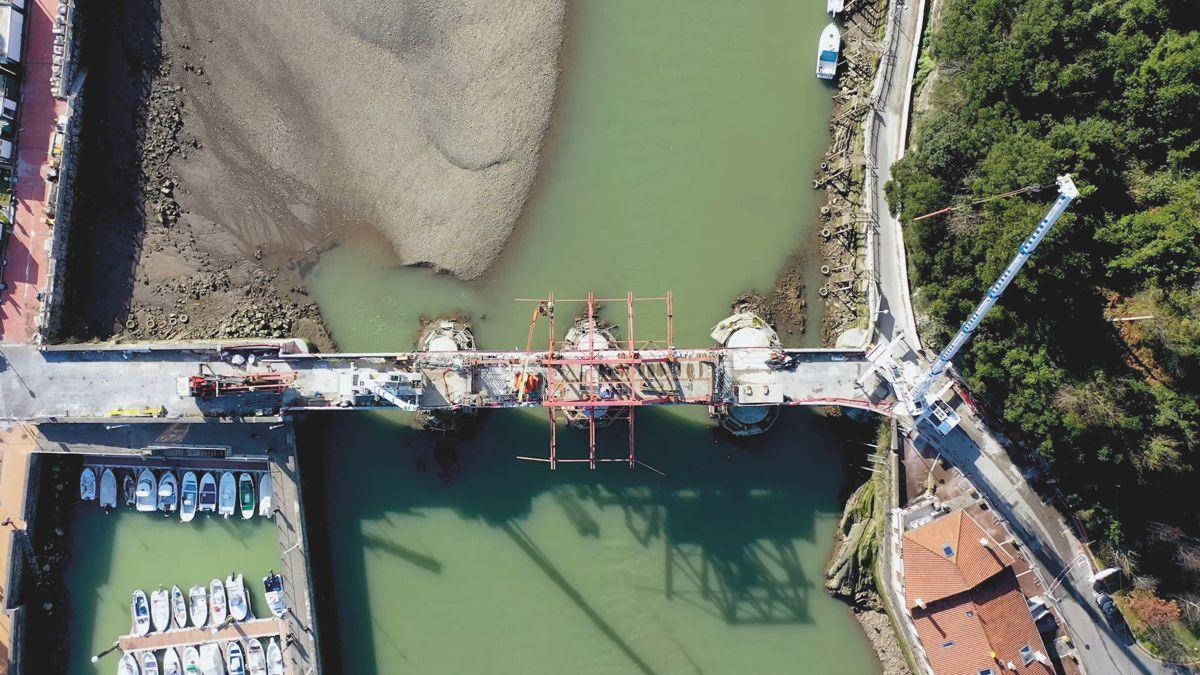
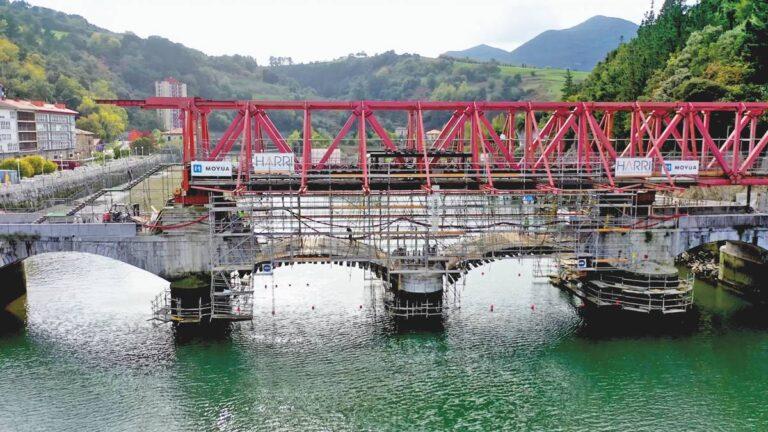
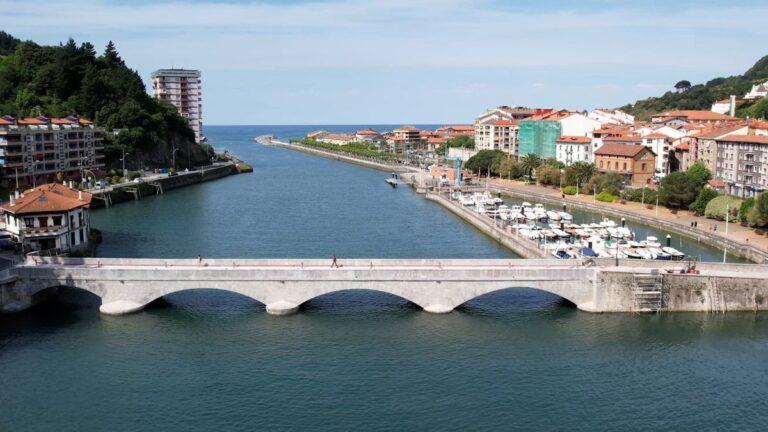 Image- ULMA Construction
Comment reconstruire un pont de pierre vieux de 160 ans sans détruire son authenticité, ni intervenir sous ses arches ? Au Pays basque espagnol, la restauration du pont de Deba-Mutriku apporte une réponse spectaculaire. Grâce à une structure de soutènement auto-lançable conçue par ULMA Construction, les ingénieurs ont littéralement suspendu le pont pour reconstruire ses arches endommagées. Une prouesse technique qui illustre le rôle croissant des équipements temporaires dans la rénovation des infrastructures européennes.
Récompensé par Europa Nostra en 2023, ce chantier démontre également comment l'ingénierie moderne peut préserver des ouvrages historiques tout en répondant aux exigences actuelles de sécurité et de durabilité.
Un pont historique au bord de l'effondrement
Construit en 1866 sur le chemin de Saint-Jacques-de-Compostelle, le pont de Deba-Mutriku a frôlé la catastrophe le 5 juillet 2018. Le deuxième pilier s'est affaissé et incliné de près de 70 cm, provoquant la rupture de deux arches.
À l'origine du problème : les fondations sur pieux en bois avaient été progressivement détruites par des mollusques marins xylophages. Privé de son appui, le pilier ne pouvait plus supporter correctement les charges de la maçonnerie.
La restauration devait donc relever un double défi : sécuriser la structure et conserver au maximum son apparence et ses matériaux d'origine.
ULMA imagine une solution spectaculaire : suspendre le pont
Les conditions du site rendaient impossible l'installation d'un étaiement traditionnel sous les arches. Le canal soumis aux marées présentait une variation de niveau d'environ quatre mètres, tandis que le sol meuble et les restrictions d'intervention interdisaient les travaux sous l'ouvrage.
ULMA Construction a alors développé une solution inversant le principe habituel du soutènement : au lieu de soutenir le pont par-dessous, il fallait le suspendre par-dessus.
Le système auto-lançable lourd CA55 a été installé au-dessus du tablier et ancré sur des piliers renforcés par des micropieux. Des panneaux de coffrage modulaires ont ensuite été suspendus à l'aide de barres Dywidag disposées radialement pour épouser la géométrie des arches.
Chaque barre pouvait être mise en tension indépendamment, permettant de transférer progressivement et avec précision le poids de la structure vers le dispositif temporaire.
Cette configuration a permis de démonter et reconstruire les parties endommagées dans des conditions de sécurité maîtrisées, sans installer de support dans le chenal.
Des équipements spécialisés pour travailler au-dessus de l'eau
La mise en œuvre du dispositif a nécessité une logistique particulièrement élaborée. Les panneaux de coffrage ont été préassemblés sur une plateforme portuaire voisine, puis transportés par barges avant leur positionnement à l'aide de moyens de levage adaptés et d'une grue spécialement conçue pour l'opération.
Une plateforme de travail BRIO a également permis de créer un environnement protégé sous les arches, facilitant les interventions des équipes.
L'ensemble illustre les possibilités offertes par les systèmes de coffrage, d'étaiement et de plateformes modulaires lorsqu'ils sont adaptés à des configurations complexes.
1 200 blocs de pierre démontés et réinstallés
La prouesse technique ne concernait pas uniquement le soutènement. La restauration devait également respecter l'architecture originale du pont.
Environ 1 200 blocs de calcaire ont été démontés, répertoriés et numérotés individuellement avant d'être replacés à leur position initiale. Près de 90 % des pierres d'origine ont ainsi été réutilisées.
Les ingénieurs ont étudié les techniques de construction du XIXe siècle pour reconstruire les arches pierre après pierre, tout en corrigeant les déformations accumulées au fil du temps.
Cette démarche a permis de préserver l'apparence historique de l'ouvrage, tout en limitant les matériaux neufs, les déchets et l'impact environnemental.
En novembre 2021, le pont avait retrouvé sa capacité à supporter son propre poids. Le système de soutènement a ensuite été démonté progressivement et de manière symétrique afin de répartir les charges.
Un avertissement pour les infrastructures européennes
Au-delà de cette restauration remarquable, le chantier de Deba met en lumière un enjeu majeur : le vieillissement des ponts européens.
Selon les chiffres présentés lors de la conférence Eurobridge 2026 à Bruxelles, la valeur cumulée du patrimoine européen de ponts avoisinerait 2 000 milliards d'euros. Environ 10 % des ouvrages seraient considérés comme présentant des déficiences importantes.
Les ponts en maçonnerie, souvent centenaires et parfois protégés, ne peuvent pas toujours être remplacés par des constructions neuves. Leur conservation nécessite des techniques spécifiques, une surveillance des fondations et des méthodes d'intervention adaptées.
Le cas de Deba rappelle également les risques liés à la dégradation biologique des fondations en bois immergées, un phénomène susceptible de s'étendre avec l'évolution des températures des eaux côtières.
L'ingénierie temporaire, un marché stratégique
Cette réalisation confirme que les structures temporaires ne sont plus de simples équipements annexes sur les grands chantiers. Elles peuvent devenir l'élément déterminant de la réussite d'une opération de restauration.
Pour des spécialistes comme ULMA Construction, les systèmes de coffrage, les structures auto-lançables et les plateformes modulaires représentent des solutions à fort potentiel dans un marché européen de la rénovation des infrastructures appelé à se développer.
Le pont de Deba démontre qu'il est possible de sauver un ouvrage historique en mobilisant les technologies les plus modernes, sans effacer les traces de son histoire. Une véritable leçon d'ingénierie où l'innovation ne consiste pas à remplacer l'ancien, mais à lui donner les moyens de traverser encore plusieurs générations.
NJC.©Info ULMA Construction
----------------------------------------------------------------------------------------------------------------
26/11/26-English
THE DEBA BRIDGE: ENGINEERING SUSPENDED OVER THE VOID TO SAVE HISTORIC HERITAGE
Image- ULMA Construction
How can a 160-year-old stone bridge be reconstructed without destroying its authenticity or requiring intervention beneath its arches? In the Spanish Basque Country, the restoration of the Deba-Mutriku bridge offers a spectacular solution. Using a self-launching support structure designed by ULMA Construction, engineers literally suspended the bridge in order to rebuild its damaged arches. This technical feat illustrates the growing role of temporary equipment in the renovation of European infrastructure.
Recognized by Europa Nostra in 2023, this project also demonstrates how modern engineering can preserve historic structures while meeting contemporary safety and sustainability requirements.
A historic bridge on the verge of collapse
Built in 1866 along the Camino de Santiago (the Way of St. James), the Deba-Mutriku bridge narrowly avoided catastrophe on July 5, 2018. Its second pier subsided and tilted by nearly 70 cm, causing two of the arches to collapse.
The root cause: the wooden pile foundations had been gradually destroyed by wood-boring marine mollusks. Deprived of its support, the pier could no longer adequately bear the weight of the masonry.
The restoration project therefore faced a dual challenge: to secure the structure while preserving its original appearance and materials as much as possible.
ULMA devises a spectacular solution: suspending the bridge
Site conditions made it impossible to install traditional shoring beneath the arches. The tidal canal experienced water-level fluctuations of approximately four meters, while the soft ground and restrictions on working beneath the structure ruled out any support from below.
ULMA Construction developed a solution that inverted the conventional shoring principle: instead of supporting the bridge from underneath, it would be suspended from above.
The heavy-duty CA55 self-launching system was installed above the bridge deck and anchored to piers reinforced with micropiles. Modular formwork panels were then suspended using Dywidag bars, arranged radially to match the geometry of the arches.
Each bar could be tensioned independently, allowing the weight of the structure to be transferred gradually and precisely onto the temporary support system.
This configuration enabled the damaged sections to be dismantled and reconstructed under controlled, safe conditions, without the need for any supports within the canal itself.
Specialized equipment for working over water
Implementing this system required highly sophisticated logistics. The formwork panels were pre-assembled at a nearby port facility, transported by barge, and then positioned using specialized lifting equipment—including a crane designed specifically for this operation.
A BRIO work platform was also used to create a protected environment beneath the arches, facilitating access for the work crews.
This project demonstrates the potential of modular formwork, shoring, and platform systems when adapted to complex site conditions.
1,200 stone blocks dismantled and reinstalled
The technical achievement extended beyond the shoring system; the restoration also had to remain faithful to the bridge’s original architecture. Approximately 1,200 limestone blocks were dismantled, cataloged, and individually numbered before being returned to their original positions. In this way, nearly 90% of the original stones were reused.
Engineers studied 19th-century construction techniques to rebuild the arches stone by stone, while simultaneously correcting deformations that had accumulated over time.
This approach helped preserve the structure's historical appearance while minimizing the need for new materials, reducing waste, and lowering the environmental impact.
By November 2021, the bridge had regained the capacity to support its own weight. The supporting system was then dismantled gradually and symmetrically to ensure an even distribution of loads.
A warning for European infrastructure
Beyond this remarkable restoration, the Deba project highlights a major issue: the aging of Europe’s bridges.
According to figures presented at the Eurobridge 2026 conference in Brussels, the cumulative value of Europe’s bridge infrastructure is estimated at around €2 trillion. Approximately 10% of these structures are considered to have significant deficiencies.
Masonry bridges—often centuries old and sometimes protected as heritage sites—cannot always be replaced with new structures. Their preservation requires specialized techniques, the monitoring of foundations, and tailored intervention methods.
The case of Deba also highlights the risks associated with the biological degradation of submerged timber foundations—a phenomenon likely to spread as coastal water temperatures evolve.
Temporary engineering: a strategic market
This project confirms that temporary structures are no longer merely auxiliary equipment on large-scale construction sites; they can, in fact, be the decisive factor in the success of a restoration operation.
For specialists like ULMA Construction, formwork systems, self-launching structures, and modular platforms represent high-potential solutions within a European infrastructure renovation market that is poised for growth.
The Deba bridge demonstrates that it is possible to save a historic structure by leveraging state-of-the-art technology, all while preserving the traces of its past. It serves as a true lesson in engineering: innovation here is not about replacing the old, but rather providing it with the means to endure for generations to come.
NJC.©Info ULMA Construction
--------------------------------------------------------------------------------------------------------------
26/11/26-NL
DEBA-BRUG: TECHNIEK BOVEN DE LEEGTE OM EEN HISTORISCH ERFGOED TE REDDEN
Image- ULMA Construction
Hoe herbouw je een 160 jaar oude stenen brug zonder de authenticiteit ervan aan te tasten of onder de bogen in te grijpen? In het Spaanse Baskenland biedt de restauratie van de Deba-Mutriku-brug een spectaculair antwoord. Dankzij een zelfdragende ondersteuningsconstructie, ontworpen door ULMA Construction, hebben ingenieurs de brug letterlijk opgehangen om de beschadigde bogen te herbouwen. Deze technische prestatie illustreert de groeiende rol van tijdelijke constructies bij de renovatie van Europese infrastructuur.
Dit project, dat in 2023 door Europa Nostra werd bekroond, laat ook zien hoe moderne techniek historische structuren kan behouden en tegelijkertijd kan voldoen aan de huidige eisen op het gebied van veiligheid en duurzaamheid.
Een historische brug op instorten
De Deba-Mutriku-brug, gebouwd in 1866 op de Camino de Santiago (pelgrimsroute naar Santiago de Compostela), ontsnapte op 5 juli 2018 ternauwernood aan een ramp. De tweede pijler stortte in en helde bijna 70 cm over, waardoor twee bogen braken.
De oorzaak: de houten fundering was geleidelijk aangetast door houtborende weekdieren. Zonder ondersteuning kon de pijler het gewicht van het metselwerk niet langer dragen.
De restauratie stond daarom voor een dubbele uitdaging: de constructie beveiligen en tegelijkertijd zoveel mogelijk van het oorspronkelijke uiterlijk en de gebruikte materialen behouden.
ULMA bedacht een spectaculaire oplossing: de brug ophangen.
De omstandigheden ter plaatse maakten het onmogelijk om traditionele stutten onder de bogen te plaatsen. Het getijdenkanaal kende een waterpeilverschil van ongeveer vier meter, terwijl de zachte grond en werkbeperkingen werkzaamheden onder de constructie onmogelijk maakten.
ULMA Construction ontwikkelde vervolgens een oplossing die het gebruikelijke ondersteuningsprincipe omkeerde: in plaats van de brug van onderaf te ondersteunen, moest deze van bovenaf worden opgehangen.
Het zware zelflancerende CA55-systeem werd boven het brugdek geïnstalleerd en verankerd aan pijlers die waren versterkt met micropalen. Modulaire bekistingspanelen werden vervolgens opgehangen met behulp van Dywidag-staven die radiaal waren geplaatst om de geometrie van de bogen te volgen.
Elke staaf kon onafhankelijk worden gespannen, waardoor het gewicht van de constructie geleidelijk en nauwkeurig naar het tijdelijke systeem kon worden overgebracht.
Deze configuratie maakte het mogelijk om de beschadigde delen onder gecontroleerde, veilige omstandigheden te demonteren en opnieuw op te bouwen, zonder ondersteuningen in het kanaal te hoeven plaatsen.
Gespecialiseerde apparatuur voor werken boven water
De implementatie van het systeem vereiste bijzonder geavanceerde logistiek. De bekistingspanelen werden vooraf gemonteerd op een nabijgelegen havenplatform, vervolgens per binnenschip vervoerd en daarna gepositioneerd met behulp van geschikte hijsapparatuur en een speciaal voor deze operatie ontworpen kraan.
Een BRIO-werkplatform creëerde bovendien een beschermde omgeving onder de bogen, wat het werk van de teams vergemakkelijkte.
Dit project illustreert de mogelijkheden die modulaire bekistings-, stut- en platformsystemen bieden wanneer ze worden aangepast aan complexe configuraties.
1200 stenen blokken gedemonteerd en opnieuw geplaatst
De technische prestatie omvatte meer dan alleen de draagconstructie. De restauratie moest ook de oorspronkelijke architectuur van de brug respecteren.
Ongeveer 1200 kalkstenen blokken werden gedemonteerd, gecatalogiseerd en individueel genummerd voordat ze op hun oorspronkelijke plaatsen werden teruggeplaatst. Bijna 90% van de originele stenen werd hergebruikt.
Ingenieurs bestudeerden 19e-eeuwse bouwtechnieken om de bogen steen voor steen te herbouwen, terwijl ze de vervormingen die zich in de loop der tijd hadden opgebouwd, corrigeerden.
Deze aanpak behield het historische uiterlijk van de constructie en minimaliseerde tegelijkertijd het gebruik van nieuwe materialen, afval en de impact op het milieu.
In november 2021 kon de brug zijn eigen gewicht weer dragen. Het ondersteuningssysteem werd vervolgens geleidelijk en symmetrisch gedemonteerd om de belasting te verdelen.
Een waarschuwing voor de Europese infrastructuur
Naast deze opmerkelijke restauratie belicht het Deba-project een belangrijk probleem: de veroudering van Europese bruggen.
Volgens cijfers die werden gepresenteerd tijdens de Eurobridge 2026-conferentie in Brussel, wordt de cumulatieve waarde van het Europese bruggenerfgoed geschat op ongeveer € 2 biljoen. Ongeveer 10% van deze constructies vertoont aanzienlijke gebreken.
Metselwerkbruggen, vaak eeuwenoud en soms beschermd, kunnen niet altijd worden vervangen door nieuwbouw. Hun behoud vereist specifieke technieken, funderingsmonitoring en passende interventiemethoden.
De Deba-brug benadrukt ook de risico's die gepaard gaan met de biologische afbraak van onder water staande houten funderingen, een fenomeen dat waarschijnlijk zal verergeren door de stijgende watertemperatuur aan de kust.
Tijdelijke constructies: een strategische markt
Dit project bevestigt dat tijdelijke constructies niet langer slechts bijkomstige apparatuur zijn op grote bouwplaatsen. Ze kunnen de doorslaggevende factor zijn voor het succes van een restauratieproject.
Voor specialisten zoals ULMA Construction vormen bekistingssystemen, zelfdragende constructies en modulaire platforms veelbelovende oplossingen in een groeiende Europese markt voor infrastructuurrenovatie.
De Deba-brug laat zien dat het mogelijk is een historisch bouwwerk te behouden door gebruik te maken van de modernste technologieën, zonder de historische sporen uit te wissen. Het is een ware les in engineering, waarbij innovatie niet schuilt in het vervangen van het oude, maar in het ervoor zorgen dat het generaties lang meegaat.
NJC.©Info ULMA Construction
--------------------------------------------------------------------------------------------------------------
Date de dernière mise à jour : 25/11/2026