


R.E.News International-Michell Excavating turns waste into value with the EvoQuip Caiman 150
 28/10/26-FR-English-NL-footere
EvoQuip Caiman 150 : sur l’île de Vancouver, les déchets deviennent une ressource précieuse
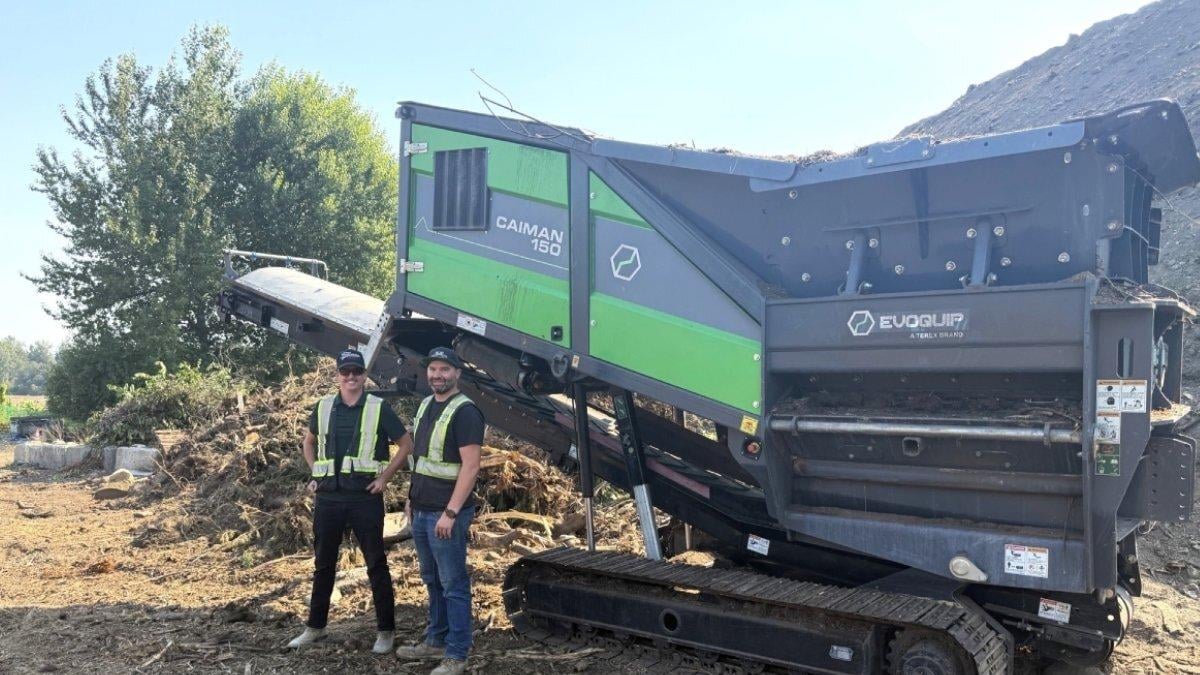 L-R: Jack Foreman, Foreman Equipment and Kyle Michell, Michell Excavating IMAGE SOURCE: EvoQuip
Transformer les déchets en matériaux réutilisables : c’est le pari réussi de Michell Excavating, une entreprise familiale canadienne qui mise sur le broyeur EvoQuip Caiman 150 pour donner une seconde vie au bois, aux déchets verts, au béton et à l’asphalte.
Sur l’île de Vancouver, en Colombie-Britannique, l’histoire de Michell Excavating remonte au XIXe siècle. Plusieurs générations se sont succédé, faisant évoluer une exploitation agricole vers une entreprise spécialisée dans les travaux d’excavation, les granulats, le compost et les amendements de sols.
Face à la hausse de la demande en compost et en produits recyclés, l’entreprise a franchi une nouvelle étape en 2025. Avec l’appui de Foreman Equipment, elle a choisi le Caiman 150 d’EvoQuip, un broyeur lent à deux arbres capable de traiter des matériaux très différents tout en limitant les risques liés aux contaminants.
100 tonnes par heure de béton recyclé
Équipé d’un moteur CAT C4.4, d’un aimant overband et d’arbres interchangeables, le Caiman 150 a rapidement dépassé sa mission initiale de traitement des déchets de bois. En adaptant les arbres de broyage, Michell Excavating peut également valoriser les déchets de béton et d’asphalte issus de ses chantiers ou réceptionnés sur son site.
Les performances sont au rendez-vous : la machine traite environ 100 tonnes par heure de béton pour produire un matériau de granulométrie inférieure à 76 mm, tandis que l’aimant assure une extraction efficace des armatures métalliques.
« C’est devenu le couteau suisse de notre exploitation », explique Kyle Michell, impressionné par la polyvalence de l’équipement et la qualité des matériaux obtenus.
Du déchet au produit commercialisable
Au-delà des matériaux de construction recyclés, le broyeur joue un rôle essentiel dans la préparation des déchets de bois destinés au compostage. Le matériau obtenu présente des caractéristiques favorables à l’aération et à l’homogénéisation du mélange, contribuant à la production finale d’amendements de qualité supérieure.
Grâce à ses arbres à rotation lente, développant jusqu’à 80 000 Nm de couple par arbre, le Caiman 150 est conçu pour affronter des déchets difficiles, notamment ceux issus de la démolition, les déchets verts, le bois, l’asphalte et les encombrants.
Pour Michell Excavating, l’investissement répond ainsi à un double objectif : mieux valoriser les déchets entrants et produire des matériaux à valeur ajoutée pour les paysagistes, les entrepreneurs et les particuliers.
Avec le Caiman 150, Michell Excavating démontre que le recyclage peut devenir un véritable levier de performance économique et environnementale. Sur l’île de Vancouver, les déchets ne représentent plus seulement un coût à gérer : ils deviennent une matière première pour les chantiers et les sols de demain.
NJC.© Info EvoQuip
---------------------------------------------------------------------------------------------------------------
28/10/26-English
EvoQuip Caiman 150: On Vancouver Island, Waste Becomes a Valuable Resource
L-R: Jack Foreman, Foreman Equipment and Kyle Michell, Michell Excavating IMAGE SOURCE: EvoQuip
Transforming waste into reusable materials: this is the successful gamble taken by Michell Excavating, a Canadian family business that relies on the EvoQuip Caiman 150 shredder to give a second life to wood, green waste, concrete, and asphalt.
On Vancouver Island, British Columbia, Michell Excavating's history dates back to the 19th century. Several generations have succeeded one another, evolving from a farm into a company specializing in excavation work, aggregates, compost, and soil amendments.
Faced with increasing demand for compost and recycled products, the company took a new step in 2025. With the support of Foreman Equipment, it chose the EvoQuip Caiman 150, a slow-speed, twin-shaft shredder capable of processing a wide variety of materials while minimizing the risks associated with contaminants.
100 Tons of Recycled Concrete per Hour
Equipped with a CAT C4.4 engine, an overband magnet, and interchangeable shafts, the Caiman 150 quickly surpassed its initial mission of processing wood waste. By adapting the crushing shafts, Michell Excavating can also process concrete and asphalt waste from its construction sites or received on-site.
The performance is impressive: the machine processes approximately 100 tons of concrete per hour to produce a material with a particle size of less than 76 mm, while the magnet ensures efficient extraction of reinforcing steel.
"It's become the Swiss Army knife of our operation," explains Kyle Michell, impressed by the equipment's versatility and the quality of the materials produced.
From Waste to Marketable Product
Beyond recycled construction materials, the crusher plays a vital role in preparing wood waste for composting. The resulting material exhibits characteristics that promote aeration and homogenization of the mixture, contributing to the final production of superior quality soil amendments.
Thanks to its slow-rotating shafts, which generate up to 80,000 Nm of torque per shaft, the Caiman 150 is designed to handle challenging waste materials, including demolition waste, green waste, wood, asphalt, and bulky items.
For Michell Excavating, this investment fulfills a dual objective: to better utilize incoming waste and to produce value-added materials for landscapers, contractors, and individuals.
With the Caiman 150, Michell Excavating demonstrates that recycling can become a true driver of economic and environmental performance. On Vancouver Island, waste is no longer just a cost to manage; it is becoming a raw material for the construction sites and soils of tomorrow.
NJC.© Info EvoQuip
-----------------------------------------------------------------------------------------------------------------------
28/10/26-NL
EvoQuip Caiman 150: Op Vancouver Island wordt afval een waardevolle grondstof
L-R: Jack Foreman, Foreman Equipment and Kyle Michell, Michell Excavating IMAGE SOURCE: EvoQuip
Afval omzetten in herbruikbare materialen: dat is de succesvolle gok van Michell Excavating, een Canadees familiebedrijf dat vertrouwt op de EvoQuip Caiman 150 shredder om hout, groenafval, beton en asfalt een tweede leven te geven.
Op Vancouver Island, British Columbia, gaat de geschiedenis van Michell Excavating terug tot de 19e eeuw. Verschillende generaties hebben elkaar opgevolgd en het bedrijf is geëvolueerd van een boerderij tot een onderneming gespecialiseerd in grondverzet, aggregaten, compost en bodemverbeteraars.
Geconfronteerd met een toenemende vraag naar compost en gerecyclede producten, zette het bedrijf in 2025 een nieuwe stap. Met de steun van Foreman Equipment koos het voor de EvoQuip Caiman 150, een shredder met lage snelheid en dubbele as die een breed scala aan materialen kan verwerken en tegelijkertijd de risico's van verontreinigingen minimaliseert.
100 ton gerecycled beton per uur
Uitgerust met een CAT C4.4-motor, een bovenbandmagneet en verwisselbare assen, overtrof de Caiman 150 al snel zijn oorspronkelijke doel: het verwerken van houtafval. Door de breekassen aan te passen, kan Michell Excavating nu ook beton- en asfaltafval verwerken, afkomstig van bouwplaatsen of ter plaatse aangeleverd.
De prestaties zijn indrukwekkend: de machine verwerkt circa 100 ton beton per uur en produceert een materiaal met een deeltjesgrootte van minder dan 76 mm, terwijl de magneet zorgt voor een efficiënte verwijdering van wapeningsstaal.
"Het is de alleskunner van ons bedrijf geworden", legt Kyle Michell uit, onder de indruk van de veelzijdigheid van de machine en de kwaliteit van de geproduceerde materialen.
Van afval tot verkoopbaar product
Naast het recyclen van bouwmaterialen speelt de breker een essentiële rol bij de voorbereiding van houtafval voor compostering. Het resulterende materiaal heeft eigenschappen die de beluchting en homogenisatie van het mengsel bevorderen, wat bijdraagt aan de uiteindelijke productie van hoogwaardige bodemverbeteraars.
Dankzij de langzaam draaiende assen, die tot 80.000 Nm koppel per as genereren, is de Caiman 150 ontworpen om lastige afvalmaterialen te verwerken, waaronder sloopafval, groenafval, hout, asfalt en grote voorwerpen.
Voor Michell Excavating vervult deze investering een dubbel doel: het beter benutten van binnenkomend afval en het produceren van waardevolle materialen voor hoveniers, aannemers en particulieren.
Met de Caiman 150 laat Michell Excavating zien dat recycling een echte motor kan zijn voor economische en ecologische prestaties. Op Vancouver Island is afval niet langer alleen een kostenpost; het wordt een grondstof voor de bouwplaatsen en de bodem van de toekomst.
NJC.© Info EvoQuip
------------------------------------------------------------------------------------------------------------------
Date de dernière mise à jour : 27/10/2026