



Processing power in a bucket: New ALLU Concrete Screening and Crushing Bucket for rebar-contaminated demolition rubble coming in 2026
 06/03/26-FR-English-NL-footer
Processing power in a bucket: la nouvelle benne ALLU pour le criblage et le concassage du béton arrive en 2026
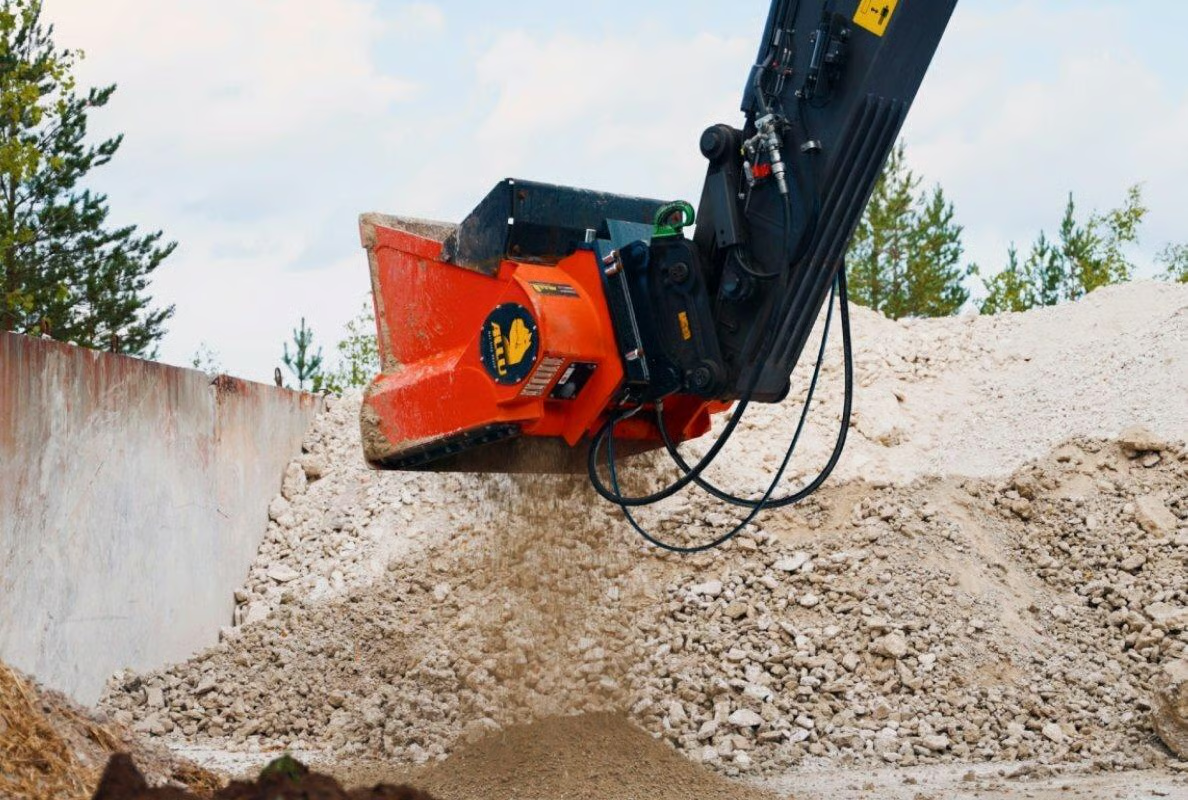 Processing power in a bucket: New ALLU Concrete Screening and Crushing Bucket for rebar-contaminated demolition rubble coming in 2026 IMAGE SOURCE: ALLU
Dans le secteur de la démolition et du recyclage, le scénario est familier : des montagnes de gravats de béton et de briques à traiter, un chantier exigu où chaque mètre compte, une logistique compliquée… et, bien souvent, des matériaux mêlés d’acier et de barres d’armature qui ralentissent la production.
Pour répondre à cette réalité de terrain, ALLU dévoile une nouvelle solution : la ALLU Concrete Screening and Crushing Bucket, une benne montée sur excavatrice capable de traiter les gravats directement sur site — y compris les matériaux habituellement rejetés ou difficiles à broyer à cause de la présence de métal.
Conçue pour les excavatrices de 25 à 45 tonnes, cette nouvelle benne permet de transformer les débris de démolition en matériau réutilisable là où ils sont produits, sans avoir à mobiliser un concasseur mobile supplémentaire.
« Les entrepreneurs n’ont pas besoin d’une machine de plus à gérer sur un chantier déjà encombré ; ils ont besoin d’une solution pratique pour valoriser les gravats avec l’excavatrice qu’ils possèdent déjà », explique Antti Rautamies, R&D Project Manager chez ALLU.
« Cette benne a été pensée pour les conditions réelles : des flux riches en fines, des espaces restreints et du béton armé qui n’arrive jamais parfaitement propre. »
Une solution pensée pour les chantiers où les concasseurs mobiles ne passent pas
La ALLU Concrete Bucket est conçue pour broyer différents matériaux issus de la démolition, tels que le béton, la brique ou encore l’asphalte recyclé (RAP). Elle répond particulièrement aux situations où l’introduction d’un concasseur mobile est peu efficace — voire impossible — en permettant le traitement du matériau directement à l’endroit où il est généré.
Elle peut également compléter un concasseur mobile existant, en assurant un pré-concassage et une alimentation optimisée sur les sites de démolition ou de recyclage.
Conçue pour supporter la présence d’acier et de barres d’armature
La présence d’acier dans les gravats est l’un des facteurs qui freinent le plus la productivité. La benne ALLU a été spécialement développée pour tolérer les contaminations métalliques, y compris les barres d’armature, limitant ainsi les interruptions fréquentes pour dégager le matériau coincé — un problème bien connu des équipes de démolition.
Pour s’adapter aux besoins de chaque chantier, la benne dispose d’un système de contre-lames interchangeables, permettant d’obtenir différentes granulométries de sortie : 0–50 mm ou 0–100 mm. Les opérateurs peuvent ainsi ajuster la taille des fragments selon les exigences du projet sans perturber l’organisation globale du chantier.
Dans des conditions optimales, la capacité de production peut atteindre jusqu’à 100 tonnes par heure, avec une taille d’alimentation maximale de 300 mm — les performances variant naturellement selon le porteur et les conditions du site.
Une construction robuste pour un usage intensif
Fidèle à la philosophie de conception d’ALLU, l’objectif est clair : robustesse pour le travail quotidien et maintenance simplifiée.
La benne intègre une structure renforcée, avec un tranchant de 40 mm et des lames latérales de 30 mm, capables de résister aux forces d’arrachement des excavatrices allant jusqu’à 45 tonnes.
Le système de concassage repose sur des tambours et des lames en cours de finalisation, déjà testés avec succès dans des conditions réelles grâce à différentes configurations innovantes développées par ALLU. Une structure de contre-lames forme la chambre de concassage, tandis que deux sens de rotation alternatifs permettent d’assurer un broyage continu tout en évacuant rapidement les fines à travers la benne.
Performances hydrauliques
La benne nécessite un débit hydraulique compris entre 190 et 315 l/min à 300 bar, soit une puissance opérationnelle typique d’environ 60 à 100 kW. Sur une excavatrice de 40 tonnes, la consommation de carburant observée est d’environ 30 litres par heure.
Une arrivée sur le marché prévue pour 2026
Actuellement en phase finale de tests, la ALLU Concrete Screening and Crushing Bucket a déjà démontré son efficacité lors d’essais sur le terrain. Sa commercialisation est prévue pour 2026, offrant aux entrepreneurs de démolition et de recyclage une nouvelle façon de transformer les gravats en ressources directement sur le chantier.
NJC.© Info ALLU
-------------------------------------------------------------------------------------------------------------------
06/03/26-English
Processing power in a bucket: the new ALLU concrete screening and crushing bucket arrives in 2026
Processing power in a bucket: New ALLU Concrete Screening and Crushing Bucket for rebar-contaminated demolition rubble coming in 2026 IMAGE SOURCE: ALLU
In the demolition and recycling sector, the scenario is familiar: mountains of concrete and brick rubble to process, a cramped worksite where every meter counts, complicated logistics… and, often, materials mixed with steel and rebar that slow down production.
To address this real-world challenge, ALLU is unveiling a new solution: the ALLU Concrete Screening and Crushing Bucket, an excavator-mounted bucket capable of processing rubble directly on-site—including materials that are usually rejected or difficult to crush due to the presence of metal.
Designed for excavators from 25 to 45 tons, this new bucket transforms demolition debris into reusable material right where it is produced, without the need for an additional mobile crusher.
“Contractors don’t need another machine to manage on an already congested site; they need a practical solution for processing rubble with the excavator they already own,” explains Antti Rautamies, R&D Project Manager at ALLU.
“This bucket was designed for real-world conditions: flows rich in fines, confined spaces, and reinforced concrete that never arrives perfectly clean.”
A solution designed for sites where mobile crushers can’t operate
The ALLU Concrete Bucket is designed to crush various demolition materials, such as concrete, brick, or recycled asphalt concrete (RAP). It is particularly suited to situations where using a mobile crusher is inefficient—or even impossible—by allowing the material to be processed directly where it is generated.
It can also complement an existing mobile crusher, providing pre-crushing and optimized feeding at demolition or recycling sites.
Designed to withstand the presence of steel and rebar
The presence of steel in rubble is one of the biggest productivity bottlenecks. The ALLU skip was specifically developed to tolerate metal contamination, including rebar, thus minimizing frequent interruptions to clear trapped material—a well-known problem for demolition crews.
To adapt to the needs of each site, the skip features an interchangeable counter-blade system, allowing for different output particle sizes: 0–50 mm or 0–100 mm. Operators can therefore adjust the fragment size according to project requirements without disrupting the overall site organization.
Under optimal conditions, production capacity can reach up to 100 tons per hour, with a maximum feed size of 300 mm—performance naturally varying depending on the carrier and site conditions.
Robust Construction for Intensive Use
True to ALLU's design philosophy, the objective is clear: robustness for everyday work and simplified maintenance.
The bucket incorporates a reinforced structure, with a 40 mm cutting edge and 30 mm side blades, capable of withstanding the breakout forces of excavators up to 45 tons.
The crushing system is based on drums and blades currently being finalized, already successfully tested under real-world conditions thanks to various innovative configurations developed by ALLU. A counter-blade structure forms the crushing chamber, while two alternating directions of rotation ensure continuous crushing while quickly ejecting the fines through the bucket.
Hydraulic Performance
The bucket requires a hydraulic flow rate of between 190 and 315 l/min at 300 bar, corresponding to a typical operating power of approximately 60 to 100 kW. On a 40-ton excavator, the observed fuel consumption is approximately 30 liters per hour.
Market launch planned for 2026
Currently in the final testing phase, the ALLU Concrete Screening and Crushing Bucket has already demonstrated its effectiveness in field trials. Its commercial launch is planned for 2026, offering demolition and recycling contractors a new way to transform rubble into resources directly on the construction site.
NJC.© Info ALLU
-------------------------------------------------------------------------------------------------------------------
06/03/26-NL
Verwerkingskracht in een bak: de nieuwe ALLU betonzeef- en breekbak komt in 2026 op de markt
Processing power in a bucket: New ALLU Concrete Screening and Crushing Bucket for rebar-contaminated demolition rubble coming in 2026 IMAGE SOURCE: ALLU
In de sloop- en recyclingsector is het scenario bekend: bergen beton- en baksteenpuin die verwerkt moeten worden, een krappe bouwplaats waar elke meter telt, gecompliceerde logistiek… en vaak materialen vermengd met staal en wapeningsstaal die de productie vertragen.
Om deze praktische uitdaging aan te pakken, introduceert ALLU een nieuwe oplossing: de ALLU betonzeef- en breekbak, een op een graafmachine te monteren bak die puin direct op locatie kan verwerken – inclusief materialen die normaal gesproken worden afgekeurd of moeilijk te breken zijn vanwege de aanwezigheid van metaal.
Deze nieuwe bak is ontworpen voor graafmachines van 25 tot 45 ton en transformeert sloopafval direct op de plek waar het ontstaat in herbruikbaar materiaal, zonder dat een extra mobiele breekinstallatie nodig is.
"Aannemers hebben geen behoefte aan nog een machine op een toch al overvolle bouwplaats; ze hebben een praktische oplossing nodig voor het verwerken van puin met de graafmachine die ze al bezitten", legt Antti Rautamies, R&D Project Manager bij ALLU, uit.
“Deze bak is ontworpen voor de praktijk: stromen met veel fijnstof, krappe ruimtes en gewapend beton dat nooit perfect schoon aankomt.”
Een oplossing voor locaties waar mobiele brekers niet kunnen werken
De ALLU betonbak is ontworpen voor het breken van diverse sloopmaterialen, zoals beton, baksteen of gerecycled asfaltbeton (RAP). Hij is bijzonder geschikt voor situaties waar het gebruik van een mobiele breker inefficiënt – of zelfs onmogelijk – is, doordat het materiaal direct op de plaats van herkomst kan worden verwerkt.
Hij kan ook een bestaande mobiele breker aanvullen door voorbreken en een geoptimaliseerde aanvoer te bieden op sloop- of recyclinglocaties.
Ontworpen om de aanwezigheid van staal en wapeningsstaal te weerstaan
De aanwezigheid van staal in puin is een van de grootste knelpunten voor de productiviteit. De ALLU-bak is speciaal ontwikkeld om metaalverontreiniging, inclusief wapeningsstaal, te verdragen, waardoor frequente onderbrekingen om vastzittend materiaal te verwijderen – een bekend probleem voor sloopteams – tot een minimum worden beperkt.
Om aan de behoeften van elke locatie te voldoen, is de bak voorzien van een verwisselbaar tegenmes-systeem, waardoor verschillende deeltjesgroottes mogelijk zijn: 0–50 mm of 0–100 mm. Operators kunnen de fragmentgrootte dus aanpassen aan de projectvereisten zonder de algehele organisatie op de bouwplaats te verstoren.
Onder optimale omstandigheden kan de productiecapaciteit oplopen tot 100 ton per uur, met een maximale invoergrootte van 300 mm – de prestaties variëren uiteraard afhankelijk van de drager en de omstandigheden op de bouwplaats.
Robuuste constructie voor intensief gebruik
Trouw aan de ontwerpfilosofie van ALLU is het doel duidelijk: robuustheid voor dagelijks gebruik en vereenvoudigd onderhoud.
De bak is voorzien van een versterkte constructie, met een snijkant van 40 mm en zijmessen van 30 mm, die bestand zijn tegen de uitbreekkrachten van graafmachines tot 45 ton.
Het breekmechanisme is gebaseerd op trommels en messen die momenteel worden afgerond en die dankzij diverse innovatieve configuraties van ALLU al succesvol in de praktijk zijn getest. Een tegenbladconstructie vormt de breekkamer, terwijl twee afwisselende draairichtingen zorgen voor continu breken en tegelijkertijd de fijne deeltjes snel door de bak afvoeren.
Hydraulische prestaties
De bak vereist een hydraulisch debiet van 190 tot 315 l/min bij 300 bar, wat overeenkomt met een typisch bedrijfsvermogen van circa 60 tot 100 kW. Op een 40-tons graafmachine bedraagt het waargenomen brandstofverbruik circa 30 liter per uur.
Marktintroductie gepland voor 2026
De ALLU betonzeef- en breekbak bevindt zich momenteel in de laatste testfase en heeft zijn effectiviteit al bewezen in praktijkproeven. De commerciële lancering staat gepland voor 2026 en biedt sloop- en recyclingbedrijven een nieuwe manier om puin direct op de bouwplaats om te zetten in grondstoffen.
NJC.© Info ALLU
--------------------------------------------------------------------------------------------------------------
Date de dernière mise à jour : 05/03/2026