











R.E.News future Technology-Ancient Chinese Symbols Shaping the Future of Smart Materials
 27/04/26-FR-English-NL-footer
Quand la calligraphie devient structure : des symboles anciens au cœur des matériaux intelligents
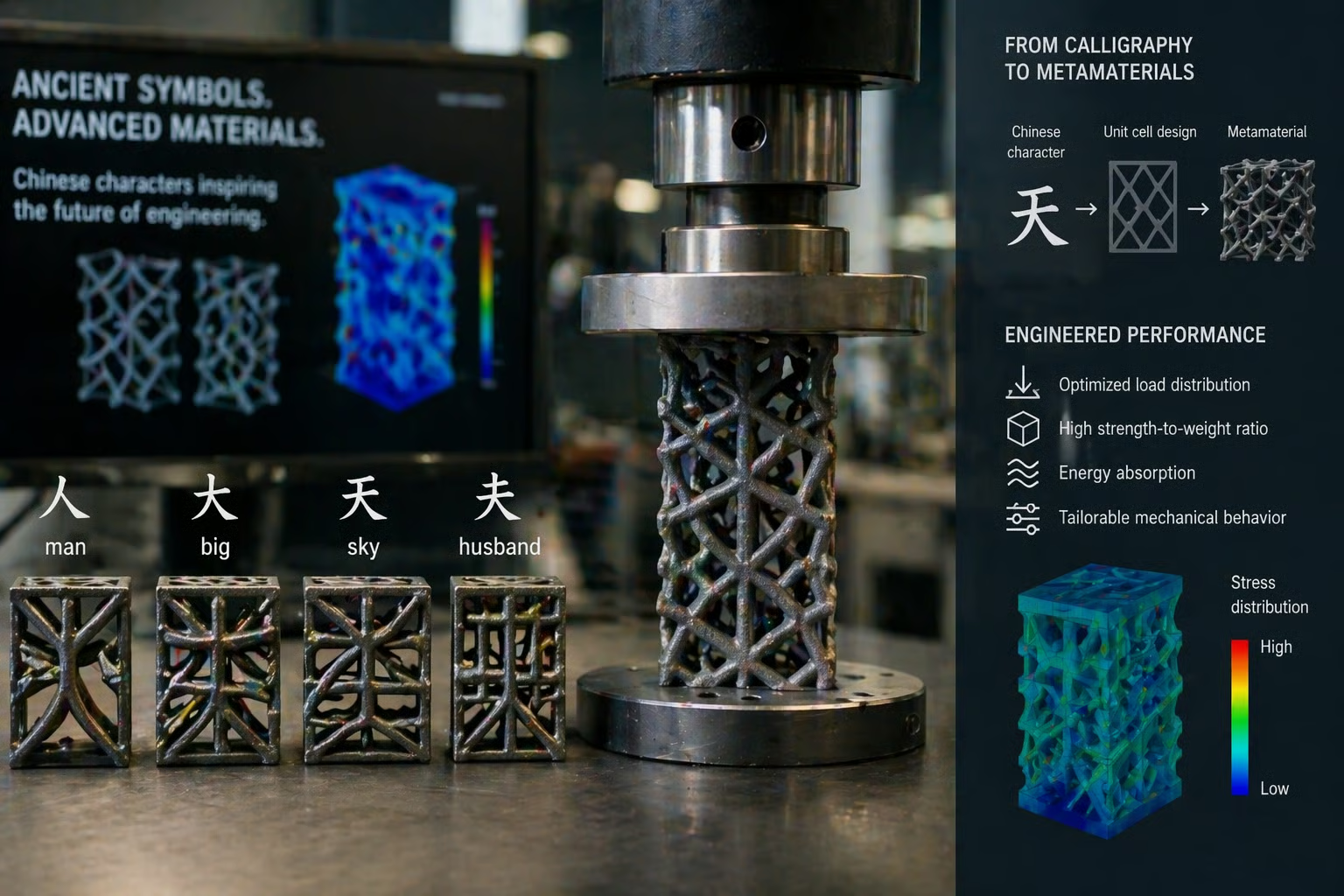 Image-R.E.News©
Et si l’innovation matérielle ne venait pas uniquement des laboratoires, mais aussi de l’histoire et du langage ? Une équipe menée par University of Edinburgh propose une lecture inattendue de l’ingénierie : utiliser la géométrie des caractères chinois comme base de conception pour des matériaux mécaniques avancés.
Publié dans AIP Publishing, ce travail s’inscrit dans le champ des métamatériaux, où la performance dépend moins de la composition que de l’architecture interne. Une approche qui pourrait redéfinir la manière dont les matériaux sont conçus pour la construction et l’infrastructure.
La géométrie comme moteur de performance
Les métamatériaux reposent sur un principe fondamental : organiser la matière pour lui donner des հատկ propriétés inédites. Jusqu’ici, ces structures s’inspiraient principalement de formes classiques — treillis, alvéoles, motifs répétitifs.
Cette recherche change de paradigme. Elle puise dans l’écriture, où chaque caractère devient une matrice structurelle. Les traits, les courbes, les symétries ne sont plus seulement esthétiques : ils dictent la manière dont un matériau absorbe, redistribue ou résiste aux contraintes.
Du symbole à la mécanique
En traduisant des caractères chinois en cellules structurelles répétées, les chercheurs ont observé des comportements mécaniques distincts sous compression.
Les résultats sont révélateurs :
les formes ouvertes et inclinées favorisent la flexibilité et l’absorption d’énergie,
l’ajout de traverses horizontales améliore la rigidité et la stabilité,
de légères asymétries modifient la propagation des contraintes.
Autrement dit, la forme devient une variable d’ingénierie à part entière. Une simple variation graphique peut transformer radicalement le comportement d’un matériau.
Une nouvelle voie pour la construction
Pour les secteurs de la construction et des infrastructures, ces travaux ouvrent des perspectives concrètes. Des matériaux plus légers, mais plus performants, pourraient être conçus sur mesure en fonction des contraintes :
structures absorbant les chocs pour les infrastructures routières,
composants optimisés pour réduire le poids des ouvrages,
éléments capables de mieux répartir les charges dans des environnements complexes.
Avec l’essor de la fabrication additive, ces géométries complexes ne sont plus théoriques. Elles peuvent être produites directement, avec une précision industrielle.
Quand culture et ingénierie se rencontrent
Au-delà de la performance, cette approche introduit une dimension nouvelle : celle de l’inspiration culturelle. Les caractères chinois ne sont qu’un point de départ. D’autres systèmes d’écriture — arabes, indiens, ou même typographies contemporaines — pourraient enrichir cette bibliothèque de formes.
Ce croisement entre ingénierie et patrimoine ouvre un champ inédit : celui d’une innovation qui puise dans la mémoire collective pour concevoir le futur.
Vers une ingénierie plus créative
À mesure que les exigences en matière de durabilité, de performance et d’efficacité augmentent, l’ingénierie doit élargir ses outils. Cette recherche envoie un signal fort : les solutions ne se trouvent pas uniquement dans l’optimisation algorithmique ou les matériaux avancés, mais aussi dans des formes déjà existantes, réinterprétées.
Dans un secteur en quête de matériaux plus intelligents, cette approche propose une nouvelle direction : penser la structure autrement, en combinant science, design et culture.
Car parfois, pour construire l’avenir, il suffit de relire le passé — différemment.
NJC.© Info study led by researchers at the University of Edinburgh The Journal of Applied Physics
---------------------------------------------------------------------------------------------------------------
27/04/26-English
When Calligraphy Becomes Structure: Ancient Symbols at the Heart of Smart Materials
Image-R.E.News©
What if material innovation came not only from laboratories, but also from history and language? A team led by the University of Edinburgh offers an unexpected perspective on engineering: using the geometry of Chinese characters as a design basis for advanced mechanical materials.
Published by AIP Publishing, this work falls within the field of metamaterials, where performance depends less on composition than on internal architecture. This approach could redefine how materials are designed for construction and infrastructure.
Geometry as a Performance Driver
Metamaterials are based on a fundamental principle: organizing matter to give it unprecedented properties. Until now, these structures have been primarily inspired by classical forms—lattices, honeycombs, repetitive patterns.
This research shifts the paradigm. It draws on writing, where each character becomes a structural matrix. Lines, curves, and symmetries are no longer merely aesthetic: they dictate how a material absorbs, redistributes, or resists stress.
From Symbol to Mechanics
By translating Chinese characters into repeating structural cells, researchers observed distinct mechanical behaviors under compression.
The results are revealing:
open and inclined shapes promote flexibility and energy absorption,
the addition of horizontal crossbeams improves rigidity and stability,
slight asymmetries modify stress propagation.
In other words, form becomes an engineering variable in its own right. A simple graphic variation can radically transform a material's behavior.
A New Path for Construction
For the construction and infrastructure sectors, this research opens up concrete possibilities. Lighter, yet higher-performing materials could be custom-designed to meet specific constraints:
shock-absorbing structures for road infrastructure,
optimized components to reduce the weight of structures,
and elements capable of better distributing loads in complex environments.
With the rise of additive manufacturing, these complex geometries are no longer theoretical. They can be produced directly, with industrial precision.
When Culture and Engineering Meet
Beyond performance, this approach introduces a new dimension: that of cultural inspiration. Chinese characters are just a starting point. Other writing systems—Arabic, Indian, or even contemporary typography—could enrich this library of forms.
This intersection of engineering and heritage opens up a new field: that of innovation which draws on collective memory to design the future.
Toward More Creative Engineering
As the demands for sustainability, performance, and efficiency increase, engineering must expand its tools. This research sends a powerful message: solutions lie not only in algorithmic optimization or advanced materials, but also in existing forms, reinterpreted.
In a sector searching for smarter materials, this approach offers a new direction: rethinking structure by combining science, design, and culture.
Because sometimes, to build the future, all it takes is a fresh look at the past.
NJC.© Info study led by researchers at the University of Edinburgh The Journal of Applied Physics
-----------------------------------------------------------------------------------------------------------------
27/04/26-NL
Wanneer kalligrafie structuur wordt: oude symbolen in het hart van slimme materialen
Image-R.E.News©
Wat als materiaalinnovatie niet alleen uit laboratoria komt, maar ook uit geschiedenis en taal? Een team onder leiding van de Universiteit van Edinburgh biedt een onverwacht perspectief op techniek: het gebruik van de geometrie van Chinese karakters als basis voor het ontwerp van geavanceerde mechanische materialen.
Dit werk, gepubliceerd door AIP Publishing, valt binnen het vakgebied van metamaterialen, waar prestaties minder afhangen van de samenstelling dan van de interne architectuur. Deze benadering zou de manier waarop materialen voor de bouw en infrastructuur worden ontworpen, kunnen herdefiniëren.
Geometrie als prestatiebevorderend element
Metamaterialen zijn gebaseerd op een fundamenteel principe: materie organiseren om het ongekende eigenschappen te geven. Tot nu toe waren deze structuren vooral geïnspireerd door klassieke vormen – roosters, honingraten, repetitieve patronen.
Dit onderzoek verschuift het paradigma. Het maakt gebruik van schrift, waarbij elk karakter een structurele matrix wordt. Lijnen, krommingen en symmetrieën zijn niet langer louter esthetisch: ze bepalen hoe een materiaal spanning absorbeert, herverdeelt of weerstaat.
Van symbool naar mechanica
Door Chinese karakters te vertalen naar herhalende structurele cellen, observeerden onderzoekers verschillende mechanische gedragingen onder druk.
De resultaten zijn veelzeggend:
open en schuine vormen bevorderen flexibiliteit en energieabsorptie,
de toevoeging van horizontale dwarsbalken verbetert de stijfheid en stabiliteit,
lichte asymmetrieën beïnvloeden de spanningsvoortplanting.
Met andere woorden, vorm wordt een volwaardige technische variabele. Een simpele grafische variatie kan het gedrag van een materiaal radicaal veranderen.
Een nieuwe weg voor de bouw
Voor de bouw- en infrastructuursector opent dit onderzoek concrete mogelijkheden. Lichtere, maar beter presterende materialen kunnen op maat worden ontworpen om aan specifieke eisen te voldoen:
schokabsorberende constructies voor wegeninfrastructuur,
geoptimaliseerde componenten om het gewicht van constructies te verminderen,
en elementen die de belasting in complexe omgevingen beter kunnen verdelen.
Met de opkomst van additive manufacturing zijn deze complexe geometrieën niet langer theoretisch. Ze kunnen direct en met industriële precisie worden geproduceerd.
Wanneer cultuur en techniek elkaar ontmoeten
Naast prestaties introduceert deze benadering een nieuwe dimensie: die van culturele inspiratie. Chinese karakters zijn slechts een beginpunt. Andere schrijfsystemen – Arabisch, Indiaas of zelfs hedendaagse typografie – zouden deze bibliotheek van vormen kunnen verrijken.
Deze kruising van techniek en erfgoed opent een nieuw terrein: dat van innovatie, die gebruikmaakt van het collectieve geheugen om de toekomst vorm te geven.
Op weg naar creatievere techniek
Naarmate de eisen aan duurzaamheid, prestaties en efficiëntie toenemen, moet de techniek haar instrumenten uitbreiden. Dit onderzoek geeft een krachtige boodschap: oplossingen liggen niet alleen in algoritmische optimalisatie of geavanceerde materialen, maar ook in bestaande vormen, herinterpreteerd.
In een sector die op zoek is naar slimmere materialen, biedt deze benadering een nieuwe richting: het heroverwegen van structuren door wetenschap, ontwerp en cultuur te combineren.
Want soms is een frisse blik op het verleden alles wat nodig is om de toekomst te bouwen.
NJC.© Info study led by researchers at the University of Edinburgh The Journal of Applied Physics
----------------------------------------------------------------------------------------------------------------
Date de dernière mise à jour : 24/04/2026