



R.E.News future Technology-BEX Asia 2026 Puts Practical AI and Robotics at the Centre of Construction Technology
 28/08/26-FR-English-NL-footer
BEX Asia 2026 : quand l’intelligence entre sur le chantier
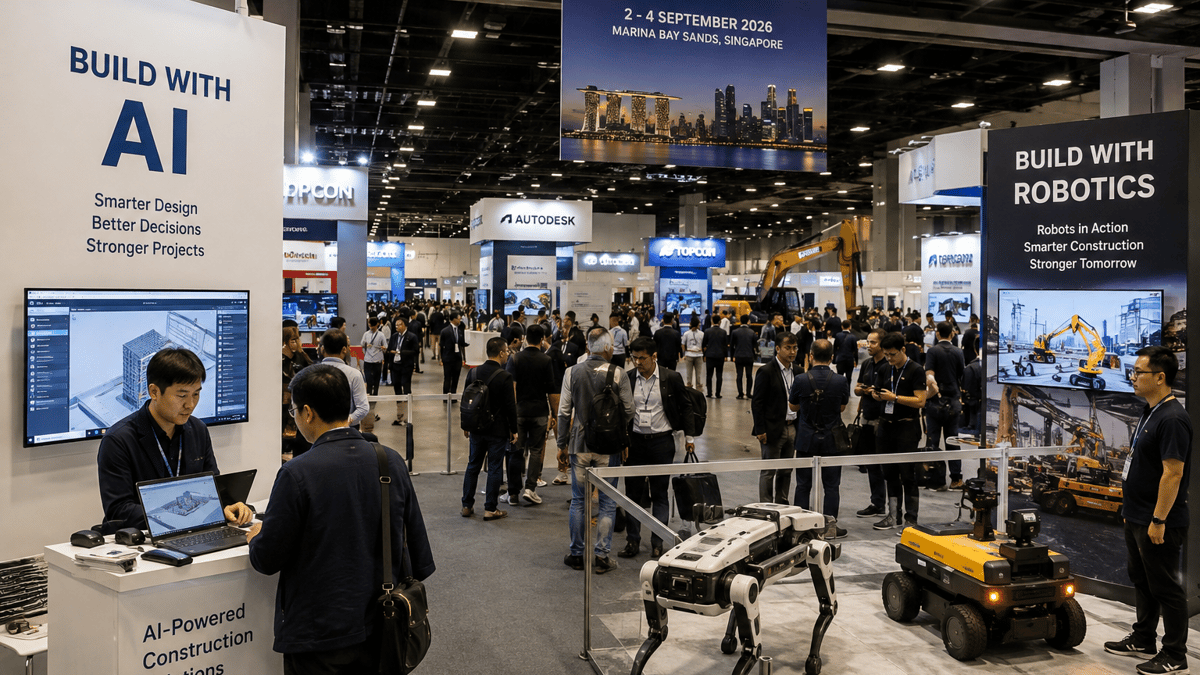 Image-creation R.E.News© via IA chat GPT
À Singapour, l’intelligence artificielle et la robotique ne seront plus exposées comme des promesses. Elles seront présentées comme des outils prêts à travailler.
Du 2 au 4 septembre 2026, Marina Bay Sands deviendra le théâtre d’une transformation silencieuse mais profonde. Plus de 200 marques participeront à BEX Asia 2026, et près de 60 % des exposants devraient présenter des solutions intégrant l’intelligence artificielle.
Un chiffre qui raconte à lui seul l’évolution d’un secteur.
Il y a quelques années encore, l’IA appartenait aux laboratoires, aux conférences et aux démonstrations futuristes. Aujourd’hui, elle s’installe dans les coulisses très concrètes du chantier : BIM, appels d’offres, contrats, inspections, suivi d’avancement, documentation et gestion des bâtiments.
Et pendant que les logiciels apprennent à comprendre les projets, les robots commencent à apprendre à les construire.
Du rêve technologique au geste professionnel
BEX Asia inaugure cette année un Build with AI Pavilion et un Build with Robotics Demo Zone, avec une ambition claire : montrer des technologies en fonctionnement plutôt que simplement raconter leur potentiel.
Les visiteurs découvriront des environnements 3D immersifs, des systèmes d’analyse vidéo capables de détecter des comportements dangereux, des plateformes connectant hommes, machines et progression des travaux, mais aussi des robots capables de souder, ligaturer des armatures, lisser le béton, peindre, carreler, meuler, percer, marquer les routes ou transporter des matériaux.
La révolution ne cherche donc pas à remplacer tout le chantier.
Elle commence par un geste, une tâche, quelques minutes gagnées — puis quelques heures, puis un projet entier.
Singapour, laboratoire grandeur nature
Cette évolution ne doit rien au hasard.
La Building and Construction Authority (BCA) pousse depuis plusieurs années l’Integrated Digital Delivery, le BIM, l’automatisation et la robotique afin d’améliorer la productivité d’un secteur confronté à une demande soutenue et à une forte pression sur la main-d’œuvre.
Plus de 20 solutions robotiques prêtes à être déployées ont déjà été identifiées par la BCA et utilisées sur plus de 50 projets.
Le gouvernement accompagne également cette transition financièrement, notamment à travers le Built Environment Productivity Solutions Grant, qui élargit son soutien aux équipements avancés, à la robotique et à l’automatisation.
La technologie n’est donc plus seulement montrée.
Elle est testée, financée et introduite dans les projets.
La vraie révolution est peut-être invisible
Derrière chaque robot et chaque algorithme se trouve pourtant un élément plus fondamental : la donnée.
Un chantier capable de transmettre en temps réel ses plans, ses images, ses contrats, ses inspections et son avancement devient un terrain idéal pour l’intelligence artificielle.
L’IA peut alors rechercher une information dans des milliers de documents, analyser une image de chantier, contrôler un modèle BIM, identifier une anomalie ou automatiser un rapport.
Et lorsque ces données rencontrent des machines capables d’agir physiquement, le numérique commence à prendre corps.
Une vitrine devenue marché mondial
BEX Asia dépasse également les frontières de Singapour. Environ 35 % des exposants devraient venir de l’étranger, avec des entreprises représentant notamment l’Australie, le Canada, la Chine, le Danemark, Hong Kong, Israël, l’Italie, le Japon, la Corée du Sud, la Suisse et les États-Unis.
Pour ces acteurs, Singapour représente plus qu’un marché : un laboratoire asiatique où une technologie peut être testée, adaptée puis déployée.
C’est ce qui donne à l’édition 2026 une dimension particulière.
Pendant longtemps, les salons de construction ont présenté le chantier du futur.
À Singapour, le futur semble désormais avoir commencé à travailler.
BEX Asia 2026 ne montrera pas seulement ce que l’IA et les robots pourraient faire demain. Il montrera ce qu’ils sont déjà capables de faire aujourd’hui.
NJC.© Info
--------------------------------------------------------------------------------------------------------------------
28/08/26-English
BEX Asia 2026: When Intelligence Takes to the Construction Site
Image-creation R.E.News© via IA chat GPT
In Singapore, artificial intelligence and robotics will no longer be showcased as mere promises. They will be presented as ready-to-use tools.
From September 2nd to 4th, 2026, Marina Bay Sands will become the stage for a quiet but profound transformation. More than 200 brands will participate in BEX Asia 2026, and nearly 60% of exhibitors are expected to present solutions integrating artificial intelligence.
This figure alone speaks volumes about the evolution of an entire sector.
Just a few years ago, AI belonged to laboratories, conferences, and futuristic demonstrations. Today, it is taking root behind the scenes of the construction site: BIM, tenders, contracts, inspections, progress monitoring, documentation, and building management.
And while software learns to understand projects, robots are beginning to learn how to build them.
From Technological Dream to Professional Action
This year, BEX Asia is launching a Build with AI Pavilion and a Build with Robotics Demo Zone, with a clear ambition: to showcase technologies in action rather than simply describing their potential.
Visitors will discover immersive 3D environments, video analytics systems capable of detecting dangerous behavior, platforms connecting people, machines, and work progress, as well as robots capable of welding, tying rebar, smoothing concrete, painting, tiling, grinding, drilling, marking roads, and transporting materials.
The revolution, therefore, is not about replacing the entire construction site.
It begins with a single action, a single task, a few minutes saved—then a few hours, then an entire project.
Singapore, a full-scale laboratory
This evolution is no accident.
The Building and Construction Authority (BCA) has been promoting Integrated Digital Delivery, BIM, automation, and robotics for several years to improve productivity in a sector facing sustained demand and significant labor pressures.
More than 20 robotic solutions ready for deployment have already been identified by the BCA and used on over 50 projects.
The government is also supporting this transition financially, notably through the Built Environment Productivity Solutions Grant, which is expanding its support for advanced equipment, robotics, and automation.
The technology is therefore no longer just being showcased.
It is being tested, funded, and integrated into projects.
The real revolution may be invisible.
Behind every robot and every algorithm, however, lies a more fundamental element: data.
A construction site capable of transmitting its plans, images, contracts, inspections, and progress in real time becomes an ideal environment for artificial intelligence.
AI can then search for information in thousands of documents, analyze a construction site image, control a BIM model, identify an anomaly, or automate a report.
And when this data encounters machines capable of physical action, the digital world begins to take shape.
A showcase that has become a global marketplace
BEX Asia also extends beyond Singapore's borders. Approximately 35% of exhibitors are expected to come from abroad, with companies representing, among others, Australia, Canada, China, Denmark, Hong Kong, Israel, Italy, Japan, South Korea, Switzerland, and the United States.
For these players, Singapore represents more than just a market: it's an Asian laboratory where a technology can be tested, adapted, and then deployed.
This is what gives the 2026 edition a unique dimension.
For a long time, construction trade shows have presented the construction site of the future.
In Singapore, the future now seems to have begun its work.
BEX Asia 2026 will not only showcase what AI and robots could do tomorrow, but also what they are already capable of today.
NJC.© Info
-----------------------------------------------------------------------------------------------------------------
28/08/26-NL
BEX Asia 2026: Intelligentie op de bouwplaats
Image-creation R.E.News© via IA chat GPT
In Singapore zullen kunstmatige intelligentie en robotica niet langer als louter beloftes worden gepresenteerd. Ze zullen worden getoond als direct toepasbare tools.
Van 2 tot en met 4 september 2026 zal Marina Bay Sands het toneel zijn van een stille maar ingrijpende transformatie. Meer dan 200 merken zullen deelnemen aan BEX Asia 2026 en naar verwachting zal bijna 60% van de exposanten oplossingen presenteren die kunstmatige intelligentie integreren.
Dit cijfer alleen al zegt veel over de evolutie van een hele sector.
Nog maar een paar jaar geleden behoorde AI tot laboratoria, conferenties en futuristische demonstraties. Vandaag de dag wortelt het achter de schermen van de bouwplaats: BIM, aanbestedingen, contracten, inspecties, voortgangsbewaking, documentatie en gebouwbeheer.
En terwijl software leert projecten te begrijpen, beginnen robots te leren hoe ze te bouwen.
Van technologische droom naar professionele actie
Dit jaar lanceert BEX Asia een Build with AI Pavilion en een Build with Robotics Demo Zone, met een duidelijke ambitie: technologieën in actie laten zien in plaats van alleen hun potentieel te beschrijven.
Bezoekers ontdekken meeslepende 3D-omgevingen, videoanalysesystemen die gevaarlijk gedrag kunnen detecteren, platforms die mensen, machines en de voortgang van het werk met elkaar verbinden, en robots die kunnen lassen, wapeningsstaal binden, beton egaliseren, schilderen, tegelen, slijpen, boren, wegen markeren en materialen transporteren.
De revolutie draait dus niet om het vervangen van de hele bouwplaats.
Het begint met één enkele actie, één enkele taak, een paar minuten tijdsbesparing – dan een paar uur, en uiteindelijk een heel project.
Singapore, een volwaardig laboratorium
Deze ontwikkeling is geen toeval.
De Building and Construction Authority (BCA) promoot al jaren Integrated Digital Delivery, BIM, automatisering en robotica om de productiviteit te verbeteren in een sector die te maken heeft met een aanhoudende vraag en aanzienlijke personeelsdruk.
De BCA heeft al meer dan 20 robotoplossingen geïdentificeerd die klaar zijn voor implementatie en die in meer dan 50 projecten worden gebruikt.
De overheid ondersteunt deze transitie ook financieel, met name via de Built Environment Productivity Solutions Grant, die de steun voor geavanceerde apparatuur, robotica en automatisering uitbreidt.
De technologie wordt dus niet langer alleen maar tentoongesteld.
Ze wordt getest, gefinancierd en geïntegreerd in projecten.
De echte revolutie is misschien wel onzichtbaar.
Achter elke robot en elk algoritme schuilt echter een fundamenteler element: data.
Een bouwplaats die in staat is om plannen, afbeeldingen, contracten, inspecties en voortgang in realtime te verzenden, wordt een ideale omgeving voor kunstmatige intelligentie.
AI kan vervolgens informatie zoeken in duizenden documenten, een afbeelding van een bouwplaats analyseren, een BIM-model besturen, een afwijking identificeren of een rapport automatiseren.
En wanneer deze data machines tegenkomen die fysiek kunnen handelen, begint de digitale wereld vorm te krijgen.
Een showcase die is uitgegroeid tot een wereldwijde marktplaats
BEX Asia reikt ook verder dan de grenzen van Singapore. Naar verwachting komt ongeveer 35% van de exposanten uit het buitenland, met bedrijven uit onder andere Australië, Canada, China, Denemarken, Hongkong, Israël, Italië, Japan, Zuid-Korea, Zwitserland en de Verenigde Staten.
Voor deze spelers is Singapore meer dan alleen een markt: het is een Aziatisch laboratorium waar technologie kan worden getest, aangepast en vervolgens ingezet.
Dit geeft de editie van 2026 een unieke dimensie.
Bouwbeurzen presenteren al lange tijd de bouwplaats van de toekomst.
In Singapore lijkt die toekomst nu al aan de gang te zijn.
BEX Asia 2026 laat niet alleen zien wat AI en robots morgen zouden kunnen doen, maar ook wat ze vandaag de dag al kunnen.
NJC.© Info
------------------------------------------------------------------------------------------------------------------
Date de dernière mise à jour : 27/08/2026