



R.E.News future Technology-Building the Construction Control Tower
 12/02/26-FR-English-NL-footer
Building the Construction Control Tower
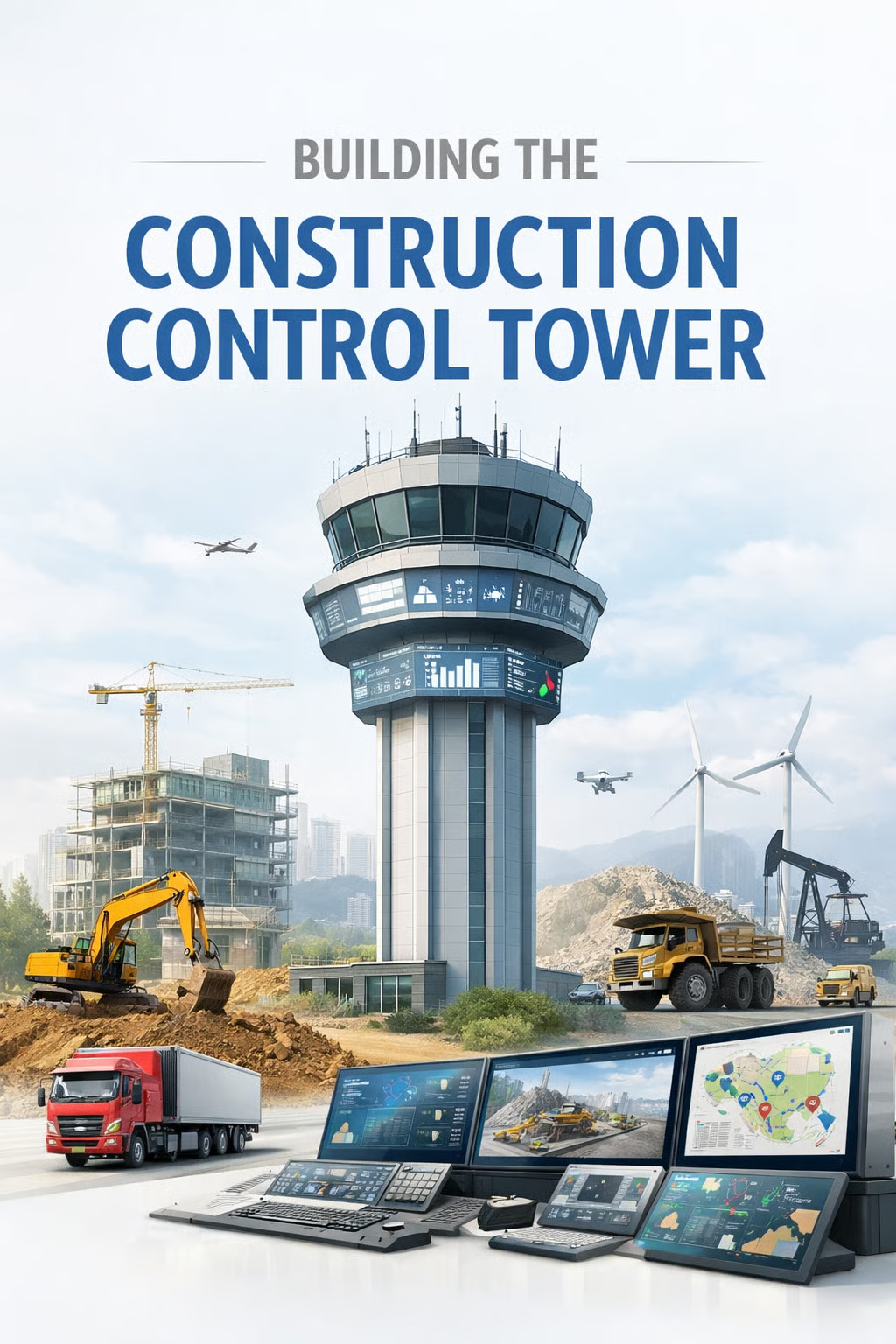 Image-R.E.News©
Dans la construction, le transport, les mines ou l’énergie, l’expression control tower a changé de sens.
Elle ne désigne plus une salle bardée d’écrans ni un simple tableau de bord sophistiqué. Elle décrit désormais un mode de pilotage : une manière de gouverner des portefeuilles complexes où les décisions sont prises plus tôt, avec davantage de contexte et une conscience claire des conséquences.
Pourquoi maintenant ?
Les grands programmes d’infrastructure n’ont jamais été aussi vastes, interconnectés et exposés politiquement. Inflation des coûts, pénuries de main-d’œuvre, chaînes d’approvisionnement fragiles, pression réglementaire et exigences de décarbonation s’entremêlent.
Dans cet environnement, piloter projet par projet ne suffit plus. Optimiser une opération isolée peut fragiliser l’ensemble. La control tower déplace le regard : elle ne demande plus si un projet est « dans les clous », mais si le portefeuille dans son ensemble dérive vers un risque inacceptable — et ce qu’il faut faire tant qu’il est encore temps.
Des racines ailleurs, une nécessité ici
L’idée n’est pas née dans la construction.
L’aviation a montré la voie : une vision partagée, des décisions continues, une autorité claire. La logistique a suivi, transformant ses chaînes mondiales en réseaux pilotés en temps réel. La défense, enfin, a rappelé une vérité essentielle : la visibilité sans priorisation paralyse.
La leçon est claire : une control tower ne réussit pas grâce au nombre d’écrans, mais grâce à la discipline de gouvernance qui l’anime.
Du reporting à la décision
Les premières tours de contrôle dans la construction agrégèrent plannings et budgets. Elles expliquaient le passé.
Les modèles les plus avancés façonnent l’avenir.
Elles structurent l’information autour des vraies questions :
Où le risque s’accumule-t-il ?
Quelles contraintes bloquent réellement le système ?
Quels arbitrages sont possibles ?
Scénarios, prévisions et gestion des exceptions remplacent les rapports mensuels figés. La control tower devient un moteur de décision, clarifiant qui décide, sur quelles bases et dans quels délais.
Voir le réseau, pas seulement les projets
Les infrastructures modernes fonctionnent comme des écosystèmes. Projets, fournisseurs, compétences, financements et contraintes réglementaires sont liés.
La control tower révèle ces interdépendances. Elle permet de comprendre comment un retard local peut se propager, comment une modification de conception affecte l’ensemble d’un programme, comment une décision d’investissement réduit — ou accroît — le risque systémique.
Elle ne cherche pas la perfection. Elle réduit les angles morts. Et dans les programmes d’investissement, le temps gagné est souvent la ressource la plus précieuse.
Données, BIM et jumeaux numériques
Techniquement, tout repose sur l’intégration : BIM, planification, coûts, capteurs IoT, données de sécurité. Mais la technologie seule ne suffit pas.
Sans standards communs, discipline des données et confiance organisationnelle, l’analytique perd sa crédibilité.
Les jumeaux numériques prennent alors tout leur sens : non comme visualisations statiques, mais comme outils vivants pour tester des scénarios, anticiper des impacts et relier décisions de construction et performance future des actifs.
Une transformation avant tout humaine
Malgré la sophistication technologique, une control tower reste un système humain. Elle concentre la responsabilité et exige du courage décisionnel.
Son efficacité repose sur :
des rôles clairs,
des droits d’escalade définis,
une autorité assumée,
une cybersécurité intégrée dès la conception.
Sans confiance ni gouvernance explicite, la tour de contrôle devient un simple observatoire. Avec elles, elle devient un levier stratégique.
Ce que cela change
La control tower n’est pas une couche supplémentaire de technologie.
C’est un changement de posture.
Elle raccourcit la distance entre la réalité du terrain et la décision stratégique. Elle transforme des données dispersées en intelligence exploitable. Elle relie livraison, exploitation et performance à long terme.
Dans une industrie où les projets s’étalent sur des années et engagent des milliards, cette capacité n’est plus un avantage compétitif.
Elle devient une condition de leadership crédible.
NJC.© Info extracted from the text by Anthonys Davis
-------------------------------------------------------------------------------------------------------------
12/02/26-English
Building the Construction Control Tower
Image-R.E.News©
In construction, transportation, mining, and energy, the term "control tower" has taken on a new meaning.
It no longer refers to a room lined with screens or simply a sophisticated dashboard. It now describes a management approach: a way of governing complex portfolios where decisions are made earlier, with more context and a clear understanding of the consequences.
Why now?
Large infrastructure programs have never been so vast, interconnected, and politically exposed. Cost inflation, labor shortages, fragile supply chains, regulatory pressure, and decarbonization requirements are all intertwined.
In this environment, managing projects individually is no longer sufficient. Optimizing a single operation can weaken the entire system. The control tower shifts the focus: it no longer asks whether a project is "on track," but whether the portfolio as a whole is drifting toward unacceptable risk—and what needs to be done while there is still time.
Roots Elsewhere, a Necessity Here
The idea didn't originate in construction.
Aviation led the way: a shared vision, continuous decision-making, and clear authority. Logistics followed, transforming its global supply chains into real-time managed networks. Defense, finally, reminded us of a crucial truth: visibility without prioritization paralyzes.
The lesson is clear: a control tower doesn't succeed because of the number of screens, but because of the governance discipline that drives it.
From Reporting to Decision-Making
The first control towers in construction aggregated schedules and budgets. They explained the past. The most advanced models shape the future.
They structure information around the real questions:
Where is the risk accumulating?
What constraints are truly blocking the system?
What trade-offs are possible?
Scenarios, forecasts, and exception management replace rigid monthly reports. The control tower becomes a decision-making engine, clarifying who decides, on what basis, and within what timeframe.
See the network, not just the projects
Modern infrastructures function as ecosystems. Projects, suppliers, skills, funding, and regulatory constraints are interconnected.
The control tower reveals these interdependencies. It helps us understand how a local delay can spread, how a design change affects an entire program, and how an investment decision reduces—or increases—systemic risk.
It doesn't strive for perfection. It reduces blind spots. And in investment programs, time saved is often the most valuable resource.
Data, BIM, and digital twins
Technically, everything hinges on integration: BIM, planning, costs, IoT sensors, and security data. But technology alone is not enough.
Without common standards, data discipline, and organizational trust, analytics loses its credibility.
Digital twins then take on their full meaning: not as static visualizations, but as dynamic tools for testing scenarios, anticipating impacts, and linking construction decisions to the future performance of assets.
A primarily human transformation
Despite technological sophistication, a control tower remains a human system. It concentrates responsibility and demands decisive courage.
Its effectiveness relies on:
clear roles,
defined escalation rights,
asserted authority,
integrated cybersecurity from the design stage.
Without trust and explicit governance, the control tower becomes a mere observation post. With them, it becomes a strategic lever.
What this changes
The control tower is not just another layer of technology.
It's a shift in approach.
It bridges the gap between the realities on the ground and strategic decision-making. It transforms scattered data into actionable intelligence. It connects delivery, operation, and long-term performance.
In an industry where projects span years and involve billions, this capability is no longer a competitive advantage.
It is becoming a prerequisite for credible leadership.
NJC.© Info extracted from the text by Anthonys Davis
---------------------------------------------------------------------------------------------------------------------
12/02/26-NL
De bouw van de controletoren
Image-R.E.News©
In de bouw, transport, mijnbouw en energie heeft de term 'controletoren' een nieuwe betekenis gekregen.
Het verwijst niet langer naar een ruimte vol schermen of simpelweg een geavanceerd dashboard. Het beschrijft nu een managementaanpak: een manier om complexe portfolio's te beheren waarbij beslissingen eerder worden genomen, met meer context en een duidelijk inzicht in de gevolgen.
Waarom nu?
Grote infrastructuurprogramma's zijn nog nooit zo omvangrijk, onderling verbonden en politiek gevoelig geweest. Kosteninflatie, personeelstekorten, kwetsbare toeleveringsketens, regelgeving en de eisen voor decarbonisatie zijn allemaal met elkaar verweven.
In deze omgeving is het beheren van individuele projecten niet langer voldoende. Het optimaliseren van één enkele operatie kan het hele systeem verzwakken. De controletoren verlegt de focus: er wordt niet langer gevraagd of een project 'op schema' ligt, maar of de portfolio als geheel afstevent op onaanvaardbaar risico – en wat er moet gebeuren zolang er nog tijd is.
Wortels elders, een noodzaak hier
Het idee is niet ontstaan in de bouw.
De luchtvaartsector gaf het goede voorbeeld: een gedeelde visie, continue besluitvorming en duidelijke bevoegdheden. De logistiek volgde, door haar wereldwijde toeleveringsketens te transformeren in realtime beheerde netwerken. Defensie herinnerde ons uiteindelijk aan een cruciale waarheid: inzicht zonder prioriteitstelling verlamt.
De les is duidelijk: een controlecentrum is niet succesvol vanwege het aantal schermen, maar vanwege de bestuurlijke discipline die eraan ten grondslag ligt.
Van rapporteren naar besluitvorming
De eerste controlecentra in de bouwsector brachten planningen en budgetten samen. Ze verklaarden het verleden. De meest geavanceerde modellen geven vorm aan de toekomst.
Ze structureren informatie rond de echte vragen:
Waar hoopt het risico zich op?
Welke beperkingen blokkeren het systeem werkelijk?
Welke afwegingen zijn mogelijk?
Scenario's, prognoses en uitzonderingsbeheer vervangen rigide maandelijkse rapporten. Het controlecentrum wordt een besluitvormingsmachine die duidelijk maakt wie beslist, op welke basis en binnen welk tijdsbestek.
Zie het netwerk, niet alleen de projecten
Moderne infrastructuren functioneren als ecosystemen. Projecten, leveranciers, vaardigheden, financiering en wettelijke beperkingen zijn met elkaar verbonden.
De control tower onthult deze onderlinge afhankelijkheden. Het helpt ons te begrijpen hoe een lokale vertraging zich kan verspreiden, hoe een ontwerpwijziging een heel programma beïnvloedt en hoe een investeringsbeslissing het systeemrisico verlaagt – of vergroot.
Het streeft niet naar perfectie. Het vermindert blinde vlekken. En in investeringsprogramma's is tijdsbesparing vaak de meest waardevolle hulpbron.
Data, BIM en digitale tweelingen
Technisch gezien draait alles om integratie: BIM, planning, kosten, IoT-sensoren en beveiligingsdata. Maar technologie alleen is niet genoeg.
Zonder gemeenschappelijke standaarden, datadiscipline en organisatorisch vertrouwen verliest analytics zijn geloofwaardigheid.
Digitale tweelingen krijgen dan hun volle betekenis: niet als statische visualisaties, maar als dynamische tools voor het testen van scenario's, het voorspellen van gevolgen en het koppelen van bouwbeslissingen aan de toekomstige prestaties van activa.
Een transformatie die vooral door mensen wordt gedreven
Ondanks technologische geavanceerdheid blijft een control tower een menselijk systeem. Het concentreert verantwoordelijkheid en vereist daadkrachtige moed.
De effectiviteit ervan hangt af van:
duidelijke rollen,
gedefinieerde escalatierechten,
gevestigde autoriteit,
geïntegreerde cybersecurity vanaf de ontwerpfase.
Zonder vertrouwen en expliciete governance wordt de control tower slechts een observatiepost. Met deze elementen wordt het een strategisch instrument.
Wat dit verandert
De control tower is niet zomaar een extra laag technologie.
Het is een verandering in aanpak.
Het overbrugt de kloof tussen de realiteit op de werkvloer en strategische besluitvorming. Het transformeert verspreide data in bruikbare informatie. Het verbindt levering, operationele processen en prestaties op de lange termijn.
In een sector waar projecten jaren duren en miljarden omvatten, is deze capaciteit niet langer een concurrentievoordeel.
Het wordt een voorwaarde voor geloofwaardig leiderschap.
NJC.© Info extracted from the text by Anthonys Davis
--------------------------------------------------------------------------------------------------------------------
Date de dernière mise à jour : 11/02/2026