











R.E.News future Technology-China’s Tethered UAV Firefighting Systems Turn Drones into Aerial Infrastructure
 28/04/26-FR-English-NL-footer
Drones captifs : quand la lutte contre l’incendie devient une infrastructure aérienne
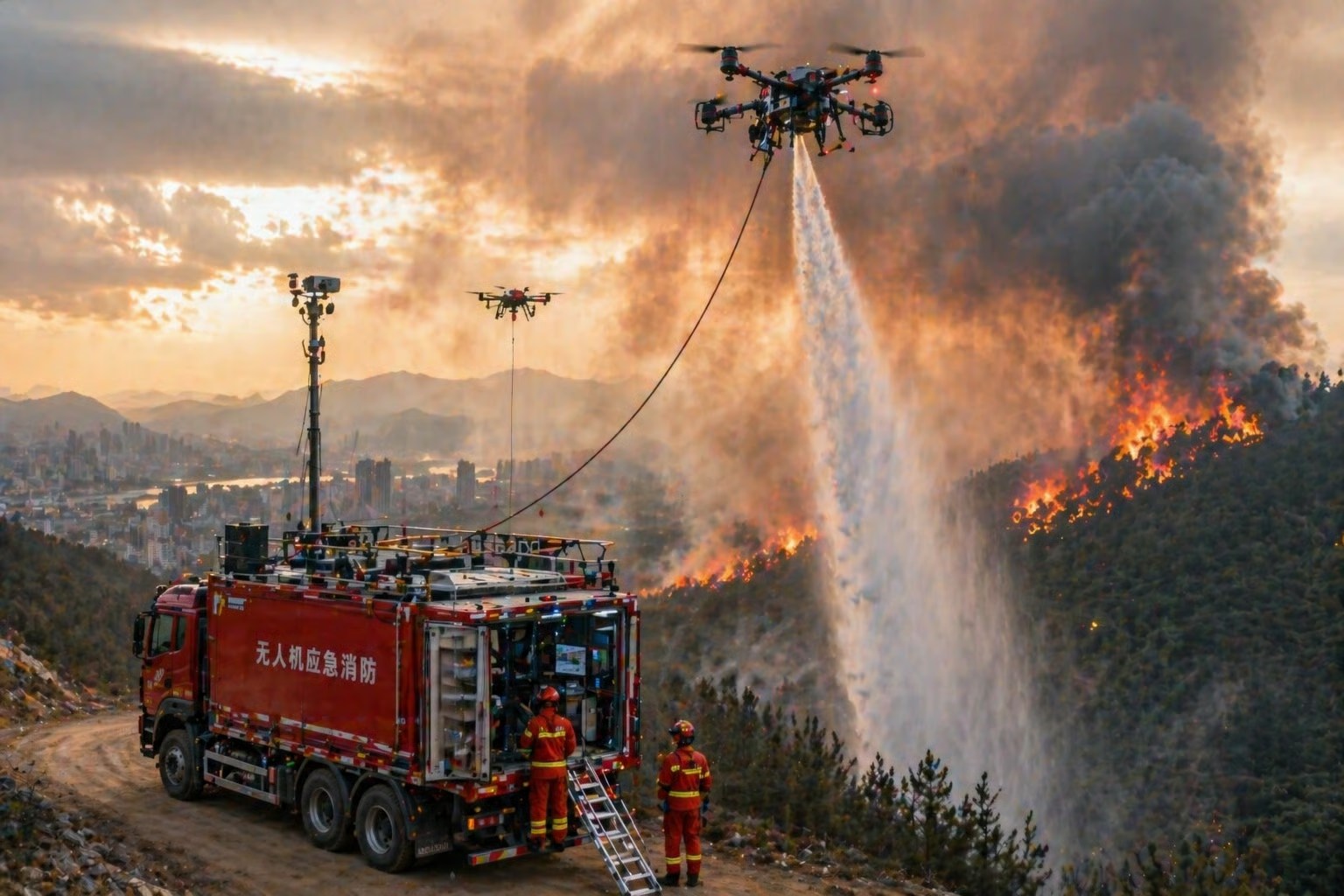
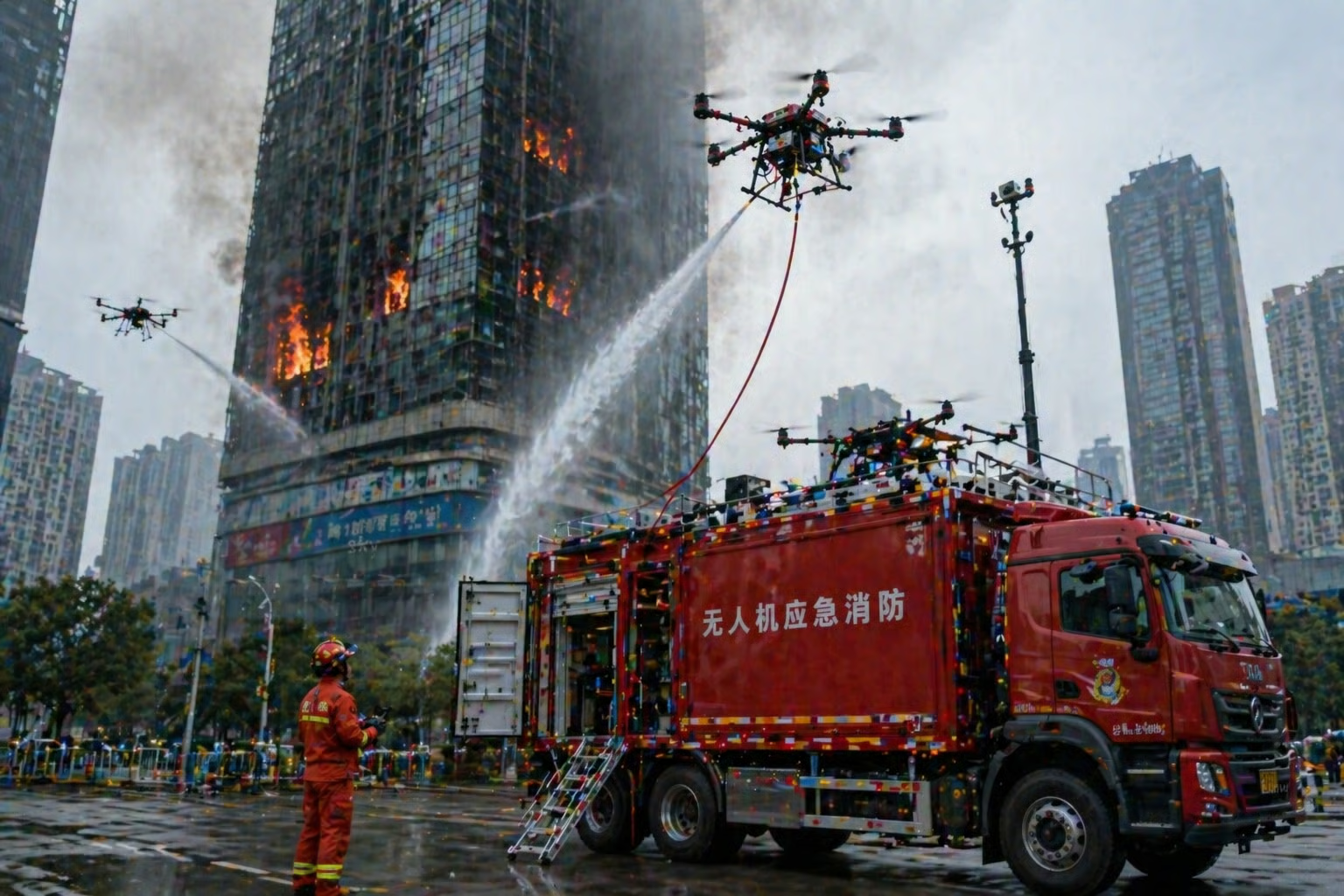 Image-R.E.News©
Longtemps, l’avenir de la lutte contre les incendies par drones s’est écrit autour d’essaims autonomes, capables de couvrir de vastes territoires avec rapidité et intelligence collective. Mais une autre trajectoire, plus pragmatique, s’impose aujourd’hui. En Chine, les drones ne sont plus seulement des outils mobiles : ils deviennent des extensions directes de l’infrastructure d’intervention.
De la mobilité à la permanence
Portées par des acteurs comme China Aerospace Science and Industry Corporation ou Norinco, ces nouvelles solutions reposent sur des unités mobiles intégrées : camions lourds équipés de modules conteneurisés, capables de déployer en quelques minutes une flotte de drones spécialisés.
Mais la véritable rupture réside dans l’usage de drones captifs. Reliés physiquement au véhicule par un câble, ces UAV ne dépendent plus de leurs batteries. Ils deviennent des plateformes aériennes permanentes, capables de rester en vol sans limite de temps.
Ce changement de paradigme est fondamental : il ne s’agit plus d’atteindre plus loin, mais de tenir plus longtemps.
Le câble, nouvel atout stratégique
À première vue, le câble peut sembler contradictoire avec l’idée même de drone. Pourtant, dans un environnement incendie, il apporte des avantages décisifs.
Endurance continue : alimentation directe depuis le sol, supprimant la contrainte énergétique
Communication stable : flux de données sécurisé, même dans la fumée dense ou les zones perturbées
Capacité d’action prolongée : possibilité d’acheminer eau ou mousse via le tether
Dans certaines configurations, le drone devient littéralement une lance à incendie volante, capable d’intervenir en hauteur de manière continue — un atout majeur pour les immeubles ou les sites industriels complexes.
Une approche hybride : flexibilité et persistance
Ces systèmes ne remplacent pas les drones autonomes, ils les complètent. Le modèle qui émerge est hybride :
Les drones captifs assurent une présence constante, une surveillance continue et une suppression prolongée
Les drones libres interviennent rapidement sur des foyers secondaires ou des zones éloignées
Des fabricants comme EHang ou MMC UAV explorent déjà cette complémentarité, dessinant une réponse multi-niveaux adaptée aux réalités du terrain.
Vers une industrialisation de la réponse d’urgence
Au-delà de la technologie, c’est la logique de déploiement qui évolue. Ces solutions ne sont plus des assemblages improvisés sur site, mais des systèmes clés en main, intégrant drones, énergie, contrôle et logistique dans une seule plateforme.
Cette approche marque une étape vers l’industrialisation de la robotique d’intervention. Le drone n’est plus un équipement isolé, mais un maillon d’un système complet, prêt à opérer immédiatement.
Des applications bien au-delà des feux de forêt
Si les premiers scénarios concernaient les incendies de grande ampleur, ces systèmes trouvent aujourd’hui leur pertinence dans des contextes variés :
Milieux urbains : intervention sur immeubles de grande hauteur
Sites industriels : gestion des risques dans des environnements dangereux
Zones difficiles d’accès : réponse rapide sans infrastructure préalable
Dans ces situations, la capacité à maintenir une action continue prime souvent sur la portée maximale.
Une innovation guidée par le réel
Certes, le tether limite le rayon d’action. Mais il apporte en échange fiabilité, stabilité et efficacité immédiate. Un compromis assumé, qui reflète une évolution plus large de l’ingénierie : concevoir non pas pour le potentiel théorique, mais pour l’efficacité opérationnelle.
En transformant les drones en infrastructures aériennes temporaires, la Chine esquisse une nouvelle manière de penser la gestion des urgences. Moins spectaculaire que les essaims autonomes, mais sans doute plus adaptée aux contraintes du terrain.
Dans la lutte contre les incendies, l’innovation ne consiste pas toujours à voler plus loin. Parfois, elle consiste simplement à rester là où l’on est vraiment utile — et à y rester le temps qu’il faut.
NJC.© Info China Aerospace Science and Industry Corporation and Norinco Manufacturers like EHang and MMC UAV
--------------------------------------------------------------------------------------------------------------------
28/04/26-English
Tethered Drones: When Firefighting Becomes an Aerial Infrastructure
Image-R.E.News©
For a long time, the future of firefighting by drones revolved around autonomous swarms, capable of covering vast territories with speed and collective intelligence. But a different, more pragmatic approach is now emerging. In China, drones are no longer just mobile tools: they are becoming direct extensions of the firefighting infrastructure.
From Mobility to Permanence
Driven by companies like China Aerospace Science and Industry Corporation and Norinco, these new solutions rely on integrated mobile units: heavy trucks equipped with containerized modules, capable of deploying a fleet of specialized drones in minutes.
But the real breakthrough lies in the use of tethered drones. Physically connected to the vehicle by a cable, these UAVs are no longer dependent on their batteries. They become permanent aerial platforms, capable of remaining airborne indefinitely.
This paradigm shift is fundamental: it's no longer about reaching further, but about lasting longer.
The tether, a new strategic asset
At first glance, the tether may seem contradictory to the very idea of a drone. Yet, in a firefighting environment, it offers decisive advantages.
Continuous endurance: direct power supply from the ground, eliminating energy constraints
Stable communication: secure data flow, even in dense smoke or disturbed areas
Extended operational capability: the ability to deliver water or foam via the tether
In certain configurations, the drone literally becomes a flying fire hose, capable of continuous intervention at height—a major asset for buildings or complex industrial sites.
A hybrid approach: flexibility and persistence
These systems do not replace autonomous drones; they complement them. The emerging model is hybrid:
Tethered drones ensure a constant presence, continuous surveillance, and extended suppression.
Free-roaming drones intervene rapidly in secondary hotspots or remote areas.
Manufacturers like EHang and MMC UAV are already exploring this complementarity, developing a multi-level response adapted to real-world conditions.
Toward the Industrialization of Emergency Response
Beyond the technology, the deployment logic is evolving. These solutions are no longer improvised on-site assemblies, but turnkey systems integrating drones, power, control, and logistics into a single platform.
This approach marks a step toward the industrialization of intervention robotics. The drone is no longer an isolated piece of equipment, but a link in a complete system, ready to operate immediately.
Applications Far Beyond Forest Fires
While initial scenarios focused on large-scale fires, these systems are now proving useful in a variety of contexts:
Urban environments: intervention on high-rise buildings
Industrial sites: risk management in hazardous environments
Hard-to-access areas: rapid response without prior infrastructure
In these situations, the ability to maintain continuous operation often takes precedence over maximum range.
An Innovation Driven by Reality
While tethering does limit the operational range, it offers reliability, stability, and immediate effectiveness in return. This deliberate compromise reflects a broader evolution in engineering: designing not for theoretical potential, but for operational efficiency.
By transforming drones into temporary aerial infrastructure, China is outlining a new approach to emergency management. Less spectacular than autonomous swarms, but undoubtedly better suited to the constraints of the terrain.
In firefighting, innovation isn't always about flying farther. Sometimes it's simply about staying where you're truly needed—and staying there as long as necessary.
NJC.© Info China Aerospace Science and Industry Corporation and Norinco Manufacturers like EHang and MMC UAV
----------------------------------------------------------------------------------------------------------------
28/04/26-NL
Drones met kabel: Wanneer brandbestrijding een luchtinfrastructuur wordt
Image-R.E.News©
Lange tijd draaide de toekomst van brandbestrijding met drones om autonome zwermen, die in staat waren om enorme gebieden snel en met collectieve intelligentie te bestrijken. Maar er ontstaat nu een andere, meer pragmatische aanpak. In China zijn drones niet langer alleen mobiele hulpmiddelen: ze worden een directe uitbreiding van de brandbestrijdingsinfrastructuur.
Van mobiliteit naar permanentie
Deze nieuwe oplossingen, gedreven door bedrijven als China Aerospace Science and Industry Corporation en Norinco, zijn gebaseerd op geïntegreerde mobiele eenheden: zware vrachtwagens uitgerust met containermodules, die in staat zijn om binnen enkele minuten een vloot gespecialiseerde drones in te zetten.
Maar de echte doorbraak zit hem in het gebruik van drones met kabel. Deze UAV's, fysiek verbonden met het voertuig door een kabel, zijn niet langer afhankelijk van hun batterijen. Ze worden permanente luchtplatformen, die onbeperkt in de lucht kunnen blijven.
Deze paradigmaverschuiving is fundamenteel: het gaat niet langer om verder reiken, maar om langer meegaan.
De kabel, een nieuwe strategische troef
Op het eerste gezicht lijkt de kabel misschien in tegenspraak met het idee van een drone. Toch biedt het in een brandbestrijdingsomgeving doorslaggevende voordelen.
Continue inzetbaarheid: directe stroomvoorziening vanaf de grond, waardoor energiebeperkingen worden geëlimineerd.
Stabiele communicatie: veilige gegevensoverdracht, zelfs in dichte rook of in onrustige gebieden.
Uitgebreide operationele mogelijkheden: de mogelijkheid om water of schuim via de kabel te leveren.
In bepaalde configuraties wordt de drone letterlijk een vliegende brandslang, in staat tot continue interventie op hoogte – een belangrijke troef voor gebouwen of complexe industriële complexen.
Een hybride aanpak: flexibiliteit en persistentie
Deze systemen vervangen autonome drones niet; ze vullen ze aan. Het opkomende model is hybride:
Drones met een kabel garanderen een constante aanwezigheid, continue bewaking en langdurige bluswerkzaamheden.
Vrij vliegende drones grijpen snel in op secundaire brandhaarden of afgelegen gebieden.
Fabrikanten zoals EHang en MMC UAV onderzoeken deze complementariteit al en ontwikkelen een respons op meerdere niveaus, aangepast aan de omstandigheden in de praktijk.
Op weg naar de industrialisatie van noodhulp
Naast de technologie evolueert ook de implementatielogica. Deze oplossingen zijn niet langer geïmproviseerde, ter plekke op te zetten systemen, maar kant-en-klare systemen die drones, stroomvoorziening, besturing en logistiek integreren in één platform.
Deze aanpak markeert een stap richting de industrialisatie van interventierobots. De drone is niet langer een losstaand apparaat, maar een schakel in een compleet systeem dat direct inzetbaar is.
Toepassingen die veel verder reiken dan bosbranden
Hoewel de eerste scenario's zich richtten op grootschalige branden, blijken deze systemen nu nuttig in diverse contexten:
Stedelijke omgevingen: interventie bij hoogbouw
Industriële locaties: risicobeheer in gevaarlijke omgevingen
Moeilijk toegankelijke gebieden: snelle respons zonder voorafgaande infrastructuur
In deze situaties heeft de mogelijkheid om continu te blijven opereren vaak voorrang boven een maximaal bereik.
Een innovatie gedreven door de realiteit
Hoewel de kabelverbinding het operationele bereik beperkt, biedt deze in ruil daarvoor betrouwbaarheid, stabiliteit en onmiddellijke effectiviteit. Dit weloverwogen compromis weerspiegelt een bredere evolutie in de techniek: ontwerpen niet voor theoretisch potentieel, maar voor operationele efficiëntie.
Door drones te transformeren tot tijdelijke luchtinfrastructuur schetst China een nieuwe aanpak voor noodbeheer. Minder spectaculair dan autonome zwermen, maar ongetwijfeld beter geschikt voor de beperkingen van het terrein.
Bij brandbestrijding draait innovatie niet altijd om verder vliegen. Soms gaat het er simpelweg om te blijven waar je echt nodig bent – en daar te blijven zolang als nodig is.
NJC.© Info China Aerospace Science and Industry Corporation and Norinco Manufacturers like EHang and MMC UAV
-------------------------------------------------------------------------------------------------------------------
Date de dernière mise à jour : 27/04/2026