



R.E.News future Technology-CoreWeave Takes Physical AI Into the Engineering Department
 21/09/26-FR-English-NL-footer
COREWEAVE L’IA entre dans l’atelier
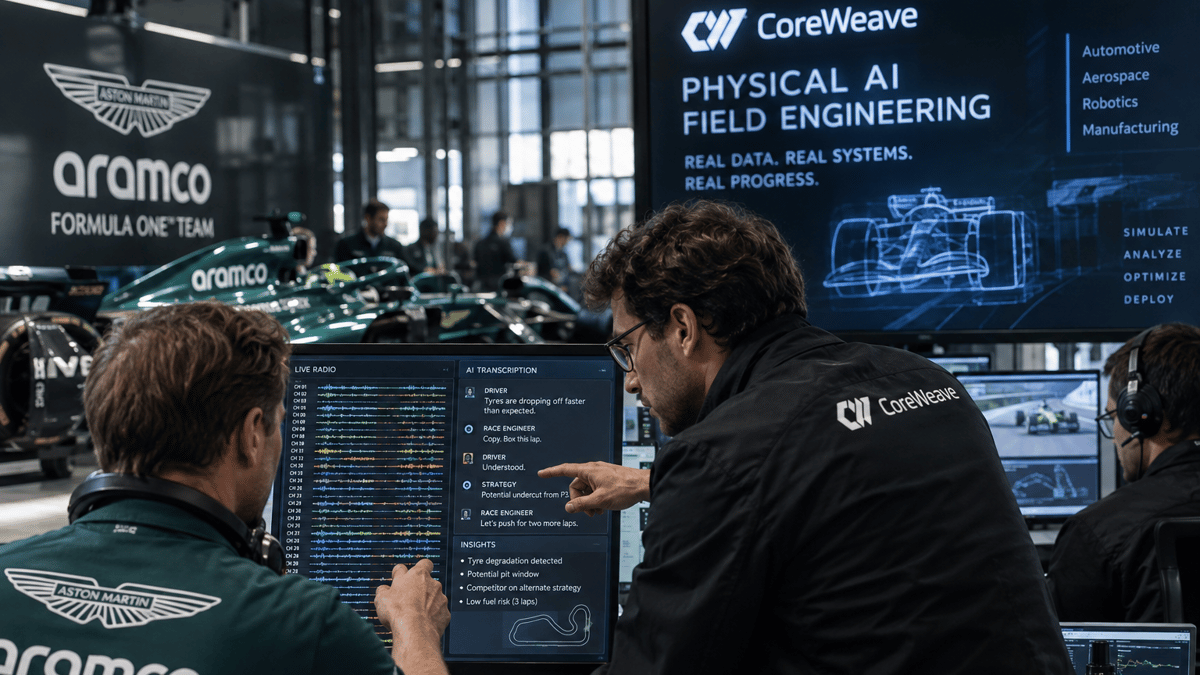 Image-creation R.E.News© via IA chat GPT
Et si l’intelligence artificielle cessait d’observer les machines pour commencer à les comprendre ?
Avec Physical AI Field Engineering, CoreWeave franchit une nouvelle frontière : ses ingénieurs spécialisés en automobile, aéronautique et mécanique rejoignent directement les équipes industrielles pour transformer capteurs, télémétrie, simulations et données d’essais en modèles d’IA conçus autour de problèmes réels.
L’approche est radicalement différente : on ne part plus d’un modèle à la recherche d’une application, mais d’un problème d’ingénierie à résoudre.
Déjà déployée sur plus de 100 projets, cette méthode rapproche deux mondes longtemps séparés — l’expertise physique de l’ingénieur et la puissance du machine learning.
L’expérience menée avec Aston Martin Aramco Formula One Team en donne une démonstration spectaculaire : 40 canaux radio analysés simultanément, un modèle affiné à travers 75 itérations et capable de transformer en quelques secondes les communications de course en informations exploitables.
Cette évolution trouve ses racines dans l’acquisition de Monolith AI, spécialiste de l’IA appliquée à l’ingénierie. CoreWeave assemble désormais calcul haute performance, simulation, gestion des modèles et expertise métier au sein d’un même écosystème.
Dans l’industrie, l’enjeu n’est pourtant pas de produire davantage d’IA. Il est de produire une IA capable de résister à l’épreuve du réel : vibrations, température, charges, matériaux, tolérances, défaillances.
La prochaine révolution industrielle pourrait ainsi commencer non pas dans le cloud, mais au contact direct de la machine.
NJC.© Info https://www.coreweave.com/
--------------------------------------------------------------------------------------------------------------
21/09/26-English
COREWEAVE AI Enters the Workshop
Image-creation R.E.News© via IA chat GPT
What if artificial intelligence stopped observing machines and started understanding them?
With Physical AI Field Engineering, CoreWeave is crossing a new frontier: its engineers specializing in automotive, aerospace, and mechanical engineering are directly joining industrial teams to transform sensors, telemetry, simulations, and test data into AI models designed around real-world problems.
The approach is radically different: instead of starting with a model and searching for an application, the focus is on solving an engineering problem.
Already deployed on more than 100 projects, this method bridges two long-separated worlds—the physical expertise of the engineer and the power of machine learning.
The experience conducted with the Aston Martin Aramco Formula One Team provides a spectacular demonstration: 40 radio channels analyzed simultaneously, a model refined through 75 iterations, and capable of transforming race communications into actionable information in just a few seconds.
This evolution stems from the acquisition of Monolith AI, a specialist in AI applied to engineering. CoreWeave now integrates high-performance computing, simulation, model management, and business expertise within a single ecosystem.
In industry, however, the challenge is not to produce more AI. It is to produce AI capable of withstanding the realities of the environment: vibrations, temperature, loads, materials, tolerances, and failures.
The next industrial revolution could thus begin not in the cloud, but with direct interaction with the machine.
NJC.© Info https://www.coreweave.com/
-----------------------------------------------------------------------------------------------------------------
21/09/26-NL
COREWEAVE AI betreedt de werkplaats
Image-creation R.E.News© via IA chat GPT
Wat als kunstmatige intelligentie zou stoppen met het observeren van machines en ze zou gaan begrijpen?
Met Physical AI Field Engineering betreedt CoreWeave een nieuwe grens: de ingenieurs, gespecialiseerd in de automobiel-, luchtvaart- en werktuigbouwkunde, werken rechtstreeks samen met industriële teams om sensoren, telemetrie, simulaties en testgegevens om te zetten in AI-modellen die zijn ontworpen rondom problemen uit de praktijk.
De aanpak is radicaal anders: in plaats van te beginnen met een model en te zoeken naar een toepassing, ligt de focus op het oplossen van een technisch probleem.
Deze methode, die al in meer dan 100 projecten is toegepast, overbrugt twee werelden die lange tijd van elkaar gescheiden waren: de fysieke expertise van de ingenieur en de kracht van machine learning.
De ervaring met het Aston Martin Aramco Formule 1-team is een spectaculair voorbeeld: 40 radiokanalen werden gelijktijdig geanalyseerd, een model werd verfijnd door 75 iteraties en kon racecommunicatie in slechts enkele seconden omzetten in bruikbare informatie.
Deze ontwikkeling is het resultaat van de overname van Monolith AI, een specialist in AI toegepast op de techniek. CoreWeave integreert nu high-performance computing, simulatie, modelbeheer en bedrijfsexpertise binnen één ecosysteem.
In de industrie ligt de uitdaging echter niet in het produceren van meer AI, maar in het produceren van AI die bestand is tegen de realiteit van de omgeving: trillingen, temperatuur, belastingen, materialen, toleranties en storingen.
De volgende industriële revolutie zou dus niet in de cloud kunnen beginnen, maar met directe interactie met de machine.
NJC.© Info https://www.coreweave.com/
-----------------------------------------------------------------------------------------------------------------
Date de dernière mise à jour : 18/09/2026