



R.E.News future Technology-From Laboratory Alloy to Working Engine in Just Four Years
 18/08/26-FR-English-NL-footer
De l’alliage de laboratoire au moteur de demain
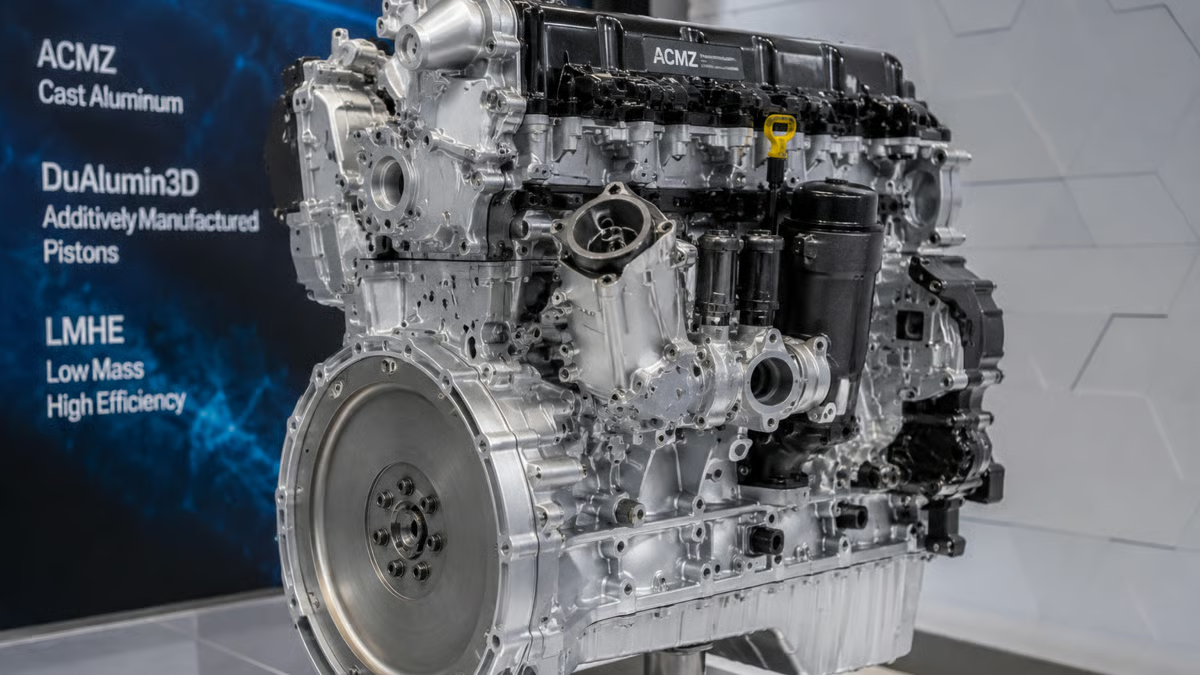 Image creation R.E.News© via IA chat GPT
Il aura fallu quatre ans pour accomplir ce que l’industrie mettait autrefois plus d’une décennie à réaliser : transformer une idée née en laboratoire en un moteur capable de travailler.
À Oak Ridge, aux États-Unis, chercheurs et industriels ont développé deux alliages d’aluminium qui pourraient discrètement changer l’équation du moteur thermique. Associés dans un moteur moyen tonnage de General Motors, ils permettent d’atteindre environ 15 % de réduction de poids et plus de 10 % de gain d’efficacité énergétique.
Mais le véritable exploit n’est pas là.
Il se trouve dans le temps.
Traditionnellement, concevoir, tester et qualifier un nouvel alliage structurel peut demander 10 à 15 ans. Oak Ridge affirme avoir ramené ce parcours à deux à quatre ans, grâce à une combinaison de simulation numérique, thermodynamique, imagerie avancée et essais ciblés.
La matière n’est plus seulement découverte. Elle est désormais conçue.
Le premier alliage, ACMZ, associe aluminium, cuivre, manganèse et zirconium. Destiné au bloc et aux culasses, il conserve sa résistance à des températures nettement supérieures à celles supportées par les alliages automobiles traditionnels.
Le second, DuAlumin3D, va encore plus loin. Pensé dès l’origine pour la fabrication additive, il résiste à des températures proches de 400 °C et ouvre la porte à des pièces complexes, plus légères et potentiellement impossibles à produire avec les méthodes conventionnelles.
C’est peut-être ici que se cache la prochaine révolution industrielle : ne plus adapter un matériau à une machine, mais concevoir le matériau pour le procédé de fabrication lui-même.
Pour les camions moyen tonnage, les conséquences sont très concrètes. Ces véhicules alimentent les chantiers sous forme de bennes, véhicules de service ou plateformes spécialisées. Chaque kilogramme économisé peut améliorer la charge utile ; chaque litre de carburant économisé se transforme en marge supplémentaire.
Et lorsqu’une technologie permet ces gains sans bouleverser l’architecture complète d’un véhicule, son potentiel industriel devient considérable.
Le projet Oak Ridge–GM, récompensé notamment par un R&D 100 Award, dépasse donc largement le cadre d’un moteur expérimental. Il révèle une nouvelle manière de penser l’innovation : accélérer la matière avant même d’accélérer la machine.
Pendant des décennies, l’industrie a demandé aux ingénieurs de faire mieux avec les matériaux disponibles. Désormais, elle peut commencer à leur demander de créer les matériaux dont elle aura besoin demain.
NJC.© Info https://www.ornl.gov/ https://www.gm.com/
--------------------------------------------------------------------------------------------------------------
18/08/26-English
From Laboratory Alloy to the Engine of Tomorrow
Image creation R.E.News© via IA chat GPT
It took four years to accomplish what the industry once took more than a decade to achieve: transforming an idea born in the laboratory into a working engine.
In Oak Ridge, USA, researchers and manufacturers have developed two aluminum alloys that could quietly change the equation for the internal combustion engine. Combined in a medium-tonnage General Motors engine, they enable a weight reduction of approximately 15% and a fuel efficiency gain of more than 10%.
But the real achievement lies elsewhere.
It lies in the time.
Traditionally, designing, testing, and qualifying a new structural alloy can take 10 to 15 years. Oak Ridge claims to have reduced this process to two to four years, thanks to a combination of numerical simulation, thermodynamics, advanced imaging, and targeted testing.
The material is no longer just discovered. It is now engineered.
The first alloy, ACMZ, combines aluminum, copper, manganese, and zirconium. Designed for engine blocks and cylinder heads, it maintains its resistance at temperatures significantly higher than those withstood by traditional automotive alloys.
The second, DuAlumin3D, goes even further. Conceived from the outset for additive manufacturing, it withstands temperatures close to 400°C and opens the door to complex, lighter parts that are potentially impossible to produce using conventional methods.
This may well be where the next industrial revolution lies: no longer adapting a material to a machine, but designing the material for the manufacturing process itself.
For medium-duty trucks, the consequences are very tangible. These vehicles supply construction sites in the form of tippers, service vehicles, or specialized platforms. Every kilogram saved can improve payload; every liter of fuel saved translates into additional profit.
And when a technology enables these gains without fundamentally altering a vehicle's architecture, its industrial potential becomes considerable.
The Oak Ridge–GM project, recognized with an R&D 100 Award, goes far beyond the scope of an experimental engine. It reveals a new way of thinking about innovation: accelerating the material itself before even accelerating the machine.
For decades, industry has asked engineers to do better with the materials available. Now, it can begin asking them to create the materials it will need tomorrow.
NJC.© Info https://www.ornl.gov/ https://www.gm.com/
------------------------------------------------------------------------------------------------------------------
18/08/26-NL
Van laboratoriumlegering tot de motor van de toekomst
Image creation R.E.News© via IA chat GPT
Het duurde vier jaar om te bereiken wat de industrie ooit meer dan tien jaar kostte: een idee dat in het laboratorium was ontstaan, omzetten in een werkende motor.
In Oak Ridge, VS, hebben onderzoekers en fabrikanten twee aluminiumlegeringen ontwikkeld die de verbrandingsmotor in stilte zouden kunnen veranderen. Gecombineerd in een General Motors-motor van gemiddelde omvang, zorgen ze voor een gewichtsvermindering van ongeveer 15% en een brandstofbesparing van meer dan 10%.
Maar de echte prestatie ligt elders.
Die zit hem in de tijd.
Traditioneel kan het ontwerpen, testen en kwalificeren van een nieuwe constructielegering 10 tot 15 jaar duren. Oak Ridge beweert dit proces te hebben teruggebracht tot twee tot vier jaar, dankzij een combinatie van numerieke simulatie, thermodynamica, geavanceerde beeldvorming en gerichte tests.
Het materiaal is niet langer alleen ontdekt. Het is nu ontwikkeld.
De eerste legering, ACMZ, combineert aluminium, koper, mangaan en zirkonium. Ontworpen voor motorblokken en cilinderkoppen, behoudt het zijn weerstand bij temperaturen die aanzienlijk hoger liggen dan die van traditionele auto-legeringen.
De tweede, DuAlumin3D, gaat nog een stap verder. Van meet af aan ontworpen voor additive manufacturing, is het bestand tegen temperaturen van bijna 400 °C en maakt het de productie mogelijk van complexere, lichtere onderdelen die met conventionele methoden onmogelijk te produceren zijn.
Hier ligt wellicht de volgende industriële revolutie: niet langer een materiaal aanpassen aan een machine, maar het materiaal ontwerpen voor het productieproces zelf.
Voor middelzware vrachtwagens zijn de gevolgen zeer tastbaar. Deze voertuigen bevoorraden bouwplaatsen in de vorm van kippers, servicevoertuigen of gespecialiseerde platforms. Elke bespaarde kilogram kan het laadvermogen verhogen; elke bespaarde liter brandstof vertaalt zich in extra winst.
En wanneer een technologie deze voordelen mogelijk maakt zonder de architectuur van een voertuig fundamenteel te veranderen, wordt het industriële potentieel aanzienlijk.
Het Oak Ridge-GM-project, bekroond met een R&D 100 Award, gaat veel verder dan een experimentele motor. Het onthult een nieuwe manier van denken over innovatie: het materiaal zelf versnellen, nog voordat de machine versneld wordt.
Al decennialang vraagt de industrie ingenieurs om het beste uit de beschikbare materialen te halen. Nu kan ze hen vragen om de materialen te creëren die ze morgen nodig zal hebben.
NJC.© Info https://www.ornl.gov/ https://www.gm.com/
-----------------------------------------------------------------------------------------------------------------
Date de dernière mise à jour : 18/08/2026