












R.E.News future Technology-Geothermal Monitoring Breakthrough Reaches New Depths
 13/04/26-FR-English-NL-footer
Géothermie : voir l’invisible pour libérer l’énergie du futur
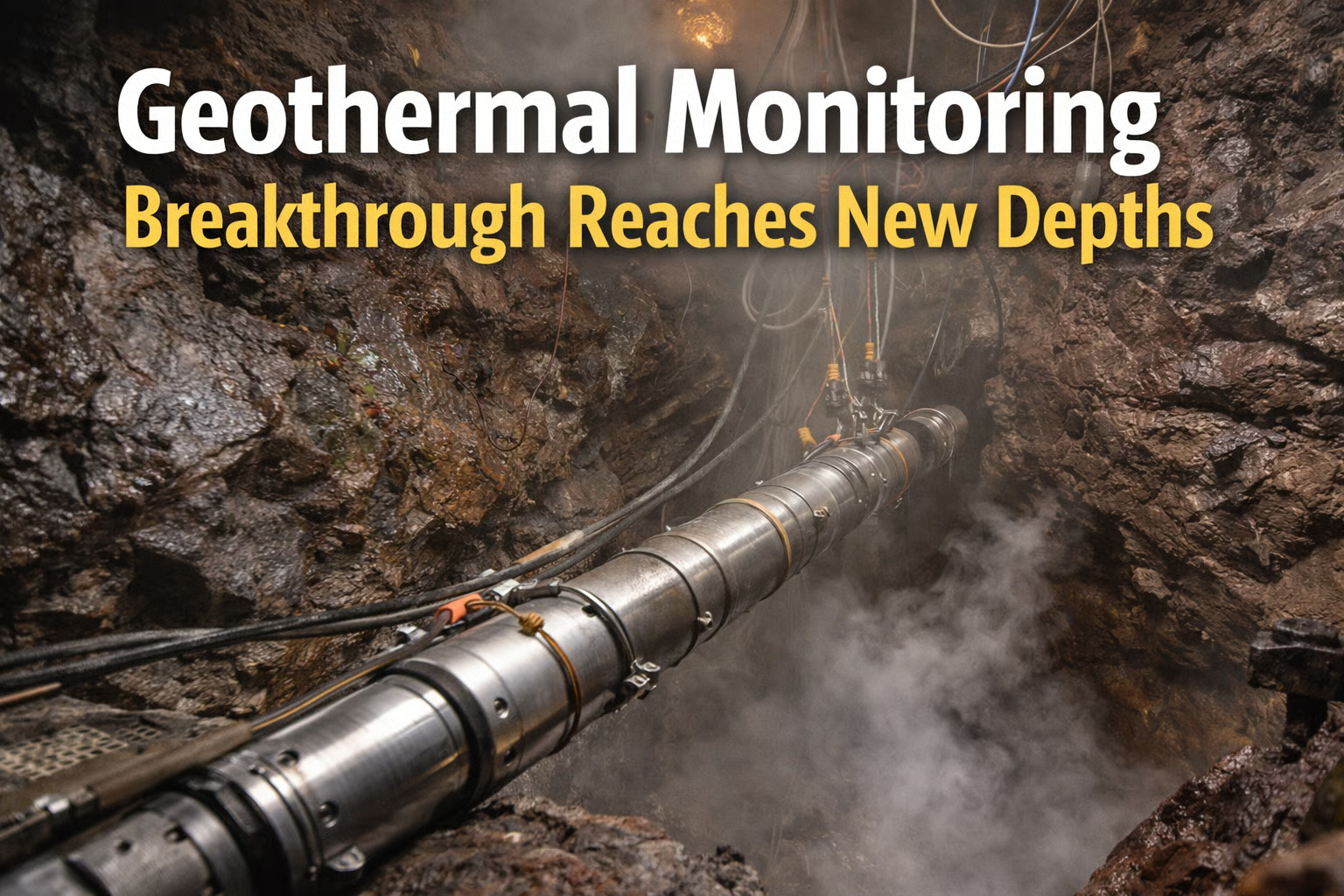 Image-R.E.News©
Dans la grande course mondiale vers une énergie décarbonée et pilotable, la géothermie sort enfin de l’ombre. Longtemps cantonnée à des niches géographiques, elle s’impose aujourd’hui comme une solution crédible de production continue — à condition de lever un verrou majeur : comprendre, en temps réel, ce qui se passe à plusieurs kilomètres sous nos pieds.
C’est précisément ce cap que viennent de franchir les équipes du Lawrence Berkeley National Laboratory et de Fervo Energy. Sur le site de Cape Station, dans l’Utah, elles ont réalisé une première mondiale : le plus long enregistrement sismique continu en environnement géothermique à haute température.
Une percée technologique à 2 000 mètres sous terre
Pendant sept mois, un capteur de nouvelle génération a fonctionné à près de 7 000 pieds (≈2 100 m) de profondeur, dans des conditions extrêmes atteignant 338°F (≈170°C) — bien au-delà des standards précédents.
Ce succès n’est pas anecdotique. Il répond à un défi central des systèmes géothermiques améliorés (EGS) :
maîtriser les fractures artificielles dans la roche pour créer un échangeur thermique souterrain performant.
Jusqu’ici, faute de données continues, les opérateurs naviguaient à vue. Désormais, chaque micro-séisme devient une information exploitable, dessinant en temps réel la cartographie dynamique du réservoir.
De la donnée au contrôle : vers une géothermie pilotée
Cette avancée transforme profondément l’exploitation géothermique :
Optimisation des injections de fluide pour maximiser la production de vapeur
Réduction des risques sismiques grâce à une meilleure anticipation
Allongement de la durée de vie des réservoirs
Amélioration du rendement énergétique global
En clair, la géothermie passe d’un modèle empirique à une industrie pilotée par la donnée, où chaque décision s’appuie sur une compréhension fine du sous-sol.
Cape Station : laboratoire d’une énergie industrielle
Le site de Cape Station s’impose comme un démonstrateur grandeur nature. L’ambition est claire :
100 MW dès 2026
jusqu’à 500 MW à terme, en production continue
À cette échelle, la géothermie change de statut : elle devient un pilier de stabilité pour les réseaux électriques, capable de compenser l’intermittence du solaire et de l’éolien.
L’ère de la géothermie augmentée
Cette percée s’inscrit dans une tendance plus large : l’industrialisation des infrastructures énergétiques via la technologie.
Capteurs haute température, modélisation avancée, intelligence artificielle…
la géothermie entre dans une nouvelle phase, où robotique, data et énergie convergent.
Résultat :
des projets plus sûrs
des coûts mieux maîtrisés
une reproductibilité à grande échelle
Une ressource mondiale enfin accessible
Contrairement aux idées reçues, la chaleur terrestre est quasi universelle. Ce qui manquait jusqu’ici, ce n’était pas la ressource… mais la capacité à l’exploiter efficacement.
Avec ces nouveaux outils, l’EGS ouvre la voie à une géothermie déployable bien au-delà des zones historiques comme la Californie ou l’Islande — vers l’Europe, l’Afrique de l’Est ou l’Asie du Sud-Est.
Une révolution silencieuse… mais structurante
En rendant visible l’invisible, cette innovation redéfinit les fondations mêmes de la production énergétique.
Moins spectaculaire que les éoliennes offshore ou les méga-centrales solaires, la géothermie avancée pourrait pourtant devenir l’un des socles les plus fiables de la transition énergétique.
Car au cœur des systèmes électriques de demain, une certitude s’impose :
la stabilité vaut autant que la puissance.
NJC.© Info Lawrence Berkeley National Laboratory Fervo Energy
-----------------------------------------------------------------------------------------------------------------
13/04/26-English
Geothermal Energy: Seeing the Invisible to Unleash the Energy of the Future
Image-R.E.News©
In the global race toward decarbonized and dispatchable energy, geothermal energy is finally emerging from the shadows. Long confined to specific geographic areas, it is now establishing itself as a credible solution for continuous energy production—provided a major obstacle is overcome: understanding, in real time, what is happening several kilometers beneath our feet.
This is precisely the hurdle that teams from Lawrence Berkeley National Laboratory and Fervo Energy have just cleared. At the Cape Station site in Utah, they achieved a world first: the longest continuous seismic recording in a high-temperature geothermal environment.
A Technological Breakthrough 2,000 Meters Underground
For seven months, a next-generation sensor operated at a depth of nearly 7,000 feet (approximately 2,100 m), in extreme conditions reaching 338°F (approximately 170°C)—far exceeding previous standards.
This success is not insignificant. It addresses a central challenge for enhanced geothermal systems (EGS):
controlling artificial fractures in the rock to create a high-performance underground heat exchanger.
Until now, due to a lack of continuous data, operators were operating blindly. Now, each micro-earthquake becomes actionable information, creating a real-time dynamic map of the reservoir.
From data to control: towards managed geothermal energy
This advancement is profoundly transforming geothermal energy production:
Optimization of fluid injections to maximize steam production
Reduction of seismic risks through better anticipation
Extended reservoir lifespan
Improved overall energy efficiency
In short, geothermal energy is shifting from an empirical model to a data-driven industry, where every decision is based on a detailed understanding of the subsurface.
Cape Station: A Laboratory for Industrial Energy
The Cape Station site is emerging as a full-scale demonstrator. The ambition is clear:
100 MW by 2026
up to 500 MW in the long term, with continuous production
At this scale, geothermal energy changes status: it becomes a pillar of stability for electrical grids, capable of compensating for the intermittency of solar and wind power.
The Era of Augmented Geothermal Energy
This breakthrough is part of a broader trend: the industrialization of energy infrastructure through technology.
High-temperature sensors, advanced modeling, artificial intelligence…
geothermal energy is entering a new phase, where robotics, data, and energy converge.
The result:
safer projects
better controlled costs
large-scale reproducibility
A finally accessible global resource
Contrary to popular belief, geothermal heat is virtually universal. What was lacking until now wasn't the resource itself… but the ability to harness it effectively.
With these new tools, EGS is paving the way for geothermal energy to be deployed far beyond traditional areas like California or Iceland—towards Europe, East Africa, and Southeast Asia.
A silent… but transformative revolution
By making the invisible visible, this innovation is redefining the very foundations of energy production.
Less spectacular than offshore wind turbines or mega solar power plants, advanced geothermal energy could nevertheless become one of the most reliable cornerstones of the energy transition.
Because at the heart of tomorrow's electrical systems, one certainty is paramount:
stability is just as important as power.
NJC.© Info Lawrence Berkeley National Laboratory Fervo Energy
--------------------------------------------------------------------------------------------------------------
13/04/26-NL
Geothermische energie: het onzichtbare zichtbaar maken om de energie van de toekomst te ontsluiten
Image-R.E.News©
In de wereldwijde race naar koolstofarme en regelbare energie komt geothermische energie eindelijk uit de schaduw. Lange tijd beperkt tot specifieke geografische gebieden, vestigt het zich nu als een geloofwaardige oplossing voor continue energieproductie – mits een belangrijk obstakel wordt overwonnen: realtime inzicht krijgen in wat er zich kilometers onder onze voeten afspeelt.
Precies die horde hebben teams van het Lawrence Berkeley National Laboratory en Fervo Energy zojuist genomen. Op de Cape Station-locatie in Utah realiseerden ze een wereldprimeur: de langste continue seismische registratie in een geothermische omgeving met hoge temperaturen.
Een technologische doorbraak op 2000 meter onder de grond
Zeven maanden lang functioneerde een geavanceerde sensor op een diepte van bijna 2100 meter, onder extreme omstandigheden met temperaturen tot 170 °C – ver boven de voorgaande normen.
Dit succes is niet onbeduidend. Het pakt een centrale uitdaging aan voor verbeterde geothermische systemen (EGS):
het beheersen van kunstmatige breuken in het gesteente om een hoogwaardige ondergrondse warmtewisselaar te creëren.
Tot nu toe werkten operators blindelings vanwege een gebrek aan continue data. Nu wordt elke micro-aardbeving omgezet in bruikbare informatie, waardoor een realtime dynamische kaart van het reservoir ontstaat.
Van data naar controle: op weg naar beheerde geothermische energie
Deze vooruitgang transformeert de geothermische energieproductie ingrijpend:
Optimalisatie van vloeistofinjecties om de stoomproductie te maximaliseren
Vermindering van seismische risico's door betere anticipatie
Verlengde levensduur van het reservoir
Verbeterde algehele energie-efficiëntie
Kortom, geothermische energie verschuift van een empirisch model naar een datagedreven industrie, waar elke beslissing gebaseerd is op een gedetailleerd begrip van de ondergrond.
Cape Station: een laboratorium voor industriële energie
De locatie Cape Station ontwikkelt zich tot een grootschalige demonstratie-installatie. De ambitie is duidelijk:
100 MW in 2026
tot 500 MW op de lange termijn, met continue productie
Op deze schaal verandert de status van geothermische energie: het wordt een pijler van stabiliteit voor elektriciteitsnetten, in staat om de wisselvalligheid van zonne- en windenergie te compenseren.
Het tijdperk van augmented geothermische energie
Deze doorbraak maakt deel uit van een bredere trend: de industrialisatie van energie-infrastructuur door middel van technologie.
Sensoren voor hoge temperaturen, geavanceerde modellering, kunstmatige intelligentie…
geothermische energie betreedt een nieuwe fase, waarin robotica, data en energie samenkomen.
Het resultaat:
veiligere projecten
beter beheersbare kosten
grootschalige reproduceerbaarheid
Eindelijk een toegankelijke wereldwijde bron
In tegenstelling tot wat vaak wordt gedacht, is geothermische warmte vrijwel overal beschikbaar. Wat tot nu toe ontbrak, was niet de bron zelf… maar het vermogen om deze effectief te benutten.
Met deze nieuwe tools effent EGS de weg voor de inzet van geothermische energie ver buiten de traditionele gebieden zoals Californië of IJsland – richting Europa, Oost-Afrika en Zuidoost-Azië.
Een stille… maar transformerende revolutie
Door het onzichtbare zichtbaar te maken, herdefinieert deze innovatie de fundamenten van energieproductie.
Minder spectaculair dan offshore windturbines of megazonne-energiecentrales, zou geavanceerde geothermische energie niettemin een van de meest betrouwbare hoekstenen van de energietransitie kunnen worden.
Want in het hart van de elektriciteitssystemen van morgen is één zekerheid van het grootste belang:
stabiliteit is net zo belangrijk als vermogen.
NJC.© Info Lawrence Berkeley National Laboratory Fervo Energy
-----------------------------------------------------------------------------------------------------------------
Date de dernière mise à jour : 13/04/2026