















R.E.News future Technology-Graphene Takes the Next Step Towards More Sustainable Industrial Innovation
 15/06/26-FR-English-NL-footer
Le graphène franchit une nouvelle étape vers une innovation industrielle durable
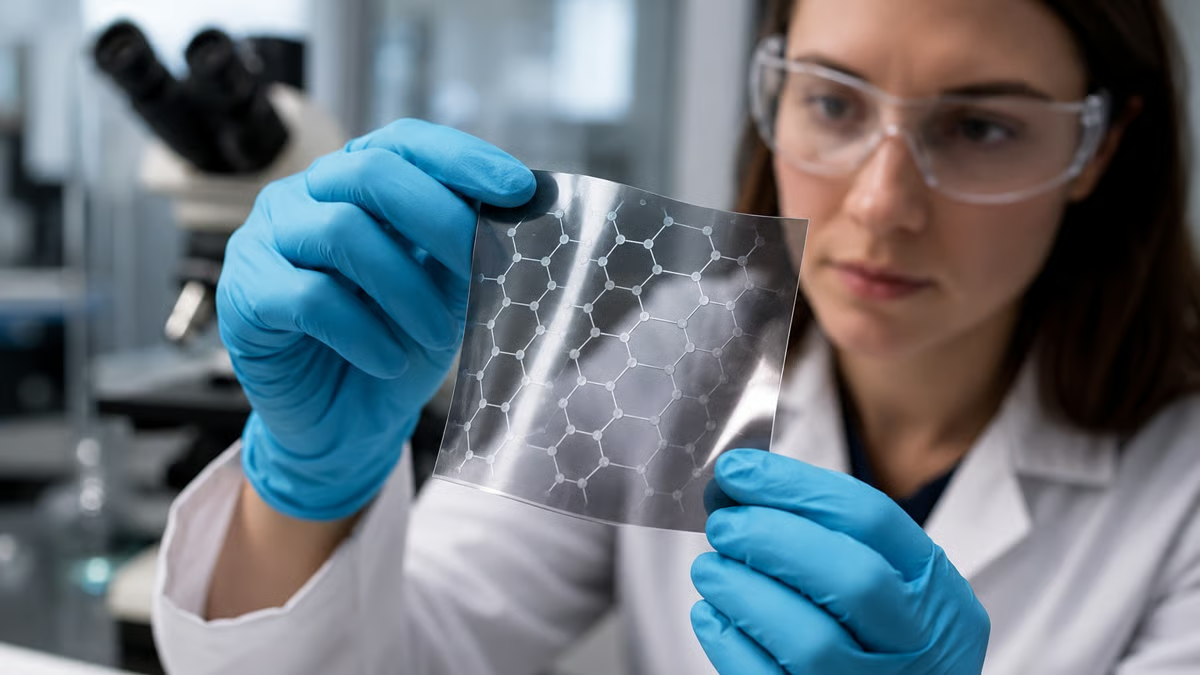 Image-R.E.News©
Longtemps présenté comme le matériau miracle du XXIe siècle, le graphène continue de fasciner l’industrie. Ultra-résistant, léger, flexible et hautement conducteur, ce réseau bidimensionnel d’atomes de carbone promet depuis plus de vingt ans de transformer des secteurs aussi variés que l’énergie, les infrastructures, les transports ou encore la fabrication avancée.
Mais aujourd’hui, la question n’est plus seulement de savoir ce que le graphène peut accomplir. L’enjeu est désormais de déterminer comment l’exploiter de manière sûre, responsable et durable.
C’est précisément l’objectif des chercheurs de l’Empa, le Laboratoire fédéral suisse d’essai des matériaux et de recherche, qui utilisent le graphène comme terrain d’expérimentation pour perfectionner le concept « Safe and Sustainable by Design » (SSbD). Cette approche vise à intégrer les critères de sécurité, d’impact environnemental et de durabilité dès la phase de conception des matériaux, plutôt qu’après leur commercialisation.
Les travaux révèlent également une réalité souvent méconnue : le graphène n’est pas un matériau unique, mais une vaste famille de matériaux aux propriétés et comportements très différents. Graphène oxydé, graphène réduit ou dérivés multicouches peuvent présenter des niveaux de performance et de risque distincts selon leur structure et leur usage.
Pour les chercheurs, le contexte d’utilisation est tout aussi déterminant que le matériau lui-même. Incorporé dans un composite structurel, utilisé dans un revêtement intelligent ou intégré à un système de filtration, le graphène n’expose pas les utilisateurs aux mêmes risques ni aux mêmes bénéfices.
Cette démarche pourrait avoir des répercussions bien au-delà du graphène. Alors que les secteurs de la construction, de l’industrie et des infrastructures s’appuient de plus en plus sur des matériaux avancés pour améliorer la durabilité et les performances, les outils capables d’évaluer simultanément innovation, sécurité et impact environnemental deviennent essentiels.
Plus qu’une simple avancée technologique, le projet de l’Empa illustre l’évolution d’une industrie où la réussite d’un matériau ne se mesure plus uniquement à ses performances, mais aussi à sa capacité à répondre aux exigences croissantes de durabilité, de transparence et de confiance. Le futur des matériaux innovants se construira autant sur la responsabilité que sur la révolution technologique.
NJC.© Info
----------------------------------------------------------------------------------------------------------------
15/06/26-English
Graphene Takes a New Step Towards Sustainable Industrial Innovation
Image-R.E.News©
Long touted as the miracle material of the 21st century, graphene continues to fascinate industry. Ultra-strong, lightweight, flexible, and highly conductive, this two-dimensional network of carbon atoms has been promising to transform sectors as diverse as energy, infrastructure, transportation, and advanced manufacturing for over twenty years.
But today, the question is no longer simply what graphene can achieve. The challenge now is to determine how to harness it safely, responsibly, and sustainably.
This is precisely the objective of researchers at Empa, the Swiss Federal Laboratories for Materials Science and Technology, who are using graphene as a testing ground to refine the "Safe and Sustainable by Design" (SSbD) concept. This approach aims to integrate safety, environmental impact, and sustainability criteria from the initial design phase of materials, rather than after they have been commercialized.
The research also reveals a little-known fact: graphene is not a single material, but a vast family of materials with very different properties and behaviors. Oxidized graphene, reduced graphene, and multilayer derivatives can exhibit distinct levels of performance and risk depending on their structure and application.
For the researchers, the context of use is just as crucial as the material itself. Incorporated into a structural composite, used in a smart coating, or integrated into a filtration system, graphene does not expose users to the same risks or the same benefits.
This approach could have repercussions far beyond graphene. As the construction, industrial, and infrastructure sectors increasingly rely on advanced materials to improve durability and performance, tools capable of simultaneously assessing innovation, safety, and environmental impact are becoming essential.
More than just a technological advancement, Empa's project illustrates the evolution of an industry where a material's success is no longer measured solely by its performance, but also by its ability to meet the growing demands for sustainability, transparency, and trust. The future of innovative materials will be built as much on responsibility as on technological revolution.
NJC.© Info
----------------------------------------------------------------------------------------------------------------
15/06/26-NL
Grafeen zet een nieuwe stap richting duurzame industriële innovatie
Image-R.E.News©
Grafeen, al lang geprezen als het wondermateriaal van de 21e eeuw, blijft de industrie fascineren. Dit tweedimensionale netwerk van koolstofatomen, ultrasterk, lichtgewicht, flexibel en zeer geleidend, belooft al meer dan twintig jaar een transformatie teweeg te brengen in uiteenlopende sectoren zoals energie, infrastructuur, transport en geavanceerde productie.
Maar de vraag is nu niet langer alleen wat grafeen kan bereiken. De uitdaging is nu om te bepalen hoe het veilig, verantwoord en duurzaam kan worden ingezet.
Dit is precies het doel van onderzoekers van Empa, de Zwitserse federale laboratoria voor materiaalkunde en -technologie, die grafeen gebruiken als proeftuin om het concept "Veilig en duurzaam door ontwerp" (SSbD) te verfijnen. Deze aanpak is erop gericht om veiligheids-, milieu-impact- en duurzaamheidscriteria te integreren vanaf de eerste ontwerpfase van materialen, in plaats van nadat ze op de markt zijn gebracht.
Het onderzoek onthult ook een weinig bekend feit: grafeen is geen enkel materiaal, maar een grote familie van materialen met zeer verschillende eigenschappen en gedragingen. Geoxideerd grafeen, gereduceerd grafeen en meerlaagse derivaten kunnen, afhankelijk van hun structuur en toepassing, verschillende prestatieniveaus en risico's vertonen.
Voor de onderzoekers is de gebruiksomgeving net zo cruciaal als het materiaal zelf. Grafeen, verwerkt in een structureel composiet, gebruikt in een slimme coating of geïntegreerd in een filtersysteem, stelt gebruikers niet bloot aan dezelfde risico's of dezelfde voordelen.
Deze aanpak zou wel eens verstrekkende gevolgen kunnen hebben, die veel verder reiken dan grafeen. Naarmate de bouw-, industrie- en infrastructuursectoren steeds meer afhankelijk worden van geavanceerde materialen om de duurzaamheid en prestaties te verbeteren, worden instrumenten die tegelijkertijd innovatie, veiligheid en milieu-impact kunnen beoordelen steeds belangrijker.
Het project van Empa is meer dan alleen een technologische vooruitgang; het illustreert de evolutie van een industrie waarin het succes van een materiaal niet langer alleen wordt afgemeten aan de prestaties, maar ook aan het vermogen om te voldoen aan de groeiende eisen op het gebied van duurzaamheid, transparantie en vertrouwen. De toekomst van innovatieve materialen zal evenzeer gebouwd zijn op verantwoordelijkheid als op technologische revolutie.
NJC.© Info
--------------------------------------------------------------------------------------------------------------------
Date de dernière mise à jour : 12/06/2026