



R.E.News future Technology-Inside Georgia’s Work to Secure the Connected Highway
 02/09/26-FR-English-NL-footer
GEORGIE : LA NOUVELLE AUTOROUTE EST CONNECTÉE… ET SOUS SURVEILLANCE
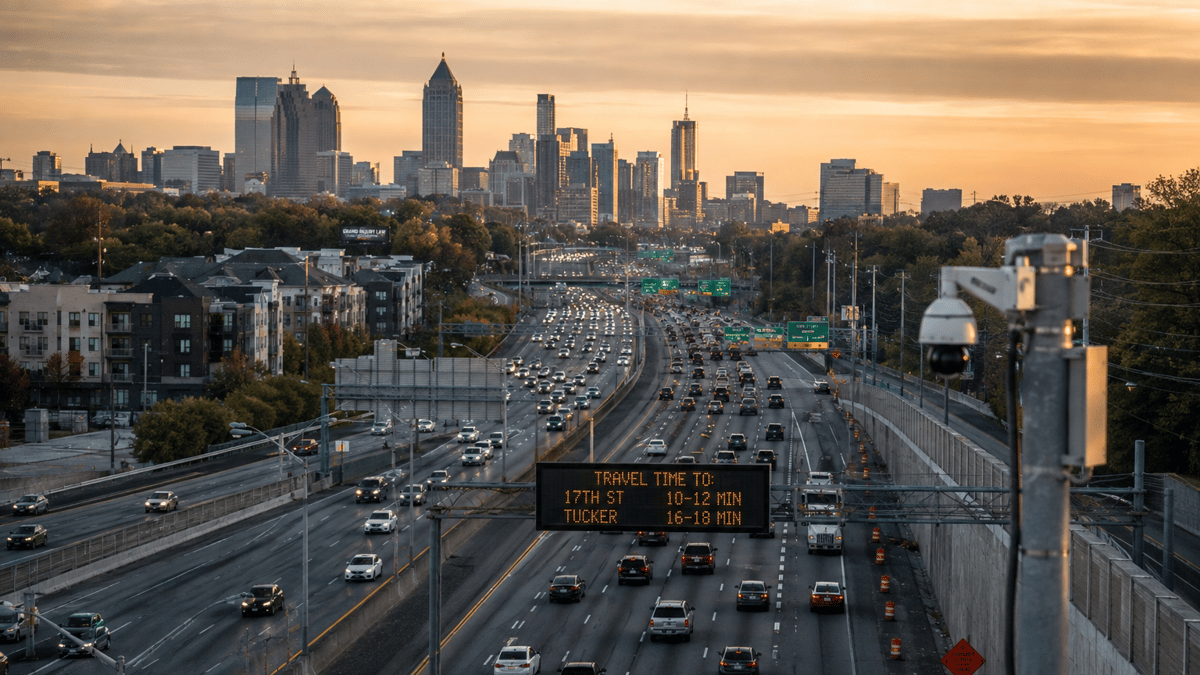 Image- creation R.E.News© via IA chat GPT
Quand l’autoroute devient un système cyber-physique, la cybersécurité quitte les serveurs pour entrer dans les équipements de la route.
Une barrière qui s’ouvre à distance, un feu qui change, une caméra qui détecte un incident : derrière ces gestes devenus presque invisibles se cache désormais un réseau numérique capable d’agir sur le monde physique. En Géorgie, Georgia Tech et le Department of Transportation veulent s’assurer que cette intelligence ne devienne pas une nouvelle porte d’entrée pour les cyberattaques.
L’AUTOROUTE ENTRE DANS L’ÈRE CYBER
Fibres optiques, caméras, capteurs, panneaux à messages variables et automates programmables sont désormais reliés au système de gestion du trafic de la Géorgie.
Le problème est simple : plus la route devient intelligente, plus elle devient une infrastructure numérique à protéger.
Un automate programmable peut recevoir une information, l’analyser puis commander physiquement une barrière ou un équipement routier. Une attaque informatique ne viserait donc plus seulement des données : elle pourrait, potentiellement, provoquer une action dans le monde réel.
C’est précisément ce que Georgia Tech et le Georgia Department of Transportation étudient depuis décembre 2025.
APPRENDRE À RECONNAÎTRE L’ANORMAL
Le programme de recherche développe un prototype capable de préparer les données du réseau pour des modèles d’IA et de machine learning chargés d’identifier les comportements inhabituels.
L’objectif n’est pas simplement de détecter une cyberattaque, mais de comprendre ce qui constitue un fonctionnement normal — afin de repérer plus rapidement ce qui ne l’est pas.
Pour aller plus loin, les chercheurs utilisent également des jumeaux numériques : des copies virtuelles de l’environnement routier et de ses systèmes de contrôle permettant de tester le comportement des automates sans toucher à une autoroute en exploitation.
LE VRAI DÉFI : SÉCURISER LA ROUTE AVANT SON AUTOMATISATION
La Géorgie prépare déjà l’étape suivante.
À mesure que l’intelligence artificielle prendra davantage de décisions et que les infrastructures deviendront plus autonomes, la frontière entre informatique et équipement routier disparaîtra progressivement.
La route de demain ne sera plus seulement construite en béton et en asphalte. Elle sera faite de capteurs, de logiciels, de communications et d’intelligence artificielle.
Et avant de lui confier davantage de décisions, une question devient essentielle :
Peut-on rendre l’autoroute suffisamment intelligente… sans la rendre vulnérable ?
NJC.© Info https://www.gatech.edu/
----------------------------------------------------------------------------------------------------------------
02/09/26-English
GEORGIA: THE NEW HIGHWAY IS CONNECTED… AND UNDER SURVEILLANCE
Image- creation R.E.News© via IA chat GPT
When the highway becomes a cyber-physical system, cybersecurity moves from servers to roadside equipment.
A barrier that opens remotely, a traffic light that changes, a camera that detects an incident: behind these now almost invisible actions lies a digital network capable of acting on the physical world. In Georgia, Georgia Tech and the Department of Transportation want to ensure that this intelligence does not become a new gateway for cyberattacks.
THE HIGHWAY ENTERS THE CYBER AGE
Fiber optics, cameras, sensors, variable message signs, and programmable logic controllers (PLCs) are now connected to Georgia's traffic management system.
The problem is simple: the smarter the road becomes, the more it becomes a digital infrastructure that needs protection.
A PLC can receive information, analyze it, and then physically control a barrier or other road equipment. A cyberattack would therefore no longer target just data: it could potentially trigger an action in the real world.
This is precisely what Georgia Tech and the Georgia Department of Transportation have been studying since December 2025.
LEARNING TO RECOGNIZE THE ABNORMAL
The research program is developing a prototype capable of preparing network data for AI and machine learning models designed to identify unusual behavior.
The goal is not simply to detect a cyberattack, but to understand what constitutes normal operation—in order to more quickly identify what is not.
To go further, researchers are also using digital twins: virtual copies of the road environment and its control systems that allow them to test the behavior of automated systems without affecting an operational highway.
THE REAL CHALLENGE: SECURING THE ROAD BEFORE AUTOMATION
Georgia is already preparing for the next step.
As artificial intelligence makes more decisions and infrastructure becomes more autonomous, the line between computing and road equipment will gradually disappear.
The road of tomorrow will no longer be built solely of concrete and asphalt. It will be made of sensors, software, communications, and artificial intelligence.
And before entrusting it with more decisions, one question becomes crucial:
Can we make the highway intelligent enough… without making it vulnerable?
NJC.© Info https://www.gatech.edu/
--------------------------------------------------------------------------------------------------------------
02/09/26-NL
GEORGIA: DE NIEUWE SNELWEG IS VERBONDEN… EN ONDER BEWAKING
Image- creation R.E.News© via IA chat GPT
Wanneer de snelweg een cyberfysisch systeem wordt, verschuift cyberbeveiliging van servers naar apparatuur langs de weg.
Een slagboom die op afstand opent, een verkeerslicht dat verandert, een camera die een incident detecteert: achter deze nu bijna onzichtbare acties schuilt een digitaal netwerk dat in staat is om in te grijpen in de fysieke wereld. In Georgia willen Georgia Tech en het Ministerie van Transport ervoor zorgen dat deze intelligentie geen nieuwe toegangspoort wordt voor cyberaanvallen.
DE SNELWEG BETREEDT HET CYBERTIJDPERK
Glasvezelkabels, camera's, sensoren, variabele informatieborden en programmeerbare logische controllers (PLC's) zijn nu verbonden met het verkeersmanagementsysteem van Georgia.
Het probleem is simpel: hoe slimmer de weg wordt, hoe meer het een digitale infrastructuur wordt die bescherming nodig heeft.
Een PLC kan informatie ontvangen, analyseren en vervolgens fysiek een slagboom of andere wegapparatuur aansturen. Een cyberaanval zou zich daarom niet langer alleen op data richten: het zou potentieel een actie in de fysieke wereld kunnen veroorzaken.
Dit is precies wat Georgia Tech en het Georgia Department of Transportation sinds december 2025 onderzoeken.
LEREN HET ABNORMALE TE HERKENNEN
Het onderzoeksprogramma ontwikkelt een prototype dat netwerkdata kan voorbereiden voor AI- en machine learning-modellen die zijn ontworpen om ongebruikelijk gedrag te identificeren.
Het doel is niet alleen om een cyberaanval te detecteren, maar ook om te begrijpen wat normaal gedrag inhoudt – om zo sneller te kunnen vaststellen wat afwijkend gedrag is.
Om nog een stap verder te gaan, gebruiken onderzoekers ook digitale tweelingen: virtuele kopieën van de wegomgeving en de bijbehorende besturingssystemen, waarmee ze het gedrag van geautomatiseerde systemen kunnen testen zonder een operationele snelweg te beïnvloeden.
DE ECHTE UITDAGING: DE WEG BEVEILIGEN VÓÓR AUTOMATISERING
Georgia bereidt zich al voor op de volgende stap.
Naarmate kunstmatige intelligentie meer beslissingen neemt en de infrastructuur autonomer wordt, zal de grens tussen computers en wegapparatuur geleidelijk vervagen.
De weg van morgen zal niet langer alleen van beton en asfalt zijn. Hij zal bestaan uit sensoren, software, communicatie en kunstmatige intelligentie.
En voordat we het meer beslissingen toevertrouwen, is één vraag cruciaal:
Kunnen we de snelweg intelligent genoeg maken... zonder hem kwetsbaar te maken?
NJC.© Info https://www.gatech.edu/
-----------------------------------------------------------------------------------------------------------------
Date de dernière mise à jour : 03/09/2026