



R.E.News future Technology-JAPAN BUILD Tokyo 2026 Reflects the Convergence Reshaping Asian Construction
 31/07/26-FR-English-NL-footer
JAPAN BUILD Tokyo 2026 : le salon qui révèle la nouvelle révolution de la construction asiatique
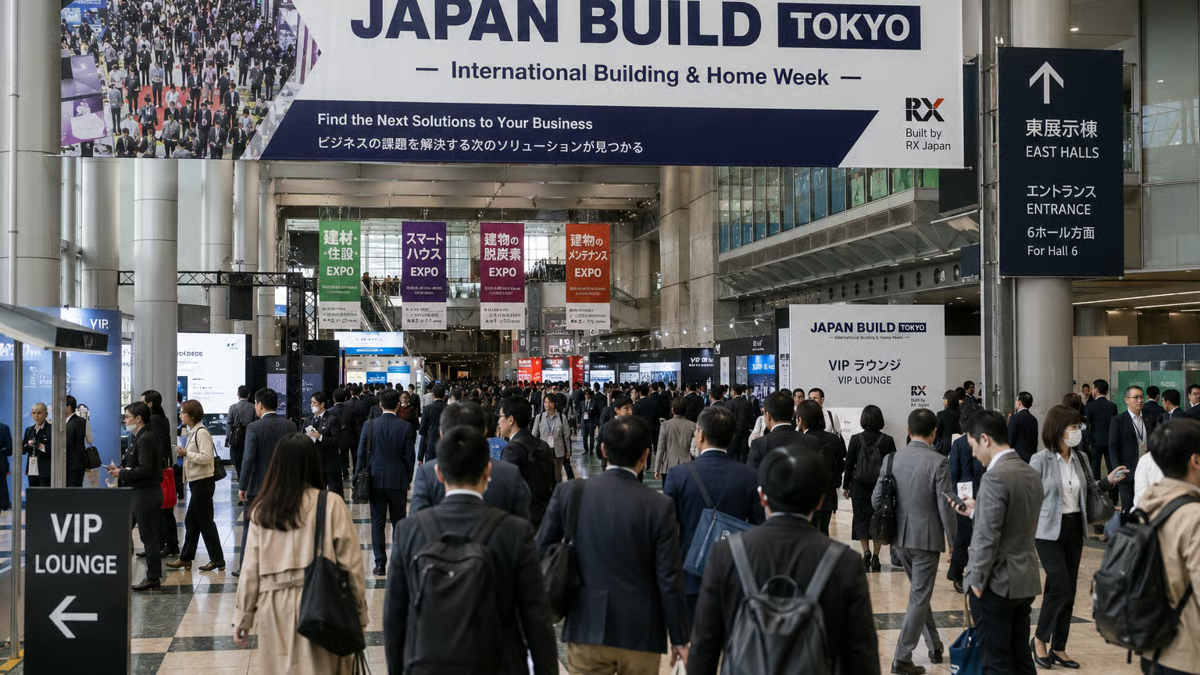 Image-R.E.News©
Du 2 au 4 décembre 2026, le Tokyo Big Sight accueillera JAPAN BUILD 2026, un rendez-vous qui dépasse largement le cadre d'un salon professionnel. Avec onze expositions spécialisées réunies sous un même toit, plus de 600 exposants attendus et près de 38 000 visiteurs, l'événement illustre la profonde transformation d'un secteur confronté à une pénurie de main-d'œuvre, au vieillissement du parc immobilier et à l'accélération de la transition numérique.
Plus qu'une simple vitrine technologique, JAPAN BUILD met en scène l'ensemble du cycle de vie d'un bâtiment : matériaux, rénovation, construction numérique, bâtiments intelligents, maintenance, immobilier et solutions bas carbone. Une organisation qui reflète l'évolution du marché japonais, où les frontières entre conception, construction, exploitation et gestion des actifs disparaissent progressivement au profit d'une approche intégrée.
Cette mutation est avant tout dictée par la réalité démographique. En dix ans, le Japon a perdu près de 20 % de sa main-d'œuvre dans la construction, tandis que plus d'un tiers des ouvriers ont désormais plus de 55 ans. L'entrée en vigueur, en avril 2024, du plafonnement des heures supplémentaires — le célèbre « 2024 Problem » — a accentué les tensions, transformant l'automatisation et la digitalisation en impératifs économiques plutôt qu'en simples leviers de compétitivité.
Face à cette situation, le gouvernement japonais accélère la modernisation du secteur avec son programme i-Construction 2.0. L'objectif est ambitieux : réduire de 30 % les besoins en main-d'œuvre sur les chantiers et augmenter la productivité de 50 % d'ici 2040 grâce au BIM, à la robotique, aux équipements autonomes, aux drones et à l'intelligence artificielle. Les grands groupes japonais expérimentent déjà ces technologies sur leurs chantiers, faisant du pays l'un des laboratoires les plus avancés de la construction numérique.
Autre tendance majeure : le marché se détourne progressivement de la construction neuve pour privilégier la rénovation, la maintenance et la prolongation de la durée de vie des infrastructures. Entre les bâtiments vieillissants, les exigences parasismiques et les objectifs de décarbonation, les investissements se concentrent désormais sur l'efficacité énergétique, les systèmes intelligents de gestion des bâtiments et les technologies de maintenance prédictive.
Pour les industriels internationaux, JAPAN BUILD représente ainsi une véritable porte d'entrée vers le marché asiatique. Dans un environnement réglementaire favorable à l'innovation, les fournisseurs capables de proposer des solutions globales — combinant équipements, logiciels, intelligence artificielle et services — disposent d'un avantage concurrentiel croissant face aux offres traditionnelles.
JAPAN BUILD Tokyo 2026 illustre une réalité qui dépasse largement les frontières japonaises. Dans les économies matures, la compétitivité de demain ne reposera plus uniquement sur la qualité des matériaux ou des équipements, mais sur la capacité à intégrer construction, numérique, automatisation et gestion du cycle de vie des actifs. Plus qu'un salon, Tokyo devient cette année un véritable observatoire des mutations qui façonneront la construction mondiale de la prochaine décennie.
NJC.© Info JAPAN BUILD Tokyo 2026
----------------------------------------------------------------------------------------------------------------
31/07/26-English
JAPAN BUILD Tokyo 2026: The trade show that reveals the new revolution in Asian construction
Image-R.E.News©
From December 2nd to 4th, 2026, Tokyo Big Sight will host JAPAN BUILD 2026, an event that goes far beyond the scope of a traditional trade show. With eleven specialized exhibitions under one roof, more than 600 exhibitors expected, and nearly 38,000 visitors, the event illustrates the profound transformation of a sector facing a labor shortage, an aging building stock, and the accelerating digital transition.
More than just a technological showcase, JAPAN BUILD presents the entire lifecycle of a building: materials, renovation, digital construction, smart buildings, maintenance, real estate, and low-carbon solutions. This structure reflects the evolution of the Japanese market, where the boundaries between design, construction, operation, and asset management are gradually disappearing in favor of an integrated approach.
This transformation is primarily driven by demographic realities. In ten years, Japan has lost nearly 20% of its construction workforce, while more than a third of workers are now over 55. The implementation, in April 2024, of the cap on overtime hours—the infamous "2024 Problem"—has exacerbated these tensions, transforming automation and digitalization into economic imperatives rather than simply drivers of competitiveness.
Faced with this situation, the Japanese government is accelerating the modernization of the sector with its i-Construction 2.0 program. The objective is ambitious: to reduce labor needs on construction sites by 30% and increase productivity by 50% by 2040 through BIM, robotics, autonomous equipment, drones, and artificial intelligence. Major Japanese companies are already experimenting with these technologies on their construction sites, making the country one of the most advanced laboratories for digital construction.
Another major trend: the market is gradually shifting away from new construction towards renovation, maintenance, and extending the lifespan of existing infrastructure. Between aging buildings, seismic requirements, and decarbonization goals, investments are now focused on energy efficiency, intelligent building management systems, and predictive maintenance technologies.
For international manufacturers, JAPAN BUILD thus represents a true gateway to the Asian market. In a regulatory environment conducive to innovation, suppliers capable of offering comprehensive solutions—combining equipment, software, artificial intelligence, and services—have a growing competitive advantage over traditional offerings.
JAPAN BUILD Tokyo 2026 illustrates a reality that extends far beyond Japan's borders. In mature economies, tomorrow's competitiveness will no longer rely solely on the quality of materials or equipment, but on the ability to integrate construction, digital technology, automation, and asset lifecycle management. More than just a trade show, Tokyo this year becomes a true observatory of the transformations that will shape global construction in the next decade.
NJC.© Info JAPAN BUILD Tokyo 2026
----------------------------------------------------------------------------------------------------------------------
31/07/26-NL
JAPAN BUILD Tokyo 2026: De vakbeurs die de nieuwe revolutie in de Aziatische bouwsector onthult
Image-R.E.News©
Van 2 tot en met 4 december 2026 vindt in Tokyo Big Sight JAPAN BUILD 2026 plaats, een evenement dat veel verder gaat dan een traditionele vakbeurs. Met elf gespecialiseerde tentoonstellingen onder één dak, meer dan 600 exposanten en naar verwachting bijna 38.000 bezoekers, illustreert het evenement de ingrijpende transformatie van een sector die kampt met een tekort aan arbeidskrachten, een verouderde gebouwenvoorraad en een versnelde digitale transitie.
JAPAN BUILD is meer dan alleen een technologische showcase; het presenteert de volledige levenscyclus van een gebouw: materialen, renovatie, digitaal bouwen, slimme gebouwen, onderhoud, vastgoed en koolstofarme oplossingen. Deze structuur weerspiegelt de evolutie van de Japanse markt, waar de grenzen tussen ontwerp, bouw, exploitatie en vastgoedbeheer geleidelijk vervagen ten gunste van een geïntegreerde aanpak.
Deze transformatie wordt voornamelijk gedreven door demografische ontwikkelingen. In tien jaar tijd is Japan bijna 20% van zijn bouwvakkers kwijtgeraakt, terwijl meer dan een derde van de werknemers nu ouder is dan 55. De invoering, in april 2024, van het maximumaantal overuren – het beruchte "probleem van 2024" – heeft deze spanningen verergerd, waardoor automatisering en digitalisering economische noodzaak zijn geworden in plaats van louter drijfveren voor concurrentievermogen.
Geconfronteerd met deze situatie versnelt de Japanse overheid de modernisering van de sector met het i-Construction 2.0-programma. De doelstelling is ambitieus: de arbeidsbehoefte op bouwplaatsen met 30% verminderen en de productiviteit met 50% verhogen tegen 2040 door middel van BIM, robotica, autonome apparatuur, drones en kunstmatige intelligentie. Grote Japanse bedrijven experimenteren al met deze technologieën op hun bouwplaatsen, waardoor het land een van de meest geavanceerde laboratoria voor digitale bouw is geworden.
Een andere belangrijke trend: de markt verschuift geleidelijk van nieuwbouw naar renovatie, onderhoud en het verlengen van de levensduur van bestaande infrastructuur. Gezien de toenemende veroudering van gebouwen, de eisen op het gebied van aardbevingsbestendigheid en de doelstellingen voor decarbonisatie, richten investeringen zich nu op energie-efficiëntie, intelligente gebouwbeheersystemen en voorspellende onderhoudstechnologieën.
Voor internationale fabrikanten vormt JAPAN BUILD daarmee een ware toegangspoort tot de Aziatische markt. In een regelgevingsklimaat dat innovatie stimuleert, hebben leveranciers die totaaloplossingen kunnen bieden – een combinatie van apparatuur, software, kunstmatige intelligentie en diensten – een groeiend concurrentievoordeel ten opzichte van traditionele aanbieders.
JAPAN BUILD Tokyo 2026 illustreert een realiteit die veel verder reikt dan de grenzen van Japan. In volwassen economieën zal de concurrentiekracht van morgen niet langer alleen afhangen van de kwaliteit van materialen of apparatuur, maar van het vermogen om bouw, digitale technologie, automatisering en asset lifecycle management te integreren. Tokyo is dit jaar meer dan alleen een vakbeurs; het is een waar observatorium voor de transformaties die de wereldwijde bouwsector de komende tien jaar zullen vormgeven.
NJC.© Info JAPAN BUILD Tokyo 2026
---------------------------------------------------------------------------------------------------------------------
Date de dernière mise à jour : 30/07/2026