















R.E.News future Technology-LED Optics Under Pressure as Study Highlights Long-Term Material Risks
 22/04/26-FR-English-NL-footer
LED : quand la performance lumineuse révèle ses fragilités cachées
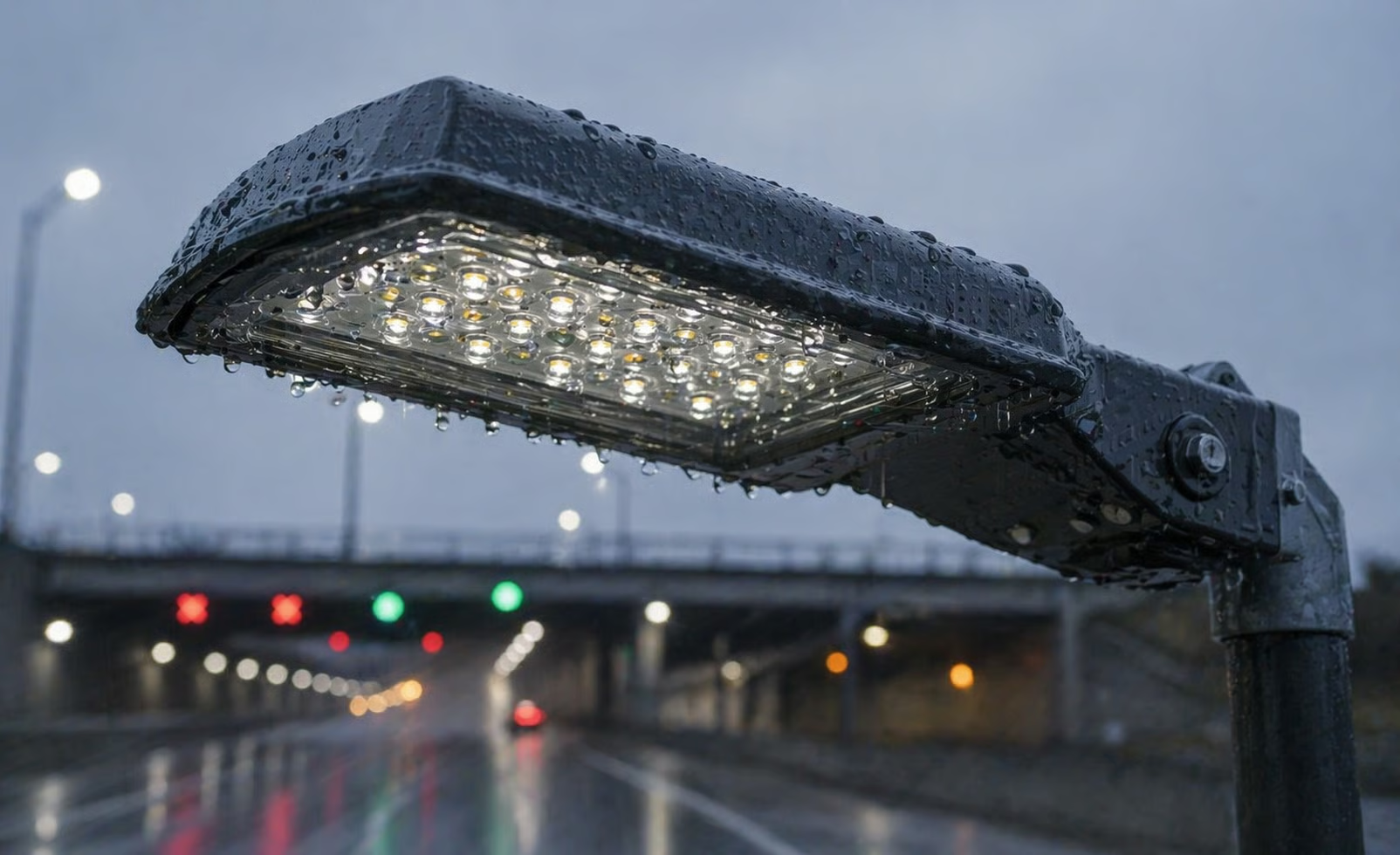 Image-R.E.News©
À mesure que les LED s’imposent comme la colonne vertébrale de l’éclairage moderne — des autoroutes aux villes intelligentes — une question longtemps reléguée au second plan refait surface : la durabilité réelle des matériaux optiques. Derrière les gains d’efficacité énergétique, une étude menée par Dow Inc. met en lumière une faiblesse structurelle potentielle, avec des implications directes pour la fiabilité des infrastructures.
Une faille discrète au cœur des systèmes LED
Si la technologie LED est souvent synonyme de longévité, ses performances reposent sur un élément clé : les optiques, chargées de diffuser et contrôler la lumière. Or, ces composants — souvent en polycarbonate ou PMMA — sont soumis à des conditions extrêmes : chaleur élevée et exposition prolongée à la lumière bleue.
L’étude révèle que ces environnements accélèrent un phénomène critique : le vieillissement photothermique. Résultat :
jaunissement progressif des lentilles
perte de transmission lumineuse
altération de l’uniformité d’éclairage
dans certains cas, défaillance brutale et imprévisible
Un constat qui transforme un détail technique en enjeu stratégique pour les exploitants d’infrastructures.
Vieillissement photothermique : comprendre le mécanisme
Sous l’effet combiné de la chaleur et des longueurs d’onde énergétiques (notamment le bleu), la structure chimique de certains polymères évolue. Ce processus, souvent lent au départ, peut s’accélérer avec le temps.
Les tests menés par Dow montrent une tendance claire :
les thermoplastiques présentent une dégradation progressive, parfois suivie de ruptures inattendues. À l’inverse, les optiques en silicone affichent une résistance nettement supérieure, avec une performance plus stable dans le temps.
Des conséquences directes pour les infrastructures
Dans des environnements critiques — routes, tunnels, sites industriels — la lumière n’est pas un simple confort : c’est un facteur de sécurité. Une baisse de performance optique peut entraîner :
une visibilité réduite
une non-conformité réglementaire
des cycles de maintenance imprévus
une hausse du coût total de possession
À grande échelle, même un faible taux de défaillance peut générer des impacts opérationnels majeurs.
Un défi de conception pour les fabricants
Le message adressé à l’industrie est clair : le choix des matériaux devient un levier stratégique. Historiquement, les thermoplastiques ont été privilégiés pour leur coût et leur facilité de production. Mais face à l’augmentation des puissances LED, leurs limites apparaissent.
Les optiques en silicone, plus résistantes, pourraient s’imposer dans les applications exigeantes. Mais leur adoption dépendra d’un équilibre entre coût, performance et industrialisation.
Vers une nouvelle génération d’éclairage durable
Le marché de l’éclairage évolue. L’enjeu ne se limite plus à consommer moins d’énergie, mais à garantir une performance stable sur toute la durée de vie des installations.
Cette étude agit comme un signal :
la durabilité ne se joue pas uniquement au niveau électronique, mais aussi — et surtout — au niveau des matériaux.
Une équation à rééquilibrer
À l’heure où les villes investissent massivement dans des infrastructures intelligentes, la fiabilité devient un critère central. L’éclairage, désormais connecté et intégré à des écosystèmes numériques, ne tolère plus l’imprévisibilité.
La conclusion est sans détour :
une LED performante ne suffit plus — elle doit être durable dans toutes ses composantes.
Et dans cette équation, les matériaux optiques pourraient bien faire toute la différence.
NJC.© Info Dow Inc Lighting at Dow
-----------------------------------------------------------------------------------------------------------------
22/04/26-English
LEDs: When Luminous Performance Reveals Hidden Weaknesses
Image-R.E.News©
As LEDs become the backbone of modern lighting—from highways to smart cities—a long-overlooked issue is resurfacing: the actual durability of optical materials. Beyond the energy efficiency gains, a study conducted by Dow Inc. highlights a potential structural weakness, with direct implications for infrastructure reliability.
A Discreet Flaw at the Heart of LED Systems
While LED technology is often synonymous with longevity, its performance relies on a key component: the optics, responsible for diffusing and controlling the light. However, these components—often made of polycarbonate or PMMA—are subjected to extreme conditions: high heat and prolonged exposure to blue light.
The study reveals that these environments accelerate a critical phenomenon: photothermal aging. Result:
Progressive yellowing of lenses
Loss of light transmission
Deterioration of lighting uniformity
In some cases, sudden and unpredictable failure
This observation transforms a technical detail into a strategic issue for infrastructure operators.
Photothermal aging: understanding the mechanism
Under the combined effect of heat and energetic wavelengths (particularly blue), the chemical structure of certain polymers changes. This process, often slow at first, can accelerate over time.
Tests conducted by Dow show a clear trend:
Thermoplastics exhibit progressive degradation, sometimes followed by unexpected breakage. Conversely, silicone optics display significantly greater resistance, with more stable performance over time.
Direct consequences for infrastructure
In critical environments—roads, tunnels, industrial sites—light is not simply a comfort: it is a safety factor. A drop in optical performance can lead to:
reduced visibility
regulatory non-compliance
unplanned maintenance cycles
an increase in total cost of ownership
On a large scale, even a low failure rate can generate major operational impacts.
A design challenge for manufacturers
The message to industry is clear: the choice of materials is becoming a strategic lever. Historically, thermoplastics have been favored for their cost and ease of production. But with the increasing power of LEDs, their limitations are becoming apparent.
Silicon optics, which are more robust, could become the standard in demanding applications. However, their adoption will depend on a balance between cost, performance, and industrialization.
Towards a new generation of sustainable lighting
The lighting market is evolving. The challenge is no longer simply about consuming less energy, but about guaranteeing stable performance throughout the entire lifespan of the installations.
This study serves as a wake-up call:
sustainability isn't just about electronics, but also—and especially—about materials.
An equation to rebalance
As cities invest heavily in smart infrastructure, reliability is becoming a key criterion. Lighting, now connected and integrated into digital ecosystems, can no longer tolerate unpredictability.
The conclusion is clear:
a high-performance LED is no longer enough—it must be durable in all its components.
And in this equation, optical materials could make all the difference.
NJC.© Info Dow Inc Lighting at Dow
-------------------------------------------------------------------------------------------------------------------
22/04/26-NL
LED's: Wanneer lichtopbrengst verborgen zwakheden aan het licht brengt
Image-R.E.News©
Nu LED's de ruggengraat vormen van moderne verlichting – van snelwegen tot slimme steden – komt een lang over het hoofd gezien probleem weer aan het licht: de daadwerkelijke duurzaamheid van optische materialen. Naast de winst in energie-efficiëntie, wijst een studie van Dow Inc. op een potentiële structurele zwakte met directe gevolgen voor de betrouwbaarheid van de infrastructuur.
Een discreet defect in het hart van LED-systemen
Hoewel LED-technologie vaak synoniem is met een lange levensduur, is de prestatie ervan afhankelijk van een cruciaal onderdeel: de optiek, die verantwoordelijk is voor het verspreiden en beheersen van het licht. Deze componenten – vaak gemaakt van polycarbonaat of PMMA – worden echter blootgesteld aan extreme omstandigheden: hoge temperaturen en langdurige blootstelling aan blauw licht.
De studie toont aan dat deze omstandigheden een kritiek fenomeen versnellen: fotothermische veroudering. Resultaat:
Progressieve vergeling van lenzen
Verlies van lichttransmissie
Verslechtering van de lichtuniformiteit
In sommige gevallen plotselinge en onvoorspelbare uitval
Deze constatering maakt van een technisch detail een strategisch probleem voor infrastructuurbeheerders.
Fotothermische veroudering: inzicht in het mechanisme
Onder invloed van warmte en energierijke golflengten (met name blauw) verandert de chemische structuur van bepaalde polymeren. Dit proces, dat aanvankelijk vaak langzaam verloopt, kan na verloop van tijd versnellen.
Tests uitgevoerd door Dow tonen een duidelijke trend:
Thermoplasten vertonen progressieve degradatie, soms gevolgd door onverwachte breuk. Siliconenoptiek daarentegen vertoont een aanzienlijk grotere weerstand en stabielere prestaties in de loop der tijd.
Directe gevolgen voor de infrastructuur
In kritieke omgevingen – wegen, tunnels, industrieterreinen – is licht niet alleen een kwestie van comfort: het is een veiligheidsfactor. Een afname van de optische prestaties kan leiden tot:
verminderde zichtbaarheid
niet-naleving van regelgeving
ongeplande onderhoudscycli
een toename van de totale eigendomskosten
Op grote schaal kan zelfs een laag uitvalpercentage grote operationele gevolgen hebben.
Een ontwerpuitdaging voor fabrikanten
De boodschap aan de industrie is duidelijk: de materiaalkeuze wordt een strategische factor. Historisch gezien werden thermoplasten geprefereerd vanwege hun kosten en eenvoudige productie. Maar met de toenemende kracht van LED's worden hun beperkingen duidelijk.
Siliciumoptiek, die robuuster is, zou de standaard kunnen worden in veeleisende toepassingen. De acceptatie ervan zal echter afhangen van een evenwicht tussen kosten, prestaties en industrialisatie.
Op weg naar een nieuwe generatie duurzame verlichting
De verlichtingsmarkt evolueert. De uitdaging is niet langer alleen het verminderen van energieverbruik, maar het garanderen van stabiele prestaties gedurende de gehele levensduur van de installaties.
Deze studie dient als een waarschuwing:
duurzaamheid gaat niet alleen over elektronica, maar ook – en vooral – over materialen.
Een vergelijking om het evenwicht te herstellen
Nu steden fors investeren in slimme infrastructuur, wordt betrouwbaarheid een cruciaal criterium. Verlichting, die nu verbonden en geïntegreerd is in digitale ecosystemen, kan onvoorspelbaarheid niet langer verdragen.
De conclusie is duidelijk:
een krachtige led is niet langer voldoende – alle componenten moeten duurzaam zijn.
En in deze vergelijking kunnen optische materialen het verschil maken.
NJC.© Info Dow Inc Lighting at Dow
-------------------------------------------------------------------------------------------------------------------
Date de dernière mise à jour : 21/04/2026