



R.E.News future Technology-Magnetic Thermal Textile Targets Overheated Railway Tracks
 18/09/26-FR-English-NL-footer
Rail : le textile magnétique qui défie la chaleur
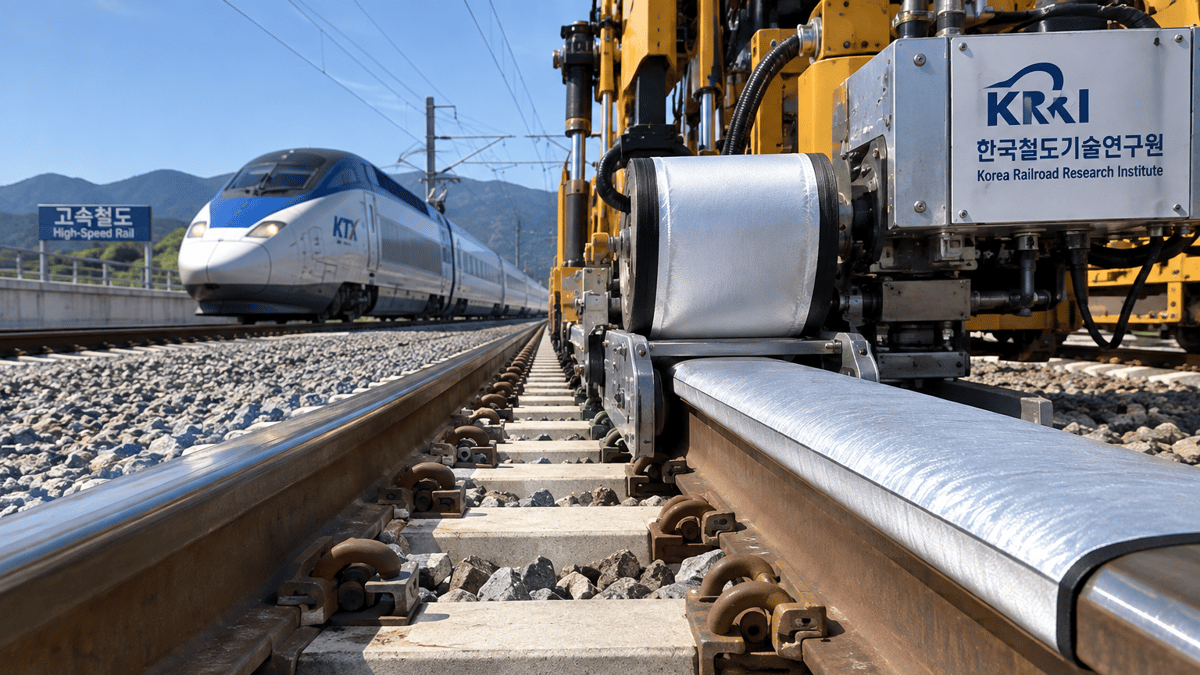 Image-creation R.E.News© via IA chat GPT
Et si les rails pouvaient résister à la canicule sans eau, sans électricité et sans modification permanente ?
En Corée du Sud, le Korea Railroad Research Institute (KRRI) a développé un textile thermique multicouche, fixé magnétiquement au rail, capable de réduire sa température jusqu’à 10,9 °C selon le programme de démonstration.
Son secret : une surface hautement réfléchissante qui bloque une grande partie du rayonnement solaire avant qu’il ne transforme l’acier en véritable accumulateur de chaleur.
Testé sur des lignes conventionnelles et à grande vitesse, notamment avec des trains KTX à 300 km/h, le dispositif associe protection thermique et déploiement mécanisé. Une machine spécialement conçue permet de poser puis récupérer le textile à plus de 2 km/h.
L’enjeu dépasse la simple performance thermique. En limitant l’échauffement du rail, cette technologie pourrait contribuer à réduire les contraintes thermiques du rail soudé continu et, dans certaines situations, le recours aux restrictions de vitesse liées aux fortes chaleurs.
Après plusieurs années de recherche et d’essais, le KRRI a transféré la technologie à PITCHCABLE Co., Ltd. pour sa commercialisation.
Une fine membrane magnétique, quelques degrés en moins… et peut-être une nouvelle arme contre les rails surchauffés par les étés de demain.
NJC.© Info
-------------------------------------------------------------------------------------------------------------------
18/09/26-English
Rail: Magnetic Textile That Defys Heat
Image-creation R.E.News© via IA chat GPT
What if rails could withstand heat waves without water, electricity, or permanent modifications?
In South Korea, the Korea Railroad Research Institute (KRRI) has developed a multi-layered thermal textile, magnetically attached to the rail, capable of reducing its temperature by up to 10.9°C, according to the demonstration program.
Its secret: a highly reflective surface that blocks a large portion of solar radiation before it transforms the steel into a veritable heat accumulator.
Tested on conventional and high-speed lines, including with KTX trains traveling at 300 km/h, the system combines thermal protection with mechanized deployment. A specially designed machine can lay and then retrieve the textile at speeds exceeding 2 km/h.
The benefits extend beyond simple thermal performance. By limiting rail heating, this technology could help reduce the thermal stresses on continuous welded rail and, in some situations, the need for speed restrictions related to extreme heat.
After several years of research and testing, KRRI transferred the technology to PITCHCABLE Co., Ltd. for commercialization.
A thin magnetic membrane, a few degrees cooler… and perhaps a new weapon against the overheated railway tracks of tomorrow's summers.
NJC.© Info
--------------------------------------------------------------------------------------------------------------
18/09/26-NL
Spoorwegen: Magnetisch textiel dat hitte trotseert
Image-creation R.E.News© via IA chat GPT
Wat als spoorrails hittegolven zouden kunnen weerstaan zonder water, elektriciteit of permanente aanpassingen?
In Zuid-Korea heeft het Korea Railroad Research Institute (KRRI) een meerlaags thermisch textiel ontwikkeld, dat magnetisch aan de rails bevestigd kan worden en de temperatuur ervan met wel 10,9 °C kan verlagen, aldus het demonstratieprogramma.
Het geheim: een sterk reflecterend oppervlak dat een groot deel van de zonnestraling blokkeert voordat het staal in een ware warmteaccumulator verandert.
Het systeem is getest op conventionele en hogesnelheidslijnen, waaronder met KTX-treinen die met 300 km/u rijden, en combineert thermische bescherming met gemechaniseerde plaatsing. Een speciaal ontworpen machine kan het textiel met snelheden van meer dan 2 km/u aanbrengen en weer verwijderen.
De voordelen gaan verder dan alleen thermische prestaties. Door de opwarming van de rails te beperken, kan deze technologie de thermische spanningen op continu gelaste rails verminderen en in sommige situaties de noodzaak van snelheidsbeperkingen als gevolg van extreme hitte wegnemen.
Na enkele jaren van onderzoek en testen heeft KRRI de technologie overgedragen aan PITCHCABLE Co., Ltd. voor commercialisering.
Een dun magnetisch membraan, een paar graden koeler… en misschien wel een nieuw wapen tegen de oververhitte spoorwegen van de zomers van morgen.
NJC.© Info
----------------------------------------------------------------------------------------------------------------
Date de dernière mise à jour : 17/09/2026