



R.E.News future Technology-Materials Research Powering Industrial Resilience
 10/02/26-FR-English-NL-footer
La recherche sur les matériaux, pilier discret de la résilience industrielle
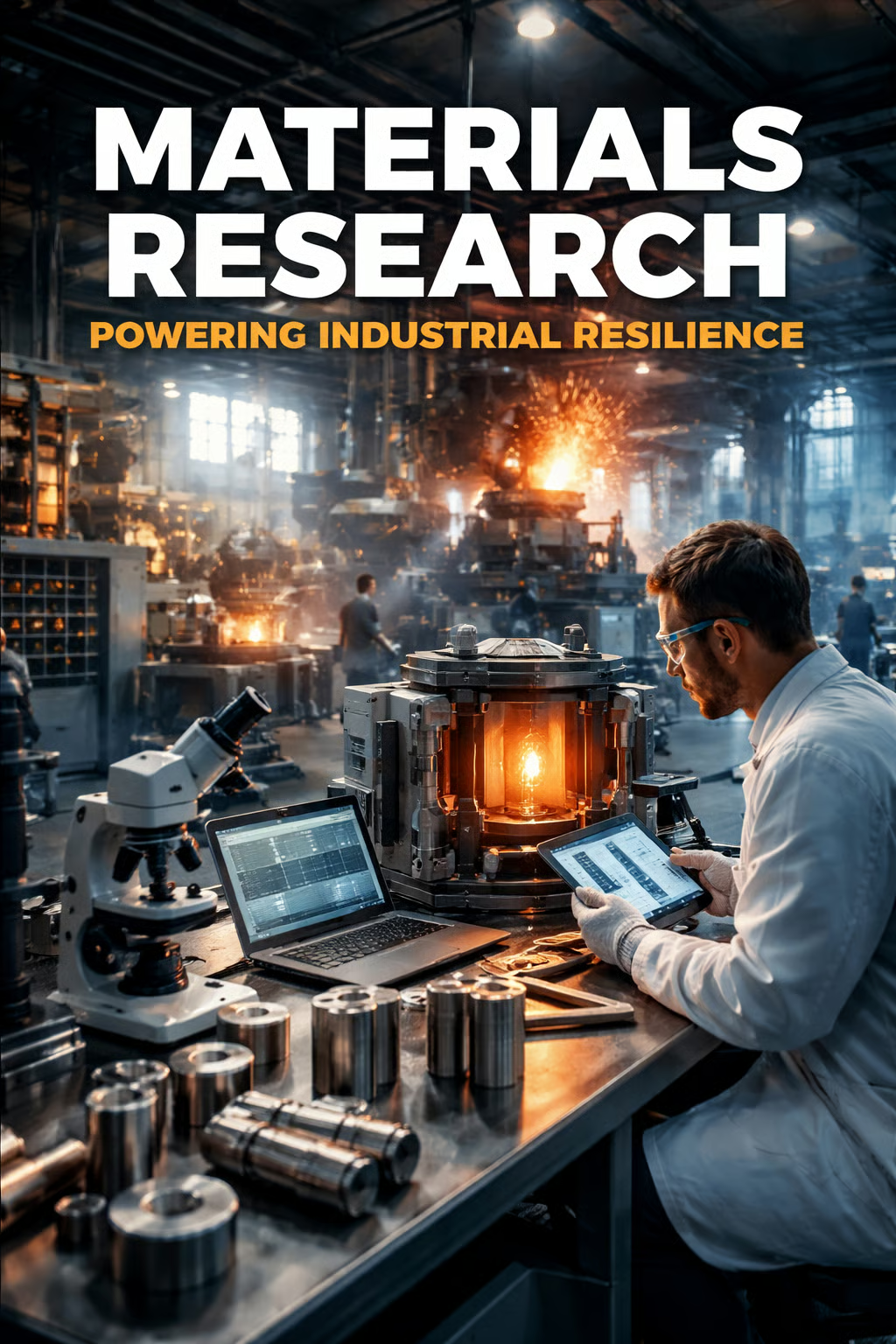 Image-R.E.News©
Dans les secteurs mondiaux de la construction, des infrastructures et des technologies industrielles, la performance des matériaux n’est jamais un détail. Elle conditionne la durée de vie des équipements, l’efficacité énergétique, les cycles de maintenance et, en définitive, la compétitivité économique. Dans les industries soumises à des contraintes extrêmes — sidérurgie, pétrochimie ou fabrication avancée — la frontière entre réussite et échec se joue souvent à la résistance d’un alliage face à la chaleur et aux contraintes mécaniques.
C’est dans ce contexte que la collaboration de longue date entre Oak Ridge National Laboratory (ORNL) et Duraloy Technologies s’impose comme un exemple emblématique de la manière dont la recherche publique peut nourrir une résilience industrielle durable. Entamé il y a plus de trente ans, ce partenariat a non seulement transformé la trajectoire de Duraloy, mais aussi démontré que l’innovation matériaux est un levier stratégique pour les chaînes d’approvisionnement mondiales.
Au milieu des années 1990, Duraloy se trouvait à un tournant critique. Fragilisée financièrement et dépendante d’alliages vieillissants, l’entreprise devait repenser en profondeur ses fondations technologiques pour survivre. Consciente que ses ressources internes ne suffiraient pas, la direction s’est tournée vers ORNL, référence mondiale en matériaux haute température capables de fonctionner dans les environnements les plus extrêmes.
Cette alliance a ouvert la voie à une rupture technologique majeure avec l’introduction de l’alliage IC-221M, un nickel aluminide innovant formant naturellement une couche protectrice d’oxyde d’aluminium à haute température. Pour les aciéries et les installations de traitement thermique, les bénéfices furent immédiats : moins de déformations, des arrêts de maintenance fortement réduits, des températures de fonctionnement plus élevées et une efficacité énergétique accrue.
Au début des années 2000, IC-221M s’impose sur le terrain. Les gains ne sont pas seulement techniques, ils sont économiques et stratégiques. La réduction des temps d’arrêt améliore la rentabilité, la qualité des produits renforce la confiance des clients, et Duraloy passe du statut de fournisseur en difficulté à celui d’innovateur reconnu, doté d’un savoir-faire différenciant.
Mais l’héritage d’IC-221M dépasse largement son adoption commerciale. Il devient une plateforme de connaissances qui mènera au développement d’alliages de nouvelle génération, comme TMA6350, aujourd’hui utilisés dans des environnements encore plus agressifs, notamment dans les fours de craquage pétrochimique. Cette dynamique permet à Duraloy de se diversifier vers la chimie, l’aéronautique, le traitement thermique avancé et la mise en forme du titane.
Ce qui distingue véritablement le partenariat ORNL–Duraloy, c’est sa profondeur. Il ne s’agit pas d’un simple transfert de technologie, mais d’un dialogue continu entre chercheurs et industriels, où chaque innovation nourrit la suivante. Sur près de trois décennies, cette collaboration a permis de faire émerger plusieurs familles d’alliages, soutenues notamment par le Département américain de l’Énergie, illustrant le rôle clé des institutions publiques dans la réduction du risque technologique.
Dans un marché mondialisé et hautement concurrentiel, cette capacité d’innovation continue est devenue un rempart stratégique. Elle renforce l’autonomie industrielle, limite la dépendance aux fournisseurs étrangers et soutient la compétitivité à long terme des infrastructures critiques.
Récompensé par un Federal Laboratory Consortium Excellence in Technology Transfer Award, le partenariat ORNL–Duraloy rappelle une vérité souvent invisible : les ponts durables, les usines efficaces et les systèmes industriels résilients ne reposent pas uniquement sur le béton et l’acier, mais sur un socle plus discret — celui des collaborations de recherche qui transforment la science des matériaux en performance réelle.
NJC.© Info Oak Ridge National Laboratory and Duraloy Technologies
-------------------------------------------------------------------------------------------------------------
10/02/26-English
Materials Research: A Hidden Pillar of Industrial Resilience
Image-R.E.News©
In the global construction, infrastructure, and industrial technology sectors, materials performance is never a minor detail. It determines equipment lifespan, energy efficiency, maintenance cycles, and ultimately, economic competitiveness. In industries subjected to extreme constraints—steel, petrochemicals, or advanced manufacturing—the line between success and failure often hinges on an alloy's resistance to heat and mechanical stress.
It is in this context that the long-standing collaboration between Oak Ridge National Laboratory (ORNL) and Duraloy Technologies stands out as a prime example of how public research can foster sustainable industrial resilience. Initiated more than thirty years ago, this partnership has not only transformed Duraloy's trajectory but also demonstrated that materials innovation is a strategic lever for global supply chains.
In the mid-1990s, Duraloy found itself at a critical juncture. Financially vulnerable and reliant on aging alloys, the company needed a complete overhaul of its technological foundations to survive. Recognizing that its internal resources would be insufficient, management turned to ORNL, a global leader in high-temperature materials capable of operating in the most extreme environments.
This alliance paved the way for a major technological breakthrough with the introduction of the IC-221M alloy, an innovative nickel aluminide that naturally forms a protective layer of aluminum oxide at high temperatures. For steel mills and heat treatment plants, the benefits were immediate: less warping, significantly reduced maintenance downtime, higher operating temperatures, and increased energy efficiency.
By the early 2000s, IC-221M had become a dominant player in the industry. The gains were not only technical, but also economic and strategic. Reduced downtime improves profitability, enhanced product quality strengthens customer confidence, and Duraloy transforms from a struggling supplier into a recognized innovator with distinctive expertise.
But the legacy of IC-221M extends far beyond its commercial adoption. It becomes a knowledge platform that leads to the development of next-generation alloys, such as TMA6350, now used in even more aggressive environments, particularly in petrochemical cracking furnaces. This momentum allows Duraloy to diversify into chemicals, aerospace, advanced heat treatment, and titanium forming.
What truly distinguishes the ORNL–Duraloy partnership is its depth. It is not simply a technology transfer, but an ongoing dialogue between researchers and industry professionals, where each innovation feeds into the next. Over nearly three decades, this collaboration has led to the development of several alloy families, supported in particular by the U.S. Department of Energy, illustrating the key role of public institutions in mitigating technological risk.
In a globalized and highly competitive market, this capacity for continuous innovation has become a strategic bulwark. It strengthens industrial autonomy, reduces dependence on foreign suppliers, and supports the long-term competitiveness of critical infrastructure.
Recognized with a Federal Laboratory Consortium Excellence in Technology Transfer Award, the ORNL–Duraloy partnership underscores an often-overlooked truth: sustainable bridges, efficient factories, and resilient industrial systems are not solely built on concrete and steel, but on a more discreet foundation—that of research collaborations that translate materials science into real-world performance.
NJC.© Info Oak Ridge National Laboratory and Duraloy Technologies
--------------------------------------------------------------------------------------------------------------
10/02/26-NL
Materiaalonderzoek: een verborgen pijler van industriële veerkracht
Image-R.E.News©
In de wereldwijde bouw-, infrastructuur- en industriële technologiesector is materiaalprestatie nooit een onbelangrijk detail. Het bepaalt de levensduur van apparatuur, energie-efficiëntie, onderhoudscycli en uiteindelijk de economische concurrentiekracht. In industrieën die aan extreme eisen onderhevig zijn – staal, petrochemie of geavanceerde productie – hangt het verschil tussen succes en mislukking vaak af van de hitte- en mechanische belastingsbestendigheid van een legering.
In deze context is de langdurige samenwerking tussen Oak Ridge National Laboratory (ORNL) en Duraloy Technologies een uitstekend voorbeeld van hoe publiek onderzoek duurzame industriële veerkracht kan bevorderen. Deze samenwerking, die meer dan dertig jaar geleden van start ging, heeft niet alleen de koers van Duraloy veranderd, maar ook aangetoond dat materiaalinnovatie een strategische hefboom is voor wereldwijde toeleveringsketens.
Midden jaren negentig bevond Duraloy zich op een kritiek punt. Financieel kwetsbaar en afhankelijk van verouderde legeringen, had het bedrijf een complete herziening van zijn technologische fundamenten nodig om te overleven. Omdat het management besefte dat de interne middelen ontoereikend zouden zijn, wendde het zich tot ORNL, een wereldleider in materialen voor hoge temperaturen die bestand zijn tegen de meest extreme omstandigheden.
Deze samenwerking maakte de weg vrij voor een belangrijke technologische doorbraak met de introductie van de IC-221M-legering, een innovatief nikkelaluminiumlegering die bij hoge temperaturen van nature een beschermende laag aluminiumoxide vormt. Voor staalfabrieken en warmtebehandelingsinstallaties waren de voordelen direct merkbaar: minder kromtrekken, aanzienlijk minder stilstand, hogere bedrijfstemperaturen en een hogere energie-efficiëntie.
Begin jaren 2000 was IC-221M uitgegroeid tot een dominante speler in de industrie. De voordelen waren niet alleen technisch, maar ook economisch en strategisch. Minder stilstand verbetert de winstgevendheid, een hogere productkwaliteit versterkt het klantvertrouwen en Duraloy transformeert van een worstelende leverancier in een erkende innovator met onderscheidende expertise.
Maar de erfenis van IC-221M reikt veel verder dan de commerciële toepassing ervan. Het wordt een kennisplatform dat leidt tot de ontwikkeling van legeringen van de volgende generatie, zoals TMA6350, die nu worden gebruikt in nog agressievere omgevingen, met name in petrochemische kraakovens. Deze ontwikkeling stelt Duraloy in staat om te diversifiëren naar de chemische industrie, de lucht- en ruimtevaart, geavanceerde warmtebehandeling en titaniumvorming.
Wat de samenwerking tussen ORNL en Duraloy werkelijk onderscheidt, is de diepgang ervan. Het is niet zomaar een technologieoverdracht, maar een voortdurende dialoog tussen onderzoekers en professionals uit de industrie, waarbij elke innovatie de volgende voedt. Gedurende bijna drie decennia heeft deze samenwerking geleid tot de ontwikkeling van verschillende legeringsfamilies, met name ondersteund door het Amerikaanse Ministerie van Energie, wat de cruciale rol van publieke instellingen bij het beperken van technologische risico's illustreert.
In een geglobaliseerde en zeer concurrerende markt is dit vermogen tot continue innovatie een strategisch bolwerk geworden. Het versterkt de industriële autonomie, vermindert de afhankelijkheid van buitenlandse leveranciers en ondersteunt het concurrentievermogen op lange termijn van kritieke infrastructuur.
De samenwerking tussen ORNL en Duraloy, bekroond met een Federal Laboratory Consortium Excellence in Technology Transfer Award, onderstreept een vaak over het hoofd geziene waarheid: duurzame bruggen, efficiënte fabrieken en veerkrachtige industriële systemen worden niet alleen gebouwd op beton en staal, maar op een meer discrete basis – die van onderzoeksamenwerkingen die materiaalkunde vertalen naar prestaties in de praktijk.
NJC.© Info Oak Ridge National Laboratory and Duraloy Technologies
-----------------------------------------------------------------------------------------------------------------
Date de dernière mise à jour : 09/02/2026