



R.E.News future Technology-Methanol Moves Into the Engine Room
 24/06/26-FR-English-NL-footer
Le méthanol s’invite dans la salle des machines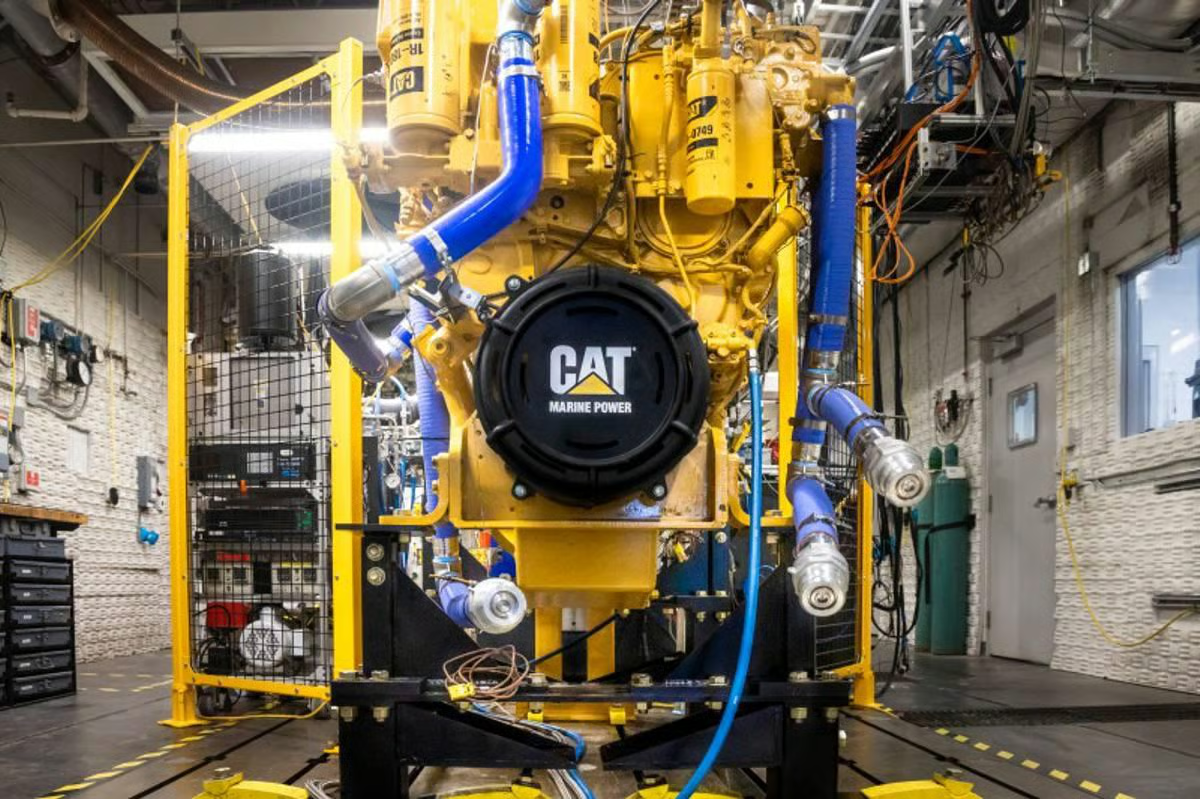 Image-A dual-fuel combustion strategy developed in a Caterpillar marine engine at DOE’s National Transportation Research Center at ORNL shows methanol can efficiently power inland and coastal vessels. Image credit: Genevieve Martin/ORNL, U.S. Dept. of Energy.
Alors que le transport maritime cherche encore la voie la plus réaliste vers la décarbonation, une avancée développée par le laboratoire américain Oak Ridge National Laboratory (ORNL) en partenariat avec Caterpillar pourrait accélérer la transition. Les chercheurs ont mis au point un système de combustion bi-carburant permettant aux moteurs marins de fonctionner avec plus de 75 % de méthanol, tout en conservant les performances et la fiabilité attendues par les opérateurs.
La solution repose sur une approche pragmatique : utiliser une faible quantité de diesel comme carburant pilote afin d’amorcer l’allumage du méthanol, un combustible qui s’enflamme difficilement dans les moteurs à allumage par compression. Cette stratégie permet de préserver l’architecture des moteurs existants sans exiger une refonte complète des groupes motopropulseurs.
Pour les armateurs, l’intérêt est considérable. Plutôt que de remplacer prématurément des actifs coûteux, les flottes pourraient être modernisées via des rétrofits ciblés, réduisant les émissions tout en limitant les investissements et les risques liés à l’évolution des marchés énergétiques.
Le méthanol séduit de plus en plus l’industrie maritime grâce à sa facilité de stockage et de transport par rapport à l’hydrogène, ainsi qu’à sa compatibilité avec des infrastructures déjà connues des exploitants. Bien que son déploiement nécessite encore le développement de réseaux d’avitaillement dédiés, il apparaît aujourd’hui comme l’un des carburants de transition les plus crédibles pour les navires côtiers et fluviaux.
Au-delà du secteur maritime, cette technologie pourrait également intéresser les industries lourdes, la construction, les mines ou encore les groupes électrogènes industriels, où les contraintes d’autonomie, de puissance et de durée de vie des équipements rendent l’électrification complexe.
Plus qu’une révolution, cette innovation illustre une tendance forte : celle des solutions de transition capables de réduire l’empreinte carbone sans bouleverser les infrastructures existantes. Une approche pragmatique qui pourrait faire du méthanol l’un des piliers de la décarbonation des moteurs lourds dans les années à venir.
NJC.© Info https://www.ornl.gov/technology/202405826
------------------------------------------------------------------------------------------------------------------
24/06/26-English
Methanol Makes Its Way into the Engine Room
Image-A dual-fuel combustion strategy developed in a Caterpillar marine engine at DOE’s National Transportation Research Center at ORNL shows methanol can efficiently power inland and coastal vessels. Image credit: Genevieve Martin/ORNL, U.S. Dept. of Energy.
While the maritime transport industry is still searching for the most realistic path to decarbonization, a breakthrough developed by the American Oak Ridge National Laboratory (ORNL) in partnership with Caterpillar could accelerate the transition. Researchers have developed a dual-fuel combustion system that allows marine engines to run on more than 75% methanol, while maintaining the performance and reliability expected by operators.
The solution is based on a pragmatic approach: using a small amount of diesel as a pilot fuel to ignite the methanol, a fuel that is difficult to ignite in compression-ignition engines. This strategy preserves the architecture of existing engines without requiring a complete overhaul of the propulsion systems.
For ship owners, the benefits are considerable. Rather than prematurely replacing costly assets, fleets could be modernized through targeted retrofits, reducing emissions while limiting investments and risks associated with fluctuating energy markets.
Methanol is increasingly appealing to the maritime industry thanks to its ease of storage and transport compared to hydrogen, as well as its compatibility with existing infrastructure. Although its deployment still requires the development of dedicated refueling networks, it is now emerging as one of the most credible transition fuels for coastal and river vessels.
Beyond the maritime sector, this technology could also be of interest to heavy industry, construction, mining, and industrial generators, where constraints related to range, power, and equipment lifespan make electrification complex.
More than a revolution, this innovation illustrates a strong trend: that of transition solutions capable of reducing carbon footprints without disrupting existing infrastructure. This pragmatic approach could make methanol one of the cornerstones of decarbonizing heavy-duty engines in the coming years.
NJC.© Info https://www.ornl.gov/technology/202405826
-----------------------------------------------------------------------------------------------------------
24/06/26-NL
Methanol vindt zijn weg naar de machinekamer
Image-A dual-fuel combustion strategy developed in a Caterpillar marine engine at DOE’s National Transportation Research Center at ORNL shows methanol can efficiently power inland and coastal vessels. Image credit: Genevieve Martin/ORNL, U.S. Dept. of Energy.
Terwijl de maritieme transportsector nog steeds op zoek is naar de meest realistische route naar decarbonisatie, zou een doorbraak van het Amerikaanse Oak Ridge National Laboratory (ORNL) in samenwerking met Caterpillar de transitie kunnen versnellen. Onderzoekers hebben een dual-fuel verbrandingssysteem ontwikkeld waarmee scheepsmotoren op meer dan 75% methanol kunnen draaien, met behoud van de prestaties en betrouwbaarheid die operators verwachten.
De oplossing is gebaseerd op een pragmatische aanpak: een kleine hoeveelheid diesel wordt gebruikt als pilootbrandstof om de methanol te ontsteken, een brandstof die moeilijk te ontsteken is in compressieontstekingsmotoren. Deze strategie behoudt de architectuur van bestaande motoren zonder dat een complete revisie van de voortstuwingssystemen nodig is.
Voor scheepseigenaren zijn de voordelen aanzienlijk. In plaats van kostbare activa voortijdig te vervangen, kunnen vloten worden gemoderniseerd door middel van gerichte aanpassingen, waardoor de uitstoot wordt verminderd en investeringen en risico's die gepaard gaan met fluctuerende energiemarkten worden beperkt.
Methanol wordt steeds aantrekkelijker voor de maritieme sector vanwege het gemak van opslag en transport in vergelijking met waterstof, en de compatibiliteit met de bestaande infrastructuur. Hoewel de inzet ervan nog steeds de ontwikkeling van speciale tanknetwerken vereist, ontpopt het zich nu als een van de meest geloofwaardige transitiebrandstoffen voor kust- en rivierschepen.
Naast de maritieme sector zou deze technologie ook interessant kunnen zijn voor de zware industrie, de bouw, de mijnbouw en industriële generatoren, waar beperkingen met betrekking tot actieradius, vermogen en levensduur van apparatuur elektrificatie complex maken.
Deze innovatie is meer dan een revolutie; ze illustreert een sterke trend: die van transitieoplossingen die de CO2-uitstoot kunnen verminderen zonder de bestaande infrastructuur te ontwrichten. Deze pragmatische aanpak zou methanol tot een van de hoekstenen kunnen maken van de decarbonisatie van zware motoren in de komende jaren.
NJC.© Info https://www.ornl.gov/technology/202405826
----------------------------------------------------------------------------------------------------------------
Date de dernière mise à jour : 23/06/2026