



R.E.News future Technology-Molten Salt Electrolysis Targets America’s Heavy Rare Earth Processing Gap
 17/09/26-FR-English-NL-footer
TERRES RARES — L’AMÉRIQUE CHERCHE LA CLÉ DES MÉTAUX LES PLUS PRÉCIEUX
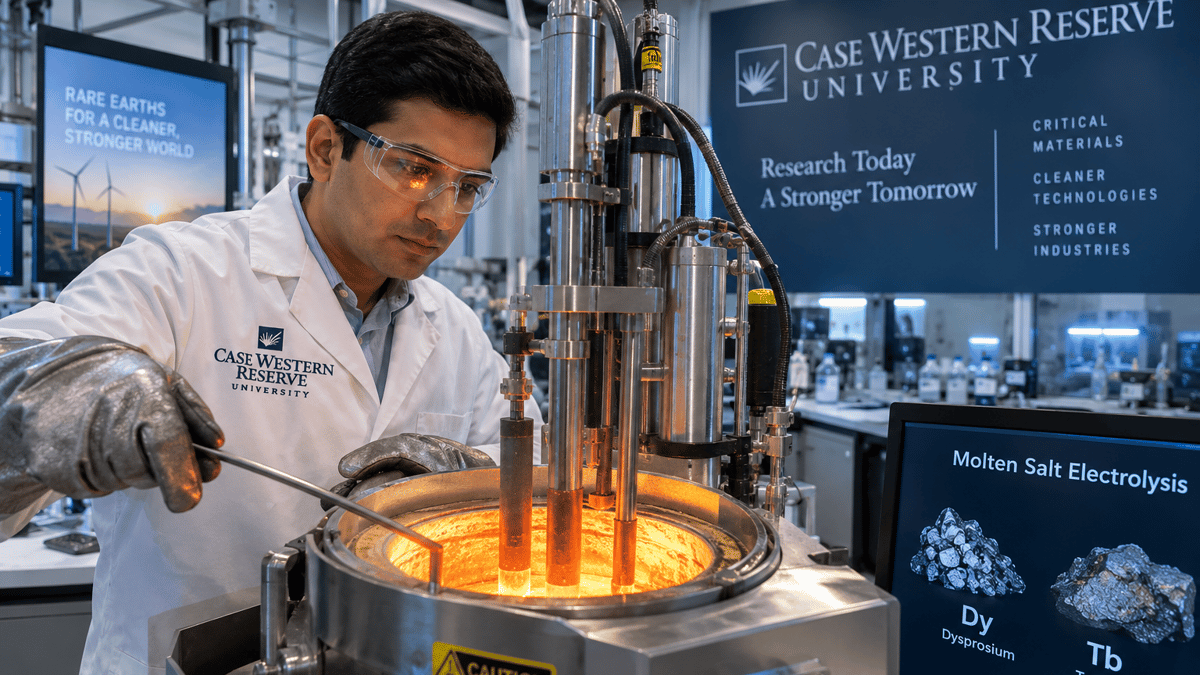 Image- creation R.E.News© via IA chat GPT
Dans l’ombre des machines électriques, une autre révolution se joue : celle des métaux capables de leur donner leur puissance.
À la Case Western Reserve University, des chercheurs américains s’attaquent à l’un des maillons les plus complexes de la chaîne des terres rares : la production de dysprosium et de terbium, deux éléments essentiels aux aimants permanents haute performance.
Leur arme ? Une technologie électrochimique encore au stade de la recherche : l’électrolyse en sels fondus.
Sélectionné dans le cadre d’un programme du U.S. Department of Energy, le projet dirigé par le professeur Rohan Akolkar cherche à transformer des ressources minérales américaines contenant de faibles concentrations de terres rares lourdes en métaux utilisables industriellement.
L’enjeu dépasse largement le laboratoire.
Le dysprosium et le terbium permettent notamment aux aimants NdFeB de conserver leurs performances à haute température. Ils deviennent ainsi des composants stratégiques pour les motorisations électriques, l’aéronautique et les applications de défense.
Mais extraire une terre rare ne suffit pas. Il faut encore la séparer, la purifier, la transformer en métal puis en alliage. C’est précisément dans cet espace critique que la recherche américaine veut intervenir.
L’électrolyse en sels fondus pourrait offrir une voie différente aux procédés chimiques conventionnels. Mais avant de rêver d’une production industrielle, les chercheurs devront répondre aux questions décisives : rendement, pureté, consommation énergétique, gestion des impuretés, matériaux, déchets et coût à grande échelle.
Autour de Case Western Reserve, plusieurs partenaires académiques et industriels participent déjà à cette aventure, dessinant progressivement une chaîne américaine allant de la ressource minérale jusqu’aux matériaux avancés.
Le véritable défi n’est donc plus seulement de posséder les terres rares.
Il est de savoir les transformer sur le sol américain.
Si cette technologie franchit le passage délicat du laboratoire à l’industrie, elle pourrait contribuer à combler l’un des derniers maillons de cette chaîne stratégique.
Une électrolyse. Deux métaux rares.
Et derrière eux, peut-être une nouvelle page de l’indépendance industrielle américaine.
NJC.© Info https://case.edu/
----------------------------------------------------------------------------------------------------------------
17/09/26-English
RARE EARTHS — AMERICA SEEKS THE KEY TO THE MOST PRECIOUS METALS
Image- creation R.E.News© via IA chat GPT
In the shadow of electrical machines, another revolution is underway: that of the metals capable of giving them their power.
At Case Western Reserve University, American researchers are tackling one of the most complex links in the rare earth chain: the production of dysprosium and terbium, two elements essential to high-performance permanent magnets.
Their weapon? An electrochemical technology still in the research stage: molten salt electrolysis.
Selected as part of a program by the U.S. Department of Energy, the project led by Professor Rohan Akolkar aims to transform American mineral resources containing low concentrations of heavy rare earths into industrially usable metals.
The stakes extend far beyond the laboratory.
Dysprosium and terbium, in particular, allow NdFeB magnets to maintain their performance at high temperatures. They are thus becoming strategic components for electric motors, aerospace, and defense applications.
But extracting a rare earth element is not enough. It must also be separated, purified, transformed into a metal, and then into an alloy. It is precisely in this critical area that American research aims to intervene.
Electrolysis using molten salts could offer an alternative to conventional chemical processes. But before dreaming of industrial production, researchers will have to answer crucial questions: yield, purity, energy consumption, impurity management, materials, waste, and large-scale cost.
Around Case Western Reserve, several academic and industrial partners are already involved in this endeavor, gradually building an American supply chain from mineral resource to advanced materials.
The real challenge, therefore, is no longer simply possessing rare earth elements.
It is knowing how to process them on American soil.
If this technology successfully navigates the delicate transition from laboratory to industrial scale, it could help fill one of the last remaining links in this strategic chain.
Electrolysis. Two rare metals.
And behind them, perhaps a new chapter in American industrial independence.
NJC.© Info https://case.edu/
------------------------------------------------------------------------------------------------------------------
17/09/26-NL
ZELDZAME AARDMETALEN — AMERIKA ZOEK DE SLEUTEL TOT DE MEEST KOSTBARE METALEN
Image- creation R.E.News© via IA chat GPT
In de schaduw van elektrische machines is een andere revolutie gaande: die van de metalen die ze van energie voorzien.
Aan de Case Western Reserve University werken Amerikaanse onderzoekers aan een van de meest complexe schakels in de keten van zeldzame aardmetalen: de productie van dysprosium en terbium, twee elementen die essentieel zijn voor hoogwaardige permanente magneten.
Hun wapen? Een elektrochemische technologie die zich nog in de onderzoeksfase bevindt: elektrolyse met gesmolten zout.
Het project, onder leiding van professor Rohan Akolkar, is geselecteerd als onderdeel van een programma van het Amerikaanse Ministerie van Energie en heeft als doel Amerikaanse minerale grondstoffen met lage concentraties zware zeldzame aardmetalen om te zetten in industrieel bruikbare metalen.
De belangen reiken veel verder dan het laboratorium.
Met name dysprosium en terbium zorgen ervoor dat NdFeB-magneten hun prestaties bij hoge temperaturen behouden. Ze worden daardoor strategische componenten voor elektromotoren, de lucht- en ruimtevaart en defensietoepassingen.
Maar het winnen van een zeldzaam aardmetaal is niet genoeg. Het moet ook worden gescheiden, gezuiverd, omgezet in een metaal en vervolgens in een legering. Juist op dit cruciale gebied wil Amerikaans onderzoek ingrijpen.
Elektrolyse met gesmolten zouten zou een alternatief kunnen bieden voor conventionele chemische processen. Maar voordat er überhaupt aan industriële productie gedacht kan worden, moeten onderzoekers cruciale vragen beantwoorden: opbrengst, zuiverheid, energieverbruik, beheersing van onzuiverheden, materialen, afval en de kosten op grote schaal.
Rond Case Western Reserve University zijn verschillende academische en industriële partners al betrokken bij dit project en bouwen ze geleidelijk aan een Amerikaanse toeleveringsketen op, van minerale grondstoffen tot geavanceerde materialen.
De echte uitdaging is daarom niet langer alleen het bezit van zeldzame aardmetalen.
Het gaat erom te weten hoe ze op Amerikaanse bodem verwerkt kunnen worden.
Als deze technologie de delicate overgang van laboratorium naar industriële schaal succesvol doorstaat, zou het een van de laatste ontbrekende schakels in deze strategische keten kunnen helpen vullen.
Elektrolyse. Twee zeldzame metalen.
En daarachter misschien een nieuw hoofdstuk in de Amerikaanse industriële onafhankelijkheid.
NJC.© Info https://case.edu/
-------------------------------------------------------------------------------------------------------------
Date de dernière mise à jour : 16/09/2026