



R.E.News future Technology-Ouster and Fujifilm Bring Native Colour Vision to the Future of Physical AI
 26/05/26-FR-English-NL-footer
Ouster et Fujifilm ouvrent une nouvelle ère pour l’intelligence artificielle physique
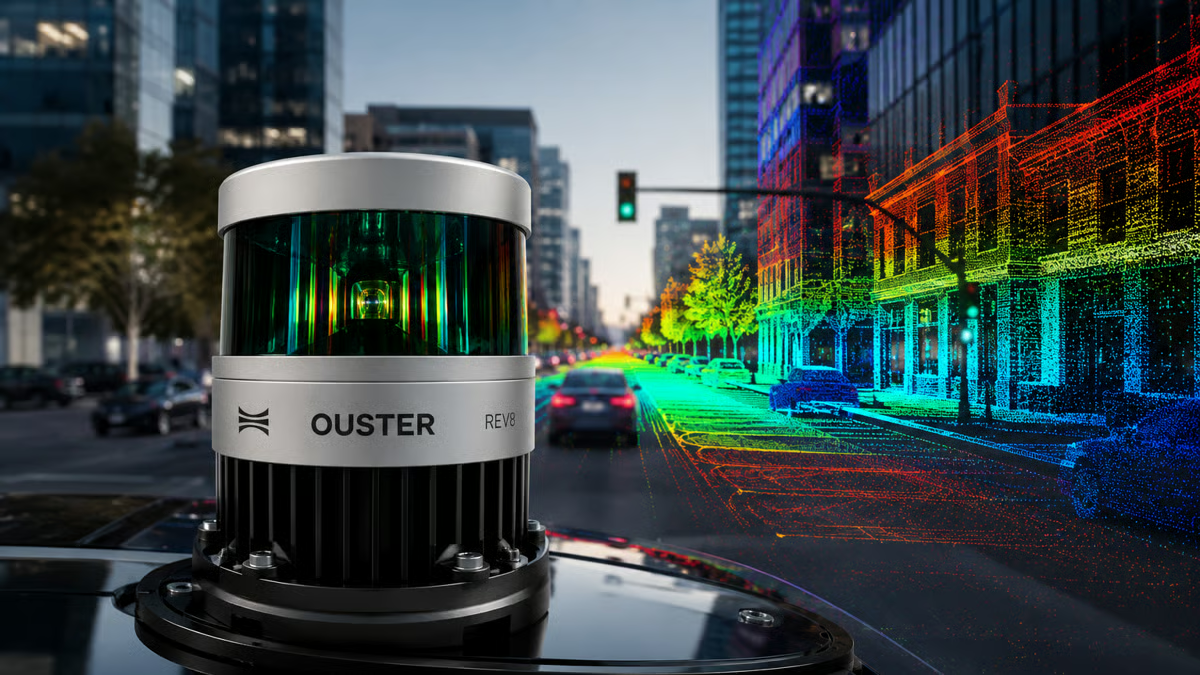 Image-R.E.News©
L’industrie mondiale de l’intelligence artificielle vient peut-être de franchir un cap décisif. En annonçant leur collaboration autour du premier système lidar couleur natif au monde, les groupes Ouster et FUJIFILM Corporation ambitionnent de transformer profondément la manière dont les machines perçoivent le monde réel.
Derrière cette avancée technologique se cache un enjeu colossal : permettre aux véhicules autonomes, robots industriels, infrastructures intelligentes et plateformes de cartographie numérique de “voir” leur environnement avec une précision comparable à celle de l’œil humain — mais avec une capacité d’analyse infiniment supérieure.
Le talon d’Achille des systèmes autonomes
Depuis plusieurs années, le lidar s’est imposé comme l’un des piliers de la révolution autonome. Grâce à ses impulsions laser, cette technologie permet de générer des cartes tridimensionnelles extrêmement précises de l’environnement.
Mais jusqu’ici, une faiblesse persistait : le lidar excellait dans la perception de profondeur sans réellement comprendre les couleurs, tandis que les caméras traditionnelles captaient les textures et les nuances visuelles sans offrir une lecture spatiale parfaitement fiable.
Résultat : les systèmes autonomes devaient combiner plusieurs capteurs distincts — caméras, lidar, radars — au prix d’architectures complexes, gourmandes en calcul et sujettes à des problèmes de synchronisation.
C’est précisément cette limite qu’Ouster et Fujifilm cherchent désormais à effacer.
Quand la machine commence réellement à voir
Au cœur de cette innovation se trouve la nouvelle architecture Rev8 développée par Ouster. Contrairement aux systèmes classiques, la technologie intègre directement la perception couleur au sein même du capteur lidar, dans une seule et unique architecture silicium.
Autrement dit, profondeur, géométrie et couleurs sont désormais capturées simultanément par un même système optique et électronique.
Cette fusion native change radicalement la qualité des données générées. Les nuages de points 3D ne sont plus simplement des structures monochromes enrichies artificiellement par des caméras externes : ils deviennent des représentations cohérentes, synchronisées et riches en contexte visuel.
Pour les intelligences artificielles chargées d’interpréter le monde physique, cette précision devient essentielle.
L’essor fulgurant de la “Physical AI”
L’intelligence artificielle quitte progressivement les écrans pour entrer dans les infrastructures, les usines, les mines, les ports et les villes.
Robots mobiles autonomes, engins de chantier intelligents, systèmes de surveillance routière, plateformes logistiques automatisées ou encore réseaux ferroviaires connectés : tous reposent désormais sur une compréhension ultra-fine de leur environnement.
Dans cet univers, la qualité des données sensorielle est devenue un avantage stratégique majeur.
Les futurs modèles d’IA physique devront non seulement mesurer les distances, mais aussi reconnaître les matériaux, identifier les défauts d’infrastructure, distinguer les objets et comprendre les conditions environnementales en temps réel.
Le lidar couleur natif pourrait précisément devenir l’un des socles technologiques de cette nouvelle génération de machines intelligentes.
Fujifilm, de la photographie à l’infrastructure IA
L’un des aspects les plus surprenants de cette collaboration réside dans le rôle central joué par Fujifilm.
Connue mondialement pour son héritage photographique, l’entreprise japonaise est également devenue un acteur majeur des matériaux semi-conducteurs et de la science des couleurs.
Ses filtres organiques spécialisés ont permis aux ingénieurs d’Ouster d’intégrer directement la capture chromatique au niveau du silicium sans perturber les signaux laser du lidar — un défi technologique particulièrement complexe.
Cette convergence entre science de l’image, électronique avancée et intelligence artificielle illustre une mutation plus large de l’industrie technologique mondiale : les frontières entre photographie, robotique, infrastructures intelligentes et semi-conducteurs s’effacent progressivement.
Des infrastructures capables de comprendre leur environnement
L’impact potentiel dépasse largement le secteur automobile autonome.
Partout dans le monde, les infrastructures deviennent progressivement “perceptives”. Autoroutes intelligentes, ports automatisés, réseaux ferroviaires autonomes, jumeaux numériques urbains et systèmes de surveillance industrielle nécessitent tous des capteurs capables de fonctionner en continu dans des environnements complexes.
Le lidar couleur natif pourrait considérablement améliorer la détection d’incidents, l’analyse du trafic, l’inspection d’ouvrages, la maintenance prédictive et la cartographie haute fidélité.
Dans les projets de villes intelligentes, cette simplification des architectures de capteurs pourrait également réduire les coûts de déploiement et de maintenance, un enjeu crucial pour les collectivités confrontées à la modernisation de leurs infrastructures vieillissantes.
La bataille mondiale des capteurs change de dimension
L’annonce d’Ouster et Fujifilm illustre enfin une évolution stratégique du marché mondial des capteurs intelligents.
La compétition ne se joue plus uniquement sur la portée ou la résolution des systèmes. Désormais, les industriels cherchent à produire des capteurs capables de fournir des données directement exploitables par les intelligences artificielles, avec un maximum de cohérence et un minimum de complexité.
Dans cette course technologique, le lidar couleur natif marque peut-être le début d’une nouvelle génération de perception machine.
Car les machines de demain ne devront plus seulement mesurer le monde. Elles devront le comprendre visuellement, spatialement et contextuellement — presque comme un être humain.
NJC.© Info Ouster and Fujifilm
------------------------------------------------------------------------------------------------------------------
26/05/26-English
Ouster and Fujifilm Usher in a New Era for Physical Artificial Intelligence
Image-R.E.News©
The global artificial intelligence industry may have just reached a decisive milestone. By announcing their collaboration on the world's first native color lidar system, Ouster and Fujifilm Corporation aim to profoundly transform how machines perceive the real world.
Behind this technological advancement lies a colossal challenge: enabling autonomous vehicles, industrial robots, smart infrastructure, and digital mapping platforms to "see" their environment with precision comparable to that of the human eye—but with infinitely greater analytical capabilities.
The Achilles' Heel of Autonomous Systems
For several years, lidar has established itself as one of the pillars of the autonomous revolution. Thanks to its laser pulses, this technology makes it possible to generate extremely precise three-dimensional maps of the environment.
But until now, one weakness remained: lidar excelled at depth perception without truly understanding color, while traditional cameras captured textures and visual nuances without offering perfectly reliable spatial reading.
As a result, autonomous systems had to combine several separate sensors—cameras, lidar, radar—resulting in complex, computationally intensive architectures prone to synchronization problems.
It is precisely this limitation that Ouster and Fujifilm are now seeking to overcome.
When the machine truly begins to see
At the heart of this innovation lies the new Rev8 architecture developed by Ouster. Unlike conventional systems, this technology directly integrates color perception within the lidar sensor itself, in a single silicon architecture.
In other words, depth, geometry, and color are now captured simultaneously by the same optical and electronic system.
This native integration radically changes the quality of the generated data. 3D point clouds are no longer simply monochrome structures artificially enhanced by external cameras: they are becoming coherent, synchronized representations rich in visual context.
For artificial intelligence systems tasked with interpreting the physical world, this precision is becoming essential.
The Rapid Rise of “Physical AI”
Artificial intelligence is gradually moving beyond screens and into infrastructure, factories, mines, ports, and cities.
Autonomous mobile robots, intelligent construction equipment, road surveillance systems, automated logistics platforms, and connected rail networks: all now rely on an ultra-precise understanding of their environment.
In this world, the quality of sensory data has become a major strategic advantage.
Future physical AI models will need not only to measure distances but also to recognize materials, identify infrastructure defects, distinguish objects, and understand environmental conditions in real time.
Native color lidar could become one of the technological cornerstones of this new generation of intelligent machines.
Fujifilm: From Photography to AI Infrastructure
One of the most surprising aspects of this collaboration lies in the central role played by Fujifilm.
Known worldwide for its photographic heritage, the Japanese company has also become a major player in semiconductor materials and color science.
Its specialized organic filters enabled Ouster engineers to directly integrate color capture at the silicon level without disrupting the lidar laser signals—a particularly complex technological challenge.
This convergence of image science, advanced electronics, and artificial intelligence illustrates a broader transformation of the global technology industry: the boundaries between photography, robotics, smart infrastructure, and semiconductors are gradually blurring.
Infrastructure Capable of Understanding Its Environment
The potential impact extends far beyond the autonomous vehicle sector.
Around the world, infrastructure is gradually becoming “perceptive.” Smart highways, automated ports, autonomous rail networks, urban digital twins, and industrial monitoring systems all require sensors capable of continuous operation in complex environments.
Native color lidar could significantly improve incident detection, traffic analysis, infrastructure inspection, predictive maintenance, and high-fidelity mapping.
In smart city projects, this simplification of sensor architectures could also reduce deployment and maintenance costs, a crucial issue for communities facing the modernization of their aging infrastructure.
The global sensor battle is changing scale
The announcement from Ouster and Fujifilm finally illustrates a strategic shift in the global smart sensor market.
The competition is no longer solely about the range or resolution of systems. Now, manufacturers are seeking to produce sensors capable of providing data directly usable by artificial intelligence, with maximum consistency and minimum complexity.
In this technological race, native color lidar may mark the beginning of a new generation of machine perception.
Because the machines of tomorrow will no longer simply have to measure the world. They will have to understand it visually, spatially, and contextually—almost like a human being.
NJC.© Info Ouster and Fujifilm
------------------------------------------------------------------------------------------------------------------
26/05/26-NL
Ouster en Fujifilm luiden een nieuw tijdperk in voor fysieke kunstmatige intelligentie
Image-R.E.News©
De wereldwijde industrie voor kunstmatige intelligentie heeft mogelijk een belangrijke mijlpaal bereikt. Met de aankondiging van hun samenwerking aan 's werelds eerste native kleurenlidar-systeem willen Ouster en Fujifilm Corporation de manier waarop machines de echte wereld waarnemen radicaal veranderen.
Achter deze technologische vooruitgang schuilt een enorme uitdaging: autonome voertuigen, industriële robots, slimme infrastructuur en digitale kaartplatformen in staat stellen hun omgeving te "zien" met een precisie die vergelijkbaar is met die van het menselijk oog, maar met oneindig veel grotere analytische mogelijkheden.
De achilleshiel van autonome systemen
Lidar heeft zich de afgelopen jaren gevestigd als een van de pijlers van de autonome revolutie. Dankzij de laserpulsen maakt deze technologie het mogelijk om extreem nauwkeurige driedimensionale kaarten van de omgeving te genereren.
Maar tot nu toe bleef er één zwakte bestaan: lidar blonk uit in diepteperceptie, maar begreep kleur niet echt, terwijl traditionele camera's texturen en visuele nuances vastlegden zonder een perfect betrouwbare ruimtelijke weergave te bieden.
Als gevolg hiervan moesten autonome systemen verschillende afzonderlijke sensoren combineren – camera's, lidar, radar – wat resulteerde in complexe, rekenintensieve architecturen die gevoelig waren voor synchronisatieproblemen.
Precies deze beperking proberen Ouster en Fujifilm nu te overwinnen.
Wanneer de machine echt begint te zien
De kern van deze innovatie wordt gevormd door de nieuwe Rev8-architectuur die door Ouster is ontwikkeld. In tegenstelling tot conventionele systemen integreert deze technologie kleurwaarneming direct in de lidar-sensor zelf, in één enkele siliciumarchitectuur.
Met andere woorden, diepte, geometrie en kleur worden nu gelijktijdig vastgelegd door hetzelfde optische en elektronische systeem.
Deze native integratie verandert de kwaliteit van de gegenereerde data radicaal. 3D-puntenwolken zijn niet langer simpelweg monochrome structuren die kunstmatig worden verbeterd door externe camera's: ze worden coherente, gesynchroniseerde representaties rijk aan visuele context.
Voor kunstmatige intelligentiesystemen die de fysieke wereld moeten interpreteren, wordt deze precisie essentieel.
De snelle opkomst van 'fysieke AI'
Kunstmatige intelligentie verplaatst zich geleidelijk van schermen naar infrastructuur, fabrieken, mijnen, havens en steden.
Autonome mobiele robots, intelligente bouwmachines, wegbewakingssystemen, geautomatiseerde logistieke platforms en verbonden spoorwegnetwerken: ze zijn allemaal afhankelijk van een uiterst nauwkeurig begrip van hun omgeving.
In deze wereld is de kwaliteit van sensorische data een belangrijk strategisch voordeel geworden.
Toekomstige fysieke AI-modellen zullen niet alleen afstanden moeten kunnen meten, maar ook materialen moeten kunnen herkennen, infrastructuurdefecten moeten kunnen identificeren, objecten moeten kunnen onderscheiden en omgevingsomstandigheden in realtime moeten kunnen begrijpen.
Native color lidar zou een van de technologische hoekstenen van deze nieuwe generatie intelligente machines kunnen worden.
Fujifilm: Van fotografie tot AI-infrastructuur
Een van de meest verrassende aspecten van deze samenwerking is de centrale rol die Fujifilm speelt.
Het Japanse bedrijf, wereldwijd bekend om zijn fotografische erfgoed, is ook een belangrijke speler geworden op het gebied van halfgeleidermaterialen en kleurenwetenschap.
Dankzij de gespecialiseerde organische filters konden de ingenieurs van Ouster kleurregistratie direct op siliciumniveau integreren zonder de lidar-lasersignalen te verstoren – een bijzonder complexe technologische uitdaging.
Deze convergentie van beeldtechnologie, geavanceerde elektronica en kunstmatige intelligentie illustreert een bredere transformatie van de wereldwijde technologie-industrie: de grenzen tussen fotografie, robotica, slimme infrastructuur en halfgeleiders vervagen geleidelijk.
Infrastructuur die zijn omgeving kan begrijpen
De potentiële impact reikt veel verder dan de sector van autonome voertuigen.
Overal ter wereld wordt infrastructuur geleidelijk aan "inzichtelijk". Slimme snelwegen, geautomatiseerde havens, autonome spoorwegnetwerken, digitale tweelingen van steden en industriële monitoringsystemen vereisen allemaal sensoren die continu kunnen functioneren in complexe omgevingen.
Native kleurenlidar zou de incidentdetectie, verkeersanalyse, infrastructuurinspectie, voorspellend onderhoud en nauwkeurige cartografie aanzienlijk kunnen verbeteren.
In smart city-projecten kan deze vereenvoudiging van sensorarchitecturen ook de implementatie- en onderhoudskosten verlagen, een cruciaal punt voor gemeenschappen die hun verouderde infrastructuur willen moderniseren.
De wereldwijde sensorstrijd verandert van schaal
De aankondiging van Ouster en Fujifilm illustreert eindelijk een strategische verschuiving in de wereldwijde markt voor slimme sensoren.
De concurrentie draait niet langer alleen om het bereik of de resolutie van systemen. Fabrikanten streven er nu naar sensoren te produceren die direct bruikbare data leveren voor kunstmatige intelligentie, met maximale consistentie en minimale complexiteit.
In deze technologische race kan native color lidar het begin markeren van een nieuwe generatie machineperceptie.
Want de machines van morgen hoeven de wereld niet langer alleen maar te meten. Ze moeten de wereld visueel, ruimtelijk en contextueel begrijpen – bijna als een mens.
NJC.© Info Ouster en Fujifilm
-----------------------------------------------------------------------------------------------------------------
Date de dernière mise à jour : 26/05/2026