



R.E.News future Technology-Ouster Redefines Machine Vision With Native Colour LiDAR and Physical AI Ambitions
 11/04/26-FR-English-NL-footer
Ouster Réinvente la Vision Machine Quand le LiDAR Commence Enfin à Voir le Monde en Couleur
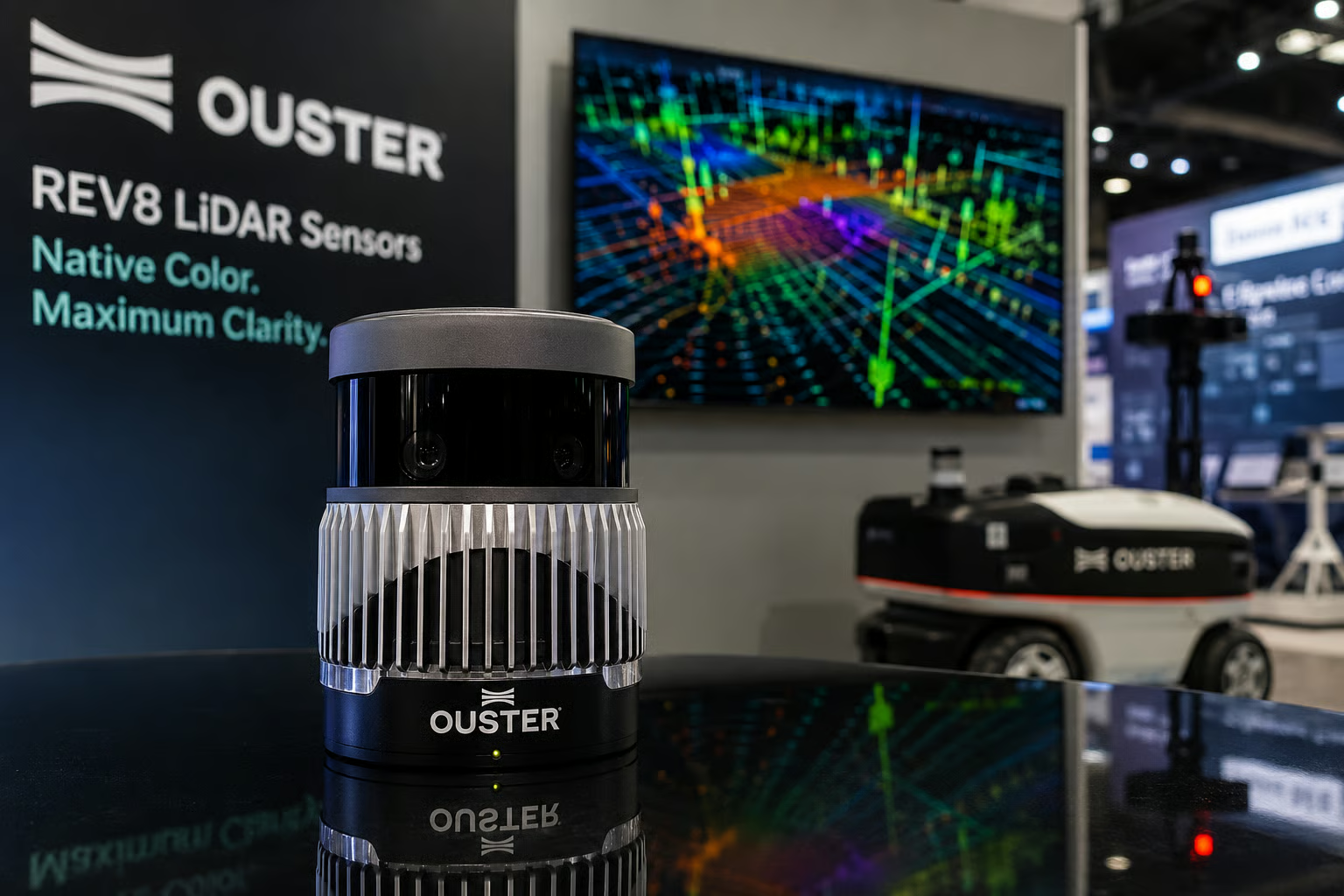 Image-R.E.News©
Pendant des années, les machines autonomes ont avancé dans un univers paradoxalement aveugle.
Elles savaient mesurer des distances au millimètre près. Elles cartographiaient l’espace en trois dimensions avec une précision impressionnante. Elles détectaient des obstacles, calculaient des trajectoires et analysaient des volumes entiers en temps réel.
Mais elles ne voyaient pas réellement le monde comme nous le voyons.
Jusqu’à aujourd’hui.
Avec le lancement de sa nouvelle génération de capteurs Rev8 OS, Ouster
affirme franchir une étape décisive dans l’évolution de la perception machine : le premier LiDAR couleur natif au monde.
Et derrière cette annonce technologique se cache peut-être une transformation beaucoup plus profonde : l’entrée véritable de l’industrie dans l’ère de la Physical AI.
La Fin du LiDAR “Aveugle”
Depuis plus d’une décennie, le LiDAR est devenu l’un des piliers de l’autonomie industrielle.
Minières autonomes, robots logistiques, véhicules intelligents, drones d’inspection, infrastructures urbaines connectées : tous dépendent de cette technologie capable de créer une lecture tridimensionnelle ultra-précise du monde physique grâce aux impulsions laser.
Mais un problème persistait.
Le LiDAR traditionnel percevait la géométrie… sans comprendre le contexte visuel.
En clair : il voyait les formes, mais pas les couleurs.
Pour compenser cette faiblesse, les industriels combinaient généralement LiDAR et caméras via des architectures complexes de fusion de données. Une approche efficace, mais lourde :
calibrations permanentes ;
latence accrue ;
synchronisation difficile ;
vulnérabilité en environnement hostile.
Avec Rev8, Ouster tente de supprimer cette frontière.
Chaque point capturé par le capteur embarque désormais directement sa propre information couleur, parfaitement alignée spatialement et temporellement.
La machine ne mesure plus seulement l’espace.
Elle commence à l’interpréter.
Donner une Vision “Humaine” aux Machines
L’ambition d’Ouster dépasse largement l’amélioration d’un simple capteur.
L’entreprise veut offrir aux systèmes autonomes une perception plus proche de celle d’un opérateur humain.
Grâce à son architecture L4 Ouster Silicon et à l’intégration des technologies colorimétriques de Fujifilm, Rev8 combine :
une profondeur couleur 48 bits ;
une plage dynamique de 116 dB ;
une capacité de fonctionnement allant de l’obscurité quasi totale à une lumière extrême de deux millions de lux.
Autrement dit : un système capable de fonctionner aussi bien dans un tunnel minier poussiéreux qu’en plein soleil sur une autoroute.
Pour les infrastructures et les environnements industriels, cette évolution change radicalement les perspectives.
Une machine autonome pourra désormais :
distinguer des marquages au sol temporaires ;
identifier plus clairement des zones de danger ;
reconnaître des équipements de sécurité ;
mieux différencier humains, obstacles et terrains complexes.
Dans des secteurs où chaque milliseconde de réaction peut éviter un accident, cette richesse contextuelle devient stratégique.
La Physical AI Quitte les Laboratoires
Depuis plusieurs années, un nouveau terme s’impose progressivement dans les milieux technologiques : la Physical AI.
Non plus une intelligence artificielle confinée aux logiciels ou aux centres de données, mais une IA capable d’interagir physiquement avec le monde réel :
robots industriels ;
engins autonomes ;
drones intelligents ;
infrastructures urbaines automatisées.
Et pour cette nouvelle génération de machines, la perception devient le véritable champ de bataille technologique.
Le Rev8 a précisément été conçu pour cette transition.
Selon Ouster, la plateforme peut traiter :
jusqu’à 10,4 millions de points par seconde ;
22,4 Gb/s de bande passante ;
près de 20 trillions de photons par seconde.
Des chiffres vertigineux qui traduisent une seule réalité : les machines doivent désormais comprendre leur environnement avec une fidélité quasi organique.
Voir Plus Loin Pour Réagir Plus Vite
Le modèle phare OS1 Max illustre parfaitement cette nouvelle philosophie.
Doté d’une architecture 256 canaux, il serait capable de détecter des objets jusqu’à 200 mètres à faible réflectivité, avec une portée maximale atteignant 500 mètres.
Dans l’univers des machines autonomes, cette distance représente du temps.
Et dans les environnements industriels, le temps équivaut à la sécurité.
Pour un camion minier autonome, un robot logistique ou un véhicule de maintenance autoroutière, quelques fractions de seconde supplémentaires peuvent transformer une situation critique en simple ajustement de trajectoire.
L’Autonomie Industrielle Devient une Question de Sécurité
L’autre signal fort envoyé par Ouster concerne la maturité industrielle du produit.
Contrairement à de nombreuses technologies autonomes encore cantonnées aux démonstrateurs, Rev8 a été conçu dès le départ pour répondre aux exigences réglementaires réelles du marché.
Le système vise notamment :
la conformité ISO 26262 (ASIL-B) ;
les standards SIL-2 ;
le niveau PLd ;
la cybersécurité ISO 21434.
Cette orientation est capitale.
Car l’autonomie industrielle ne pourra se généraliser que lorsque les exploitants auront confiance dans la robustesse fonctionnelle et cybernétique des systèmes.
Dans les mines, les ports, les infrastructures routières ou les chantiers automatisés, une défaillance logicielle peut avoir des conséquences humaines et économiques majeures.
NVIDIA et la Guerre des Écosystèmes IA
En parallèle du lancement Rev8, NVIDIA
et Ouster renforcent également leur partenariat autour de la plateforme Jetson.
Cette alliance reflète une mutation profonde du secteur : le capteur seul ne suffit plus.
L’enjeu devient désormais l’intégration complète entre :
perception ;
calcul accéléré ;
simulation ;
apprentissage IA ;
traitement temps réel.
Grâce à l’intégration avec NVIDIA Isaac ROS et Isaac Sim, les développeurs pourront entraîner leurs systèmes autonomes dans des environnements virtuels avant déploiement réel.
Les jumeaux numériques, les simulations robotiques et les données synthétiques deviennent ainsi les nouveaux terrains d’essai de l’industrie automatisée.
L’Industrie Lourde Devient le Nouveau Terrain de l’Autonomie
Longtemps associée à la voiture autonome grand public, la révolution LiDAR se déplace aujourd’hui vers les secteurs industriels.
Et ce n’est pas un hasard.
Car les besoins y sont immenses :
pénurie de main-d’œuvre ;
exigences de productivité ;
sécurité renforcée ;
automatisation des opérations dangereuses.
Selon Ouster, plusieurs acteurs majeurs préparent déjà des déploiements autour de Rev8, parmi lesquels :
Google
,
Liebherr
,
Epiroc
,
Skydio
,
Seegrid
,
et Volvo Autonomous Solutions
.
La bataille de l’autonomie ne se joue plus uniquement sur les routes urbaines.
Elle se joue désormais dans les carrières, les entrepôts, les ports, les infrastructures critiques et les mégachantiers.
Quand les Machines Commencent à Comprendre le Monde
Le Rev8 ne résoudra pas instantanément tous les défis de l’autonomie :
réglementation ;
responsabilité juridique ;
coûts ;
acceptation opérationnelle ;
fiabilité de l’IA.
Mais une frontière technologique semble bel et bien avoir été franchie.
Les machines ne se contentent plus de détecter des volumes et des distances.
Elles commencent à percevoir le contexte.
Et dans l’histoire de l Ouster
NJC.© Info Ouster
-----------------------------------------------------------------------------------------------------------------
11/04/26-English
Ouster Reinvents Machine Vision When LiDAR Finally Begins to See the World in Color
Image-R.E.News©
For years, autonomous machines have operated in a paradoxically blind world.
They could measure distances to the millimeter. They mapped three-dimensional space with impressive precision. They detected obstacles, calculated trajectories, and analyzed entire volumes in real time.
But they didn't truly see the world as we do.
Until now.
With the launch of its new generation of Rev8 OS sensors, Ouster
claims to be taking a decisive step in the evolution of machine perception: the world's first native color LiDAR.
And behind this technological announcement may lie a much deeper transformation: the industry's true entry into the era of Physical AI.
The End of “Blind” LiDAR
For over a decade, LiDAR has been a cornerstone of industrial autonomy.
Autonomous mining, logistics robots, smart vehicles, inspection drones, connected urban infrastructure: all rely on this technology, which uses laser pulses to create an ultra-precise three-dimensional scan of the physical world.
But one problem persisted.
Traditional LiDAR perceived geometry… without understanding the visual context.
In short: it saw shapes, but not colors.
To compensate for this weakness, manufacturers typically combined LiDAR and cameras using complex data fusion architectures. An effective but cumbersome approach:
constant calibration;
increased latency;
difficult synchronization;
vulnerability in harsh environments.
With Rev8, Ouster is attempting to eliminate this limitation.
Each point captured by the sensor now directly carries its own color information, perfectly aligned spatially and temporally.
The machine no longer simply measures space.
It begins to interpret it.
Giving Machines a “Human” Vision
Ouster’s ambition goes far beyond simply improving a sensor.
The company aims to provide autonomous systems with a perception closer to that of a human operator.
Thanks to its Ouster Silicon L4 architecture and the integration of Fujifilm’s colorimetric technologies, Rev8 combines:
48-bit color depth;
116 dB dynamic range;
operating capabilities ranging from near-total darkness to extreme light of two million lux.
In other words: a system capable of functioning equally well in a dusty mine tunnel or in bright sunlight on a highway.
For infrastructure and industrial environments, this evolution radically changes the outlook.
An autonomous machine will now be able to:
distinguish temporary road markings;
more clearly identify danger zones;
recognize safety equipment;
better differentiate between humans, obstacles, and complex terrain.
In sectors where every millisecond of reaction time can prevent an accident, this rich contextual awareness becomes strategic.
Physical AI Leaves the Labs
For several years, a new term has been gradually gaining traction in the tech world: Physical AI.
No longer an artificial intelligence confined to software or data centers, but an AI capable of physically interacting with the real world:
industrial robots;
autonomous vehicles;
intelligent drones;
automated urban infrastructure.
And for this new generation of machines, perception becomes the true technological battleground.
The Rev8 was specifically designed for this transition.
According to Ouster, the platform can process:
up to 10.4 million points per second;
22.4 Gb/s of bandwidth;
nearly 20 trillion photons per second.
Staggering figures that reflect a single reality: machines must now understand their environment with near-organic fidelity.
See Further to React Faster
The flagship OS1 Max model perfectly illustrates this new philosophy.
With its 256-channel architecture, it is reportedly capable of detecting objects up to 200 meters away in low-reflectivity environments, with a maximum range of 500 meters.
In the world of autonomous machines, this distance represents time.
And in industrial environments, time is synonymous with safety.
For an autonomous mining truck, a logistics robot, or a highway maintenance vehicle, a few extra fractions of a second can transform a critical situation into a simple trajectory adjustment.
Industrial Autonomy Becomes a Matter of Safety
The other strong signal sent by Ouster concerns the product's industrial maturity.
Unlike many autonomous technologies still confined to demonstration projects, Rev8 was designed from the ground up to meet real-world regulatory market requirements.
The system specifically targets:
ISO 26262 (ASIL-B) compliance;
SIL-2 standards;
PLd level;
ISO 21434 cybersecurity.
This focus is crucial.
Because industrial autonomy can only become widespread when operators have confidence in the functional and cybersecurity robustness of the systems.
In mines, ports, road infrastructure, or automated construction sites, a software failure can have major human and economic consequences.
NVIDIA and the AI Ecosystem Wars
Alongside the Rev8 launch, NVIDIA
and Ouster are also strengthening their partnership around the Jetson platform.
This alliance reflects a profound shift in the sector: sensors alone are no longer sufficient.
The challenge now lies in the complete integration of:
perception;
accelerated computing; Simulation;
AI learning;
Real-time processing.
Thanks to integration with NVIDIA Isaac ROS and Isaac Sim, developers can train their autonomous systems in virtual environments before real-world deployment.
Digital twins, robotic simulations, and synthetic data are thus becoming the new testing grounds for automated industry.
Heavy Industry Becomes the New Battleground for Autonomy
Long associated with the consumer autonomous vehicle, the LiDAR revolution is now shifting towards industrial sectors.
And this is no coincidence.
Because the needs are immense:
Labor shortages;
Productivity requirements;
Enhanced safety;
Automation of hazardous operations.
According to Ouster, several major players are already preparing deployments around Rev8, including:
Google
,
Liebherr
,
Epiroc
,
Skydio
,
Seegrid
, and Volvo Autonomous Solutions
.
The battle for autonomy is no longer fought solely on urban roads.
It is now being fought in quarries, warehouses, ports, critical infrastructure, and mega-construction sites.
When Machines Begin to Understand the World
Rev8 will not instantly solve all the challenges of autonomy:
regulations;
legal liability;
costs;
operational acceptance;
AI reliability.
But a technological frontier seems to have been crossed.
Machines are no longer content with simply detecting volumes and distances.
They are beginning to perceive context.
And in the history of industrial automation, this nuance could change everything.
NJC.© Info Ouster
------------------------------------------------------------------------------------------------------------------
11/04/26-NL
Ouster herdefinieert machinaal zien Wanneer LiDAR eindelijk de wereld in kleur begint te zien
Image-R.E.News©
Jarenlang opereerden autonome machines in een paradoxaal blinde wereld.
Ze konden afstanden tot op de millimeter nauwkeurig meten. Ze brachten driedimensionale ruimtes met indrukwekkende precisie in kaart. Ze detecteerden obstakels, berekenden trajecten en analyseerden complete volumes in realtime.
Maar ze zagen de wereld niet echt zoals wij dat doen.
Tot nu toe.
Met de lancering van de nieuwe generatie Rev8 OS-sensoren claimt Ouster
een beslissende stap te zetten in de evolutie van machinale waarneming: 's werelds eerste native kleuren-LiDAR.
En achter deze technologische aankondiging schuilt mogelijk een veel diepere transformatie: de daadwerkelijke intrede van de industrie in het tijdperk van fysieke AI.
Het einde van "blinde" LiDAR
Al meer dan tien jaar is LiDAR een hoeksteen van industriële autonomie.
Autonome mijnbouw, logistieke robots, slimme voertuigen, inspectiedrones, verbonden stedelijke infrastructuur: ze vertrouwen allemaal op deze technologie, die laserpulsen gebruikt om een uiterst nauwkeurige driedimensionale scan van de fysieke wereld te maken.
Maar er bleef één probleem bestaan.
Traditionele LiDAR registreerde geometrie… zonder de visuele context te begrijpen.
Kortom: het zag vormen, maar geen kleuren.
Om deze zwakte te compenseren, combineerden fabrikanten doorgaans LiDAR en camera's met behulp van complexe datafusie-architecturen. Een effectieve, maar omslachtige aanpak:
constante kalibratie;
verhoogde latentie;
moeilijke synchronisatie;
kwetsbaarheid in ruwe omgevingen.
Met Rev8 probeert Ouster deze beperking te elimineren.
Elk punt dat door de sensor wordt vastgelegd, draagt nu direct zijn eigen kleurinformatie, perfect ruimtelijk en temporeel uitgelijnd.
De machine meet niet langer alleen de ruimte.
Hij begint deze te interpreteren.
Machines een "menselijk" gezichtsvermogen geven
De ambitie van Ouster gaat veel verder dan alleen het verbeteren van een sensor.
Het bedrijf streeft ernaar autonome systemen te leveren met een waarneming die dichter bij die van een menselijke operator ligt.
Dankzij de Ouster Silicon L4-architectuur en de integratie van Fujifilms colorimetrische technologieën combineert Rev8:
48-bits kleurdiepte;
116 dB dynamisch bereik;
werkvermogen van bijna volledige duisternis tot extreem licht van twee miljoen lux.
Met andere woorden: een systeem dat even goed functioneert in een stoffige mijntunnel als in fel zonlicht op een snelweg.
Voor infrastructuur en industriële omgevingen verandert deze ontwikkeling het perspectief radicaal.
Een autonome machine kan nu:
tijdelijke wegmarkeringen onderscheiden;
gevarenzones duidelijker identificeren;
veiligheidsapparatuur herkennen;
mensen, obstakels en complex terrein beter van elkaar onderscheiden.
In sectoren waar elke milliseconde reactietijd een ongeluk kan voorkomen, wordt dit rijke contextbewustzijn strategisch.
Fysieke AI verlaat de laboratoria
Al enkele jaren wint een nieuwe term geleidelijk aan terrein in de techwereld: Fysieke AI.
Kunstmatige intelligentie is niet langer beperkt tot software of datacenters, maar kan fysiek interageren met de echte wereld:
industriële robots;
autonome voertuigen;
intelligente drones;
geautomatiseerde stedelijke infrastructuur.
En voor deze nieuwe generatie machines wordt perceptie het ware technologische strijdveld.
De Rev8 is specifiek ontworpen voor deze transitie.
Volgens Ouster kan het platform verwerken:
tot 10,4 miljoen punten per seconde;
22,4 Gb/s bandbreedte;
bijna 20 biljoen fotonen per seconde.
Verbluffende cijfers die één realiteit weerspiegelen: machines moeten hun omgeving nu met bijna organische precisie begrijpen.
Zie Verder voor sneller reageren
Het vlaggenschipmodel OS1 Max illustreert deze nieuwe filosofie perfect.
Met zijn 256-kanaals architectuur kan het naar verluidt objecten detecteren tot op 200 meter afstand in omgevingen met weinig reflectie, met een maximaal bereik van 500 meter.
In de wereld van autonome machines staat deze afstand gelijk aan tijd.
En in industriële omgevingen is tijd synoniem met veiligheid.
Voor een autonome mijnbouwtruck, een logistieke robot of een voertuig voor wegonderhoud kunnen een paar extra fracties van een seconde een kritieke situatie veranderen in een simpele koerscorrectie.
Industriële autonomie wordt een kwestie van veiligheid
Het andere sterke signaal dat Ouster afgeeft, betreft de industriële volwassenheid van het product.
In tegenstelling tot veel autonome technologieën die nog steeds beperkt zijn tot demonstratieprojecten, is Rev8 van de grond af ontworpen om te voldoen aan de daadwerkelijke wettelijke eisen van de markt.
Het systeem richt zich specifiek op:
conformiteit met ISO 26262 (ASIL-B);
SIL-2-normen;
PLd-niveau;
ISO 21434-cyberbeveiliging.
Deze focus is cruciaal.
Industriële autonomie kan immers alleen wijdverspreid raken als operators vertrouwen hebben in de functionele en cyberbeveiligingsrobuustheid van de systemen.
In mijnen, havens, wegenbouw of geautomatiseerde bouwplaatsen kan een softwarefout grote menselijke en economische gevolgen hebben.
NVIDIA en de AI-ecosysteemoorlogen
Naast de lancering van Rev8 versterken NVIDIA
en Ouster ook hun partnerschap rond het Jetson-platform.
Deze alliantie weerspiegelt een fundamentele verschuiving in de sector: sensoren alleen zijn niet langer voldoende.
De uitdaging ligt nu in de volledige integratie van:
waarneming;
versnelde computerberekeningen; simulatie;
AI-leren;
Realtime verwerking.
Dankzij de integratie met NVIDIA Isaac ROS en Isaac Sim kunnen ontwikkelaars hun autonome systemen trainen in virtuele omgevingen vóór de daadwerkelijke inzet.
Digitale tweelingen, robotsimulaties en synthetische data worden zo de nieuwe testomgevingen voor geautomatiseerde industrie.
De zware industrie wordt het nieuwe strijdveld voor autonomie
De LiDAR-revolutie, die lange tijd geassocieerd werd met autonome voertuigen voor consumenten, verschuift nu naar de industriële sector.
En dat is geen toeval.
De behoeften zijn namelijk enorm:
Tekorten aan arbeidskrachten;
Productiviteitseisen;
Verbeterde veiligheid;
Automatisering van gevaarlijke werkzaamheden.
Volgens Ouster bereiden verschillende grote spelers zich al voor op implementaties rond Rev8, waaronder:
Google
,
Liebherr
,
Epiroc
,
Skydio
,
Seegrid
en Volvo Autonomous Solutions
.
De strijd om autonomie wordt niet langer alleen op stedelijke wegen uitgevochten.
Het wordt nu uitgevochten in steengroeven, magazijnen, havens, kritieke infrastructuur en megabouwprojecten.
Wanneer machines de wereld beginnen te begrijpen
Rev8 zal niet direct alle uitdagingen van autonomie oplossen:
regelgeving;
juridische aansprakelijkheid;
kosten;
operationele acceptatie;
betrouwbaarheid van AI.
Maar er lijkt een technologische grens te zijn overschreden.
Machines nemen geen genoegen meer met het simpelweg detecteren van volumes en afstanden.
Ze beginnen context te begrijpen.
En in de geschiedenis van industriële automatisering zou deze nuance alles kunnen veranderen.
NJC.© Info Ouster
----------------------------------------------------------------------------------------------------------------
Date de dernière mise à jour : 11/05/2026