



R.E.News future Technology-Pasig River Digital Twin Builds a Shared Picture of Plastic Pollution
 07/10/26-FR-English-NL-footer
Pasig River : quand l’intelligence numérique traque le plastique
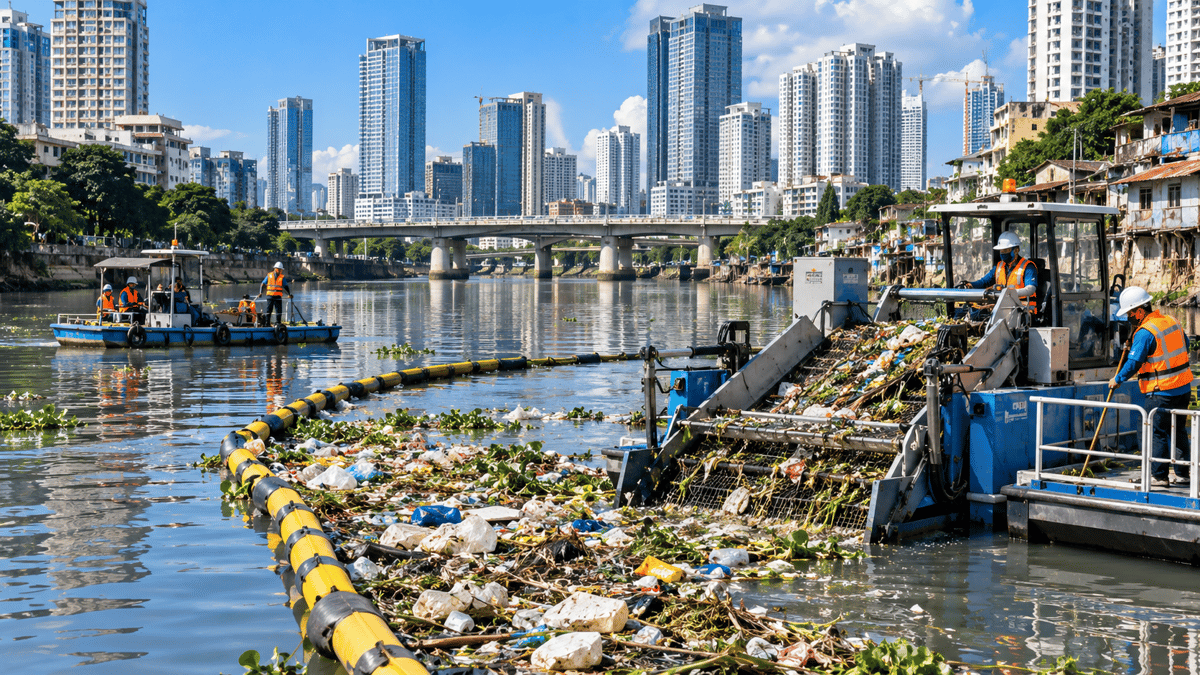 Image- creation R.E.News© via IA chat GPT
À Manille, un fleuve de seulement 27 kilomètres transporte chaque année vers l’océan une quantité vertigineuse de plastique, estimée à 63 000 tonnes. Alimenté par plus de 48 affluents, le Pasig traverse une métropole où pluie, marées, ruissellement urbain, déchets et développement accéléré composent un système aussi complexe qu’imprévisible.
Pour comprendre ce fleuve, il fallait désormais aller au-delà du simple nettoyage.
L’Asian Development Bank, avec ses partenaires institutionnels et techniques, a développé un jumeau numérique du Pasig River : une représentation virtuelle capable de réunir données hydrologiques, images satellites, informations d’infrastructures, observations des déchets et intelligence artificielle.
L’objectif est spectaculaire par sa simplicité : voir le fleuve comme un seul système, alors que sa gestion est répartie entre de nombreuses administrations.
Plus de 40 jeux de données sont déjà accessibles, tandis qu’environ 200 autres sont en développement. Les modèles hydrauliques analysent pluie, marées, niveaux d’eau et vitesse des courants afin d’identifier les zones où les déchets risquent de s’accumuler.
Mais la véritable innovation se trouve aussi dans l’œil numérique posé sur le fleuve. Des caméras installées sur les affluents filment le déplacement des déchets. Des milliers d’images servent à entraîner une intelligence artificielle capable de reconnaître plastiques rigides, films souples et mousses, tout en estimant leur direction et leur vitesse. Les premiers essais affichent une précision de 60 à 70 %.
À Buhangin Creek, plus de 300 000 fragments de plastique ont ainsi été recensés en seulement un mois.
Le jumeau numérique ne ramassera évidemment pas les déchets. Il peut cependant révéler où agir, quand intervenir et pourquoi le plastique se concentre à certains endroits. Une future évolution pourrait même croiser automatiquement les mouvements des déchets avec les précipitations, les courants et les marées pour anticiper les zones d’accumulation.
Derrière la technologie se cache pourtant le véritable défi : faire travailler ensemble les institutions. Plus de 18 agences gouvernementales ont participé au projet, obligeant chacune à partager données, responsabilités et expertise.
Le Pasig devient ainsi bien plus qu’un projet environnemental. Il devient un laboratoire grandeur nature où l’intelligence artificielle, l’hydraulique, la donnée et l’ingénierie numérique se rencontrent pour comprendre un fleuve avant d’agir sur lui.
Et peut-être est-ce là la véritable révolution : demain, les villes ne se contenteront plus de nettoyer leurs infrastructures. Elles apprendront d’abord à les comprendre en temps réel.
NJC.© Info https://development.asia/
-------------------------------------------------------------------------------------------------------------------
07/10/26-English
The Pasig River: Digital Intelligence Tracks Plastic Waste
Image- creation R.E.News© via IA chat GPT
In Manila, a river spanning just 27 kilometers carries a staggering 63,000 tons of plastic into the ocean each year. Fed by over 48 tributaries, the Pasig flows through a metropolis where rainfall, tides, urban runoff, waste, and rapid development combine to create a system that is as complex as it is unpredictable.
To truly understand this river, it was necessary to go beyond mere cleanup efforts.
The Asian Development Bank, together with its institutional and technical partners, has developed a digital twin of the Pasig River—a virtual representation capable of integrating hydrological data, satellite imagery, infrastructure details, waste observations, and artificial intelligence.
The goal is strikingly simple: to view the river as a single, unified system, even though its management is currently split among numerous administrative bodies.
More than 40 datasets are already available, with around 200 others currently under development. Hydraulic models analyze rainfall, tides, water levels, and current speeds to pinpoint areas where waste is likely to accumulate.
However, the true innovation also lies in the "digital eye" trained on the river. Cameras installed along the tributaries monitor the movement of waste. Thousands of images are used to train an AI capable of recognizing rigid plastics, soft films, and foam, while also estimating their direction and speed. Initial trials show an accuracy rate of 60% to 70%.
At Buhangin Creek, for instance, more than 300,000 pieces of plastic were recorded in just one month.
Naturally, the digital twin will not physically collect the waste itself. It can, however, reveal where action is needed, when to intervene, and why plastic accumulates in specific locations. Future developments could even automatically cross-reference waste movement with rainfall, currents, and tides to predict areas of accumulation.
Yet, the real challenge lies behind the technology: getting institutions to work together. More than 18 government agencies participated in the project, requiring each to share data, responsibilities, and expertise.
The Pasig project is thus becoming far more than just an environmental initiative. It is turning into a real-world laboratory where artificial intelligence, hydraulics, data, and digital engineering converge to understand a river before taking action on it.
And perhaps that is the true revolution: in the future, cities will no longer simply clean their infrastructure; they will first learn to understand it in real time.
NJC.© Info https://development.asia/
--------------------------------------------------------------------------------------------------------------
07/10/26-NL
De Pasig-rivier: Wanneer digitale intelligentie plastic in kaart brengt
Image- creation R.E.News© via IA chat GPT
In Manilla voert een rivier van slechts 27 kilometer lang jaarlijks een duizelingwekkende hoeveelheid plastic, naar schatting 63.000 ton, naar de oceaan. De Pasig, gevoed door meer dan 48 zijrivieren, stroomt door een metropool waar regen, getijden, stedelijk afvalwater, afval en snelle ontwikkeling samenkomen om een systeem te creëren dat even complex als onvoorspelbaar is.
Om deze rivier te begrijpen, was het nu nodig om verder te gaan dan alleen het schoonmaken ervan.
De Aziatische Ontwikkelingsbank heeft, samen met haar institutionele en technische partners, een digitale tweeling van de Pasig-rivier ontwikkeld: een virtuele representatie die hydrologische gegevens, satellietbeelden, infrastructuurinformatie, afvalobservaties en kunstmatige intelligentie combineert.
Het doel is opmerkelijk eenvoudig: de rivier als één systeem beschouwen, ook al is het beheer ervan verdeeld over talrijke overheidsinstanties.
Er zijn al meer dan 40 datasets beschikbaar, terwijl er ongeveer 200 andere in ontwikkeling zijn. Hydraulische modellen analyseren regenval, getijden, waterstanden en stroomsnelheden om gebieden te identificeren waar afval zich waarschijnlijk zal ophopen.
Maar de echte innovatie schuilt in het digitale oog dat de rivier observeert. Camera's die op zijrivieren zijn geïnstalleerd, filmen de beweging van afval. Duizenden beelden worden gebruikt om kunstmatige intelligentie te trainen die in staat is om harde kunststoffen, flexibele folies en schuim te herkennen en hun richting en snelheid te schatten. Eerste tests tonen een nauwkeurigheid van 60 tot 70%.
In Buhangin Creek werden in slechts één maand meer dan 300.000 plasticfragmenten geteld.
De digitale tweeling zal het afval natuurlijk niet verzamelen. Het kan echter wel onthullen waar actie nodig is, wanneer moet worden ingegrepen en waarom plastic zich in bepaalde gebieden concentreert. Een toekomstige ontwikkeling zou zelfs automatisch de afvalbeweging kunnen koppelen aan regenval, stromingen en getijden om ophopingszones te voorspellen.
Achter de technologie schuilt echter de echte uitdaging: instellingen laten samenwerken. Meer dan 18 overheidsinstanties namen deel aan het project, waarbij elk van hen gegevens, verantwoordelijkheden en expertise moest delen.
PASIG wordt daarmee veel meer dan een milieuproject. Het wordt een volwaardig laboratorium waar kunstmatige intelligentie, hydraulica, data en digitale engineering samenkomen om een rivier te begrijpen voordat er actie wordt ondernomen.
En misschien is dit wel de ware revolutie: morgen zullen steden hun infrastructuur niet langer alleen maar schoonmaken. Ze zullen eerst leren die in realtime te begrijpen.
NJC.© Info https://development.asia/
------------------------------------------------------------------------------------------------------------
Date de dernière mise à jour : 06/10/2026