



R.E.News future Technology-Physical AI and Humanoid Robots Moving From Theory to the Jobsite
 22/01/26-FR-English-NL-footer
L’IA physique et les robots humanoïdes : de la théorie au chantier
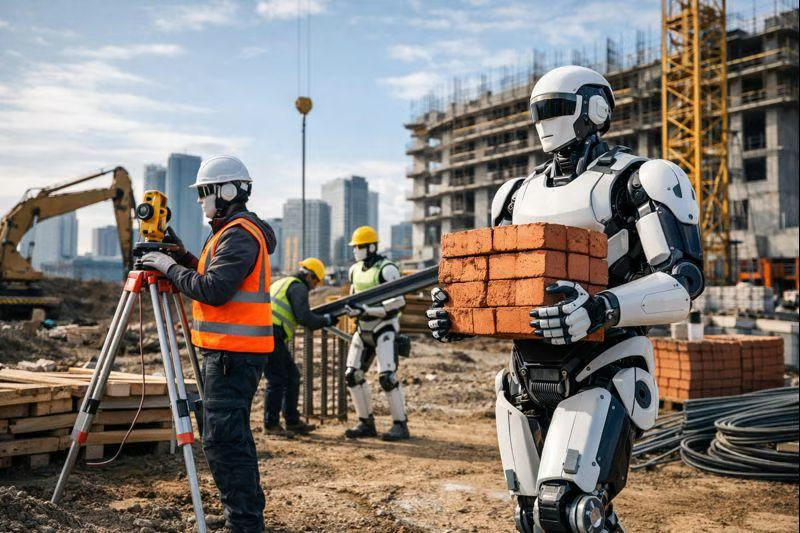 Image-R.E.News©
Pendant des années, l’intelligence artificielle a surtout évolué dans le monde du logiciel. Algorithmes prédictifs, analyse de données et automatisation numérique ont transformé les bureaux et les centres de décision, mais ont laissé de côté une grande partie de l’économie physique. Pour des secteurs comme la construction, les infrastructures ou la logistique, cette première vague n’a fait qu’effleurer le potentiel réel de l’IA.
Selon les analyses récentes de Barclays Research, la prochaine étape est déjà en marche : une IA capable d’agir dans le monde réel. Les robots humanoïdes, conçus pour évoluer dans des environnements complexes et non structurés, quittent les laboratoires pour rejoindre les chantiers. Ils ne remplacent pas les travailleurs, mais les accompagnent, en prenant en charge les tâches répétitives, pénibles ou à risque, tout en améliorant la sécurité et la productivité.
Dans la construction, où les conditions changent en permanence et où l’automatisation reste difficile, leur forme humaine devient un atout. Escaliers, échafaudages et cabines sont pensés pour des personnes — et donc naturellement accessibles à ces machines. Face au vieillissement de la main-d’œuvre et aux pénuries de compétences, l’IA physique apparaît moins comme une vision futuriste que comme une réponse concrète aux défis du terrain.
Portée par les progrès conjoints de l’IA, de la mécatronique et des batteries, cette révolution est aussi économique : les coûts ont fortement chuté, rendant les robots humanoïdes commercialement crédibles. L’intelligence artificielle sort ainsi des écrans pour entrer dans le monde du béton, de l’acier et du mouvement.
Pour la construction et les infrastructures, une nouvelle ère s’ouvre — celle où le numérique et le physique convergent, et où l’IA devient un partenaire de travail à part entière sur les chantiers.
NJC.© Info
-------------------------------------------------------------------------------------------------------------------
22/01/26-English
Physical AI and Humanoid Robots: From Theory to the Construction Site
Image-R.E.News©
For years, artificial intelligence has primarily evolved within the software world. Predictive algorithms, data analysis, and digital automation have transformed offices and decision-making centers, but have left much of the physical economy behind. For sectors like construction, infrastructure, and logistics, this first wave only scratched the surface of AI's true potential.
According to recent analyses by Barclays Research, the next step is already underway: AI capable of operating in the real world. Humanoid robots, designed to navigate complex and unstructured environments, are leaving the laboratories and joining construction sites. They don't replace workers, but rather assist them, taking over repetitive, strenuous, or risky tasks, while simultaneously improving safety and productivity.
In construction, where conditions are constantly changing and automation remains challenging, their human-like form becomes a valuable asset. Stairs, scaffolding, and cabins are designed for people—and therefore naturally accessible to these machines. Faced with an aging workforce and skills shortages, physical AI appears less as a futuristic vision than as a concrete response to on-the-ground challenges.
Driven by the combined advances of AI, mechatronics, and batteries, this revolution is also economic: costs have plummeted, making humanoid robots commercially viable. Artificial intelligence is thus moving beyond screens and into the world of concrete, steel, and movement.
For construction and infrastructure, a new era is dawning—one where digital and physical technologies converge, and where AI becomes a fully-fledged partner on construction sites.
NJC.© Info
-------------------------------------------------------------------------------------------------------------
22/01/26-NL
Fysieke AI en humanoïde robots: van theorie naar de bouwplaats
Image-R.E.News©
Jarenlang heeft kunstmatige intelligentie zich voornamelijk in de softwarewereld ontwikkeld. Voorspellende algoritmes, data-analyse en digitale automatisering hebben kantoren en besluitvormingscentra getransformeerd, maar de fysieke economie is grotendeels achtergebleven. Voor sectoren zoals de bouw, infrastructuur en logistiek heeft deze eerste golf slechts een glimp van het ware potentieel van AI laten zien.
Volgens recente analyses van Barclays Research is de volgende stap al gezet: AI die in de echte wereld kan opereren. Humanoïde robots, ontworpen om te navigeren in complexe en ongestructureerde omgevingen, verlaten de laboratoria en betreden de bouwplaatsen. Ze vervangen geen werknemers, maar ondersteunen hen door repetitieve, zware of risicovolle taken over te nemen, terwijl ze tegelijkertijd de veiligheid en productiviteit verbeteren.
In de bouw, waar de omstandigheden constant veranderen en automatisering een uitdaging blijft, is hun mensachtige vorm een waardevolle troef. Trappen, steigers en cabines zijn ontworpen voor mensen – en daardoor vanzelfsprekend toegankelijk voor deze machines. Geconfronteerd met een vergrijzende beroepsbevolking en tekorten aan geschoolde arbeidskrachten, lijkt fysieke AI minder een futuristische visie dan een concrete oplossing voor uitdagingen in de praktijk.
Gedreven door de gecombineerde vooruitgang van AI, mechatronica en batterijen, is deze revolutie ook economisch: de kosten zijn drastisch gedaald, waardoor humanoïde robots commercieel haalbaar zijn. Kunstmatige intelligentie verplaatst zich daarmee van schermen naar de wereld van beton, staal en beweging.
Voor de bouw en infrastructuur breekt een nieuw tijdperk aan – een tijdperk waarin digitale en fysieke technologieën samenkomen en waarin AI een volwaardige partner wordt op bouwplaatsen.
NJC.© Info
------------------------------------------------------------------------------------------------------------------
Date de dernière mise à jour : 21/01/2026