



R.E.News future Technology-Quantum Communication Breakthroughs Strengthen NZ Korea Innovation Ties
 24/12/25-FR-English-NL-footer
Quand le quantique rapproche la Nouvelle-Zélande et la Corée
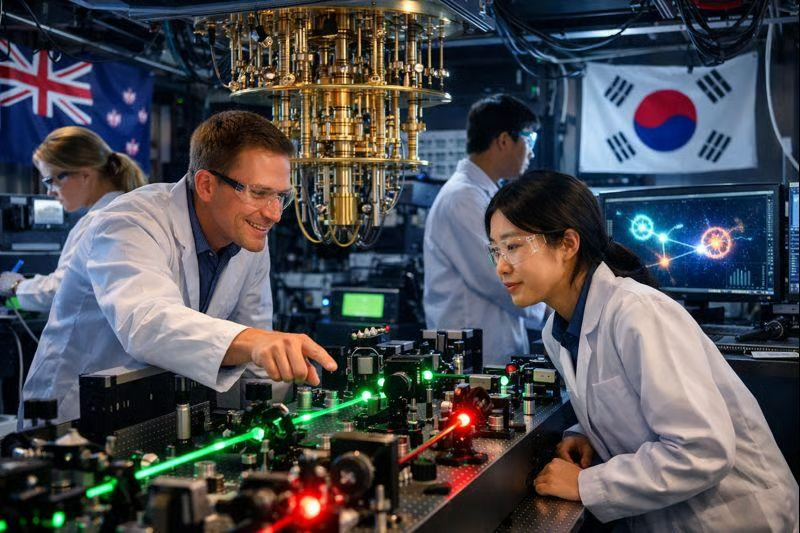 Image-R.E.News©
Face à l’accélération du numérique et à l’émergence de nouvelles menaces cyber, la Nouvelle-Zélande et la République de Corée ont choisi d’unir leurs forces là où se dessine l’avenir de la sécurité mondiale : la communication quantique. À travers trois projets de recherche de pointe, les deux pays ambitionnent de transformer la manière dont les données circulent et se protègent, tout en jetant les bases des réseaux de communication de prochaine génération.
Cette collaboration s’inscrit dans le cadre du New Zealand–Korea Joint Research Partnerships Programme, un dispositif bilatéral triennal piloté en Nouvelle-Zélande par le ministère du Business, de l’Innovation et de l’Emploi (MBIE). Pensé comme un catalyseur d’excellence scientifique et de retombées économiques, le programme cible des domaines à fort potentiel commercial et stratégique. En 2025, le choix s’est imposé naturellement : le quantique, et plus précisément la communication sécurisée.
À l’heure où les systèmes de chiffrement traditionnels seront bientôt mis à l’épreuve par la puissance des ordinateurs quantiques, la communication quantique offre une promesse radicale : une sécurité fondée sur les lois de la physique. Grâce à des technologies comme la distribution quantique de clés (QKD), toute tentative d’interception devient immédiatement détectable. Un atout majeur pour protéger les réseaux financiers, les données médicales, les infrastructures critiques et les communications gouvernementales.
Dans ce paysage mondial en pleine mutation — où la Chine déploie déjà des réseaux quantiques à grande échelle et où l’Europe bâtit son infrastructure sécurisée — le partenariat néo-zélandais et coréen positionne les deux nations à l’avant-garde d’une révolution technologique et géopolitique.
Trois projets pour bâtir les réseaux du futur
Coordonnée avec le soutien du Dodd Walls Centre for Photonic and Quantum Technologies, référence internationale en optique quantique, l’initiative repose sur trois axes complémentaires.
Le premier vise à dépasser la limite majeure des communications quantiques : la distance. Des chercheurs de l’Université d’Otago et du KAIST développent des répéteurs quantiques intégrés à des puces photoniques, capables de préserver l’état quantique de la lumière sur de longues distances. Une avancée clé pour relier villes et pays via des réseaux sécurisés existants.
Le deuxième projet, mené par l’Université d’Auckland et le KAIST, s’attaque au coût et à la complexité des systèmes actuels de communication quantique. En miniaturisant les sources de lumière quantique sur des puces, les chercheurs ouvrent la voie à une adoption industrielle et commerciale à grande échelle, des centres de données jusqu’aux réseaux de télécommunications.
Enfin, le troisième projet explore un maillon essentiel des architectures quantiques de demain : la conversion entre signaux micro-ondes et photons optiques. En reliant ordinateurs quantiques et réseaux de communication longue distance, cette technologie hybride pourrait rendre possibles des réseaux quantiques distribués et, à terme, le cloud quantique.
Une alliance stratégique tournée vers l’avenir
Au-delà des avancées scientifiques, cette collaboration incarne une vision partagée : faire du quantique un levier de souveraineté numérique et de croissance économique. En combinant l’excellence néo-zélandaise en photonique et en sciences quantiques avec l’expertise coréenne en ingénierie et en semi-conducteurs, le partenariat crée un écosystème propice à l’innovation, à la commercialisation et à l’export.
À terme, ces travaux pourraient donner naissance à de nouvelles entreprises, attirer des investissements internationaux et contribuer à l’élaboration de standards de cybersécurité quantique. Dans un monde où la course au quantique s’intensifie, la Nouvelle-Zélande et la Corée posent ainsi les fondations d’une infrastructure numérique plus sûre, plus résiliente et résolument tournée vers l’avenir.
NJC.© Info Ministry of Business, Innovation and Employment
-------------------------------------------------------------------------------------------------------------------
24/12/25-English
When Quantum Technology Brings New Zealand and Korea Together
Image-R.E.News©
Faced with the accelerating pace of digitalization and the emergence of new cyber threats, New Zealand and the Republic of Korea have chosen to join forces where the future of global security is taking shape: quantum communication. Through three cutting-edge research projects, the two countries aim to transform how data flows and is protected, while laying the foundations for next-generation communication networks.
This collaboration is part of the New Zealand–Korea Joint Research Partnerships Programme, a three-year bilateral initiative led in New Zealand by the Ministry of Business, Innovation and Employment (MBIE). Designed as a catalyst for scientific excellence and economic benefits, the program targets areas with strong commercial and strategic potential. By 2025, the choice was a natural one: quantum technology, and more specifically, secure communication.
As traditional encryption systems are soon to be challenged by the power of quantum computers, quantum communication offers a radical promise: security based on the laws of physics. Thanks to technologies like quantum key distribution (QKD), any interception attempt becomes immediately detectable. This is a major advantage for protecting financial networks, medical data, critical infrastructure, and government communications.
In this rapidly changing global landscape—where China is already deploying quantum networks on a large scale and Europe is building its secure infrastructure—the New Zealand-South Korean partnership positions both nations at the forefront of a technological and geopolitical revolution.
Three projects to build the networks of the future
Coordinated with the support of the Dodd Walls Centre for Photonic and Quantum Technologies, an international leader in quantum optics, the initiative is based on three complementary pillars.
The first aims to overcome the major limitation of quantum communications: distance. Researchers from the University of Otago and KAIST are developing quantum repeaters integrated into photonic chips, capable of preserving the quantum state of light over long distances. This is a key advancement for connecting cities and countries via existing secure networks.
The second project, led by the University of Auckland and KAIST, tackles the cost and complexity of current quantum communication systems. By miniaturizing quantum light sources onto chips, researchers are paving the way for large-scale industrial and commercial adoption, from data centers to telecommunications networks.
Finally, the third project explores a crucial component of tomorrow's quantum architectures: the conversion between microwave signals and optical photons. By linking quantum computers and long-distance communication networks, this hybrid technology could enable distributed quantum networks and, ultimately, the quantum cloud.
A Strategic Alliance Focused on the Future
Beyond scientific advancements, this collaboration embodies a shared vision: to leverage quantum technology for digital sovereignty and economic growth. By combining New Zealand's excellence in photonics and quantum sciences with Korean expertise in engineering and semiconductors, the partnership creates an ecosystem conducive to innovation, commercialization, and export.
Ultimately, this work could lead to the creation of new companies, attract international investment, and contribute to the development of quantum cybersecurity standards. In a world where the race for quantum computing is intensifying, New Zealand and Korea are laying the foundations for a more secure, resilient, and future-proof digital infrastructure.
NJC.© Info Ministry of Business, Innovation and Employment
------------------------------------------------------------------------------------------------------------
24/12/25-NL
Wanneer kwantumtechnologie Nieuw-Zeeland en Korea samenbrengt
Image-R.E.News©
Geconfronteerd met het versnelde tempo van digitalisering en de opkomst van nieuwe cyberdreigingen, hebben Nieuw-Zeeland en de Republiek Korea ervoor gekozen de krachten te bundelen op het gebied waar de toekomst van de wereldwijde veiligheid vorm krijgt: kwantumcommunicatie. Via drie baanbrekende onderzoeksprojecten willen de twee landen de manier waarop data stroomt en wordt beschermd transformeren en tegelijkertijd de basis leggen voor de volgende generatie communicatienetwerken.
Deze samenwerking maakt deel uit van het New Zealand–Korea Joint Research Partnerships Programme, een driejarig bilateraal initiatief dat in Nieuw-Zeeland wordt geleid door het Ministerie van Handel, Innovatie en Werkgelegenheid (MBIE). Het programma is ontworpen als katalysator voor wetenschappelijke excellentie en economische voordelen en richt zich op gebieden met een sterk commercieel en strategisch potentieel. Tegen 2025 was de keuze voor kwantumtechnologie, en meer specifiek veilige communicatie, een logische.
Terwijl traditionele encryptiesystemen binnenkort zullen worden uitgedaagd door de kracht van kwantumcomputers, biedt kwantumcommunicatie een radicale belofte: veiligheid gebaseerd op de wetten van de natuurkunde. Dankzij technologieën zoals kwantumsleuteldistributie (QKD) wordt elke poging tot interceptie direct detecteerbaar. Dit is een groot voordeel voor de bescherming van financiële netwerken, medische gegevens, kritieke infrastructuur en overheidscommunicatie.
In dit snel veranderende wereldlandschap – waar China al op grote schaal kwantumnetwerken inzet en Europa zijn veilige infrastructuur opbouwt – plaatst het partnerschap tussen Nieuw-Zeeland en Zuid-Korea beide landen in de voorhoede van een technologische en geopolitieke revolutie.
Drie projecten om de netwerken van de toekomst te bouwen
Het initiatief, gecoördineerd met de steun van het Dodd Walls Centre for Photonic and Quantum Technologies, een internationale leider in kwantumoptica, is gebaseerd op drie complementaire pijlers.
De eerste is gericht op het overwinnen van de grootste beperking van kwantumcommunicatie: afstand. Onderzoekers van de Universiteit van Otago en KAIST ontwikkelen kwantumrepeaters die geïntegreerd zijn in fotonische chips, die in staat zijn de kwantumtoestand van licht over lange afstanden te behouden. Dit is een belangrijke vooruitgang voor het verbinden van steden en landen via bestaande veilige netwerken.
Het tweede project, geleid door de Universiteit van Auckland en KAIST, pakt de kosten en complexiteit van de huidige kwantumcommunicatiesystemen aan. Door kwantumlichtbronnen te miniaturiseren op chips, effenen onderzoekers de weg voor grootschalige industriële en commerciële toepassing, van datacenters tot telecommunicatienetwerken.
Ten slotte onderzoekt het derde project een cruciaal onderdeel van de kwantumarchitecturen van morgen: de conversie tussen microgolfsignalen en optische fotonen. Door kwantumcomputers en langeafstandscommunicatienetwerken te koppelen, zou deze hybride technologie gedistribueerde kwantumnetwerken en uiteindelijk de kwantumcloud mogelijk kunnen maken.
Een strategische alliantie gericht op de toekomst
Naast wetenschappelijke vooruitgang belichaamt deze samenwerking een gedeelde visie: kwantumtechnologie inzetten voor digitale soevereiniteit en economische groei. Door de Nieuw-Zeelandse expertise in fotonica en kwantumwetenschappen te combineren met de Koreaanse expertise in engineering en halfgeleiders, creëert het partnerschap een ecosysteem dat bevorderlijk is voor innovatie, commercialisering en export.
Uiteindelijk zou dit werk kunnen leiden tot de oprichting van nieuwe bedrijven, het aantrekken van internationale investeringen en een bijdrage aan de ontwikkeling van kwantumcyberbeveiligingsnormen. In een wereld waarin de race om kwantumcomputing steeds heviger wordt, leggen Nieuw-Zeeland en Korea de basis voor een veiligere, veerkrachtigere en toekomstbestendige digitale infrastructuur.
NJC.© Info Ministry of Business, Innovation and Employment
----------------------------------------------------------------------------------------------------------------
Date de dernière mise à jour : 23/12/2025