



R.E.News future Technology-Quantum Honeycomb Materials Move Closer To The Spin Liquid Frontier
 26/01/26-FR-English-NL-footer
Les matériaux quantiques en nid d’abeilles s’approchent de la frontière des liquides de spin
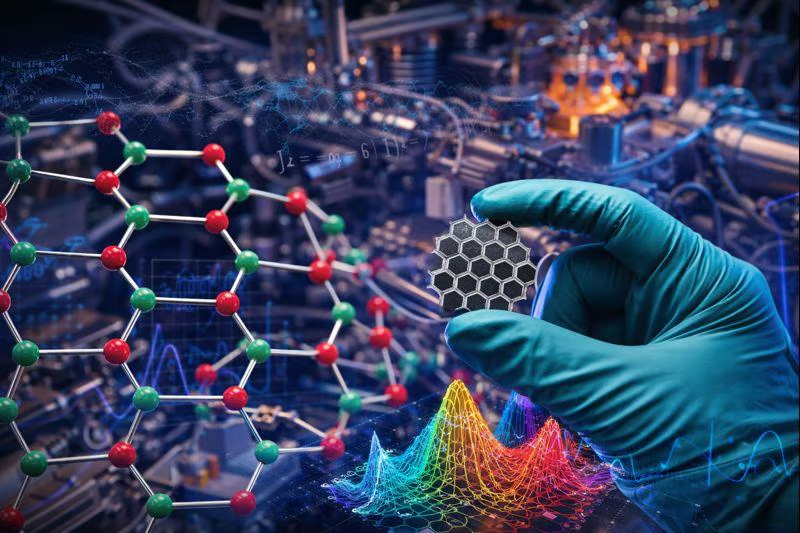 Image-R.E.News©
La course aux technologies quantiques ne se joue pas seulement dans les algorithmes ou les lignes de code. Elle se joue aussi, et peut-être surtout, dans la matière elle-même. Car sans matériaux capables d’héberger des comportements quantiques stables, la théorie reste lettre morte.
C’est précisément sur ce terrain difficile que s’avancent les chercheurs du Oak Ridge National Laboratory (ORNL). Leur dernier travail porte sur un matériau magnétique singulier — le potassium cobalt arsenate — façonné dans une structure en nid d’abeilles. Un motif simple en apparence, mais qui pourrait ouvrir la voie à l’un des états les plus énigmatiques de la physique moderne : le liquide de spin quantique.
Dans cet état rare, les spins magnétiques refusent de s’aligner. Même à basse température, ils restent en mouvement, intriqués, indisciplinés. Cette agitation quantique persistante est précisément ce que recherchent les scientifiques, car elle pourrait héberger des excitations exotiques — comme les fermions de Majorana — potentiellement plus robustes pour les futures technologies quantiques.
La difficulté est immense. En physique quantique des matériaux, la moindre distorsion cristalline peut faire basculer un système du rêve à la banalité. Et c’est exactement ce que révèle l’étude d’ORNL : le réseau en nid d’abeilles est légèrement déformé. Résultat, le matériau adopte encore un comportement magnétique ordonné, plutôt qu’un véritable liquide de spin.
Mais loin d’être un échec, cette découverte est un signal précieux. Le matériau se situe près de la frontière. Assez proche pour être prometteur. Assez stable pour être étudié. Et surtout, potentiellement ajustable — par pression, champ magnétique ou modification chimique — vers le régime quantique recherché.
Ce travail illustre une vérité fondamentale de l’innovation scientifique : les percées ne surgissent pas d’un coup. Elles émergent par plateformes successives, imparfaites mais fécondes. Comme les batteries lithium-ion ou les semi-conducteurs avant elles, les matériaux quantiques avancent par itérations patientes.
Soutenue par le Quantum Science Center du Département de l’Énergie américain, cette recherche s’inscrit dans un effort collectif mêlant synthèse, expérimentation, calcul et grandes infrastructures scientifiques. Une approche qui rappelle, à sa manière, le concept de jumeau numérique — mais appliqué à la matière quantique.
Le potassium cobalt arsenate n’est pas encore une révolution technologique. Mais il est une pierre d’appui. Un pas de plus vers des matériaux capables de soutenir les futures architectures de calcul, de détection et de communication quantiques.
À la frontière du connu, c’est souvent ainsi que le progrès commence : discrètement, imparfaitement — mais résolument.
NJC.© Info Inorganic Chemistr
-------------------------------------------------------------------------------------------------------
26/01/26-English
Honeycomb Quantum Materials Approach the Spin Liquid Frontier
Image-R.E.News©
The race for quantum technologies isn't just about algorithms or lines of code. It's also, and perhaps even more importantly, about matter itself. Without materials capable of hosting stable quantum behavior, the theory remains a dead letter.
It is precisely in this challenging territory that researchers at Oak Ridge National Laboratory (ORNL) are venturing. Their latest work focuses on a unique magnetic material—potassium cobalt arsenate—shaped into a honeycomb structure. A seemingly simple pattern, but one that could pave the way for one of the most enigmatic states in modern physics: the quantum spin liquid.
In this rare state, magnetic spins refuse to align. Even at low temperatures, they remain in motion, entangled, unruly. This persistent quantum agitation is precisely what scientists are looking for, as it could harbor exotic excitations—like Majorana fermions—potentially more robust for future quantum technologies.
The challenge is immense. In quantum materials physics, the slightest crystalline distortion can tip a system from the realm of dreams to the realm of the mundane. And that is exactly what ORNL’s study reveals: the honeycomb lattice is slightly deformed. As a result, the material still exhibits ordered magnetic behavior, rather than that of a true spin liquid.
But far from being a failure, this discovery is a valuable signal. The material is close to the boundary. Close enough to be promising. Stable enough to be studied. And above all, potentially tunable—by pressure, magnetic field, or chemical modification—toward the desired quantum regime.
This work illustrates a fundamental truth of scientific innovation: breakthroughs don’t happen all at once. They emerge through successive, imperfect but fruitful platforms. Like lithium-ion batteries and semiconductors before them, quantum materials are advancing through patient iterations.
Supported by the U.S. Department of Energy’s Quantum Science Center, this research is part of a collaborative effort combining synthesis, experimentation, computing, and large-scale scientific infrastructure. This approach, in its own way, recalls the concept of a digital twin—but applied to quantum matter.
Potassium cobalt arsenate is not yet a technological revolution. But it is a cornerstone. A step closer to materials capable of supporting future quantum computing, detection, and communication architectures.
At the frontier of the known, this is often how progress begins: quietly, imperfectly—but resolutely.
NJC.© Info Inorganic Chemistr
-----------------------------------------------------------------------------------------------------------------
26/01/26-NL
Honingraatvormige kwantummaterialen naderen de spinvloeistofgrens
Image-R.E.News©
De race naar kwantumtechnologieën draait niet alleen om algoritmes of regels code. Het gaat ook, en misschien nog wel belangrijker, om materie zelf. Zonder materialen die stabiel kwantumgedrag kunnen vertonen, blijft de theorie een dode letter.
Precies op dit uitdagende terrein begeven onderzoekers van het Oak Ridge National Laboratory (ORNL) zich. Hun nieuwste werk richt zich op een uniek magnetisch materiaal – kaliumkobaltarsenaat – in de vorm van een honingraat. Een ogenschijnlijk eenvoudig patroon, maar een patroon dat de weg zou kunnen banen voor een van de meest raadselachtige toestanden in de moderne natuurkunde: de kwantumspinvloeistof.
In deze zeldzame toestand weigeren magnetische spins zich uit te lijnen. Zelfs bij lage temperaturen blijven ze in beweging, verstrengeld en onhandelbaar. Deze aanhoudende kwantumagitatie is precies waar wetenschappers naar op zoek zijn, omdat het exotische excitaties – zoals Majorana-fermionen – zou kunnen bevatten die mogelijk robuuster zijn voor toekomstige kwantumtechnologieën.
De uitdaging is enorm. In de kwantumfysica kan de kleinste kristalvervorming een systeem van het rijk der dromen naar het rijk der alledaagsheid brengen. En dat is precies wat het onderzoek van ORNL aantoont: het honingraatrooster is licht vervormd. Daardoor vertoont het materiaal nog steeds geordend magnetisch gedrag, in plaats van dat van een echte spinvloeistof.
Maar deze ontdekking is verre van een mislukking; het is juist een waardevol signaal. Het materiaal bevindt zich dicht bij de grens. Dichtbij genoeg om veelbelovend te zijn. Stabiel genoeg om te bestuderen. En bovenal potentieel afstembaar – door druk, magnetisch veld of chemische modificatie – naar het gewenste kwantumregime.
Dit werk illustreert een fundamentele waarheid van wetenschappelijke innovatie: doorbraken vinden niet in één keer plaats. Ze ontstaan via opeenvolgende, onvolmaakte maar vruchtbare platforms. Net als lithium-ionbatterijen en halfgeleiders vóór hen, ontwikkelen kwantummaterialen zich door geduldige iteraties.
Dit onderzoek, ondersteund door het Quantum Science Center van het Amerikaanse Ministerie van Energie, maakt deel uit van een samenwerkingsverband dat synthese, experimenten, computergebruik en grootschalige wetenschappelijke infrastructuur combineert. Deze aanpak doet op een bepaalde manier denken aan het concept van een digitale tweeling – maar dan toegepast op kwantummaterie.
Kaliumkobaltarsenaat is nog geen technologische revolutie. Maar het is wel een hoeksteen. Een stap dichter bij materialen die toekomstige kwantumcomputers, -detectie- en -communicatiearchitecturen kunnen ondersteunen.
Aan de grens van het bekende begint vooruitgang vaak zo: stil, onvolmaakt – maar vastberaden.
NJC.© Info Inorganic Chemistr
---------------------------------------------------------------------------------------------------------------
Date de dernière mise à jour : 23/01/2026