



R.E.News future Technology-Sunlight Turns Plastic Waste Into Clean Fuel Opportunity
 30/04/26-FR-English-NL-footer
Quand le soleil transforme les déchets plastiques en énergie d’avenir
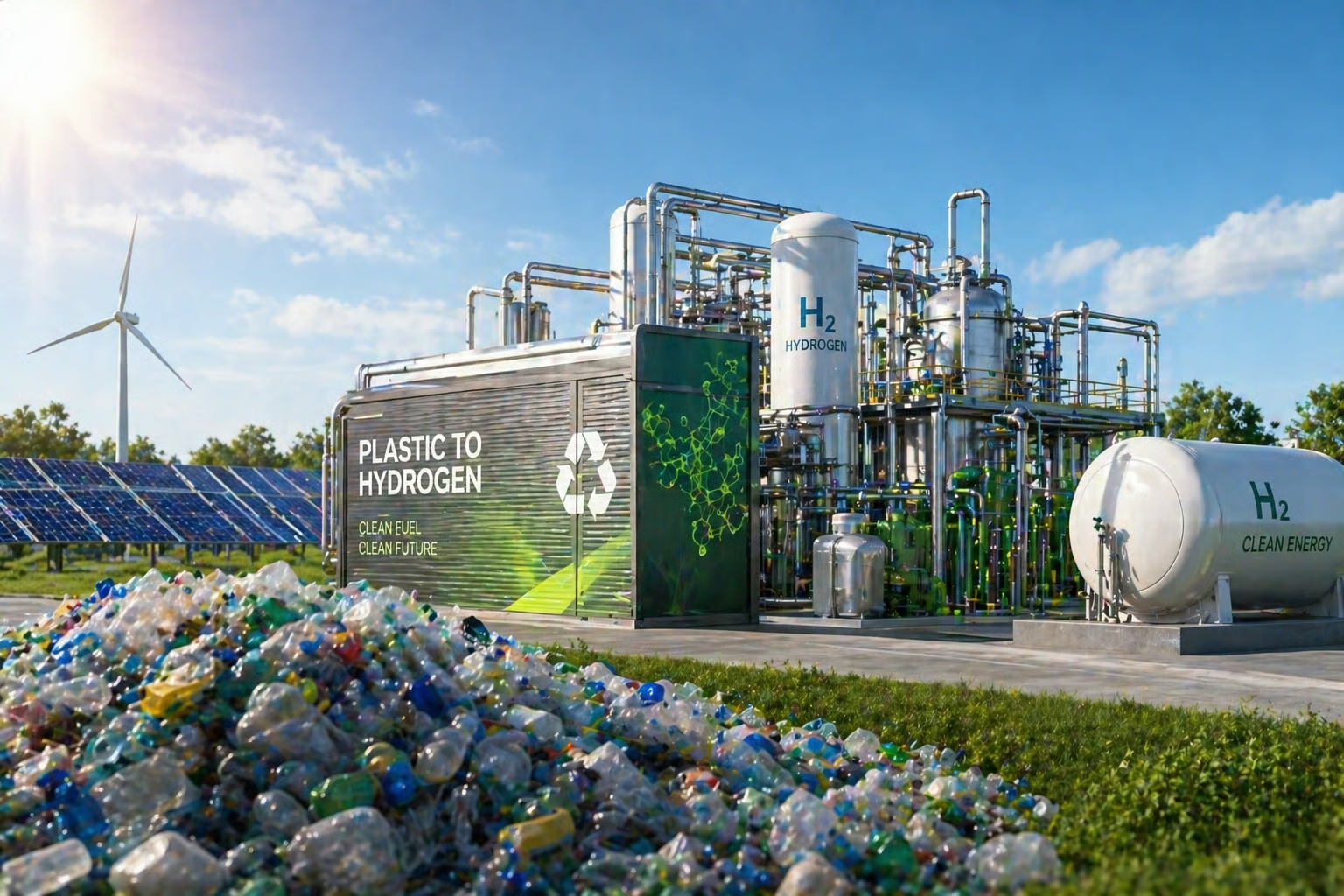 Image-R.E.News©
Et si le plastique, symbole de pollution globale, devenait une ressource stratégique pour l’énergie propre ? C’est le pari audacieux exploré par University of Adelaide, dont les chercheurs ouvrent une nouvelle voie : utiliser la lumière solaire pour convertir les déchets plastiques en carburants et molécules industrielles.
Une approche qui ne se contente pas de recycler — elle redéfinit la valeur même du déchet.
Du rebut au réservoir d’énergie
Longtemps considérés comme un problème environnemental, les plastiques révèlent ici une autre facette : celle d’un réservoir riche en carbone et en hydrogène. Grâce à un procédé appelé photoréformage solaire, ces matériaux peuvent être décomposés pour produire :
de l’hydrogène, carburant clé de la transition énergétique
du syngas, utilisé dans l’industrie chimique
des composés valorisables pour les carburants synthétiques
Contrairement aux procédés thermiques classiques, cette technologie fonctionne à basse température et s’appuie sur une ressource abondante : le soleil.
Une technologie au croisement de deux urgences
Cette innovation s’inscrit à l’intersection de deux défis majeurs : la gestion des déchets et la décarbonation industrielle. Selon l’Organisation for Economic Co-operation and Development, les volumes de déchets plastiques pourraient tripler d’ici 2060. Parallèlement, des secteurs comme l’acier, le transport ou la chimie cherchent des alternatives aux énergies fossiles.
Transformer les déchets en énergie locale pourrait ainsi :
réduire la pression sur les décharges
limiter les importations de combustibles
renforcer la résilience énergétique des territoires
Des promesses… mais encore des défis
Les premiers résultats expérimentaux sont encourageants : production d’hydrogène stable, fonctionnement sur plusieurs dizaines d’heures, génération de sous-produits valorisables. Mais la route vers l’industrialisation reste exigeante.
Parmi les obstacles :
la complexité des déchets plastiques mixtes
la durabilité des catalyseurs exposés à des conditions chimiques sévères
les coûts de purification des produits obtenus
Autrement dit, la science avance — mais l’équation économique reste à résoudre.
Vers une nouvelle logique industrielle
Au-delà de la technologie, c’est un changement de paradigme qui se dessine. Le plastique n’est plus seulement un déchet à éliminer, mais une matière première secondaire à exploiter intelligemment.
Dans un futur proche, des unités de conversion pourraient émerger à proximité des villes, des ports ou des zones industrielles, transformant les flux de déchets en ressources énergétiques locales.
Une pièce clé de l’économie circulaire
Le photoréformage ne remplacera pas les autres formes de recyclage, mais il pourrait compléter l’écosystème existant, notamment pour les plastiques difficiles à valoriser.
Dans cette vision, chaque déchet devient une opportunité :
les plastiques recyclables retournent dans la chaîne de production
les plastiques complexes alimentent des filières énergétiques
Transformer un problème en solution
Les travaux de University of Adelaide illustrent une tendance de fond : repenser les ressources à travers le prisme de la circularité.
Si les verrous technologiques sont levés, cette approche pourrait bien redéfinir la manière dont nos sociétés produisent, consomment… et recyclent.
Car dans un monde sous pression climatique, la prochaine source d’énergie pourrait déjà être là — enfouie dans nos déchets.
NJC.© Info The University of Adelaide
---------------------------------------------------------------------------------------------------------------
30/04/26-English
When the Sun Transforms Plastic Waste into the Energy of the Future
Image-R.E.News©
What if plastic, a symbol of global pollution, became a strategic resource for clean energy? This is the bold proposition being explored by the University of Adelaide, whose researchers are pioneering a new approach: using sunlight to convert plastic waste into industrial fuels and molecules.
This approach goes beyond mere recycling—it redefines the very value of waste.
From Scrap to Energy Reservoir
Long considered an environmental problem, plastics are revealing another facet: that of a reservoir rich in carbon and hydrogen. Thanks to a process called solar photoreforming, these materials can be broken down to produce:
hydrogen, a key fuel for the energy transition;
syngas, used in the chemical industry;
compounds valuable for synthetic fuels.
Unlike conventional thermal processes, this technology operates at low temperatures and relies on an abundant resource: the sun.
A Technology at the Crossroads of Two Urgent Challenges
This innovation lies at the intersection of two major challenges: waste management and industrial decarbonization. According to the Organisation for Economic Co-operation and Development, plastic waste volumes could triple by 2060. At the same time, sectors such as steel, transportation, and chemicals are seeking alternatives to fossil fuels.
Transforming waste into local energy could thus:
reduce pressure on landfills
limit fuel imports
strengthen the energy resilience of local areas
Promises… but still challenges
The initial experimental results are encouraging: stable hydrogen production, operation for several dozen hours, and generation of valuable byproducts. But the road to industrialization remains demanding.
Among the obstacles:
the complexity of mixed plastic waste
the durability of catalysts exposed to harsh chemical conditions
the costs of purifying the resulting products
In other words, science is advancing—but the economic equation remains to be solved.
Towards a new industrial logic
Beyond the technology, a paradigm shift is emerging. Plastic is no longer simply waste to be disposed of, but a secondary raw material to be used intelligently.
In the near future, conversion units could emerge near cities, ports, or industrial zones, transforming waste streams into local energy resources.
A key component of the circular economy
Photoreforming will not replace other forms of recycling, but it could complement the existing ecosystem, particularly for plastics that are difficult to recycle.
In this vision, every piece of waste becomes an opportunity:
recyclable plastics return to the production chain
complex plastics fuel energy production
Turning a problem into a solution
The work of the University of Adelaide illustrates a fundamental trend: rethinking resources through the lens of circularity.
If technological barriers are overcome, this approach could well redefine how our societies produce, consume… and recycle.
Because in a world under climate pressure, the next source of energy could already be here—buried in our waste.
NJC.© Info The University of Adelaide
----------------------------------------------------------------------------------------------------------------
30/04/26-NL
Wanneer de zon plastic afval omzet in de energie van de toekomst
Image-R.E.News©
Wat als plastic, een symbool van wereldwijde vervuiling, een strategische grondstof voor schone energie zou worden? Dit is het gedurfde voorstel dat wordt onderzocht door de Universiteit van Adelaide, waar onderzoekers een nieuwe aanpak ontwikkelen: het gebruik van zonlicht om plastic afval om te zetten in industriële brandstoffen en moleculen.
Deze aanpak gaat verder dan louter recycling – het herdefinieert de waarde van afval.
Van schroot tot energiebron
Plastic, lange tijd beschouwd als een milieuprobleem, onthult een andere kant: die van een reservoir rijk aan koolstof en waterstof. Dankzij een proces genaamd fotoreforming met zonne-energie kunnen deze materialen worden afgebroken om te produceren:
waterstof, een belangrijke brandstof voor de energietransitie;
synthesegas, gebruikt in de chemische industrie;
verbindingen die waardevol zijn voor synthetische brandstoffen.
In tegenstelling tot conventionele thermische processen werkt deze technologie bij lage temperaturen en is ze afhankelijk van een overvloedige bron: de zon.
Een technologie op het kruispunt van twee dringende uitdagingen
Deze innovatie bevindt zich op het snijvlak van twee grote uitdagingen: afvalbeheer en de decarbonisatie van de industrie. Volgens de Organisatie voor Economische Samenwerking en Ontwikkeling (OESO) zou de hoeveelheid plastic afval tegen 2060 kunnen verdrievoudigen. Tegelijkertijd zoeken sectoren zoals de staal-, transport- en chemische industrie naar alternatieven voor fossiele brandstoffen.
Het omzetten van afval in lokale energie zou dus kunnen leiden tot:
vermindering van de druk op stortplaatsen
beperking van brandstofimport
versterking van de energiezekerheid van lokale gebieden
Belofte… maar nog steeds uitdagingen
De eerste experimentele resultaten zijn veelbelovend: stabiele waterstofproductie, een werking van tientallen uren en de productie van waardevolle bijproducten. Maar de weg naar industrialisatie blijft zwaar.
Enkele obstakels:
de complexiteit van gemengd plastic afval
de duurzaamheid van katalysatoren die worden blootgesteld aan zware chemische omstandigheden
de kosten van het zuiveren van de resulterende producten
Met andere woorden, de wetenschap boekt vooruitgang, maar de economische vergelijking moet nog worden opgelost.
Op weg naar een nieuwe industriële logica
Naast de technologie is er een paradigmaverschuiving gaande. Plastic is niet langer simpelweg afval dat moet worden weggegooid, maar een secundaire grondstof die intelligent kan worden ingezet.
In de nabije toekomst zouden er conversie-installaties kunnen verschijnen in de buurt van steden, havens of industriële zones, die afvalstromen omzetten in lokale energiebronnen.
Een belangrijk onderdeel van de circulaire economie
Fotoreforming zal andere vormen van recycling niet vervangen, maar het zou het bestaande ecosysteem kunnen aanvullen, met name voor plastics die moeilijk te recyclen zijn.
In deze visie wordt elk stukje afval een kans:
recyclebaar plastic keert terug in de productieketen
complex plastic levert brandstof voor energieproductie
Een probleem omzetten in een oplossing
Het werk van de Universiteit van Adelaide illustreert een fundamentele trend: het heroverwegen van grondstoffen vanuit een circulair perspectief.
Als technologische barrières worden overwonnen, zou deze aanpak wel eens de manier waarop onze samenlevingen produceren, consumeren... en recyclen, kunnen herdefiniëren.
Want in een wereld die onder klimaatdruk staat, zou de volgende energiebron wel eens al hier kunnen zijn – verborgen in ons afval.
NJC.© Info The University of Adelaide
-----------------------------------------------------------------------------------------------------------------
Date de dernière mise à jour : 29/04/2026