












R.E.News future Technology-Teaching Large-Scale 3D Printers to Think on Their Feet
 30/07/26-FR-English-NL-footer
Quand les imprimantes 3D industrielles apprennent à penser par elles-mêmes
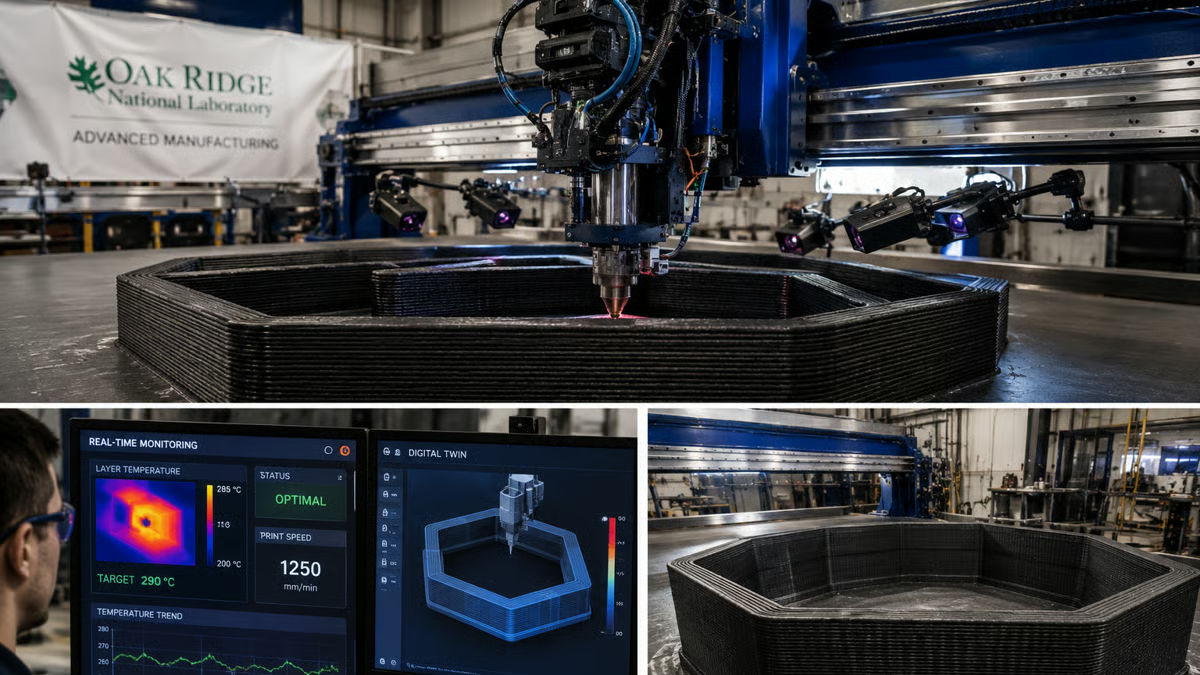 Image-R.E.News©
L'impression 3D grand format franchit une nouvelle étape vers l'usine autonome. Les chercheurs de l'Oak Ridge National Laboratory (ORNL), aux États-Unis, ont développé un système intelligent capable de détecter et corriger automatiquement les défauts de fabrication pendant l'impression, sans intervention humaine. Une avancée qui pourrait accélérer l'adoption industrielle de la fabrication additive dans les secteurs de la construction, des transports, de la défense et des composites.
L'intelligence artificielle au cœur du procédé
Le principal défi de l'impression 3D grand format reste la maîtrise de la température. Un matériau trop froid compromet l'adhérence entre les couches ; trop chaud, il déforme la pièce. Jusqu'à présent, ces paramètres exigeaient une surveillance constante des opérateurs.
La solution développée par l'ORNL change la donne. Associant caméras thermiques, vision artificielle, apprentissage automatique et jumeau numérique, le système observe en permanence le dépôt de matière, analyse les écarts thermiques en temps réel et ajuste automatiquement la vitesse d'impression afin de préserver la qualité de fabrication.
Contrairement à de nombreux systèmes pilotés par l'IA, cette technologie fonctionne sans devoir être réentraînée pour chaque nouvelle géométrie, offrant ainsi une flexibilité particulièrement adaptée à la production industrielle.
Vers une fabrication réellement autonome
Les essais réalisés sur une pièce composite de grande dimension ont démontré la capacité du système à détecter instantanément des écarts de température de seulement quelques degrés et à corriger automatiquement le processus avant l'apparition de défauts structurels.
Cette approche transforme profondément le contrôle qualité. L'objectif n'est plus d'identifier les défauts une fois la pièce terminée, mais de les empêcher d'apparaître, réduisant ainsi les rebuts, les temps d'arrêt et les coûts de production sur des impressions pouvant durer plusieurs jours.
Le jumeau numérique devient un véritable copilote
L'une des innovations majeures réside dans l'intégration d'un jumeau numérique alimenté par l'intelligence artificielle. Cette réplique virtuelle du procédé permet de simuler de nouveaux matériaux, d'optimiser les paramètres de fabrication et de valider les stratégies de production avant même leur mise en œuvre sur la machine réelle.
Cette convergence entre IA, vision industrielle et simulation numérique illustre l'évolution rapide de l'Industrie 4.0 vers des systèmes capables d'observer, d'analyser et de prendre eux-mêmes les bonnes décisions.
Une technologie appelée à transformer plusieurs secteurs
Au-delà des laboratoires, les perspectives sont considérables. Construction modulaire, moules composites, infrastructures, pièces aéronautiques, véhicules légers ou applications marines pourraient bénéficier d'une fabrication plus fiable, plus rapide et moins coûteuse.
En réduisant la dépendance à une supervision humaine permanente, cette nouvelle génération d'imprimantes intelligentes répond également à la pénurie mondiale de compétences spécialisées tout en améliorant la compétitivité des industriels.
Vers l'usine qui s'autorégule
Pour l'ORNL, cette innovation marque une évolution majeure : faire passer l'impression 3D d'un procédé encore fortement supervisé à une production autonome capable de contrôler elle-même sa qualité. À mesure que la fabrication additive s'impose dans les chaînes industrielles, cette intelligence embarquée pourrait devenir un avantage aussi décisif que les progrès réalisés sur les matériaux ou les performances des machines.
L'avenir de l'impression 3D grand format ne dépendra plus seulement de la vitesse des imprimantes, mais de leur capacité à apprendre, s'adapter… et décider en temps réel.
NJC.© Info https://www.ornl.gov/
-------------------------------------------------------------------------------------------------------------
30/07/26-English
When Industrial 3D Printers Learn to Think for Themselves
Image-R.E.News©
Large-format 3D printing is taking another step toward the autonomous factory. Researchers at Oak Ridge National Laboratory (ORNL) in the United States have developed an intelligent system capable of automatically detecting and correcting manufacturing defects during printing, without human intervention. This breakthrough could accelerate the industrial adoption of additive manufacturing in the construction, transportation, defense, and composites sectors.
Artificial intelligence at the heart of the process
The main challenge of large-format 3D printing remains temperature control. A material that is too cold compromises the adhesion between layers; too hot, it deforms the part. Until now, these parameters required constant monitoring by operators.
The solution developed by ORNL is a game changer. Combining thermal cameras, computer vision, machine learning, and a digital twin, the system continuously monitors the material deposition, analyzes temperature variations in real time, and automatically adjusts the printing speed to maintain manufacturing quality.
Unlike many AI-driven systems, this technology operates without needing to be retrained for each new geometry, offering flexibility particularly well-suited to industrial production.
Toward truly autonomous manufacturing
Tests conducted on a large composite part demonstrated the system's ability to instantly detect temperature variations of just a few degrees and automatically correct the process before structural defects appear.
This approach fundamentally transforms quality control. The goal is no longer to identify defects once the part is finished, but to prevent them from appearing in the first place, thus reducing scrap, downtime, and production costs on prints that can last several days.
The Digital Twin Becomes a True Co-Pilot
One of the major innovations lies in the integration of a digital twin powered by artificial intelligence. This virtual replica of the process makes it possible to simulate new materials, optimize manufacturing parameters, and validate production strategies even before their implementation on the actual machine.
This convergence of AI, machine vision, and digital simulation illustrates the rapid evolution of Industry 4.0 toward systems capable of observing, analyzing, and making the right decisions independently.
A Technology Set to Transform Several Sectors
Beyond the laboratories, the prospects are considerable. Modular construction, composite molds, infrastructure, aeronautical parts, light vehicles, and marine applications could all benefit from more reliable, faster, and less expensive manufacturing.
By reducing reliance on constant human supervision, this new generation of intelligent printers also addresses the global shortage of specialized skills while improving the competitiveness of manufacturers.
Towards the Self-Regulating Factory
For ORNL, this innovation marks a major evolution: moving 3D printing from a still heavily supervised process to an autonomous production capable of controlling its own quality. As additive manufacturing becomes more prevalent in industrial chains, this embedded intelligence could become as decisive an advantage as advances in materials or machine performance.
The future of large-format 3D printing will no longer depend solely on printer speed, but on their ability to learn, adapt… and make decisions in real time.
NJC.© Info https://www.ornl.gov/
------------------------------------------------------------------------------------------------------------
30/07/26-NL
Wanneer industriële 3D-printers leren zelf te denken
Image-R.E.News©
Grootformaat 3D-printen zet een volgende stap richting de autonome fabriek. Onderzoekers van het Oak Ridge National Laboratory (ORNL) in de Verenigde Staten hebben een intelligent systeem ontwikkeld dat automatisch productiefouten tijdens het printen kan detecteren en corrigeren, zonder menselijke tussenkomst. Deze doorbraak zou de industriële toepassing van additive manufacturing in de bouw-, transport-, defensie- en composietensector kunnen versnellen.
Kunstmatige intelligentie in het hart van het proces
De grootste uitdaging bij grootformaat 3D-printen blijft temperatuurbeheersing. Een te koud materiaal brengt de hechting tussen de lagen in gevaar; een te warm materiaal vervormt het onderdeel. Tot nu toe vereisten deze parameters constante monitoring door operators.
De door ORNL ontwikkelde oplossing is baanbrekend. Door thermische camera's, computervisie, machine learning en een digitale tweeling te combineren, monitort het systeem continu de materiaalafzetting, analyseert het temperatuurvariaties in realtime en past het automatisch de printsnelheid aan om de productiekwaliteit te waarborgen.
In tegenstelling tot veel AI-gestuurde systemen werkt deze technologie zonder dat hertraining nodig is voor elke nieuwe geometrie, wat een flexibiliteit biedt die bijzonder geschikt is voor industriële productie.
Op weg naar echt autonome productie
Tests uitgevoerd op een groot composietonderdeel toonden aan dat het systeem direct temperatuurschommelingen van slechts enkele graden kan detecteren en het proces automatisch kan corrigeren voordat structurele defecten ontstaan.
Deze aanpak transformeert kwaliteitscontrole fundamenteel. Het doel is niet langer om defecten te identificeren nadat het onderdeel is afgewerkt, maar om ze te voorkomen voordat ze überhaupt ontstaan. Dit leidt tot minder afval, minder stilstand en lagere productiekosten bij prints die meerdere dagen kunnen duren.
De digitale tweeling wordt een echte co-piloot
Een van de belangrijkste innovaties is de integratie van een digitale tweeling, aangedreven door kunstmatige intelligentie. Deze virtuele replica van het proces maakt het mogelijk om nieuwe materialen te simuleren, productieparameters te optimaliseren en productiestrategieën te valideren, zelfs voordat ze op de daadwerkelijke machine worden geïmplementeerd.
Deze convergentie van AI, machinaal zien en digitale simulatie illustreert de snelle evolutie van Industrie 4.0 naar systemen die zelfstandig kunnen observeren, analyseren en de juiste beslissingen nemen.
Een technologie die diverse sectoren zal transformeren
Buiten de laboratoria zijn de vooruitzichten aanzienlijk. Modulaire constructie, composietmatrijzen, infrastructuur, vliegtuigonderdelen, lichte voertuigen en maritieme toepassingen kunnen allemaal profiteren van betrouwbaardere, snellere en goedkopere productie.
Door de afhankelijkheid van constante menselijke supervisie te verminderen, pakt deze nieuwe generatie intelligente printers ook het wereldwijde tekort aan gespecialiseerde vaardigheden aan en verbetert tegelijkertijd de concurrentiepositie van fabrikanten.
Op weg naar de zelfregulerende fabriek
Voor ORNL markeert deze innovatie een belangrijke evolutie: 3D-printen verschuift van een nog steeds sterk gecontroleerd proces naar een autonome productie die in staat is de eigen kwaliteit te controleren. Naarmate additive manufacturing steeds gangbaarder wordt in industriële ketens, kan deze ingebouwde intelligentie een even doorslaggevend voordeel worden als vooruitgang in materialen of machineprestaties.
De toekomst van grootformaat 3D-printen zal niet langer alleen afhangen van de snelheid van de printer, maar van zijn vermogen om te leren, zich aan te passen... en in realtime beslissingen te nemen.
NJC.© Info https://www.ornl.gov/
--------------------------------------------------------------------------------------------------------------------
Date de dernière mise à jour : 29/07/2026