



R.E.News future Technology-Terahertz Breakthrough a Turning Point for 6G Infrastructure
 06/02/26-FR-English-NL-footer
Terahertz : le signal faible qui annonce la révolution 6G
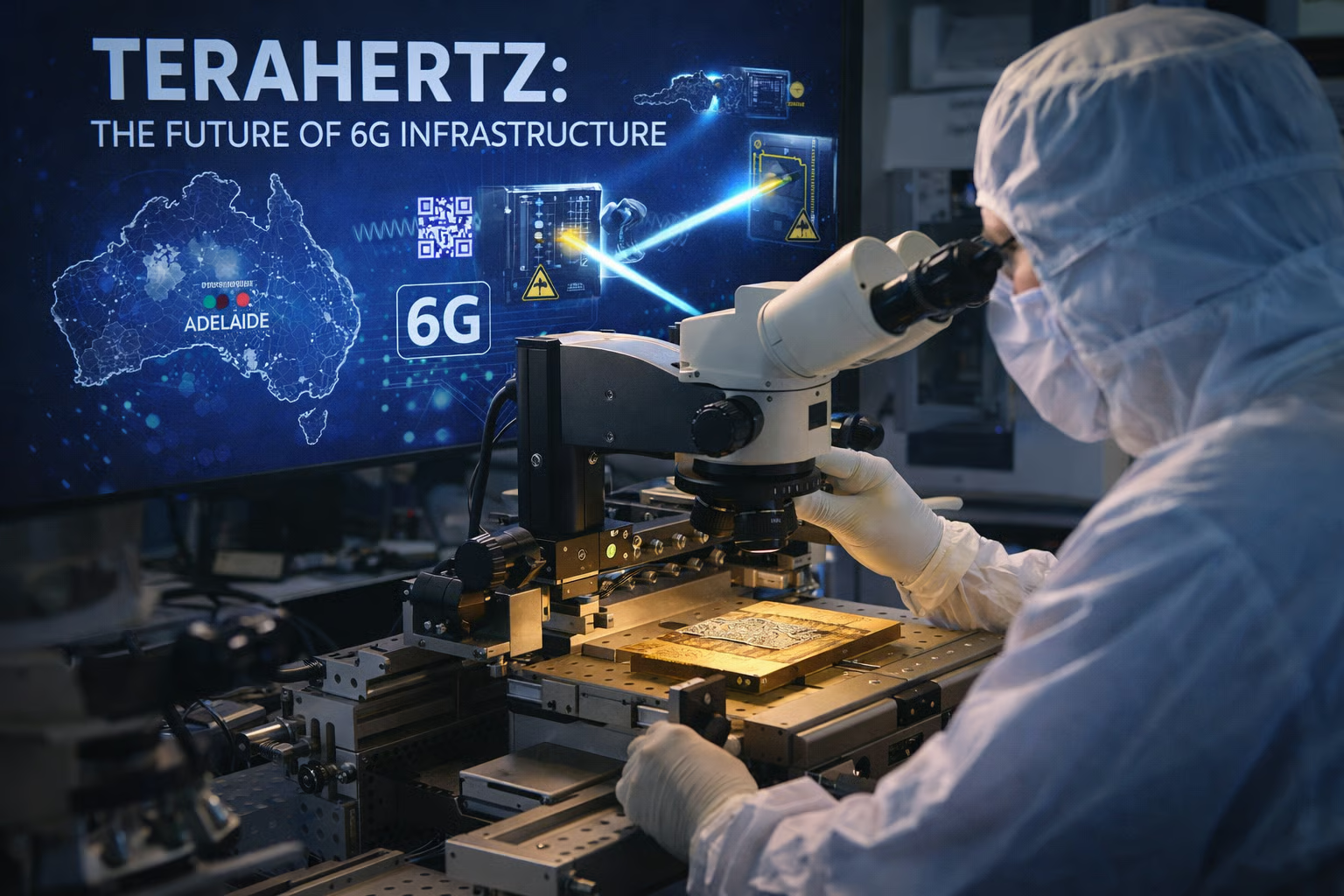 Image-R.E.News©
La course mondiale vers la 6G a changé de rythme. À Adélaïde, dans le sud de l’Australie, des chercheurs transforment une zone longtemps négligée du spectre électromagnétique — les fréquences térahertz — en pierre angulaire des réseaux du futur. Ce passage décisif de la théorie aux dispositifs concrets marque un tournant pour les télécommunications, mais aussi pour l’ensemble des infrastructures numériques et industrielles qui en dépendent.
Situées entre les micro-ondes et l’infrarouge, les ondes térahertz ont longtemps résisté aux ingénieurs. Trop complexes à générer, trop délicates à contrôler. Aujourd’hui, les avancées en micro- et nanofabrication ont rebattu les cartes. À l’Université d’Adélaïde, les chercheurs ne se contentent plus d’expérimenter en laboratoire : ils conçoivent des composants capables d’atteindre des débits dépassant le térabit par seconde sur plusieurs kilomètres. Une perspective qui redéfinit les limites de la connectivité sans fil.
Car la 6G ne se résume pas à une promesse de vitesse. Elle esquisse une nouvelle relation entre infrastructure physique et infrastructure numérique. Chantiers, réseaux de transport, systèmes énergétiques et logistiques exigent désormais des échanges de données continus, massifs et ultra-fiables. Les technologies térahertz pourraient devenir la couche invisible qui soutient cette complexité croissante, en particulier dans les environnements étendus ou isolés.
Ce saut technologique repose sur une autre révolution, plus discrète mais essentielle : la fabrication de précision. Grâce au partenariat avec l’Australian National Fabrication Facility, les idées prennent forme dans le silicium. Photolithographie avancée, gravure profonde, structures microscopiques perforées à l’échelle du micron… Chaque détail compte. Les « through-silicon vias », véritables autoroutes verticales du signal, permettent une intégration compacte et performante, condition indispensable pour exploiter les fréquences térahertz.
Au-delà des télécommunications, ces innovations irriguent d’autres domaines. Les ondes térahertz, capables de traverser les matériaux sans les endommager, ouvrent des perspectives inédites en inspection de sécurité, contrôle qualité, agriculture ou surveillance d’infrastructures. Ponts, tunnels et équipements critiques pourraient demain être analysés de manière non invasive, avant même que les défauts ne deviennent visibles.
Dans un contexte de compétition internationale intense, l’approche intégrée d’Adélaïde — alliant recherche appliquée et maîtrise industrielle — lui confère un avantage stratégique. Elle illustre aussi une réalité de plus en plus évidente : les infrastructures de demain dépendront autant de l’ingénierie des semi-conducteurs que du béton et de l’acier.
La 6G n’est pas encore là, mais ses fondations se construisent déjà. Et dans ces laboratoires où le silicium est sculpté à l’échelle microscopique, se dessine un futur où les données circuleront avec la même fluidité que les idées — rapides, invisibles, et indispensables.
NJC.© Info Adelaide’s Terahertz Engineering Laboratory
----------------------------------------------------------------------------------------------------------
06/02/26-English
Terahertz: The Weak Signal Heralding the 6G Revolution
Image-R.E.News©
The global race toward 6G has shifted gears. In Adelaide, South Australia, researchers are transforming a long-neglected area of the electromagnetic spectrum—terahertz frequencies—into the cornerstone of the networks of the future. This crucial transition from theory to concrete devices marks a turning point for telecommunications, as well as for all the digital and industrial infrastructures that depend on them.
Located between microwaves and infrared, terahertz waves have long eluded engineers. Too complex to generate, too delicate to control. Today, advances in micro- and nanofabrication have changed the game. At the University of Adelaide, researchers are no longer content with laboratory experiments: they are designing components capable of achieving speeds exceeding one terabit per second over several kilometers. A prospect that redefines the limits of wireless connectivity.
Because 6G is more than just a promise of speed. It outlines a new relationship between physical and digital infrastructure. Construction sites, transportation networks, energy and logistics systems now demand continuous, massive, and ultra-reliable data exchange. Terahertz technologies could become the invisible layer supporting this increasing complexity, particularly in large or isolated environments.
This technological leap relies on another, more discreet but essential revolution: precision manufacturing. Thanks to the partnership with the Australian National Fabrication Facility, ideas are taking shape in silicon. Advanced photolithography, deep etching, microscopic structures perforated at the micron scale… Every detail counts. “Through-silicon vias,” veritable vertical signal highways, enable compact and high-performance integration, an essential condition for harnessing terahertz frequencies.
Beyond telecommunications, these innovations are impacting other sectors. Terahertz waves, capable of passing through materials without damaging them, are opening up unprecedented possibilities in safety inspections, quality control, agriculture, and infrastructure monitoring. Bridges, tunnels, and critical equipment could soon be analyzed non-invasively, even before defects become visible.
In a context of intense international competition, Adelaide's integrated approach—combining applied research and industrial expertise—gives it a strategic advantage. It also illustrates an increasingly evident reality: tomorrow's infrastructure will depend as much on semiconductor engineering as on concrete and steel.
6G isn't here yet, but its foundations are already being built. And in these laboratories where silicon is sculpted at the microscopic scale, a future is taking shape where data will circulate with the same fluidity as ideas—fast, invisible, and indispensable.
NJC.© Info Adelaide’s Terahertz Engineering Laboratory
--------------------------------------------------------------------------------------------------------------
06/02/26-NL
Terahertz: Het zwakke signaal dat de 6G-revolutie aankondigt
Image-R.E.News©
De wereldwijde race naar 6G heeft een nieuwe fase bereikt. In Adelaide, Zuid-Australië, transformeren onderzoekers een lang verwaarloosd deel van het elektromagnetische spectrum – terahertzfrequenties – tot de hoeksteen van de netwerken van de toekomst. Deze cruciale overgang van theorie naar concrete apparaten markeert een keerpunt voor de telecommunicatie, evenals voor alle digitale en industriële infrastructuren die ervan afhankelijk zijn.
Terahertzgolven, gelegen tussen microgolven en infrarood, zijn lange tijd een uitdaging geweest voor ingenieurs. Te complex om te genereren, te kwetsbaar om te beheersen. Vandaag de dag hebben de ontwikkelingen in micro- en nanofabricage de situatie veranderd. Aan de Universiteit van Adelaide nemen onderzoekers geen genoegen meer met laboratoriumexperimenten: ze ontwerpen componenten die snelheden van meer dan één terabit per seconde over meerdere kilometers kunnen bereiken. Een vooruitzicht dat de grenzen van draadloze connectiviteit herdefinieert.
Want 6G is meer dan alleen een belofte van snelheid. Het schetst een nieuwe relatie tussen fysieke en digitale infrastructuur. Bouwplaatsen, transportnetwerken, energie- en logistieke systemen vereisen tegenwoordig continue, massale en uiterst betrouwbare gegevensuitwisseling. Terahertztechnologieën zouden de onzichtbare laag kunnen vormen die deze toenemende complexiteit ondersteunt, met name in grote of geïsoleerde omgevingen.
Deze technologische sprong is gebaseerd op een andere, meer discrete maar essentiële revolutie: precisieproductie. Dankzij de samenwerking met de Australian National Fabrication Facility krijgen ideeën vorm in silicium. Geavanceerde fotolithografie, diep etsen, microscopische structuren geperforeerd op micronniveau… Elk detail telt. "Through-silicon vias", ware verticale signaalwegen, maken compacte en hoogwaardige integratie mogelijk, een essentiële voorwaarde voor het benutten van terahertzfrequenties.
Naast telecommunicatie hebben deze innovaties ook impact op andere sectoren. Terahertzgolven, die door materialen heen kunnen dringen zonder ze te beschadigen, openen ongekende mogelijkheden voor veiligheidsinspecties, kwaliteitscontrole, landbouw en infrastructuurbewaking. Bruggen, tunnels en kritieke apparatuur zouden binnenkort niet-invasief geanalyseerd kunnen worden, zelfs voordat defecten zichtbaar worden.
In een context van intense internationale concurrentie geeft de geïntegreerde aanpak van Adelaide – een combinatie van toegepast onderzoek en industriële expertise – de universiteit een strategisch voordeel. Het illustreert tevens een steeds duidelijker wordende realiteit: de infrastructuur van morgen zal net zozeer afhangen van halfgeleidertechnologie als van beton en staal.
6G is er nog niet, maar de fundamenten ervoor worden al gelegd. En in deze laboratoria waar silicium op microscopisch niveau wordt bewerkt, krijgt een toekomst vorm waarin data met dezelfde vloeiendheid circuleren als ideeën – snel, onzichtbaar en onmisbaar.
NJC.© Info Adelaide’s Terahertz Engineering Laboratory
--------------------------------------------------------------------------------------------------------------------
Date de dernière mise à jour : 05/02/2026