



R.E.News future Technology-The Autonomous Construction Company
 13/08/26-FR-English-NL-footer
The Autonomous Construction Company Quand le chantier commence à penser
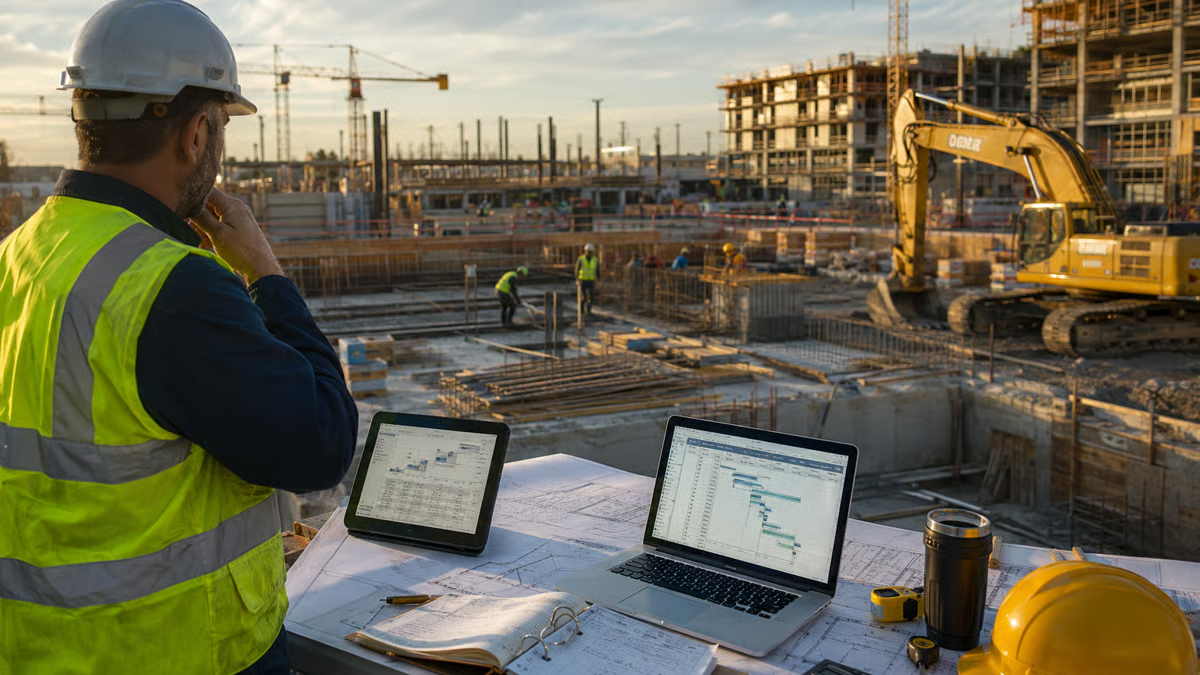 Image - creation R.E.News© via IA chat GPT
Pendant des années, l’industrie a imaginé l’autonomie sous une forme spectaculaire : une pelle sans conducteur, des drones dans le ciel, des robots exécutant inlassablement les mêmes tâches.
Mais la véritable révolution pourrait être beaucoup moins visible.
Car derrière la machine autonome, le constructeur continue souvent de travailler comme hier : devis dans des tableurs, appels d’offres échangés par e-mail, factures vérifiées ligne par ligne, plannings modifiés manuellement et rapports compilés chaque vendredi.
La machine a appris à travailler seule. L’entreprise, elle, reste encore largement manuelle.
C’est précisément là que commence la prochaine révolution.
L’entreprise devient une machine à décider
Un grand contractor ne construit pas seulement des routes ou des bâtiments. Il prend, chaque jour, des milliers de décisions : quel fournisseur choisir, quelle machine déplacer, pourquoi un chantier prend du retard, si une facture est correcte, si une variation menace la marge ou si un contrat fait courir un risque excessif.
Jusqu’ici, des équipes entières passaient une partie considérable de leur temps à rechercher, vérifier et transmettre l’information avant même de pouvoir décider.
L’IA peut changer cette mécanique.
La première génération d’outils répondait. La nouvelle génération commence à agir.
Un assistant signale qu’il manque trois offres fournisseurs. Un agent peut les demander. Un système détecte une facture qui ne correspond pas au bon de commande : il peut la bloquer, lancer une vérification et ne solliciter un humain que si le problème dépasse les règles définies.
C’est une différence fondamentale.
L’IA ne remplace pas nécessairement l’homme. Elle commence à remplacer l’attente de l’homme.
Du projet isolé au chantier qui s’auto-organise
Imaginez un projet autoroutier de 70 millions d’euros.
Dès l’appel d’offres, les systèmes analysent les documents, extraient les quantités, comparent le projet avec des opérations similaires, évaluent les fournisseurs, calculent plusieurs scénarios de planning et identifient les clauses contractuelles à risque.
Puis le projet est remporté.
Et c’est là que l’histoire devient intéressante.
Le devis devient la base des achats. Les achats alimentent le planning. Le planning commande les besoins en main-d’œuvre et en machines. Le chantier renvoie en permanence ses données vers le système.
Un bétonnage prend du retard ?
Le logiciel ne se contente plus de l’inscrire dans un rapport. Il comprend que ce retard modifie une activité suivante, qu’une pelle réservée mardi devient inutile sur ce chantier et qu’elle pourrait être immédiatement affectée à un autre site.
Le coût du transport est comparé au prix d’une location. La machine est déplacée. Le planning est ajusté. Les achats évoluent. La trésorerie est recalculée.
Une décision en entraîne une autre, sans attendre la prochaine réunion.
C’est le passage d’une entreprise qui collecte des données à une entreprise qui fait circuler l’intelligence à travers ses opérations.
Le véritable trésor : la mémoire
Mais la transformation la plus profonde se trouve ailleurs.
Pendant des décennies, la construction a souffert d’une faiblesse presque structurelle : à la fin d’un chantier, une grande partie de l’expérience disparaît avec les équipes.
Le prochain projet recommence alors avec de nouveaux fichiers, de nouvelles hypothèses et trop souvent les mêmes erreurs.
Le contractor autonome fonctionne autrement.
Il mesure ce qui s’est réellement passé, compare le résultat au devis, mémorise les coûts, les délais, les rendements et les problèmes rencontrés — puis réinjecte ces informations dans le prochain appel d’offres.
Le cycle devient :
prévoir → construire → mesurer → apprendre → prévoir mieux.
C’est ce que l’on pourrait appeler le closed-loop contractor.
Une entreprise qui ne se contente plus d’automatiser son travail, mais qui apprend de chaque chantier.
La prochaine bataille sera économique
C’est ici que l’IA cesse d’être une histoire technologique pour devenir une histoire économique.
Traditionnellement, lorsqu’un contractor grandit, son administration grandit avec lui : davantage de projets signifie davantage de planificateurs, d’acheteurs, de contrôleurs, de comptables et de gestionnaires.
Si l’intelligence logicielle absorbe une partie de cette complexité, une nouvelle équation apparaît :
le chiffre d’affaires peut croître plus vite que les frais généraux.
Et cette possibilité pourrait être plus importante pour l’industrie que n’importe quelle machine autonome.
Les grands groupes disposent déjà d’une puissance considérable. Mais les entreprises régionales pourraient, grâce aux agents IA, accéder à des capacités d’analyse, d’achat, d’estimation et de gestion autrefois réservées aux géants du secteur.
En parallèle, les grands contractors possèdent un avantage précieux : des décennies de données propriétaires.
Dans le monde du closed-loop, cette mémoire opérationnelle pourrait devenir l’un des actifs les plus stratégiques de la construction.
Le chantier devient un système
L’autonomie ne viendra donc pas d’une seule application.
Elle apparaîtra lorsque l’ERP, le BIM, les achats, la finance, le planning, la télématique, la gestion documentaire et les systèmes de suivi de chantier commenceront à fonctionner comme un seul organisme numérique.
Le vrai défi ne sera plus de savoir quelle application possède la meilleure IA.
Il sera de savoir si toutes les applications savent se parler.
Car lorsqu’un retard détecté sur le terrain peut automatiquement modifier un planning, réaffecter une machine, ajuster un achat et recalculer une prévision financière, l’entreprise cesse progressivement d’être une collection de services.
Elle devient un système.
L’humain reste au centre
Il serait pourtant trompeur de parler d’une construction sans hommes.
L’objectif n’est pas de donner aux logiciels une liberté illimitée. C’est au contraire de définir précisément ce qu’ils peuvent décider seuls, ce qui nécessite une validation et ce qui doit toujours rester entre des mains humaines.
L’humain quitte progressivement la routine pour se concentrer sur l’exception, le risque, la stratégie et le jugement.
C’est probablement cela, la véritable entreprise autonome.
Pas une entreprise sans salariés.
Une entreprise où les décisions ordinaires se prennent presque seules, où les machines exécutent, où les données circulent et où chaque chantier rend le suivant plus intelligent.
La pelle autonome était peut-être seulement le premier chapitre.
Le prochain chantier ne sera pas seulement capable de travailler seul.
Il saura se souvenir de ce qu’il a appris.
NJC.© Info https://en-gb.support.procore.com/product-releases/weekly-release-notes/may-2026 https://www.gartner.com/en/newsroom/press-releases/2025-06-25-gartner-predicts-over-40-percent-of-agentic-ai-projects-will-be-canceled-by-end-of-2027
--------------------------------------------------------------------------------------------------------------
13/08/26-English
The Autonomous Construction Company When the Construction Site Starts to Think
Image - creation R.E.News© via IA chat GPT
For years, the industry has envisioned autonomy in a spectacular form: a driverless excavator, drones in the sky, robots tirelessly performing the same tasks.
But the real revolution might be far less visible.
Because behind the autonomous machine, the construction company often continues to work as it did yesterday: quotes in spreadsheets, tenders exchanged by email, invoices checked line by line, schedules modified manually, and reports compiled every Friday.
The machine has learned to work on its own. The company, however, remains largely manual.
This is precisely where the next revolution begins.
The company becomes a decision-making machine
A large contractor doesn't just build roads or buildings. Every day, it makes thousands of decisions: which supplier to choose, which machine to move, why a project is behind schedule, whether an invoice is correct, whether a variation threatens the profit margin, or whether a contract poses an excessive risk.
Until now, entire teams spent a considerable amount of time searching for, verifying, and transmitting information before they could even make a decision.
AI can change this dynamic.
The first generation of tools responded. The new generation is starting to act.
An assistant reports that three supplier quotes are missing. An agent can request them. A system detects an invoice that doesn't match the purchase order: it can block it, initiate a verification, and only involve a human if the problem exceeds the defined rules.
This is a fundamental difference.
AI doesn't necessarily replace humans. It's starting to replace human waiting.
From an isolated project to a self-organizing construction site
Imagine a €70 million highway project.
From the tender stage, the systems analyze the documents, extract quantities, compare the project with similar operations, evaluate suppliers, calculate several scheduling scenarios, and identify risky contractual clauses.
Then the project is won.
And that's where the story gets interesting.
The quote becomes the basis for purchasing. Purchasing feeds into the schedule. The schedule dictates the labor and equipment needs. The construction site constantly sends its data back to the system.
Is a concrete pour running behind schedule?
The software no longer simply records it in a report. It understands that this delay affects a subsequent activity, that an excavator reserved for Tuesday is now useless on this site and could be immediately assigned to another location.
The cost of transportation is compared to the rental price. The machine is moved. The schedule is adjusted. Purchases are modified. Cash flow is recalculated.
One decision leads to another, without waiting for the next meeting.
This is the shift from a company that collects data to a company that circulates intelligence throughout its operations.
The real treasure: memory.
But the most profound transformation lies elsewhere.
For decades, the construction industry has suffered from an almost structural weakness: at the end of a project, much of the experience disappears along with the teams.
The next project then starts again with new files, new assumptions, and all too often, the same mistakes.
The autonomous contractor operates differently.
It measures what actually happened, compares the result to the estimate, records costs, deadlines, yields, and problems encountered—then feeds this information back into the next tender.
The cycle becomes:
plan → build → measure → learn → plan better.
This is what could be called the closed-loop contractor.
A company that no longer simply automates its work, but learns from every project.
The next battle will be economic.
This is where AI ceases to be a technological story and becomes an economic one.
Traditionally, as a contractor grows, its administration grows with it: more projects mean more planners, buyers, controllers, accountants, and managers.
If software intelligence absorbs some of this complexity, a new equation emerges:
revenue can grow faster than overhead costs.
And this possibility could be more important to the industry than any autonomous machine.
Large corporations already possess considerable power. But regional companies could, thanks to AI agents, access analytical, purchasing, estimating, and management capabilities once reserved for industry giants.
Meanwhile, major contractors possess a valuable advantage: decades of proprietary data.
In the world of closed-loop construction, this operational memory could become one of the most strategic assets in the industry.
The construction site becomes a system
Autonomy will therefore not come from a single application.
It will emerge when ERP, BIM, procurement, finance, scheduling, telematics, document management, and site monitoring systems begin to function as a single digital entity.
The real challenge will no longer be which application has the best AI.
It will be whether all the applications can communicate with each other.
Because when a delay detected on-site can automatically modify a schedule, reassign a machine, adjust a purchase, and recalculate a financial forecast, the company gradually ceases to be a collection of services.
It becomes a system.
Humans remain at the center
However, it would be misleading to speak of construction without people.
The goal is not to give software unlimited freedom. On the contrary, it's to precisely define what it can decide on its own, what requires validation, and what must always remain in human hands.
Humans are gradually moving away from routine to focus on exceptions, risk, strategy, and judgment.
This is probably what a truly autonomous company is all about.
Not a company without employees.
A company where ordinary decisions are made almost entirely on their own, where machines execute, where data flows freely, and where each project makes the next one smarter.
The autonomous excavator may have been just the first chapter.
The next project won't just be able to work independently.
It will remember what it has learned.
NJC.© Info https://en-gb.support.procore.com/product-releases/weekly-release-notes/may-2026 https://www.gartner.com/en/newsroom/press-releases/2025-06-25-gartner-predicts-over-40-percent-of-agentic-ai-projects-will-be-canceled-by-end-of-2027
-----------------------------------------------------------------------------------------------------------------
13/08/26-NL
Het autonome bouwbedrijf Wanneer de bouwplaats begint te denken
Image - creation R.E.News© via IA chat GPT
De bouwsector heeft jarenlang een spectaculair beeld van autonomie voor ogen gehad: een zelfrijdende graafmachine, drones in de lucht, robots die onvermoeibaar dezelfde taken uitvoeren.
Maar de echte revolutie is misschien veel minder zichtbaar.
Want achter de autonome machine werkt het bouwbedrijf vaak gewoon door zoals gisteren: offertes in spreadsheets, aanbestedingen per e-mail, facturen die regel voor regel worden gecontroleerd, planningen die handmatig worden aangepast en rapporten die elke vrijdag worden opgesteld.
De machine heeft geleerd om zelfstandig te werken. Het bedrijf zelf blijft echter grotendeels handmatig.
Precies hier begint de volgende revolutie.
Het bedrijf wordt een beslissingsmachine
Een grote aannemer bouwt niet alleen wegen of gebouwen. Elke dag neemt het duizenden beslissingen: welke leverancier te kiezen, welke machine te verplaatsen, waarom een project achterloopt op schema, of een factuur klopt, of een wijziging de winstmarge bedreigt, of een contract een te groot risico vormt.
Tot nu toe besteedden complete teams aanzienlijk veel tijd aan het zoeken, verifiëren en doorgeven van informatie voordat ze überhaupt een beslissing konden nemen.
AI kan deze dynamiek veranderen.
De eerste generatie tools reageerde. De nieuwe generatie begint nu actie te ondernemen.
Een assistent meldt dat er drie offertes van leveranciers ontbreken. Een medewerker kan deze opvragen. Een systeem detecteert een factuur die niet overeenkomt met de inkooporder: het kan deze blokkeren, een verificatie starten en alleen een mens inschakelen als het probleem de vastgestelde regels overschrijdt.
Dit is een fundamenteel verschil.
AI vervangt mensen niet per se. Het begint wel de wachttijden van mensen te vervangen.
Van een geïsoleerd project naar een zelforganiserende bouwplaats
Stel je een snelwegproject van € 70 miljoen voor.
Vanaf de aanbestedingsfase analyseren de systemen de documenten, berekenen de hoeveelheden, vergelijken het project met vergelijkbare projecten, evalueren leveranciers, berekenen verschillende planningsscenario's en identificeren risicovolle contractuele clausules.
Dan wordt het project gewonnen.
En daar wordt het verhaal interessant.
De offerte vormt de basis voor de aankoop. Inkoop vormt de basis van de planning. De planning bepaalt de benodigde arbeidskrachten en materieel. De bouwplaats stuurt continu gegevens terug naar het systeem.
Loopt een betonstorting achter op schema?
De software registreert dit niet langer alleen in een rapport. Het systeem begrijpt dat deze vertraging een volgende activiteit beïnvloedt, dat een graafmachine die voor dinsdag gereserveerd was, nu nutteloos is op deze locatie en direct naar een andere locatie kan worden overgeplaatst.
De transportkosten worden vergeleken met de huurprijs. De machine wordt verplaatst. De planning wordt aangepast. Inkopen worden gewijzigd. De cashflow wordt opnieuw berekend.
De ene beslissing leidt tot de andere, zonder te hoeven wachten op de volgende vergadering.
Dit is de verschuiving van een bedrijf dat data verzamelt naar een bedrijf dat intelligentie door de hele organisatie verspreidt.
De echte schat: het geheugen.
Maar de meest ingrijpende transformatie ligt elders.
De bouwsector kampt al decennia met een bijna structurele zwakte: aan het einde van een project verdwijnt een groot deel van de ervaring samen met de teams.
Het volgende project begint dan weer opnieuw met nieuwe bestanden, nieuwe aannames en, maar al te vaak, dezelfde fouten.
De autonome aannemer werkt anders.
Hij meet wat er daadwerkelijk is gebeurd, vergelijkt het resultaat met de schatting, registreert kosten, deadlines, opbrengsten en ondervonden problemen – en gebruikt deze informatie vervolgens voor de volgende aanbesteding.
De cyclus wordt:
plannen → bouwen → meten → leren → beter plannen.
Dit is wat je de gesloten-lus-aannemer zou kunnen noemen.
Een bedrijf dat zijn werk niet langer simpelweg automatiseert, maar van elk project leert.
De volgende strijd zal economisch van aard zijn.
Hier houdt AI op een technologisch verhaal te zijn en wordt het een economisch verhaal.
Traditioneel groeit de administratie van een aannemer mee met de groei: meer projecten betekenen meer planners, inkopers, controllers, accountants en managers.
Als software-intelligentie een deel van deze complexiteit overneemt, ontstaat er een nieuwe vergelijking:
de omzet kan sneller groeien dan de overheadkosten.
En deze mogelijkheid zou wel eens belangrijker kunnen zijn voor de industrie dan welke autonome machine dan ook.
Grote bedrijven beschikken al over aanzienlijke macht. Maar regionale bedrijven zouden dankzij AI-agenten toegang kunnen krijgen tot analytische, inkoop-, calculatie- en managementmogelijkheden die voorheen alleen waren voorbehouden aan industriereuzen.
Ondertussen beschikken grote aannemers over een waardevol voordeel: tientallen jaren aan eigen data.
In de wereld van gesloten-lusconstructies in de bouw kan dit operationele geheugen een van de meest strategische troeven in de sector worden.
De bouwplaats wordt een systeem
Autonomie zal daarom niet voortkomen uit één enkele applicatie.
Het zal ontstaan wanneer ERP-, BIM-, inkoop-, financiële, plannings-, telematica-, documentbeheer- en bouwplaatsbewakingssystemen als één digitale entiteit gaan functioneren.
De echte uitdaging zal niet langer zijn welke applicatie de beste AI heeft.
Het zal erom gaan of alle applicaties met elkaar kunnen communiceren.
Want wanneer een vertraging die op de bouwplaats wordt geconstateerd automatisch een planning kan aanpassen, een machine kan herindelen, een aankoop kan bijstellen en een financiële prognose kan herberekenen, houdt het bedrijf geleidelijk op een verzameling diensten te zijn.
Het wordt een systeem.
De mens blijft centraal staan
Het zou echter misleidend zijn om over de bouw te spreken zonder mensen.
Het doel is niet om software onbeperkte vrijheid te geven. Integendeel, het gaat erom precies te definiëren wat het zelfstandig kan beslissen, wat validatie vereist en wat altijd in menselijke handen moet blijven.
Mensen bewegen zich geleidelijk weg van routines om zich te richten op uitzonderingen, risico's, strategie en oordeelsvorming.
Dit is waarschijnlijk waar een echt autonoom bedrijf om draait.
Geen bedrijf zonder werknemers.
Een bedrijf waar gewone beslissingen bijna volledig zelfstandig worden genomen, waar machines uitvoeren, waar data vrijelijk stroomt en waar elk project het volgende slimmer maakt.
De autonome graafmachine was misschien slechts het eerste hoofdstuk.
Het volgende project zal niet alleen zelfstandig kunnen werken.
Het zal onthouden wat het heeft geleerd.
NJC.© Info https://en-gb.support.procore.com/product-releases/weekly-release-notes/may-2026 https://www.gartner.com/en/newsroom/press-releases/2025-06-25-gartner-predicts-over-40-percent-of-agentic-ai-projects-will-be-canceled-by-end-of-2027
-------------------------------------------------------------------------------------------------------------------
Date de dernière mise à jour : 12/08/2026