



R.E.News future Technology-The Quantum Computing Race Is Shifting From Qubits To Infrastructure
 04/09/26-FR-English-NL-footer
LA COURSE AU QUANTIQUE CHANGE DE TERRAIN
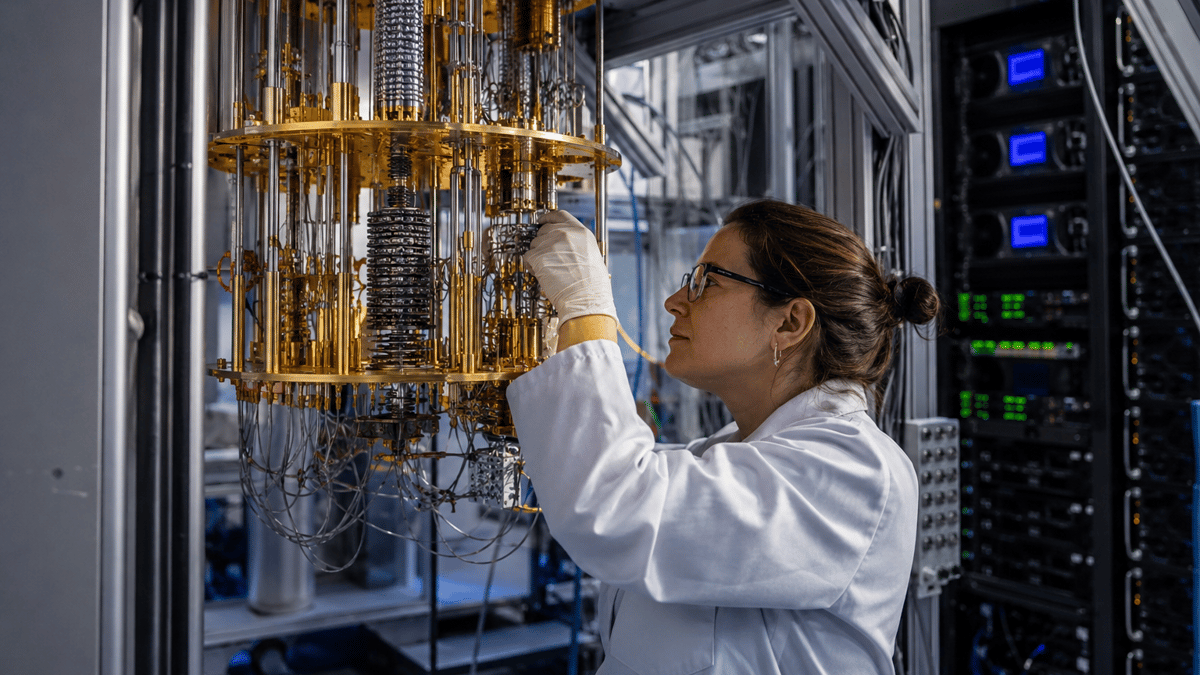 Image- creation R.E.News© via IA chat GPT
Les qubits ne sont plus les seuls à compter. Désormais, la véritable bataille se joue autour des infrastructures, des talents, des logiciels et de la souveraineté numérique.
Pendant des années, l’informatique quantique a été racontée comme une promesse lointaine. Une technologie fascinante, mais encore enfermée dans les laboratoires.
Aujourd’hui, quelque chose change.
Le quantique commence à prendre les contours d’une véritable infrastructure industrielle : des machines achetées, installées au cœur des supercalculateurs, soumises à des exigences de souveraineté et entourées d’équipes formées bien avant que les investissements ne commencent à produire leurs résultats.
Le signal est spectaculaire : 89 % des organisations interrogées travaillent déjà concrètement sur le quantique, mais seulement 10 % déclarent une utilisation limitée en production et à peine 3 % ont atteint un déploiement à grande échelle.
L’intérêt est donc massif.
La production, elle, reste encore rare.
8,3 MILLIARDS DE DOLLARS : LE MARCHÉ CHANGE D’ÉCHELLE
Image- creation R.E.News© via IA chat GPT
En 2025, les investissements mondiaux dans l’informatique quantique ont atteint 8,3 milliards de dollars, près de cinq fois plus qu’un an auparavant.
Mais le chiffre le plus révélateur n’est pas seulement celui des investissements. Ce sont les contrats.
Au premier trimestre 2026, 121 transactions, représentant environ 2,6 milliards de dollars, avaient été recensées. Le volume annuel des contrats a été multiplié par plus de six depuis 2021.
Le marché commence ainsi à parler le langage des infrastructures : capacité, intégration, contrats, exploitation et retour sur investissement.
DE LA LOCATION À LA PROPRIÉTÉ
Le modèle évolue lui aussi.
Le cloud reste la porte d’entrée idéale pour expérimenter. Mais les organisations qui veulent construire une compétence durable se tournent de plus en plus vers des architectures sur site ou hybrides.
Dans les trois prochaines années, environ 46 % des acheteurs prévoient d’intégrer une infrastructure sur site dans leur modèle d’accès, contre 24 % qui privilégient exclusivement le cloud public.
Pourquoi ?
Parce qu’un ordinateur quantique n’est pas simplement une machine que l’on allume.
Sa valeur se construit autour des ingénieurs capables de l’exploiter, des algorithmes développés pour des problèmes spécifiques, de l’intégration avec les supercalculateurs et surtout de l’expérience accumulée au fil des années.
Les principales feuilles de route industrielles convergent désormais vers 2029–2031 pour l’arrivée de systèmes tolérants aux fautes.
Le compte à rebours a donc déjà commencé.
LE VRAI GOULET D’ÉTRANGLEMENT : L’HUMAIN
La surprise est peut-être là.
Le principal obstacle n’est plus uniquement le matériel.
Ce sont les compétences.
Plus de 66 % des grandes entreprises, universités et organismes publics citent le manque de talents comme une difficulté majeure. Former une nouvelle génération d’experts peut prendre deux à cinq ans.
Le logiciel constitue l’autre grand défi. Les écosystèmes quantiques nécessitent encore plusieurs années pour atteindre une maturité opérationnelle comparable à celle des technologies classiques.
Et une question devient cruciale : comment éviter de reconstruire toute son architecture à chaque changement de fournisseur ?
L’absence de standards communs et d’interopérabilité pourrait devenir l’un des prochains champs de bataille du secteur.
LA SOUVERAINETÉ ENTRE DANS LE CAHIER DES CHARGES
Pour les États, le calcul quantique n’est déjà plus une simple technologie émergente.
C’est une question de souveraineté.
Présence locale, résidence des données, capacité nationale de maintenance, contrôle des systèmes : ces critères commencent à apparaître directement dans les appels d’offres.
L’Europe, les États-Unis, le Moyen-Orient et l’Asie accélèrent leurs programmes nationaux.
Plus de 30 programmes nationaux associant HPC et quantique ont été lancés depuis 2025 dans 14 pays.
Le modèle qui se dessine est particulièrement intéressant : le processeur quantique n’est plus considéré comme un ordinateur isolé, mais comme un accélérateur spécialisé connecté aux supercalculateurs classiques.
Le futur ne sera probablement pas quantique ou classique.
Il sera quantique et classique.
L’INDUSTRIE PRÉPARE DÉJÀ L’APRÈS
Dans les entreprises, la prudence reste pourtant de mise.
Les projets pilotes se multiplient, mais les applications industrielles capables de démontrer un avantage quantique durable restent encore limitées.
Les domaines les plus surveillés sont néanmoins très concrets : intelligence artificielle, optimisation, logistique, simulation, cybersécurité et science des matériaux.
Pour les secteurs de la construction, des infrastructures et des matériaux, cette dernière catégorie pourrait devenir particulièrement stratégique : batteries, nouveaux matériaux, composites et procédés à plus faible empreinte carbone sont déjà au cœur des recherches.
LE QUANTIQUE N’EST PLUS UNE PROMESSE. C’EST UNE PRÉPARATION.
Le véritable changement n’est peut-être donc pas l’arrivée prochaine d’une machine capable de résoudre tous les problèmes.
C’est le fait que les entreprises, les universités et les gouvernements commencent à construire aujourd’hui les infrastructures et les compétences nécessaires pour demain.
Le matériel évoluera. Les architectures changeront. Les qubits progresseront.
Mais les équipes formées, les logiciels développés, les données préparées et l’expérience accumulée ne s’improvisent pas du jour au lendemain.
La prochaine bataille du quantique ne se gagnera donc pas seulement avec davantage de qubits.
Elle se gagnera avec des infrastructures capables de les exploiter.
NJC.© Info https://iqm.tech/reports/IQM-State-of-Quantum-2026.pdf https://iqm.tech/company/about-iqm/
----------------------------------------------------------------------------------------------------------------
04/09/26-English
THE QUANTUM RACE IS CHANGING THE GROUND
Image- creation R.E.News© via IA chat GPT
Qubits are no longer the only thing that matters. Now, the real battle is being fought over infrastructure, talent, software, and digital sovereignty.
For years, quantum computing was touted as a distant promise. A fascinating technology, but still confined to laboratories.
Today, something is changing.
Quantum computing is beginning to take the form of a true industrial infrastructure: machines purchased, installed at the heart of supercomputers, subject to sovereignty requirements, and staffed by teams trained long before the investments begin to yield results.
The signal is striking: 89% of the organizations surveyed are already actively working with quantum computing, but only 10% report limited use in production, and barely 3% have achieved large-scale deployment.
The interest is therefore massive.
Production, however, remains scarce.
$8.3 BILLION: THE MARKET IS SCALING UP
In 2025, global investments in quantum computing reached $8.3 billion, nearly five times more than the previous year.
But the most telling figure isn't just the investment. It's the contracts.
In the first quarter of 2026, 121 deals, representing approximately $2.6 billion, were recorded. The annual volume of contracts has increased more than sixfold since 2021.
The market is thus beginning to speak the language of infrastructure: capacity, integration, contracts, operation, and return on investment.
FROM LEASING TO OWNERSHIP
The model is also evolving.
The cloud remains the ideal entry point for experimentation. But organizations that want to build lasting expertise are increasingly turning to on-premises or hybrid architectures.
In the next three years, approximately 46% of buyers plan to integrate on-premises infrastructure into their access model, compared to 24% who exclusively favor the public cloud.
Why?
Because a quantum computer isn't simply a machine you turn on.
Its value is built around the engineers capable of operating it, the algorithms developed for specific problems, integration with supercomputers, and above all, the experience accumulated over the years.
The main industry roadmaps are now converging on 2029–2031 for the arrival of fault-tolerant systems.
The countdown has therefore already begun.
THE REAL BOTTLENECK: HUMANS
Perhaps the surprise lies here.
The main obstacle is no longer just the hardware.
It's the skills.
More than 66% of large companies, universities, and public organizations cite the talent shortage as a major challenge. Training a new generation of experts can take two to five years.
Software is the other major challenge. Quantum ecosystems still need several years to reach operational maturity comparable to that of classical technologies.
And a crucial question arises: how to avoid rebuilding your entire architecture every time you change suppliers?
The lack of common standards and interoperability could become one of the sector's next battlegrounds.
SOVEREIGNTY IS NOW PART OF THE SPECIFICATIONS
For governments, quantum computing is no longer simply an emerging technology.
It's a matter of sovereignty.
Local presence, data residency, national maintenance capacity, and system control: these criteria are beginning to appear directly in calls for tenders.
Europe, the United States, the Middle East, and Asia are accelerating their national programs.
More than 30 national programs combining HPC and quantum computing have been launched in 14 countries since 2025.
The emerging model is particularly interesting: the quantum processor is no longer considered an isolated computer, but a specialized accelerator connected to classical supercomputers.
The future will probably not be quantum or classical.
It will be quantum and classical.
INDUSTRY IS ALREADY PREPARING FOR THE AFTERMATH
In companies, however, caution remains the order of the day.
Pilot projects are multiplying, but industrial applications capable of demonstrating a lasting quantum advantage are still limited.
The most closely watched areas are nevertheless very concrete: artificial intelligence, optimization, logistics, simulation, cybersecurity, and materials science.
For the construction, infrastructure, and materials sectors, this last category could become particularly strategic: batteries, new materials, composites, and lower-carbon processes are already at the heart of research.
QUANTUM IS NO LONGER A PROMISE. IT'S A PREPARATION.
The real change, therefore, may not be the imminent arrival of a machine capable of solving all problems.
It's the fact that businesses, universities, and governments are starting today to build the infrastructure and skills necessary for tomorrow.
Hardware will evolve. Architectures will change. Qubits will advance.
But the trained teams, developed software, prepared data, and accumulated experience cannot be improvised overnight.
The next quantum battle will therefore not be won simply with more qubits.
It will be won with the infrastructure capable of harnessing them.
NJC.© Info https://iqm.tech/reports/IQM-State-of-Quantum-2026.pdf https://iqm.tech/company/about-iqm/
-------------------------------------------------------------------------------------------------------------------
04/09/26-NL
DE QUANTUMWEDSTRIJD VERANDERT DE WERELD
Image- creation R.E.News© via IA chat GPT
Qubits zijn niet langer het enige dat telt. De echte strijd wordt nu gevoerd over infrastructuur, talent, software en digitale soevereiniteit.
Jarenlang werd kwantumcomputing beschouwd als een verre belofte. Een fascinerende technologie, maar nog steeds beperkt tot laboratoria.
Vandaag de dag verandert er iets.
Kwantumcomputing begint de vorm aan te nemen van een echte industriële infrastructuur: machines die worden aangeschaft, geïnstalleerd in het hart van supercomputers, onderworpen aan soevereiniteitseisen en bemand door teams die lang voordat de investeringen resultaten opleveren, worden opgeleid.
Het signaal is opvallend: 89% van de ondervraagde organisaties werkt al actief met kwantumcomputing, maar slechts 10% meldt beperkt gebruik in productie en amper 3% heeft grootschalige implementatie bereikt.
De interesse is dus enorm.
De productie blijft echter schaars.
$8,3 MILJARD: DE MARKT GROEIT OP
In 2025 bereikten de wereldwijde investeringen in kwantumcomputing $8,3 miljard, bijna vijf keer zoveel als het jaar ervoor.
Maar het meest veelzeggende cijfer is niet alleen de investering. Het zijn de contracten.
In het eerste kwartaal van 2026 werden 121 deals gesloten, goed voor ongeveer $2,6 miljard. Het jaarlijkse volume aan contracten is sinds 2021 meer dan zes keer zo groot geworden.
De markt begint dus de taal van infrastructuur te spreken: capaciteit, integratie, contracten, beheer en rendement op investering.
VAN LEASING NAAR EIGENDOM
Het model evolueert ook.
De cloud blijft het ideale instapmodel voor experimenten. Maar organisaties die duurzame expertise willen opbouwen, kiezen steeds vaker voor on-premises of hybride architecturen.
In de komende drie jaar is ongeveer 46% van de kopers van plan om on-premises infrastructuur in hun toegangsmodel te integreren, vergeleken met 24% die uitsluitend de publieke cloud verkiest.
Waarom?
Omdat een kwantumcomputer niet zomaar een machine is die je aanzet.
De waarde ervan zit hem in de ingenieurs die hem kunnen bedienen, de algoritmes die ontwikkeld zijn voor specifieke problemen, de integratie met supercomputers en vooral de ervaring die in de loop der jaren is opgebouwd.
De belangrijkste roadmaps van de industrie wijzen nu op 2029-2031 voor de komst van fouttolerante systemen.
Het aftellen is dus al begonnen.
DE ECHTE KNOOPPUNT: MENSEN
Misschien zit de verrassing hier wel.
Het grootste obstakel is niet langer alleen de hardware.
Het zijn de vaardigheden.
Meer dan 66% van de grote bedrijven, universiteiten en publieke organisaties noemt het tekort aan talent als een grote uitdaging. Het opleiden van een nieuwe generatie experts kan twee tot vijf jaar duren.
Software is de andere grote uitdaging. Kwantum-ecosystemen hebben nog een aantal jaren nodig om een operationele volwassenheid te bereiken die vergelijkbaar is met die van klassieke technologieën.
En dan rijst een cruciale vraag: hoe voorkom je dat je je hele architectuur opnieuw moet opbouwen telkens als je van leverancier wisselt?
Het gebrek aan gemeenschappelijke standaarden en interoperabiliteit zou wel eens een van de volgende strijdtonen in de sector kunnen worden.
SOEVEREINITEIT MAAKT NU DEEL UIT VAN DE SPECIFICATIES
Voor overheden is kwantumcomputing niet langer slechts een opkomende technologie.
Het is een kwestie van soevereiniteit.
Lokale aanwezigheid, dataopslag, nationale onderhoudscapaciteit en systeembeheer: deze criteria duiken steeds vaker direct op in aanbestedingen.
Europa, de Verenigde Staten, het Midden-Oosten en Azië versnellen hun nationale programma's.
Sinds 2025 zijn er in 14 landen meer dan 30 nationale programma's gestart die HPC en kwantumcomputing combineren.
Het opkomende model is bijzonder interessant: de kwantumprocessor wordt niet langer beschouwd als een geïsoleerde computer, maar als een gespecialiseerde accelerator die is verbonden met klassieke supercomputers.
De toekomst zal waarschijnlijk niet kwantum of klassiek zijn.
Het zal kwantum én klassiek zijn.
DE INDUSTRIE BEREIDT ZICH AL VOOR OP DE NASLEEP
Binnen bedrijven blijft echter voorzichtigheid geboden.
Er worden steeds meer pilotprojecten uitgevoerd, maar industriële toepassingen die een blijvend kwantumvoordeel kunnen aantonen, zijn nog schaars.
De meest in het oog springende gebieden zijn niettemin zeer concreet: kunstmatige intelligentie, optimalisatie, logistiek, simulatie, cybersecurity en materiaalkunde.
Voor de bouw-, infrastructuur- en materialensector zou deze laatste categorie bijzonder strategisch kunnen worden: batterijen, nieuwe materialen, composieten en koolstofarme processen staan al centraal in het onderzoek.
Quantum is geen belofte meer. Het is een voorbereiding.
De echte verandering is daarom misschien niet de onmiddellijke komst van een machine die alle problemen kan oplossen.
Het is het feit dat bedrijven, universiteiten en overheden vandaag beginnen met het opbouwen van de infrastructuur en de vaardigheden die nodig zijn voor morgen.
Hardware zal evolueren. Architecturen zullen veranderen. Qubits zullen zich verder ontwikkelen.
Maar de getrainde teams, ontwikkelde software, voorbereide data en opgebouwde ervaring kunnen niet van de ene op de andere dag worden geïmproviseerd.
De volgende kwantumstrijd zal daarom niet simpelweg gewonnen worden met meer qubits.
Die zal gewonnen worden met de infrastructuur die in staat is ze te benutten.
NJC.© Info https://iqm.tech/reports/IQM-State-of-Quantum-2026.pdf https://iqm.tech/company/about-iqm/
----------------------------------------------------------------------------------------------------------------
Date de dernière mise à jour : 03/09/2026