



R.E.News future Technology-The Real Bottleneck in Physical AI and Robotics is Data
 21/08/26-FR-English-NL-footer
Physical AI : le véritable goulot d’étranglement n’est plus le robot, mais la donnée
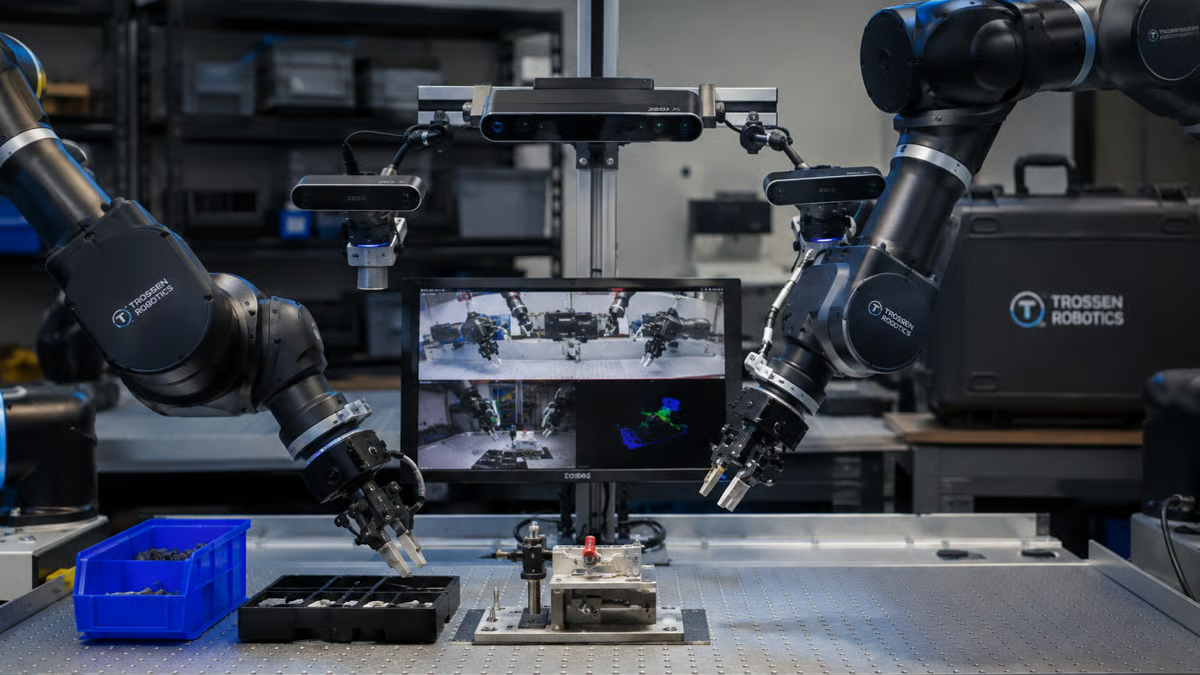 Image- creation R.E.News via IA chat GPT
Pendant deux ans, l’industrie de la robotique a cru que le futur se jouerait dans les moteurs, les bras articulés ou la puissance de calcul. Aujourd’hui, le verdict est différent : le composant le plus rare n’est ni le robot ni le processeur. C’est la donnée.
Pour apprendre à saisir, déplacer, trier ou assembler dans le monde réel, une machine a besoin d’innombrables démonstrations parfaitement synchronisées. Or ces données sont difficiles à produire : elles nécessitent des robots réels, des opérateurs humains, plusieurs caméras et une précision absolue.
C’est précisément ce que cherchent à résoudre Trossen Robotics et Stereolabs avec leurs nouvelles plateformes Physical AI, Workbench et Rivet. Les caméras ZED X Mini et ZED X Nano sont intégrées directement à la machine, transformant chaque séance de téléopération en une source de données prête à entraîner les futurs robots.
Le détail est loin d’être anodin. Trois caméras calibrées, des images stéréo, de la profondeur et une synchronisation précise permettent de capturer simultanément la scène globale et les gestes des pinces. Avec une connexion GMSL2 conçue pour les longues liaisons industrielles, le système évite les approximations des installations bricolées en laboratoire.
La nouvelle matière première
Un modèle d’IA peut absorber des milliards de textes ou d’images déjà disponibles. Un robot, lui, doit apprendre en faisant.
Chaque mouvement humain devient donc une matière première : une main qui saisit, un objet qui résiste, une trajectoire qui échoue, puis recommence. Quelques centaines de démonstrations propres peuvent avoir davantage de valeur que des milliers d’enregistrements mal synchronisés.
La conséquence est majeure : la valeur se déplace vers ceux capables de produire cette donnée de manière fiable, rapide et industrielle.
L’acquisition de Stereolabs par Ouster en février 2026 prend alors une nouvelle dimension. Caméras, lidar, perception et logiciels convergent progressivement vers des plateformes capables de contrôler non seulement ce que le robot voit, mais aussi la qualité des données avec lesquelles il apprend.
Du laboratoire au chantier
Le mouvement dépasse largement les robots de laboratoire.
Avec plus de 542 000 robots industriels installés dans le monde en 2024, l’automatisation atteint déjà une échelle industrielle. La prochaine étape sera celle des machines capables de s’adapter à des environnements moins prévisibles : usines flexibles, entrepôts, infrastructures… et demain, chantiers de construction.
Pour les secteurs du BTP et des infrastructures, cette évolution pourrait être décisive. Une pelle autonome, un robot de manutention ou une machine capable d’interpréter son environnement ne naîtra pas seulement d’un meilleur moteur ou d’un meilleur algorithme.
Elle naîtra de millions de bonnes données.
La véritable bataille de la Physical AI commence donc peut-être loin des projecteurs, derrière les caméras, les câbles et les systèmes de calibration.
Car dans la robotique de demain, celui qui contrôle la donnée pourrait bien contrôler le rythme auquel les machines deviennent intelligentes.
NJC.© Info https://ouster.com/ https://www.stereolabs.com/en-fr/products/zed-x https://www.trossenrobotics.com/
---------------------------------------------------------------------------------------------------------------
21/08/26-English
Physical AI: The Real Bottleneck Is No Longer the Robot, But the Data
Image- creation R.E.News via IA chat GPT
For two years, the robotics industry believed that the future lay in motors, robotic arms, and computing power. Today, the verdict is different: the rarest component is neither the robot nor the processor. It's data.
To learn to grasp, move, sort, or assemble in the real world, a machine needs countless perfectly synchronized demonstrations. But this data is difficult to produce: it requires real robots, human operators, multiple cameras, and absolute precision.
This is precisely what Trossen Robotics and Stereolabs are trying to solve with their new Physical AI platforms, Workbench and Rivet. The ZED X Mini and ZED X Nano cameras are integrated directly into the machine, transforming each teleoperation session into a data source ready to train future robots.
This detail is far from insignificant. Three calibrated cameras, stereo imaging, depth sensing, and precise synchronization enable the simultaneous capture of the overall scene and the gripper movements. With a GMSL2 connection designed for long industrial links, the system avoids the approximations of makeshift lab setups.
The New Raw Material
An AI model can absorb billions of readily available texts or images. A robot, however, must learn by doing.
Every human movement thus becomes raw material: a hand grasping, an object resisting, a trajectory failing and then starting again. A few hundred clean demonstrations can be more valuable than thousands of poorly synchronized recordings.
The consequence is significant: value shifts to those capable of producing this data reliably, quickly, and on an industrial scale.
Ouster's acquisition of Stereolabs in February 2026 then takes on a new dimension. Cameras, lidar, perception, and software are gradually converging into platforms capable of controlling not only what the robot sees, but also the quality of the data it learns from.
From the Lab to the Construction Site
The movement extends far beyond laboratory robots.
With over 542,000 industrial robots installed worldwide by 2024, automation has already reached an industrial scale. The next step will be machines capable of adapting to less predictable environments: flexible factories, warehouses, infrastructure… and tomorrow, construction sites.
For the construction and infrastructure sectors, this evolution could be decisive. An autonomous excavator, a material handling robot, or a machine capable of interpreting its environment will not simply be born from a better engine or a better algorithm.
It will be born from millions of good data points.
The real battle for Physical AI may therefore begin far from the spotlight, behind the cameras, cables, and calibration systems.
Because in the robotics of tomorrow, whoever controls the data could very well control the pace at which machines become intelligent.
NJC.© Info https://ouster.com/ https://www.stereolabs.com/en-fr/products/zed-x https://www.trossenrobotics.com/
-----------------------------------------------------------------------------------------------------
21/08/26-NL
Fysieke AI: De echte bottleneck is niet langer de robot, maar de data
Image- creation R.E.News via IA chat GPT
Twee jaar lang geloofde de robotica-industrie dat de toekomst lag in motoren, robotarmen en rekenkracht. Vandaag de dag is het oordeel anders: de meest schaarse component is niet de robot of de processor. Het is data.
Om in de echte wereld te leren grijpen, bewegen, sorteren of assembleren, heeft een machine talloze perfect gesynchroniseerde demonstraties nodig. Maar deze data is moeilijk te produceren: het vereist echte robots, menselijke operators, meerdere camera's en absolute precisie.
Precies dit probleem proberen Trossen Robotics en Stereolabs op te lossen met hun nieuwe fysieke AI-platforms, Workbench en Rivet. De ZED X Mini- en ZED X Nano-camera's zijn direct in de machine geïntegreerd, waardoor elke teleoperatiesessie een databron wordt die klaar is om toekomstige robots te trainen.
Dit detail is allesbehalve onbelangrijk. Drie gekalibreerde camera's, stereobeeldvorming, dieptesensoren en nauwkeurige synchronisatie maken het mogelijk om tegelijkertijd de gehele scène en de bewegingen van de grijper vast te leggen. Met een GMSL2-verbinding, ontworpen voor lange industriële trajecten, vermijdt het systeem de onnauwkeurigheden van geïmproviseerde laboratoriumopstellingen.
De nieuwe grondstof
Een AI-model kan miljarden direct beschikbare teksten of afbeeldingen verwerken. Een robot moet echter leren door te doen.
Elke menselijke beweging wordt zo grondstof: een hand die iets vastgrijpt, een object dat weerstand biedt, een traject dat mislukt en vervolgens opnieuw begint. Een paar honderd zuivere demonstraties kunnen waardevoller zijn dan duizenden slecht gesynchroniseerde opnames.
Het gevolg is significant: waarde verschuift naar degenen die deze data betrouwbaar, snel en op industriële schaal kunnen produceren.
De overname van Stereolabs door Ouster in februari 2026 krijgt dan een nieuwe dimensie. Camera's, lidar, perceptie en software komen geleidelijk samen in platforms die niet alleen kunnen bepalen wat de robot ziet, maar ook de kwaliteit van de data waaruit hij leert.
Van het lab naar de bouwplaats
De ontwikkeling reikt veel verder dan laboratoriumrobots.
Met meer dan 542.000 industriële robots die in 2024 wereldwijd geïnstalleerd zullen zijn, heeft automatisering al een industriële schaal bereikt. De volgende stap zijn machines die zich kunnen aanpassen aan minder voorspelbare omgevingen: flexibele fabrieken, magazijnen, infrastructuur... en morgen bouwplaatsen.
Voor de bouw- en infrastructuursector kan deze evolutie doorslaggevend zijn. Een autonome graafmachine, een materiaalbehandelingsrobot of een machine die zijn omgeving kan interpreteren, zal niet simpelweg ontstaan uit een betere motor of een beter algoritme.
Het zal ontstaan uit miljoenen goede datapunten.
De echte strijd om fysieke AI zou daarom wel eens ver buiten de schijnwerpers kunnen beginnen, achter de camera's, kabels en kalibratiesystemen.
Want in de robotica van de toekomst kan degene die de data beheert, wel eens de snelheid bepalen waarmee machines intelligent worden.
NJC.© Info https://ouster.com/ https://www.stereolabs.com/en-fr/products/zed-x https://www.trossenrobotics.com/
--------------------------------------------------------------------------------------------------------------
Date de dernière mise à jour : 20/08/2026