



R.E.News future Technology-The Search for the Next Power Site Begins in Orbit
 17/06/26-FR-English-NL-footer
La quête des futurs sites énergétiques commence désormais depuis l’espace
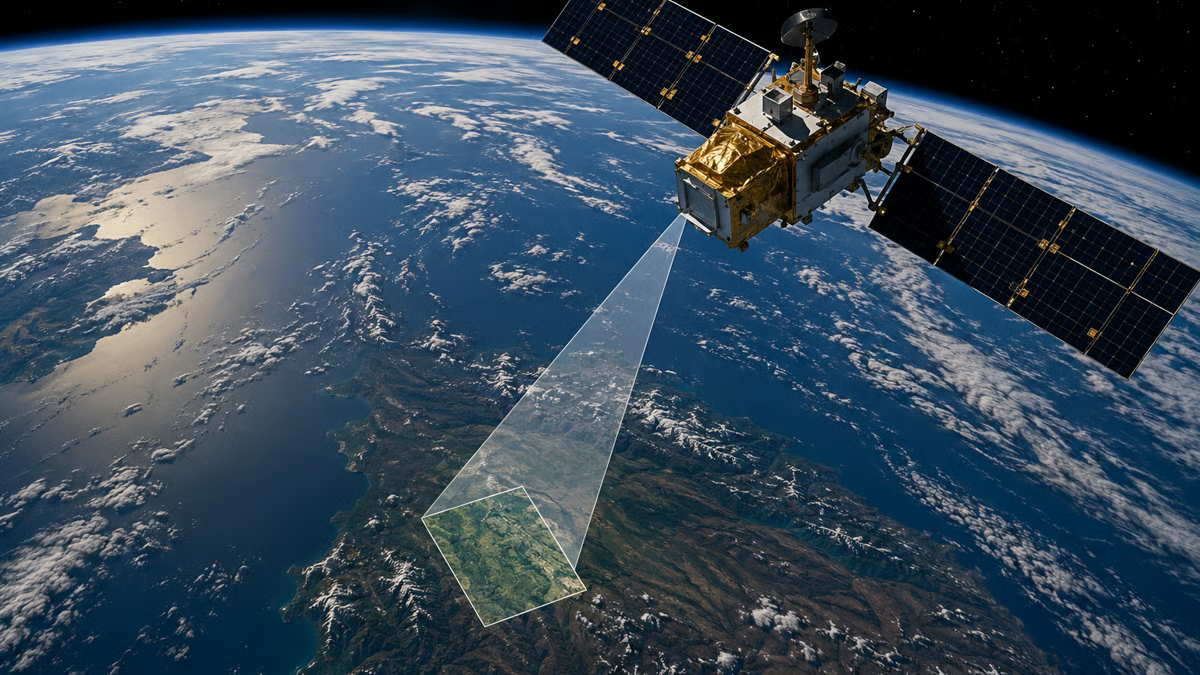 Image-R.E.News©
Alors que la transition énergétique mondiale accélère, un obstacle continue de freiner discrètement des milliers de projets : trouver le bon emplacement. Pour la jeune pousse singapourienne RIFFAI, le véritable goulot d’étranglement des énergies renouvelables ne réside ni dans le financement ni dans la technologie, mais dans la sélection des sites.
Présentée début juin lors du salon Echelon Singapore, la société fondée en 2024 par le spécialiste des données satellitaires Kolatat Katousano mise sur l’intelligence artificielle et l’imagerie spatiale pour révolutionner cette étape critique. Son ambition : identifier, analyser et classer en quelques heures des centaines de sites potentiels pour des parcs solaires, éoliens terrestres et offshore, ainsi que pour les futurs centres de données hyperscale.
L’enjeu est colossal. Une mauvaise localisation peut entraîner des années de retard, des coûts d’études inutiles et des investissements finalement abandonnés. RIFFAI estime que de nombreux projets prometteurs disparaissent bien avant la phase de construction à cause de processus de sélection encore trop lents et fragmentés.
Pour changer la donne, l’entreprise exploite des données satellitaires hyper-multispectrales couplées à des algorithmes de machine learning capables d’évaluer l’ensoleillement, les régimes de vent, les risques climatiques, la proximité des réseaux électriques ou encore les contraintes environnementales. L’objectif est simple : transformer des millions de pixels en décisions d’investissement.
Cette approche arrive au bon moment. Le marché mondial des solutions satellitaires dédiées à l’implantation des projets renouvelables était évalué à près de 1,4 milliard de dollars en 2024 et pourrait dépasser les 4 milliards de dollars d’ici 2033. Plus largement, l’économie de l’observation de la Terre alimentée par l’IA est appelée à devenir l’un des piliers de la prochaine décennie d’infrastructures intelligentes.
RIFFAI ne vise cependant pas uniquement l’énergie verte. L’entreprise cible également les centres de données hyperscale, dont la croissance explosive, portée par l’intelligence artificielle, crée une demande sans précédent pour des sites combinant accès à l’énergie, connectivité, refroidissement et résilience climatique. Une convergence stratégique qui relie deux des plus grands marchés d’investissement de la décennie.
Face à des géants du secteur de l’observation terrestre, la jeune entreprise ne cherche pas à construire ses propres satellites. Son pari repose sur la couche d’intelligence capable de transformer des données spatiales massives en outils de décision concrets pour les développeurs, les énergéticiens et les investisseurs.
Au-delà de la technologie, RIFFAI illustre une évolution plus profonde du secteur des infrastructures : les décisions qui façonnent les réseaux énergétiques de demain se prennent désormais autant depuis l’orbite terrestre que sur le terrain. Une question s’impose alors à l’industrie : et si le futur des grands projets énergétiques commençait par un regard depuis l’espace ?
NJC.© Info https://www.riffai.org/ https://echelon.e27.co/
--------------------------------------------------------------------------------------------------------------
17/06/26-English
The quest for future energy sites now begins from space.
Image-R.E.News©
As the global energy transition accelerates, one obstacle continues to quietly hinder thousands of projects: finding the right location. For the Singaporean startup RIFFAI, the real bottleneck for renewable energy lies neither in financing nor technology, but in site selection.
Presented in early June at the Echelon Singapore trade show, the company, founded in 2024 by satellite data specialist Kolatat Katousano, is leveraging artificial intelligence and satellite imagery to revolutionize this critical step. Its ambition: to identify, analyze, and rank hundreds of potential sites for solar, onshore and offshore wind farms, as well as for future hyperscale data centers, in just a few hours.
The stakes are enormous. Poor site selection can lead to years of delays, unnecessary feasibility studies, and ultimately abandoned investments. RIFFAI believes that many promising projects disappear well before the construction phase due to selection processes that are still too slow and fragmented.
To change this, the company leverages hyper-multispectral satellite data coupled with machine learning algorithms capable of assessing solar irradiance, wind patterns, climate risks, proximity to power grids, and environmental constraints. The goal is simple: to transform millions of pixels into investment decisions.
This approach is timely. The global market for satellite solutions dedicated to the deployment of renewable energy projects was valued at nearly $1.4 billion in 2024 and could exceed $4 billion by 2033. More broadly, the AI-powered Earth observation economy is poised to become one of the pillars of the next decade of smart infrastructure.
However, RIFFAI is not solely focused on green energy. The company is also targeting hyperscale data centers, whose explosive growth, driven by artificial intelligence, is creating unprecedented demand for sites that combine energy access, connectivity, cooling, and climate resilience. This strategic convergence links two of the decade's largest investment markets.
Facing giants in the Earth observation sector, the young company is not looking to build its own satellites. Its bet rests on the intelligence layer capable of transforming massive amounts of space data into concrete decision-making tools for developers, energy companies, and investors.
Beyond technology, RIFFAI illustrates a deeper evolution in the infrastructure sector: the decisions that shape tomorrow's energy networks are now made as much from Earth orbit as on the ground. This raises a crucial question for the industry: what if the future of major energy projects began with a view from space?
NJC.© Info https://www.riffai.org/ https://echelon.e27.co/
-------------------------------------------------------------------------------------------------------------
17/06/26-NL
De zoektocht naar toekomstige energielocaties begint nu vanuit de ruimte.
Image-R.E.News©
Terwijl de wereldwijde energietransitie versnelt, blijft één obstakel duizenden projecten stilletjes belemmeren: het vinden van de juiste locatie. Voor de Singaporese startup RIFFAI ligt het echte knelpunt voor hernieuwbare energie niet in de financiering of technologie, maar in de locatiekeuze.
Het bedrijf, opgericht in 2024 door satellietdataspecialist Kolatat Katousano, presenteerde zich begin juni op de Echelon Singapore-beurs en gebruikt kunstmatige intelligentie en satellietbeelden om deze cruciale stap te revolutioneren. Hun ambitie: honderden potentiële locaties voor zonne-energieparken, windparken op land en op zee, en toekomstige hyperscale datacenters identificeren, analyseren en rangschikken in slechts enkele uren.
De belangen zijn enorm. Een slechte locatiekeuze kan leiden tot jarenlange vertragingen, onnodige haalbaarheidsstudies en uiteindelijk afgebroken investeringen. RIFFAI is ervan overtuigd dat veel veelbelovende projecten al lang voor de bouwfase sneuvelen door selectieprocessen die nog steeds te traag en gefragmenteerd zijn.
Om hier verandering in te brengen, maakt het bedrijf gebruik van hyper-multispectrale satellietgegevens in combinatie met machine learning-algoritmen die in staat zijn om zonnestraling, windpatronen, klimaatrisico's, de nabijheid van elektriciteitsnetten en milieubeperkingen te beoordelen. Het doel is simpel: miljoenen pixels omzetten in investeringsbeslissingen.
Deze aanpak komt op het juiste moment. De wereldwijde markt voor satellietoplossingen voor de uitrol van projecten voor hernieuwbare energie had in 2024 een waarde van bijna 1,4 miljard dollar en zou in 2033 de 4 miljard dollar kunnen overschrijden. Bovendien staat de door AI aangedreven aardobservatie-economie op het punt een van de pijlers van de slimme infrastructuur van het komende decennium te worden.
RIFFAI richt zich echter niet alleen op groene energie. Het bedrijf richt zich ook op hyperscale datacenters, waarvan de explosieve groei, gedreven door kunstmatige intelligentie, een ongekende vraag creëert naar locaties die energievoorziening, connectiviteit, koeling en klimaatbestendigheid combineren. Deze strategische convergentie verbindt twee van de grootste investeringsmarkten van het decennium.
Het jonge bedrijf, dat het opneemt tegen giganten in de aardobservatiesector, is niet van plan om zelf satellieten te bouwen. De inzet is gebaseerd op de intelligentielaag die enorme hoeveelheden ruimtedata kan omzetten in concrete hulpmiddelen voor besluitvorming voor ontwikkelaars, energiebedrijven en investeerders.
Naast de technologie illustreert RIFFAI een diepere evolutie in de infrastructuursector: de beslissingen die de energienetwerken van morgen vormgeven, worden nu net zo goed vanuit een baan om de aarde genomen als vanaf de grond. Dit roept een cruciale vraag op voor de sector: wat als de toekomst van grote energieprojecten begint met een blik vanuit de ruimte?
NJC.© Info https://www.riffai.org/ https://echelon.e27.co/
--------------------------------------------------------------------------------------------------------------
Date de dernière mise à jour : 16/06/2026