













R.E.News future Technology-Topcon Partners With Xona To Strengthen Resilient GNSS Infrastructure
 18/02/26-FR-English-NL-footer
Topcon Positioning Systems et Xona : vers une nouvelle ère du positionnement résilient
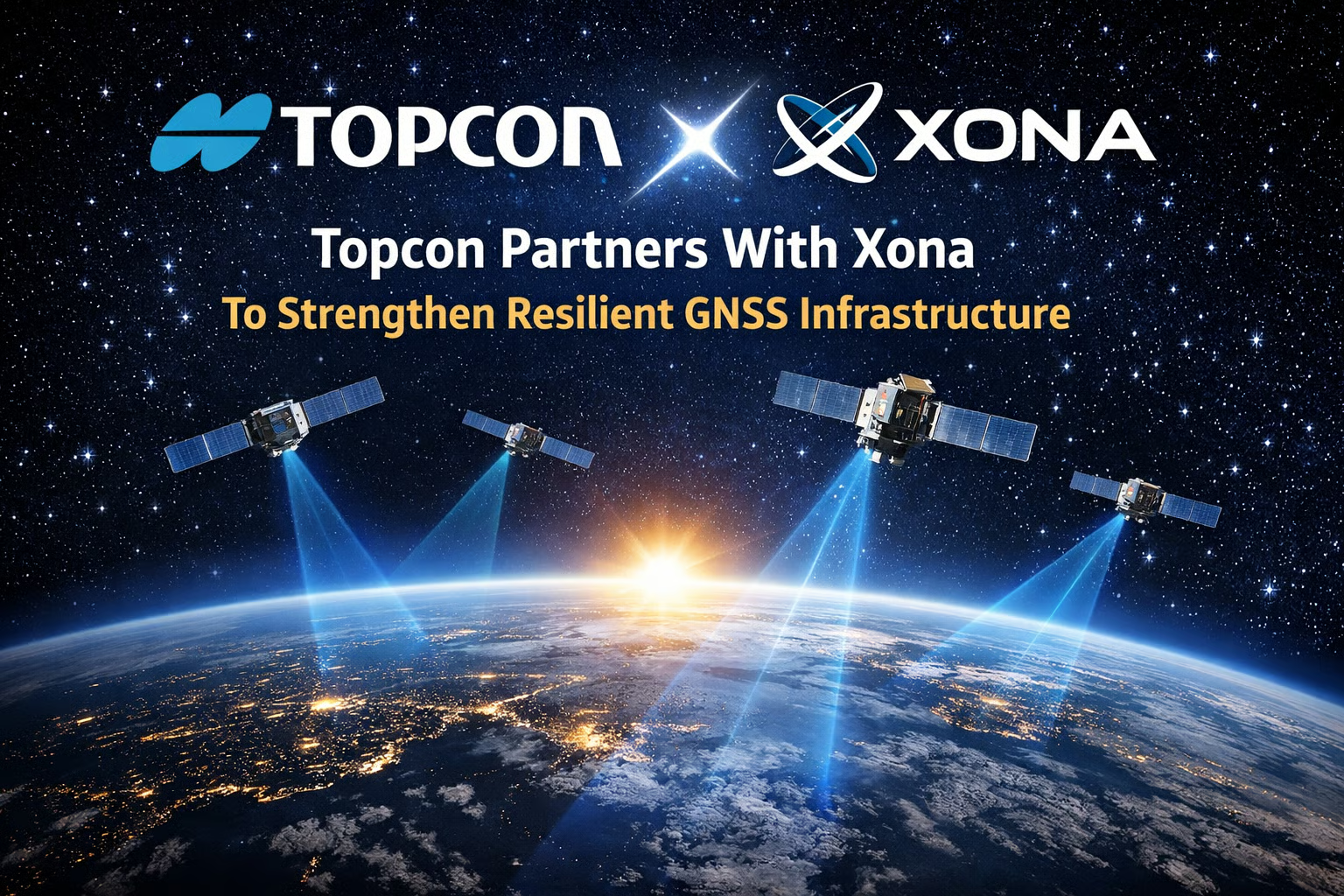 Image-R.E.News©
La course à la précision ne se joue plus seulement au centimètre près — elle se joue désormais en orbite.
En signant un accord commercial avec Xona pour un accès anticipé à Pulsar, sa constellation de satellites en orbite basse (LEO), Topcon Positioning Systems ne conclut pas simplement un partenariat technologique. L’entreprise anticipe un basculement profond dans la manière dont la construction, les infrastructures et la géomatique sécuriseront leurs données de positionnement dans les années à venir.
Quand la précision devient stratégique
Routes intelligentes, corridors ferroviaires automatisés, ports digitalisés, mégaprojets urbains : aujourd’hui, la précision centimétrique n’est plus un avantage compétitif, c’est une nécessité opérationnelle.
Les systèmes GNSS traditionnels — GPS, Galileo, GLONASS — opèrent à près de 20 000 kilomètres au-dessus de la Terre. Révolutionnaires, ils restent pourtant vulnérables : signaux affaiblis, interférences urbaines, effets de masquage, risques de brouillage ou de spoofing.
Les constellations LEO changent la donne. Évoluant entre 500 et 2 000 kilomètres d’altitude, elles émettent des signaux plus puissants, à plus faible latence et plus robustes face aux perturbations. Pour des chantiers installés dans des environnements complexes — centres urbains denses, reliefs montagneux, zones industrielles — cette différence n’est pas théorique : elle conditionne la productivité et la sécurité.
Vers un positionnement multi-orbite
Pulsar n’a pas vocation à remplacer les GNSS existants, mais à les compléter. L’enjeu est clair : passer d’une dépendance à une architecture unique à un modèle multi-orbite, multi-fréquence, plus résilient.
Dans un monde où les machines deviennent autonomes, où les jumeaux numériques pilotent les décisions et où les flux logistiques sont synchronisés en temps réel, la moindre interruption de signal peut ralentir, voire paralyser, l’activité.
En intégrant dès aujourd’hui une couche LEO à ses solutions, Topcon prépare le terrain pour une infrastructure de positionnement capable d’absorber les perturbations sans compromettre la continuité opérationnelle.
Un signal fort pour la construction et l’agriculture
Historiquement ancrée dans les technologies de précision pour la construction, la géomatique et l’agriculture, Topcon se positionne ainsi à l’avant-garde d’une transformation silencieuse mais décisive.
Pour les chantiers automatisés, l’earthmoving autonome, le pavage assisté ou la cartographie par drone, la fiabilité du PNT (Positioning, Navigation, Timing) devient une infrastructure critique.
En agriculture également, où le guidage automatisé et les applications à taux variable dépendent d’une précision constante, une couche LEO pourrait renforcer la performance dans les zones boisées ou accidentées.
Construire sur des signaux plus solides
Ce partenariat dépasse la simple innovation produit. Il reflète une évolution systémique : le positionnement de haute précision devient un pilier stratégique des économies modernes.
À mesure que les constellations LEO se déploieront, le secteur des infrastructures pourrait adopter le multi-orbite comme nouveau standard. Non pas pour gagner quelques millimètres supplémentaires, mais pour sécuriser des opérations de plus en plus automatisées et moins tolérantes aux interruptions.
Dans cette perspective, l’accord entre Topcon et Xona n’est pas seulement une annonce.
C’est l’affirmation qu’à l’ère des infrastructures intelligentes, la solidité d’un projet commence désormais bien au-delà du béton — elle commence dans l’espace.
NJC.© Info Topcon Positioning Systems Xona
-------------------------------------------------------------------------------------------------------------
18/02/26-English
Topcon Positioning Systems and Xona: Toward a New Era of Resilient Positioning
Image-R.E.News©
The race for accuracy is no longer just about centimeter-level precision—it's now about orbit.
By signing a commercial agreement with Xona for early access to Pulsar, its constellation of low Earth orbit (LEO) satellites, Topcon Positioning Systems is not simply entering into a technological partnership. The company anticipates a profound shift in how construction, infrastructure, and geomatics will secure their positioning data in the coming years.
When Accuracy Becomes Strategic
Smart roads, automated rail corridors, digitized ports, mega-urban projects: today, centimeter-level accuracy is no longer a competitive advantage, it's an operational necessity.
Traditional GNSS systems—GPS, Galileo, GLONASS—operate at nearly 20,000 kilometers above the Earth. Revolutionary as they are, they remain vulnerable: weakened signals, urban interference, masking effects, and risks of jamming or spoofing.
LEO constellations are a game changer. Operating between 500 and 2,000 kilometers in altitude, they emit stronger signals with lower latency and greater robustness against interference. For construction sites located in complex environments—dense urban centers, mountainous terrain, industrial zones—this difference is not theoretical: it determines productivity and safety.
Toward multi-orbit positioning
Pulsar is not intended to replace existing GNSS systems, but to complement them. The goal is clear: to move from dependence on a single architecture to a more resilient, multi-orbit, multi-frequency model.
In a world where machines are becoming autonomous, where digital twins drive decisions, and where logistics flows are synchronized in real time, the slightest signal interruption can slow down, or even paralyze, operations.
By integrating a LEO layer into its solutions today, Topcon is paving the way for a positioning infrastructure capable of absorbing disruptions without compromising operational continuity.
A strong signal for construction and agriculture
Historically rooted in precision technologies for construction, geomatics, and agriculture, Topcon is positioning itself at the forefront of a silent but decisive transformation.
For automated construction sites, autonomous earthmoving, assisted paving, or drone mapping, the reliability of PNT (Positioning, Navigation, Timing) is becoming a critical infrastructure.
In agriculture as well, where automated guidance and variable-rate applications depend on consistent accuracy, an LEO layer could enhance performance in wooded or rugged areas.
Building on Stronger Signals
This partnership goes beyond mere product innovation. It reflects a systemic shift: high-precision positioning is becoming a strategic pillar of modern economies.
As LEO constellations are deployed, the infrastructure sector could adopt multi-orbit as the new standard. Not to gain a few extra millimeters, but to secure increasingly automated operations that are less tolerant of disruptions.
From this perspective, the agreement between Topcon and Xona is not just an announcement.
It is an affirmation that in the age of smart infrastructure, the robustness of a project now begins far beyond concrete—it begins in space.
NJC.© Info Topcon Positioning Systems Xona
--------------------------------------------------------------------------------------------------------------------
18/02/26-NL
Topcon Positioning Systems en Xona: Op weg naar een nieuw tijdperk van betrouwbare positionering
Image-R.E.News©
De race naar nauwkeurigheid draait niet langer alleen om precisie op centimeterniveau, maar nu om de baan om de aarde.
Door een commerciële overeenkomst met Xona te sluiten voor vroege toegang tot Pulsar, de constellatie van satellieten in een lage baan om de aarde (LEO), gaat Topcon Positioning Systems niet zomaar een technologisch partnerschap aan. Het bedrijf verwacht een ingrijpende verandering in de manier waarop de bouw, infrastructuur en geomatica de komende jaren hun positioneringsgegevens zullen beveiligen.
Wanneer nauwkeurigheid strategisch wordt
Slimme wegen, geautomatiseerde spoorlijnen, gedigitaliseerde havens, megastedelijke projecten: nauwkeurigheid op centimeterniveau is tegenwoordig geen concurrentievoordeel meer, maar een operationele noodzaak.
Traditionele GNSS-systemen – GPS, Galileo, GLONASS – werken op bijna 20.000 kilometer boven de aarde. Hoe revolutionair ze ook zijn, ze blijven kwetsbaar: verzwakte signalen, stedelijke interferentie, maskeringseffecten en risico's op jamming of spoofing.
LEO-constellaties zijn een gamechanger. Ze opereren op een hoogte tussen 500 en 2000 kilometer en zenden sterkere signalen uit met een lagere latentie en een grotere robuustheid tegen storingen. Voor bouwplaatsen in complexe omgevingen – dichtbevolkte stedelijke gebieden, bergachtig terrein, industriële zones – is dit verschil niet theoretisch: het bepaalt de productiviteit en veiligheid.
Naar positionering met meerdere banen
Pulsar is niet bedoeld om bestaande GNSS-systemen te vervangen, maar om ze aan te vullen. Het doel is duidelijk: overstappen van afhankelijkheid van één enkele architectuur naar een veerkrachtiger model met meerdere banen en meerdere frequenties.
In een wereld waarin machines autonoom worden, digitale tweelingen beslissingen sturen en logistieke stromen in realtime worden gesynchroniseerd, kan de kleinste signaalonderbreking de werkzaamheden vertragen of zelfs lamleggen.
Door vandaag al een LEO-laag in haar oplossingen te integreren, effent Topcon de weg voor een positioneringsinfrastructuur die verstoringen kan opvangen zonder de operationele continuïteit in gevaar te brengen.
Een sterk signaal voor de bouw en landbouw
Topcon, van oudsher geworteld in precisietechnologieën voor de bouw, geomatica en landbouw, positioneert zich in de voorhoede van een stille maar beslissende transformatie.
Voor geautomatiseerde bouwplaatsen, autonoom grondverzet, ondersteunde bestrating of dronekartering wordt de betrouwbaarheid van PNT (Positionering, Navigatie, Timing) een cruciale infrastructuur.
Ook in de landbouw, waar geautomatiseerde geleiding en variabele doseringstoepassingen afhankelijk zijn van consistente nauwkeurigheid, kan een LEO-laag de prestaties in bosrijke of ruige gebieden verbeteren.
Voortbouwend op sterkere signalen
Deze samenwerking gaat verder dan louter productinnovatie. Het weerspiegelt een systemische verschuiving: uiterst nauwkeurige positionering wordt een strategische pijler van moderne economieën.
Naarmate LEO-constellaties worden ingezet, zou de infrastructuursector multi-orbit als de nieuwe standaard kunnen omarmen. Niet om een paar extra millimeters te winnen, maar om steeds meer geautomatiseerde processen te garanderen die minder tolerant zijn voor verstoringen.
Vanuit dit perspectief is de overeenkomst tussen Topcon en Xona meer dan alleen een aankondiging.
Het bevestigt dat in het tijdperk van slimme infrastructuur de robuustheid van een project veel verder reikt dan het beton – het begint in de ruimte.
NJC.© Info Topcon Positioning Systems Xona
--------------------------------------------------------------------------------------------------------------
Date de dernière mise à jour : 17/02/2026