



R.E.News future Technology-Toyota Material Handling Europe and SoftServe to reduce autonomous solution commissioning time by 50% using NVIDIA Physical AI
 26/10/26-FR-English-NL-footer
TOYOTA MATERIAL HANDLING, NVIDIA ET SOFTSERVE : L’INTELLIGENCE ARTIFICIELLE DIVISE PAR DEUX LE TEMPS DE MISE EN SERVICE DES CHARIOTS AUTONOMES
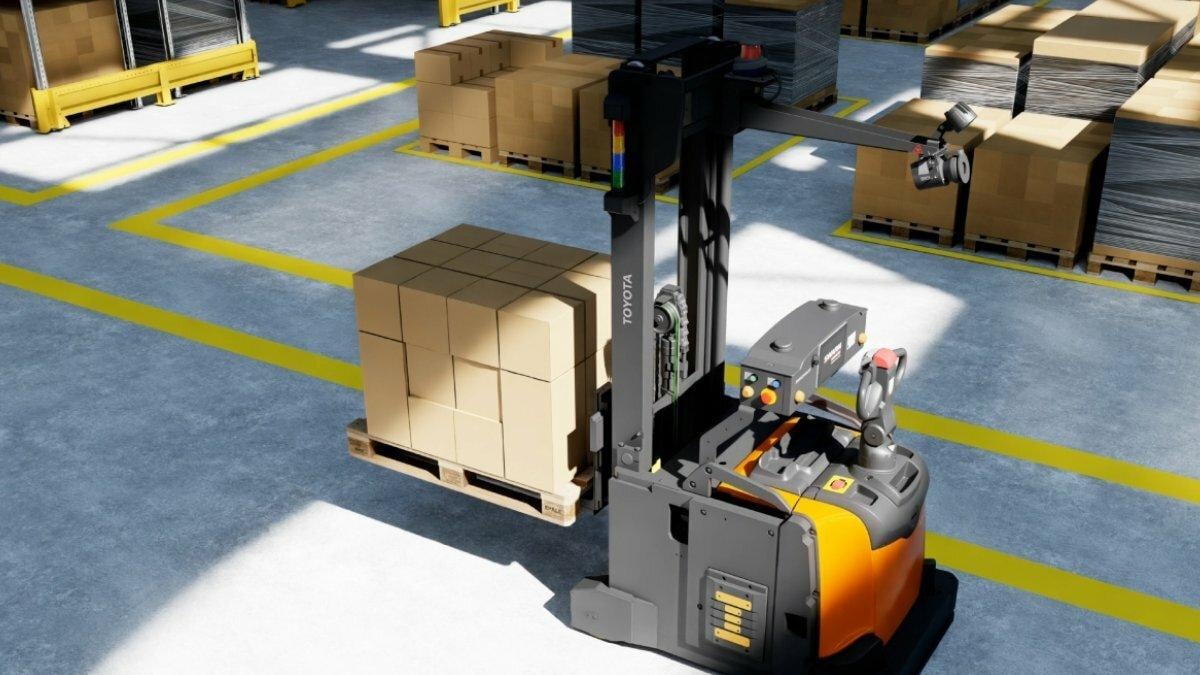
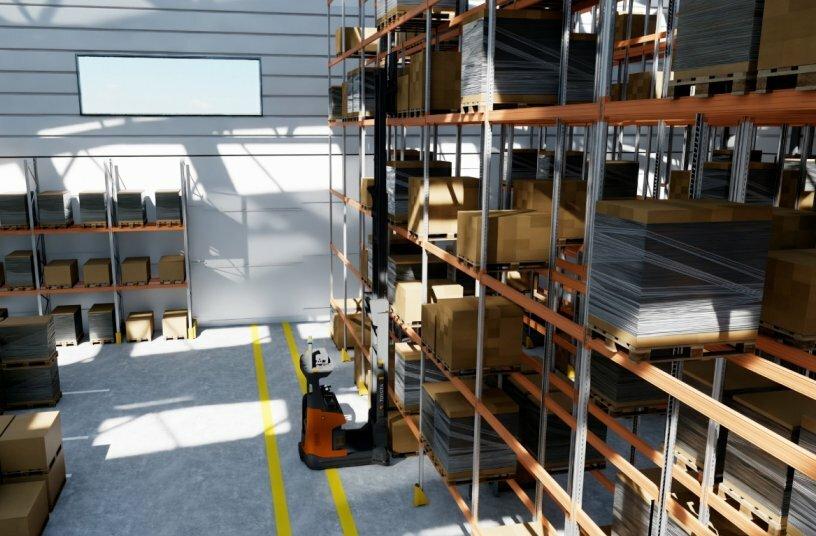 Toyota Material Handling Europe and SoftServe uses NVIDIA Physical AI IMAGE SOURCE: Toyota Material Handling Europe-
Et si les chariots élévateurs autonomes pouvaient apprendre à évoluer dans un entrepôt avant même d’y mettre les roues ? Toyota Material Handling Europe, NVIDIA et SoftServe franchissent une nouvelle étape dans l’automatisation industrielle grâce à l’IA physique et aux jumeaux numériques. À la clé : jusqu’à 50 % de réduction des efforts de mise en service et une détection des palettes nettement améliorée.
Dans les entrepôts et les usines, déployer un chariot autonome ne consiste pas simplement à programmer un itinéraire. Il faut anticiper les obstacles, sécuriser les déplacements et adapter le comportement du véhicule à chaque environnement, où se croisent opérateurs, chariots manuels et flux logistiques.
Pour relever ce défi, les trois partenaires inversent la logique traditionnelle : tester et valider dans un monde virtuel avant de passer au réel.
Un entrepôt numérique pour anticiper chaque difficulté
En combinant les bibliothèques NVIDIA Omniverse, la plateforme de simulation robotique NVIDIA Isaac Sim et l’expertise en ingénierie numérique de SoftServe, Toyota Material Handling Europe développe des jumeaux numériques capables de reproduire les conditions opérationnelles des clients.
Dans cet environnement virtuel, les ingénieurs peuvent tester la navigation, les fonctions de sécurité et le comportement des chariots face à des situations complexes. Les problèmes sont identifiés et corrigés avant l’installation sur site, réduisant les interventions sur le terrain, les interruptions d’activité et les ressources mobilisées.
Cette approche s’inscrit dans la philosophie Lean de Toyota et son objectif de « zéro muda », autrement dit l’élimination des gaspillages de temps, de ressources et d’efforts.
Une vision artificielle plus performante
L’intelligence artificielle ne se limite pas à simuler les déplacements. Elle contribue également à améliorer la perception de l’environnement.
Pour entraîner le système de détection des palettes, les partenaires ont généré des données synthétiques avec les technologies Omniverse, complétées par les modèles d’IA NVIDIA Cosmos. Résultat annoncé : plus de 70 % d’amélioration du taux de rappel de détection des objets sur les jeux de données d’entrepôts réels évalués.
Cette progression renforce le potentiel des chariots autonomes à reconnaître leur environnement et à évoluer dans des espaces logistiques où la sécurité et la précision sont essentielles.
Jusqu’à 50 % d’efforts en moins, 40 % de délai de commercialisation économisé
Les objectifs sont ambitieux : réduire jusqu’à 50 % les efforts de mise en service et jusqu’à 40 % le délai de commercialisation des solutions concernées.
Au-delà des gains de temps, cette stratégie vise à améliorer la qualité des déploiements, la flexibilité des installations et la productivité des équipes d’ingénierie, tout en limitant les coûts opérationnels.
Pour Toyota Material Handling Europe, NVIDIA et SoftServe, la simulation devient ainsi un outil stratégique : elle permet de préparer les systèmes autonomes aux contraintes du terrain avant leur arrivée chez le client.
L’usine du futur se construit aussi dans le monde virtuel
Cette collaboration illustre une évolution majeure de la manutention automatisée : les jumeaux numériques et l’IA physique rapprochent simulation, robotique et opérations industrielles.
En apprenant d’abord dans le virtuel, les chariots autonomes peuvent être déployés plus rapidement, avec des solutions mieux validées et moins de perturbations sur les sites clients. Une nouvelle étape vers une logistique intelligente où chaque mouvement doit conjuguer sécurité, précision et efficacité.
NJC.© Info Toyota Material Handling Europe
---------------------------------------------------------------------------------------------------------
26/10/26-English
TOYOTA MATERIAL HANDLING, NVIDIA, AND SOFTSERVE: ARTIFICIAL INTELLIGENCE HALF THE COMMISSIONING TIME OF AUTONOMOUS FORKLIFT TRUCKS
Toyota Material Handling Europe and SoftServe uses NVIDIA Physical AI IMAGE SOURCE: Toyota Material Handling Europe-
What if autonomous forklifts could learn to navigate a warehouse before they even set foot inside? Toyota Material Handling Europe, NVIDIA, and SoftServe are taking industrial automation to the next level with physical AI and digital twins. The result: up to 50% reduction in commissioning effort and significantly improved pallet detection.
In warehouses and factories, deploying an autonomous forklift is not simply a matter of programming a route. It requires anticipating obstacles, ensuring safe movement, and adapting the vehicle's behavior to each environment, where operators, manual forklifts, and logistics flows intersect.
To meet this challenge, the three partners are reversing the traditional approach: testing and validating in a virtual world before moving to the real world.
A Digital Warehouse to Anticipate Every Challenge
By combining NVIDIA Omniverse libraries, the NVIDIA Isaac Sim robotics simulation platform, and SoftServe's digital engineering expertise, Toyota Material Handling Europe is developing digital twins capable of replicating customers' operational conditions.
In this virtual environment, engineers can test navigation, safety features, and forklift behavior in complex situations. Problems are identified and corrected before on-site installation, reducing field interventions, business interruptions, and resource usage.
This approach aligns with Toyota's Lean philosophy and its goal of "zero muda," meaning the elimination of wasted time, resources, and effort.
Enhanced Artificial Vision
Artificial intelligence is not limited to simulating movement. It also helps improve environmental perception.
To train the pallet detection system, the partners generated synthetic data using Omniverse technologies, complemented by NVIDIA Cosmos AI models. The announced result: over 70% improvement in object detection recall rate on the evaluated real-world warehouse datasets.
This improvement strengthens the potential of autonomous forklifts to recognize their environment and operate in logistics spaces where safety and precision are critical.
Up to 50% less effort, 40% time to market saved
The objectives are ambitious: to reduce commissioning effort by up to 50% and time to market for the solutions involved by up to 40%.
Beyond time savings, this strategy aims to improve deployment quality, installation flexibility, and engineering team productivity, while limiting operational costs.
For Toyota Material Handling Europe, NVIDIA, and SoftServe, simulation is becoming a strategic tool: it allows them to prepare autonomous systems for real-world conditions before they arrive at the customer's site.
The factory of the future is also being built in the virtual world.
This collaboration illustrates a major evolution in automated material handling: digital twins and physical AI are bringing simulation, robotics, and industrial operations closer together.
By learning first in the virtual world, autonomous trucks can be deployed more quickly, with better-validated solutions and less disruption at customer sites. This is a new step toward intelligent logistics where every movement must combine safety, precision, and efficiency.
NJC.© Info Toyota Material Handling Europe
---------------------------------------------------------------------------------------------------------------
26/10/26-NL
TOYOTA MATERIAL HANDLING, NVIDIA EN SOFTSERVE: KUNSTMATIGE INTELLIGENTIE HALF DE INBEDRIJFSTELLINGSTIJD VAN AUTONOME VORKHEFTRUCKS
Toyota Material Handling Europe and SoftServe uses NVIDIA Physical AI IMAGE SOURCE: Toyota Material Handling Europe-
Wat als autonome vorkheftrucks een magazijn zouden kunnen leren navigeren nog voordat ze er voet aan wal zetten? Toyota Material Handling Europe, NVIDIA en SoftServe tillen industriële automatisering naar een hoger niveau met fysieke AI en digitale tweelingen. Het resultaat: tot 50% minder inbedrijfstellingstijd en aanzienlijk verbeterde palletdetectie.
In magazijnen en fabrieken is het inzetten van een autonome vorkheftruck niet zomaar een kwestie van een route programmeren. Het vereist het anticiperen op obstakels, het garanderen van veilige beweging en het aanpassen van het gedrag van het voertuig aan elke omgeving, waar operators, handmatige vorkheftrucks en logistieke stromen elkaar kruisen.
Om deze uitdaging aan te gaan, keren de drie partners de traditionele aanpak om: testen en valideren in een virtuele wereld voordat ze naar de echte wereld gaan.
Een digitaal magazijn dat op elke uitdaging voorbereid is
Door de NVIDIA Omniverse-bibliotheken, het NVIDIA Isaac Sim-robotsimulatieplatform en de digitale engineeringexpertise van SoftServe te combineren, ontwikkelt Toyota Material Handling Europe digitale tweelingen die de operationele omstandigheden van klanten kunnen nabootsen.
In deze virtuele omgeving kunnen engineers de navigatie, veiligheidsfuncties en het gedrag van heftrucks in complexe situaties testen. Problemen worden geïdentificeerd en gecorrigeerd vóór de installatie op locatie, waardoor interventies ter plaatse, bedrijfsonderbrekingen en resourcegebruik worden verminderd.
Deze aanpak sluit aan bij Toyota's Lean-filosofie en het doel van "zero muda", oftewel het elimineren van verspilde tijd, middelen en inspanning.
Verbeterde kunstmatige intelligentie
Kunstmatige intelligentie is niet beperkt tot het simuleren van beweging. Het helpt ook bij het verbeteren van de omgevingsperceptie.
Om het palletdetectiesysteem te trainen, genereerden de partners synthetische data met behulp van Omniverse-technologieën, aangevuld met NVIDIA Cosmos AI-modellen. Het aangekondigde resultaat: een verbetering van meer dan 70% in de nauwkeurigheid van objectdetectie op de geëvalueerde datasets uit een echt magazijn.
Deze verbetering versterkt het potentieel van autonome heftrucks om hun omgeving te herkennen en te opereren in logistieke omgevingen waar veiligheid en precisie cruciaal zijn.
Tot 50% minder inspanning, 40% tijdsbesparing
De doelstellingen zijn ambitieus: de inbedrijfstellingsinspanning met maximaal 50% verminderen en de tijdsbesparing voor de betrokken oplossingen met maximaal 40%.
Naast tijdsbesparing is deze strategie gericht op het verbeteren van de implementatiekwaliteit, de installatieflexibiliteit en de productiviteit van het engineeringteam, terwijl de operationele kosten worden beperkt.
Voor Toyota Material Handling Europe, NVIDIA en SoftServe wordt simulatie een strategisch instrument: het stelt hen in staat autonome systemen voor te bereiden op de praktijk voordat ze bij de klant aankomen.
De fabriek van de toekomst wordt ook in de virtuele wereld gebouwd.
Deze samenwerking illustreert een belangrijke evolutie in geautomatiseerde materiaalverwerking: digitale tweelingen en fysieke AI brengen simulatie, robotica en industriële processen dichter bij elkaar.
Door eerst in de virtuele wereld te leren, kunnen autonome trucks sneller worden ingezet, met beter gevalideerde oplossingen en minder verstoring op klantlocaties. Dit is een nieuwe stap richting intelligente logistiek, waarbij elke beweging veiligheid, precisie en efficiëntie moet combineren.
NJC.© Info Toyota Material Handling Europe
----------------------------------------------------------------------------------------------------------
Date de dernière mise à jour : 23/10/2026