



R.E.News future Technology-Turning Captured Carbon Into Graphite Could Reset the Anode Supply Chain
 19/08/26-FR-English-NL-footer
Du CO₂ au graphite — Le carbone qui pourrait rebattre les cartes des batteries
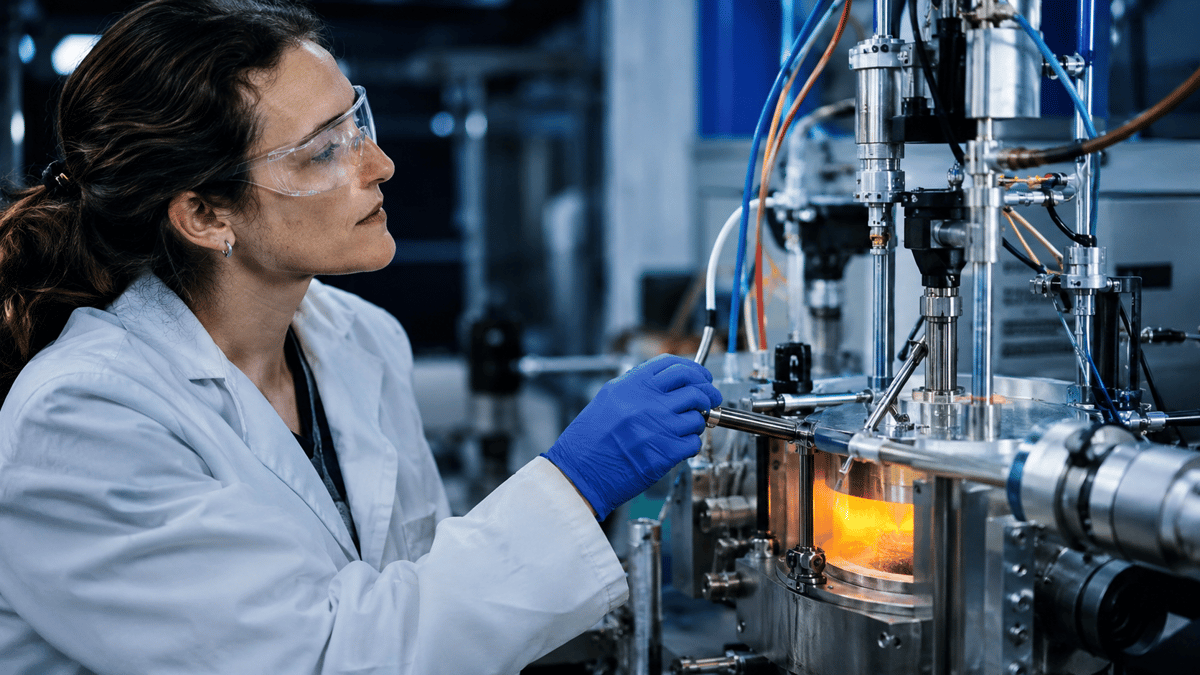 Image- creation R.E.News© via IA chat GPT
Et si le prochain grand bouleversement de la batterie ne venait pas d’une mine, mais… de l’air ?
Dans les laboratoires californiens de Lawrence Berkeley National Laboratory et de l’UC Berkeley, des chercheurs ont démontré une voie étonnante : transformer du dioxyde de carbone capté dans l’air ou les rejets industriels en carbone solide, avec à terme la possibilité de produire du graphite destiné aux batteries lithium-ion.
La découverte prend une dimension stratégique lorsqu’on sait que le graphite constitue l’anode de presque toutes les batteries lithium-ion. Il alimente aussi bien nos smartphones que les batteries des excavatrices, chargeuses et autres machines électriques qui transforment progressivement les chantiers.
Le verrou du graphite
Le problème n’est pas la présence du graphite dans le sous-sol. C’est sa transformation en matériau utilisable par les fabricants de batteries.
La production et surtout le raffinage sont aujourd’hui extrêmement concentrés en Chine, qui domine très largement la chaîne mondiale. Cette dépendance est devenue un enjeu industriel majeur à mesure que Pékin renforce ses contrôles à l’exportation.
La recherche de Berkeley propose alors un changement de perspective spectaculaire : ne plus dépendre uniquement de la géologie pour obtenir du graphite, mais fabriquer le matériau à partir d’un déchet industriel.
Une réaction observée au cœur du sel fondu
À environ 500 °C, les chercheurs ont observé directement, grâce à une instrumentation spécialement développée, la transformation du CO₂ dans un bain de sels fondus.
Et la surprise fut scientifique autant qu’industrielle : la réaction ne se déroule pas en une seule étape. Le CO₂ passe par un intermédiaire avant de devenir du carbone solide. Cette observation permet enfin de comprendre et surtout de mieux contrôler une réaction étudiée depuis des décennies.
C’est là que commence le véritable potentiel industriel. En jouant sur les électrodes et la chimie des sels, les chercheurs espèrent pouvoir orienter la structure du carbone produit et, à terme, atteindre les exigences extrêmement strictes du graphite pour batteries.
Transformer un problème en ressource
Le graphite synthétique actuel nécessite des procédés extrêmement énergivores, avec des températures pouvant approcher 3 000 °C lors de la graphitisation. La nouvelle approche imagine une autre équation : utiliser comme matière première un CO₂ que l’industrie cherche déjà à capturer.
Le déchet devient donc matière première.
Et si le procédé peut être industrialisé avec une consommation énergétique maîtrisée et une électricité bas carbone, il pourrait offrir simultanément une nouvelle source de graphite, une réduction de la dépendance aux chaînes d’approvisionnement concentrées et une valorisation du carbone capturé.
Une révolution encore à l’état de promesse
Il reste cependant un long chemin entre l’éprouvette et l’usine. Produire quelques échantillons n’est pas produire des milliers de tonnes de graphite de qualité batterie. Il faudra réduire les coûts, optimiser les sels et les électrodes, augmenter considérablement les volumes et surtout démontrer que le matériau obtenu répond aux normes des fabricants de cellules.
Mais le signal est puissant.
Pour l’industrie automobile comme pour les engins de construction électriques, le graphite est une matière invisible mais essentielle. Si demain il pouvait être fabriqué localement à partir de CO₂ capturé, la carte mondiale de son approvisionnement pourrait commencer à changer.
Hier, le graphite se cherchait sous terre. Demain, il pourrait se fabriquer à partir de ce que nous rejetons dans l’atmosphère.
Et dans cette nouvelle bataille industrielle, le véritable gisement pourrait bien être le carbone lui-même.
NJC.© Info https://www.lbl.gov/ https://www.nature.com/articles/s41467-026-70977-0
-------------------------------------------------------------------------------------------------------------
19/08/26-English
From CO₂ to Graphite — Carbon That Could Change the Game for Batteries
Image- creation R.E.News© via IA chat GPT
What if the next major revolution in batteries didn't come from a mine, but… from the air?
In California's Lawrence Berkeley National Laboratory and UC Berkeley, researchers have demonstrated a surprising method: transforming carbon dioxide captured from the air or industrial emissions into solid carbon, with the potential to eventually produce graphite for lithium-ion batteries.
This discovery takes on strategic importance given that graphite is the anode of almost all lithium-ion batteries. It powers everything from our smartphones to the batteries of excavators, loaders, and other electric machines that are gradually transforming construction sites.
The Graphite Challenge
The problem isn't the presence of graphite underground. It's transforming it into a usable material for battery manufacturers.
Production and, above all, refining are currently highly concentrated in China, which largely dominates the global supply chain. This dependence has become a major industrial challenge as Beijing tightens its export controls.
The Berkeley research proposes a dramatic shift in perspective: no longer relying solely on geology to obtain graphite, but manufacturing the material from an industrial waste product.
A reaction observed at the heart of molten salt
At approximately 500°C, researchers directly observed, using specially developed instrumentation, the transformation of CO₂ in a bath of molten salts.
The surprise was as much scientific as it was industrial: the reaction does not occur in a single step. The CO₂ passes through an intermediate stage before becoming solid carbon. This observation finally allows us to understand, and above all, to better control, a reaction that has been studied for decades.
This is where the real industrial potential begins. By manipulating the electrodes and the chemistry of the salts, the researchers hope to be able to influence the structure of the carbon produced and, ultimately, meet the extremely stringent requirements for graphite used in batteries.
Turning a Problem into a Resource
Current synthetic graphite requires extremely energy-intensive processes, with temperatures reaching nearly 3,000°C during graphitization. The new approach envisions a different equation: using CO₂, which industry is already trying to capture, as a raw material.
Waste thus becomes raw material.
And if the process can be industrialized with controlled energy consumption and low-carbon electricity, it could simultaneously offer a new source of graphite, reduce dependence on concentrated supply chains, and valorize the captured carbon.
A Revolution Still in the Promises
However, there is still a long way to go from the test tube to the factory. Producing a few samples is not the same as producing thousands of tons of battery-grade graphite. Costs will need to be reduced, salts and electrodes optimized, volumes significantly increased, and, above all, it will be necessary to demonstrate that the resulting material meets the standards of cell manufacturers.
But the signal is powerful.
For the automotive industry, as well as for electric construction equipment, graphite is an invisible but essential material. If tomorrow it could be produced locally from captured CO₂, the global map of its supply could begin to change.
Yesterday, graphite was sought underground. Tomorrow, it could be produced from what we release into the atmosphere.
And in this new industrial battle, the real resource might well be carbon itself.
NJC.© Info https://www.lbl.gov/ https://www.nature.com/articles/s41467-026-70977-0
---------------------------------------------------------------------------------------------------------------
19/08/26-NL
Van CO₂ naar grafiet — Koolstof die de batterij-industrie op zijn kop kan zetten
Image- creation R.E.News© via IA chat GPT
Wat als de volgende grote revolutie in batterijen niet uit een mijn komt, maar… uit de lucht?
In het Lawrence Berkeley National Laboratory in Californië en aan de Universiteit van Californië in Berkeley hebben onderzoekers een verrassende methode ontwikkeld: het omzetten van koolstofdioxide, afgevangen uit de lucht of industriële emissies, in vaste koolstof, met de potentie om uiteindelijk grafiet te produceren voor lithium-ionbatterijen.
Deze ontdekking is van strategisch belang, aangezien grafiet de anode is van bijna alle lithium-ionbatterijen. Het drijft alles aan, van onze smartphones tot de batterijen van graafmachines, laders en andere elektrische machines die bouwplaatsen geleidelijk aan transformeren.
De grafietuitdaging
Het probleem is niet de aanwezigheid van grafiet onder de grond. Het probleem is de transformatie ervan tot een bruikbaar materiaal voor batterijfabrikanten.
De productie en vooral de raffinage zijn momenteel sterk geconcentreerd in China, dat de wereldwijde toeleveringsketen grotendeels domineert. Deze afhankelijkheid is een grote industriële uitdaging geworden nu Peking de exportbeperkingen aanscherpt.
Het onderzoek van Berkeley stelt een drastische verandering in perspectief voor: niet langer uitsluitend afhankelijk zijn van geologie voor de winning van grafiet, maar het materiaal produceren uit een industrieel afvalproduct.
Een reactie waargenomen in het hart van gesmolten zout
Bij ongeveer 500 °C observeerden onderzoekers, met behulp van speciaal ontwikkelde instrumenten, de transformatie van CO₂ in een bad van gesmolten zouten.
De verrassing was zowel wetenschappelijk als industrieel: de reactie verloopt niet in één stap. De CO₂ doorloopt een tussenstadium voordat het vaste koolstof wordt. Deze waarneming stelt ons eindelijk in staat om een reactie die al decennialang wordt bestudeerd te begrijpen en vooral beter te beheersen.
Hier begint het echte industriële potentieel. Door de elektroden en de chemie van de zouten te manipuleren, hopen de onderzoekers de structuur van de geproduceerde koolstof te kunnen beïnvloeden en uiteindelijk te voldoen aan de extreem strenge eisen voor grafiet dat in batterijen wordt gebruikt.
Van een probleem een grondstof maken
De huidige synthetische grafietproductie vereist extreem energie-intensieve processen, waarbij de temperaturen tijdens de grafitisatie oplopen tot bijna 3000 °C. De nieuwe aanpak ziet een andere formule voor zich: het gebruik van CO₂, dat de industrie al probeert af te vangen, als grondstof.
Afval wordt zo grondstof.
En als het proces kan worden geïndustrialiseerd met gecontroleerd energieverbruik en koolstofarme elektriciteit, zou het tegelijkertijd een nieuwe bron van grafiet kunnen bieden, de afhankelijkheid van geconcentreerde toeleveringsketens kunnen verminderen en de afgevangen koolstof kunnen valoriseren.
Een revolutie die nog in de kinderschoenen staat
Er is echter nog een lange weg te gaan van het reageerbuisje naar de fabriek. Het produceren van een paar monsters is niet hetzelfde als het produceren van duizenden tonnen grafiet van batterijkwaliteit. De kosten moeten worden verlaagd, de zouten en elektroden geoptimaliseerd, de volumes aanzienlijk verhoogd en, bovenal, moet worden aangetoond dat het resulterende materiaal voldoet aan de eisen van batterijfabrikanten.
Maar het signaal is krachtig.
Voor de auto-industrie, maar ook voor elektrische bouwmachines, is grafiet een onzichtbaar maar essentieel materiaal. Als het morgen lokaal geproduceerd zou kunnen worden uit afgevangen CO₂, zou de wereldwijde kaart van de grafietvoorziening wel eens kunnen veranderen.
Gisteren werd grafiet ondergronds gezocht. Morgen zou het geproduceerd kunnen worden uit wat we in de atmosfeer uitstoten.
En in deze nieuwe industriële strijd zou de echte grondstof wel eens koolstof zelf kunnen zijn.
NJC.© Info https://www.lbl.gov/ https://www.nature.com/articles/s41467-026-70977-0
-----------------------------------------------------------------------------------------------------------------
Date de dernière mise à jour : 18/08/2026