



R.E.News future Technology- Verified Failure Data is Becoming the New Currency of Recycled Plastics
 12/08/26-FR-English-NL-footer
PLASTIQUES RECYCLÉS — LA PREUVE VAUT DE L’OR
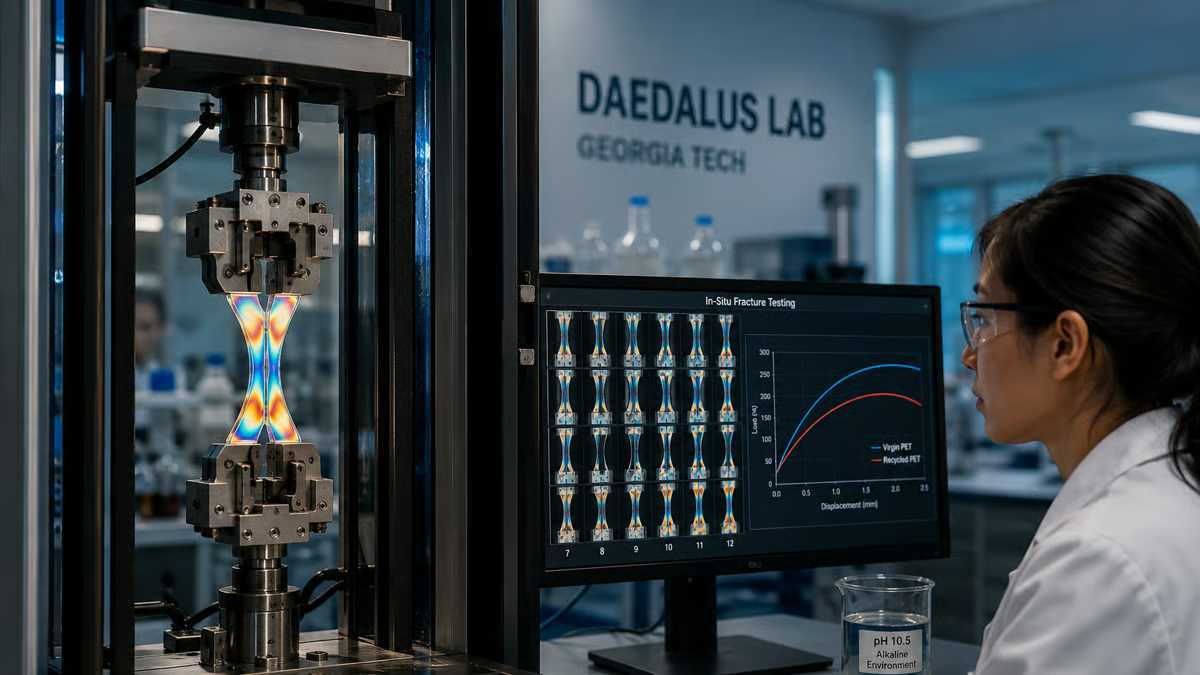 Image- creation R.E.News© via IA chat GPT
Dans l’économie circulaire, le véritable luxe ne sera bientôt plus le recyclé. Ce sera la preuve qu’il dure.
Le marché des géosynthétiques, estimé à près de 18 milliards de dollars en 2026, entre dans une nouvelle ère. D’un côté, la réglementation européenne accélère l’intégration de matières recyclées. De l’autre, une question demeure : combien de temps ces matériaux résisteront-ils réellement sur le terrain ?
À Atlanta, les chercheurs du Daedalus Lab de Georgia Tech viennent d’apporter une réponse particulièrement intéressante.
Publiée dans Science Advances, leur nouvelle plateforme de fracture permet de tester plusieurs éprouvettes simultanément, dans des environnements chimiques réalistes, tout en visualisant les contraintes et l’apparition des fissures grâce à la photoélasticité.
Résultat : plus de 60 % de temps de test économisé.
Mais la véritable révolution est ailleurs.
DU LABEL À LA PERFORMANCE
Tester un plastique recyclé dans des conditions de laboratoire idéales ne raconte qu’une partie de son histoire.
Dans une décharge, sous une route ou dans un système de drainage, un géotextile peut être exposé pendant des décennies à l’humidité, aux contraintes mécaniques et à des environnements fortement alcalins.
C’est précisément là que l’étude devient révélatrice.
En comparant du PET recyclé et du PET vierge, les chercheurs ont constaté que le recyclé présentait une résistance moindre au stress environnemental dans des conditions alcalines supérieures à pH 9, typiques de certaines applications de géotextiles et de confinement.
Le message n’est pas que le recyclé serait mauvais.
Il est beaucoup plus subtil :
un matériau recyclé doit être choisi pour l’environnement dans lequel il devra survivre.
Une autre étude publiée dans Geosynthetics International a par ailleurs observé, pour certains géotextiles non tissés en PET recyclé, une durée de service pouvant être jusqu’à 30 % inférieure à celle d’équivalents vierges.
LA FIN DU “RECYCLÉ = DURABLE”
C’est ici que l’économie rejoint l’ingénierie.
Un géotextile qui échoue prématurément ne coûte pas seulement son remplacement. Il peut entraîner excavation, traitement, remise en état, responsabilité environnementale et perte de confiance.
Autrement dit, le bénéfice écologique obtenu au moment de l’achat peut disparaître si la durée de vie n’est pas au rendez-vous.
À l’inverse, disposer rapidement de données fiables permet aux ingénieurs de distinguer les applications où le recyclé est parfaitement pertinent de celles où il représente un risque.
La donnée devient ainsi une nouvelle matière première.
UNE TECHNOLOGIE QUI CHANGE LE CALCUL
La plateforme de Georgia Tech agit précisément sur ce point faible : le coût et la lenteur de la qualification.
Tests parallèles, environnement chimique réaliste, observation des champs de contraintes et analyse de l’initiation des fissures : l’objectif est de transformer la caractérisation des matériaux en un processus plus rapide et plus riche.
La technologie est désormais proposée sous licence par le Georgia Tech Office of Technology Licensing, avec à terme la possibilité d’exploiter les vastes ensembles de données générés pour développer des modèles numériques et des applications d’intelligence artificielle capables de simuler certains essais mécaniques.
Le laboratoire ne cherche donc pas seulement à mieux tester les matériaux.
Il contribue à créer une nouvelle économie de la preuve.
2030 SE RAPPROCHE
La pression ne fera que croître.
À partir de 2030, le règlement européen sur les emballages et déchets d’emballages imposera progressivement des taux minimums de plastique recyclé allant de 10 à 35 %, avec notamment 30 % pour certains emballages PET en contact avec les produits.
La demande en recyclé va donc progresser.
Mais plus le recyclé devient obligatoire, plus une question devient stratégique :
est-il capable de tenir la promesse technique ?
Pour les fabricants, les bureaux d’études et les maîtres d’ouvrage, le futur ne se jouera donc plus uniquement sur le pourcentage de matière recyclée affiché sur une fiche technique.
Il se jouera sur la capacité à démontrer sa durabilité réelle, application par application.
Le recyclé ouvre la porte de l’économie circulaire.
La donnée décidera jusqu’où il pourra aller.
NJC.© Info https://sustainability.gatech.edu/home https://news.research.gatech.edu/2026/07/24/rapid-testing-offers-path-more-sustainable-material-choices
---------------------------------------------------------------------------------------------------------------
12/08/26-English
RECYCLED PLASTICS — PROOF IS WORTH ITS WORTH
Image- creation R.E.News© via IA chat GPT
In the circular economy, the true luxury will soon no longer be recycling itself. It will be proof of its durability.
The geosynthetics market, estimated at nearly $18 billion in 2026, is entering a new era. On the one hand, European regulations are accelerating the integration of recycled materials. On the other, one question remains: how long will these materials actually hold up in the field?
In Atlanta, researchers at Georgia Tech’s Daedalus Lab have just provided a particularly interesting answer.
Published in Science Advances, their new fracture platform allows for the simultaneous testing of multiple specimens in realistic chemical environments, while visualizing stress and the onset of cracks using photoelasticity.
The result: more than 60% of testing time saved.
But the real revolution lies elsewhere.
FROM LABEL TO PERFORMANCE
Testing recycled plastic under ideal laboratory conditions only tells part of its story.
In a landfill, under a road, or in a drainage system, a geotextile can be exposed for decades to moisture, mechanical stress, and highly alkaline environments.
This is precisely where the study becomes revealing.
By comparing recycled PET and virgin PET, researchers found that the recycled material exhibited less resistance to environmental stress in alkaline conditions above pH 9, typical of certain geotextile and containment applications.
The message is not that recycled material is inherently bad.
It is much more nuanced:
a recycled material must be chosen for the environment in which it will have to survive.
Another study published in Geosynthetics International also observed that some nonwoven geotextiles made from recycled PET had a service life that could be up to 30% shorter than that of virgin equivalents.
THE END OF “RECYCLED = SUSTAINABLE”
This is where economics and engineering intersect.
A geotextile that fails prematurely doesn't just cost replacement. It can lead to excavation, treatment, remediation, environmental liability, and a loss of trust.
In other words, the environmental benefit gained at the time of purchase can vanish if the lifespan doesn't live up to expectations.
Conversely, having access to reliable data quickly allows engineers to distinguish between applications where recycled materials are perfectly suited and those where they pose a risk.
Data thus becomes a new raw material.
A TECHNOLOGY THAT CHANGES THE RULE
Georgia Tech's platform addresses precisely this weakness: the cost and slowness of qualification.
Parallel testing, a realistic chemical environment, stress field observation, and crack initiation analysis: the goal is to transform materials characterization into a faster and more comprehensive process.
The technology is now licensed by the Georgia Tech Office of Technology Licensing, with the eventual possibility of leveraging the vast datasets generated to develop digital models and artificial intelligence applications capable of simulating certain mechanical tests.
The laboratory is therefore not just looking to improve materials testing.
It is helping to create a new evidence-based economy.
2030 IS APPROACHING
The pressure will only increase.
From 2030, the European regulation on packaging and packaging waste will progressively impose minimum recycled plastic content levels ranging from 10% to 35%, including 30% for certain PET packaging in contact with products.
The demand for recycled materials will therefore increase.
But the more mandatory recycled materials become, the more strategic a question arises:
Can it deliver on its technical promise?
For manufacturers, engineering firms, and project owners, the future will no longer depend solely on the percentage of recycled material listed on a technical data sheet.
It will depend on the ability to demonstrate its actual durability, application by application.
Recycling opens the door to the circular economy. Data will determine how far it can go.
NJC.© Info https://sustainability.gatech.edu/home https://news.research.gatech.edu/2026/07/24/rapid-testing-offers-path-more-sustainable-material-choices
----------------------------------------------------------------------------------------------------------------
12/08/26-NL
GERECYCLEDE PLASTIC – BEWIJS IS WAARDEVOL
Image- creation R.E.News© via IA chat GPT
In de circulaire economie zal de ware luxe binnenkort niet langer het recyclen zelf zijn, maar het bewijs van de duurzaamheid ervan.
De markt voor geosynthetische materialen, geschat op bijna 18 miljard dollar in 2026, betreedt een nieuw tijdperk. Enerzijds versnellen Europese regelgevingen de integratie van gerecyclede materialen. Anderzijds blijft één vraag over: hoe lang zullen deze materialen daadwerkelijk standhouden in de praktijk?
In Atlanta hebben onderzoekers van het Daedalus Lab van Georgia Tech onlangs een bijzonder interessant antwoord gegeven.
Hun nieuwe breukplatform, gepubliceerd in Science Advances, maakt het mogelijk om gelijktijdig meerdere monsters te testen in realistische chemische omgevingen, terwijl spanning en het ontstaan van scheuren worden gevisualiseerd met behulp van foto-elasticiteit.
Het resultaat: meer dan 60% van de testtijd bespaard.
Maar de echte revolutie ligt elders.
VAN ETIKET TOT PRESTATIES
Het testen van gerecycled plastic onder ideale laboratoriumomstandigheden vertelt slechts een deel van het verhaal.
Op een stortplaats, onder een weg of in een afwateringssysteem kan een geotextiel tientallen jaren worden blootgesteld aan vocht, mechanische spanning en sterk alkalische omgevingen.
Precies hier onthult het onderzoek zijn waarde.
Door gerecycled PET te vergelijken met nieuw PET, ontdekten onderzoekers dat het gerecyclede materiaal minder bestand was tegen omgevingsinvloeden in alkalische omstandigheden boven pH 9, wat typisch is voor bepaalde geotextiel- en afdichtingstoepassingen.
De boodschap is niet dat gerecycled materiaal per definitie slecht is.
Het is veel genuanceerder:
een gerecycled materiaal moet worden gekozen op basis van de omgeving waarin het moet functioneren.
Een ander onderzoek, gepubliceerd in Geosynthetics International, toonde ook aan dat sommige niet-geweven geotextielen gemaakt van gerecycled PET een levensduur hadden die tot 30% korter kon zijn dan die van nieuwe varianten.
HET EINDE VAN "GERECYCLED = DUURZAAM"
Dit is waar economie en techniek elkaar kruisen.
Een geotextiel dat voortijdig slijt, kost niet alleen vervanging. Het kan leiden tot opgravingen, behandeling, sanering, milieuaansprakelijkheid en een verlies aan vertrouwen.
Met andere woorden, het milieuvoordeel dat bij de aankoop wordt behaald, kan verdwijnen als de levensduur niet aan de verwachtingen voldoet.
Omgekeerd stelt toegang tot betrouwbare data ingenieurs in staat om snel onderscheid te maken tussen toepassingen waar gerecyclede materialen perfect geschikt zijn en toepassingen waar ze een risico vormen.
Data wordt zo een nieuwe grondstof.
EEN TECHNOLOGIE DIE DE REGELS VERANDERT
Het platform van Georgia Tech pakt precies deze zwakte aan: de kosten en de traagheid van kwalificatie.
Parallelle testen, een realistische chemische omgeving, observatie van spanningsvelden en analyse van scheurvorming: het doel is om materiaalkarakterisering te transformeren in een sneller en uitgebreider proces.
De technologie is nu in licentie gegeven door het Georgia Tech Office of Technology Licensing, met de uiteindelijke mogelijkheid om de enorme datasets die worden gegenereerd te gebruiken voor de ontwikkeling van digitale modellen en toepassingen voor kunstmatige intelligentie die bepaalde mechanische testen kunnen simuleren.
Het laboratorium streeft dus niet alleen naar verbetering van materiaaltesten.
Het helpt bij het creëren van een nieuwe, op bewijs gebaseerde economie.
2030 NADERT
De druk zal alleen maar toenemen.
Vanaf 2030 zal de Europese regelgeving inzake verpakkingen en verpakkingsafval geleidelijk aan minimumpercentages voor gerecycled plastic opleggen, variërend van 10% tot 35%, inclusief 30% voor bepaalde PET-verpakkingen die in contact komen met producten.
De vraag naar gerecyclede materialen zal daarom toenemen.
Maar hoe meer gerecyclede materialen verplicht worden, hoe strategischer de vraag wordt:
Kan het zijn technische belofte waarmaken?
Voor fabrikanten, ingenieursbureaus en projecteigenaren zal de toekomst niet langer alleen afhangen van het percentage gerecycled materiaal dat op een technisch gegevensblad staat vermeld.
Het zal afhangen van het vermogen om de daadwerkelijke duurzaamheid, toepassing per toepassing, aan te tonen.
Recycling opent de deur naar de circulaire economie. Data zullen bepalen hoe ver het kan gaan.
NJC.© Info https://sustainability.gatech.edu/home https://news.research.gatech.edu/2026/07/24/rapid-testing-offers-path-more-sustainable-material-choices
-------------------------------------------------------------------------------------------------------------------
Date de dernière mise à jour : 11/08/2026