



R.E.News future Technology-Volvo Palfinger Electric crane action for Albert van de Scheur
 22/07/26-FR-English-NL-footer
Albert van de Scheur accélère sa transition verte avec sa première grue électrique Palfinger
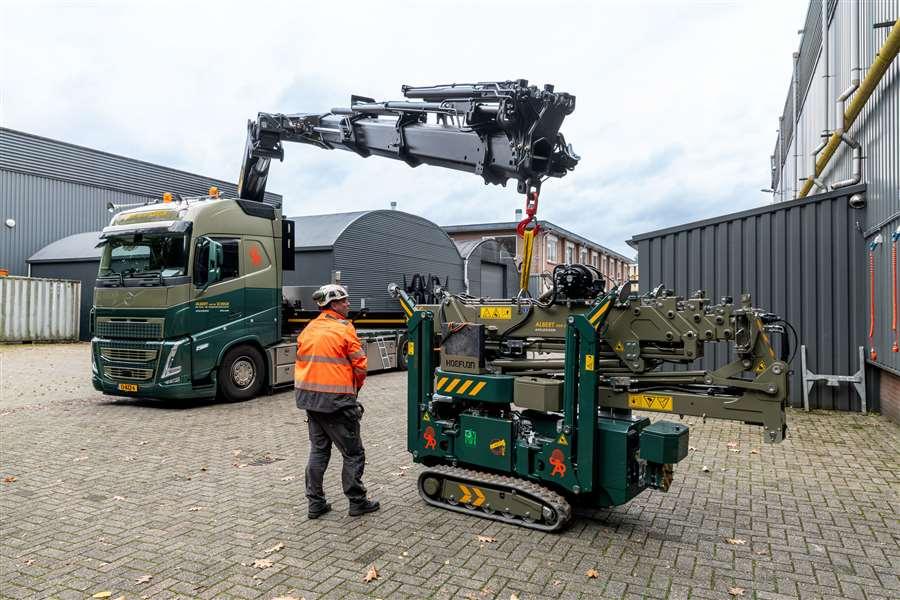 Image-Crane unloads crane: electric Palfinger loader crane with jib unloads a Hoeflon mini crawler crane from the back of Albert van de Scheur’s latest fleet addition, a Volvo FH 8x2 rigid truck. Photo: Volvo Trucks
La décarbonation du levage ne passe plus uniquement par les véhicules électriques. Aux Pays-Bas, le spécialiste du levage et du transport industriel Albert van de Scheur démontre que l'électrification des équipements auxiliaires peut également transformer les opérations sur chantier. L'entreprise familiale d'Apeldoorn vient d'intégrer sa première grue de chargement électrique Palfinger, une solution pensée pour les interventions en intérieur et dans les environnements soumis à de strictes contraintes environnementales.
Montée derrière la cabine d'un Volvo FH 500 8x2, cette grue Palfinger de 72 tonnes-mètre, équipée d'un jib, est le fruit d'un développement mené avec le concessionnaire Harbers Trucks Apeldoorn et le carrossier HSE. L'objectif n'était pas simplement d'ajouter une nouvelle machine à la flotte, mais de concevoir un ensemble parfaitement adapté aux exigences du déplacement de lignes de production industrielles.
Cette spécialisation impose des contraintes particulières. Les camions pénètrent directement dans les bâtiments industriels, où les émissions, le bruit et les gaz d'échappement deviennent des facteurs critiques. Une fois le véhicule positionné, la grue électrique prend le relais pour démonter, déplacer et réinstaller les équipements de production avec un minimum de nuisances.
Cette stratégie s'inscrit dans un plan plus large. L'entreprise vise une exploitation entièrement neutre en CO₂ d'ici 2028 et mettra également en service son premier camion Volvo 100 % électrique cette année. Pour son directeur, Peter Schoenmaker, chaque investissement doit répondre à une double exigence : améliorer la durabilité tout en restant économiquement rentable.
Au-delà de son bilan environnemental, la technologie apporte des bénéfices opérationnels concrets. Alimentée par un pack de batteries dédié, la grue offre jusqu'à huit heures d'autonomie en fonctionnement électrique et peut être rechargée pendant les trajets grâce à l'alternateur du camion. Sa capacité atteint 1 tonne à 30 mètres de portée, répondant aux besoins des opérations de manutention industrielle les plus exigeantes.
Le fonctionnement électrique ouvre également de nouveaux marchés. L'absence d'émissions locales et la réduction significative du bruit permettent d'intervenir dans des bâtiments fermés, mais aussi dans des zones sensibles où les réglementations environnementales sont particulièrement strictes, comme les espaces protégés Natura 2000.
La conception du véhicule a été optimisée pour conjuguer conformité réglementaire européenne, charge utile maximale et maniabilité. Un empattement raccourci améliore le rayon de braquage, tandis que la carrosserie modulable peut être utilisée en configuration ouverte ou fermée afin de transporter aussi bien des machines sensibles que des équipements de grande dimension.
Cette réalisation illustre une évolution de fond dans le secteur du levage. Alors que l'attention se concentre souvent sur l'électrification des porteurs, les équipements de manutention deviennent à leur tour un levier majeur de réduction des émissions, d'amélioration des conditions de travail et d'accès aux chantiers soumis à des exigences environnementales croissantes. Pour les entreprises spécialisées dans les opérations industrielles complexes, l'électrification des grues apparaît désormais comme une solution aussi stratégique que pragmatique.
NJC.© Info Palfinger, Albert van de Scheur
-----------------------------------------------------------------------------------------------------------
22/07/26-English
Albert van de Scheur Accelerates its Green Transition with its First Palfinger Electric Crane
Image-Crane unloads crane: electric Palfinger loader crane with jib unloads a Hoeflon mini crawler crane from the back of Albert van de Scheur’s latest fleet addition, a Volvo FH 8x2 rigid truck. Photo: Volvo Trucks
Decarbonizing the lifting industry is no longer solely about electric vehicles. In the Netherlands, the lifting and industrial transport specialist Albert van de Scheur is demonstrating that electrifying auxiliary equipment can also transform on-site operations. The family-owned company from Apeldoorn has just integrated its first Palfinger electric loading crane, a solution designed for indoor operations and in environments subject to strict environmental constraints.
Mounted behind the cab of a Volvo FH 500 8x2, this 72-tonne-meter Palfinger crane, equipped with a jib, is the result of a development carried out in collaboration with the dealership Harbers Trucks Apeldoorn and the bodybuilder HSE. The goal was not simply to add a new machine to the fleet, but to design a system perfectly suited to the demands of moving industrial production lines.
This specialization imposes specific constraints. The trucks drive directly into industrial buildings, where emissions, noise, and exhaust fumes become critical factors. Once the vehicle is positioned, the electric crane takes over to dismantle, move, and reinstall production equipment with minimal disruption.
This strategy is part of a broader plan. The company aims for completely CO₂-neutral operations by 2028 and will also put its first 100% electric Volvo truck into service this year. For its director, Peter Schoenmaker, every investment must meet a dual requirement: improving sustainability while remaining economically viable.
Beyond its environmental impact, the technology delivers tangible operational benefits. Powered by a dedicated battery pack, the crane offers up to eight hours of autonomy in electric mode and can be recharged en route using the truck's alternator. Its lifting capacity reaches 1 ton at a 30-meter reach, meeting the needs of even the most demanding industrial handling operations.
Electric operation also opens up new markets. The absence of local emissions and the significant reduction in noise allow for work in enclosed buildings, as well as in sensitive areas where environmental regulations are particularly strict, such as Natura 2000 protected areas.
The vehicle's design has been optimized to combine European regulatory compliance, maximum payload, and maneuverability. A shorter wheelbase improves the turning radius, while the modular body can be used in open or closed configurations to transport both delicate machinery and large equipment.
This achievement illustrates a fundamental shift in the lifting sector. While attention is often focused on the electrification of carriers, material handling equipment is in turn becoming a major lever for reducing emissions, improving working conditions, and facilitating access to worksites subject to increasing environmental requirements. For companies specializing in complex industrial operations, the electrification of cranes now appears as a solution that is both strategic and pragmatic.
NJC.© Info Palfinger, Albert van de Scheur
--------------------------------------------------------------------------------------------------------------------
22/07/26-NL
Albert van de Scheur versnelt zijn groene transitie met zijn eerste elektrische Palfinger-kraan
Image-Crane unloads crane: electric Palfinger loader crane with jib unloads a Hoeflon mini crawler crane from the back of Albert van de Scheur’s latest fleet addition, a Volvo FH 8x2 rigid truck. Photo: Volvo Trucks
Het decarboniseren van de hijsindustrie draait niet langer alleen om elektrische voertuigen. In Nederland laat specialist in hijs- en industrieel transport Albert van de Scheur zien dat de elektrificatie van hulpapparatuur ook de werkzaamheden op locatie kan transformeren. Het familiebedrijf uit Apeldoorn heeft zojuist zijn eerste elektrische Palfinger-laadkraan geïntegreerd, een oplossing die is ontworpen voor gebruik binnenshuis en in omgevingen met strenge milieueisen.
Deze 72-tonmeter Palfinger-kraan, uitgerust met een giek, is gemonteerd achter de cabine van een Volvo FH 500 8x2 en is het resultaat van een ontwikkeling in samenwerking met dealer Harbers Trucks Apeldoorn en carrosseriebouwer HSE. Het doel was niet simpelweg een nieuwe machine aan het wagenpark toe te voegen, maar een systeem te ontwerpen dat perfect aansluit op de eisen van het verplaatsen van industriële productielijnen.
Deze specialisatie brengt specifieke beperkingen met zich mee. De vrachtwagens rijden rechtstreeks industriële gebouwen binnen, waar emissies, lawaai en uitlaatgassen kritische factoren worden. Zodra het voertuig op de juiste positie staat, neemt de elektrische kraan het over om de productieapparatuur te demonteren, te verplaatsen en opnieuw te installeren met minimale verstoring.
Deze strategie maakt deel uit van een breder plan. Het bedrijf streeft naar volledig CO₂-neutrale bedrijfsvoering in 2028 en neemt dit jaar ook zijn eerste 100% elektrische Volvo-vrachtwagen in gebruik. Voor directeur Peter Schoenmaker moet elke investering aan twee eisen voldoen: het verbeteren van de duurzaamheid én het behouden van economische haalbaarheid.
Naast de milieu-impact biedt de technologie tastbare operationele voordelen. Aangedreven door een speciaal accupakket, biedt de kraan tot acht uur autonomie in de elektrische modus en kan onderweg worden opgeladen met de dynamo van de vrachtwagen. Het hefvermogen bedraagt 1 ton bij een reikwijdte van 30 meter, waarmee zelfs de meest veeleisende industriële handlingtaken worden uitgevoerd.
Elektrisch rijden opent bovendien nieuwe markten. De afwezigheid van lokale emissies en de aanzienlijke geluidsreductie maken het mogelijk om in besloten gebouwen te werken, evenals in gevoelige gebieden waar de milieuregelgeving bijzonder streng is, zoals Natura 2000-gebieden.
Het ontwerp van het voertuig is geoptimaliseerd om te voldoen aan de Europese regelgeving, een maximaal laadvermogen te bieden en wendbaar te zijn. Een kortere wielbasis verbetert de draaicirkel, terwijl de modulaire opbouw in open of gesloten configuratie kan worden gebruikt voor het transport van zowel delicate machines als grote apparatuur.
Deze prestatie illustreert een fundamentele verschuiving in de hijssector. Hoewel de aandacht vaak uitgaat naar de elektrificatie van transportvoertuigen, wordt materiaalbehandelingsapparatuur op zijn beurt een belangrijke hefboom voor het verminderen van emissies, het verbeteren van de arbeidsomstandigheden en het vergemakkelijken van de toegang tot werklocaties die onderworpen zijn aan steeds strengere milieueisen. Voor bedrijven die gespecialiseerd zijn in complexe industriële processen, lijkt de elektrificatie van kranen nu een strategische én pragmatische oplossing.
NJC.© Info Palfinger, Albert van de Scheur
-------------------------------------------------------------------------------------------------------------------
Date de dernière mise à jour : 17/07/2026