



R.E.News future Technology-Worldsensing’s G7 Digital Logger and the Quiet Rewiring of Infrastructure Monitoring
 11/08/26-FR-English-NL-footer
Worldsensing : quand l’infrastructure apprend à écouter
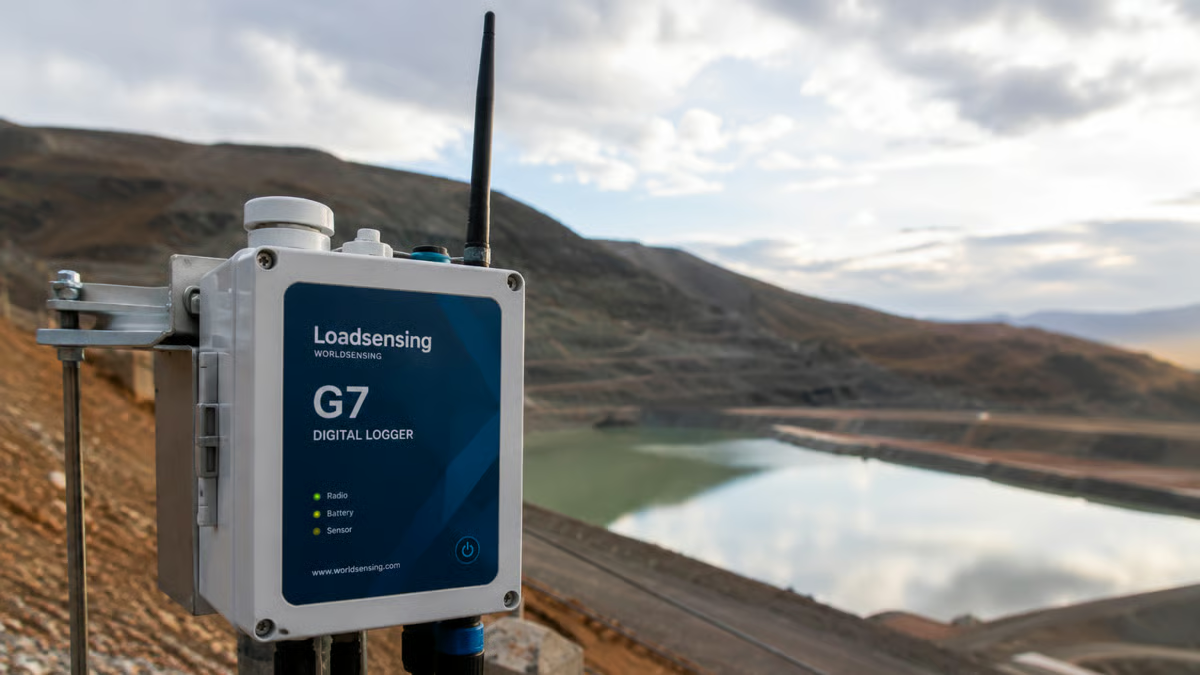 Image-creation R.E.News© via IA chat GPT
Pendant des décennies, surveiller un barrage, un tunnel, une pente ou une structure complexe signifiait installer des capteurs, attendre les relevés et envoyer des équipes sur le terrain pour comprendre ce qui s’était passé.
Cette époque est en train de disparaître.
Avec son Loadsensing G7 Digital Data Logger, Worldsensing propose une nouvelle vision du monitoring : des équipements capables non seulement de mesurer, mais aussi de comprendre, sélectionner et transmettre les informations qui comptent.
Derrière ce boîtier robuste et discret se joue une transformation beaucoup plus profonde : celle d'une infrastructure qui devient progressivement connectée, autonome et prédictive.
L’intelligence au bord du terrain
Conçu pour les environnements industriels, géotechniques, structurels et environnementaux, le G7 peut fonctionner pendant plus de dix ans sur batteries remplaçables.
Mais sa véritable force ne réside pas dans sa longévité.
Elle se trouve dans son intelligence embarquée.
Grâce à son mode de fonctionnement avancé, le système peut traiter les informations directement sur le terrain. Son accéléromètre intégré à trois axes peut également déclencher automatiquement des mesures lorsqu'un mouvement dépasse un seuil défini.
Autrement dit, le G7 ne transmet pas simplement des chiffres.
Il sait quand quelque chose mérite d'être regardé.
Dans une mine isolée, sur un versant instable ou autour d'un tunnel, cette différence peut être considérable. Moins de transmissions inutiles, moins de déplacements humains, moins de maintenance et surtout une surveillance qui ne dépend plus d'une visite périodique.
Quand la sécurité devient une obligation
Cette évolution intervient alors que le monde des infrastructures entre dans une nouvelle ère réglementaire.
Après la catastrophe de Brumadinho au Brésil en 2019, le Global Industry Standard on Tailings Management a renforcé les exigences imposées aux exploitants miniers. La surveillance continue des barrages de résidus, des mouvements de terrain et des pressions devient progressivement une obligation documentée et vérifiable.
Le même mouvement gagne les ponts, les tunnels, les barrages et les réseaux vieillissants.
L'inspection ponctuelle ne suffit plus.
Les infrastructures critiques doivent désormais raconter leur état en permanence.
C'est précisément là que les technologies comme le G7 prennent toute leur dimension.
Une décennie sans interruption
Sur un site accessible, remplacer une batterie ou effectuer une maintenance représente une opération classique.
À flanc de montagne, dans une excavation profonde ou au cœur d'une installation isolée, chaque intervention devient une expédition.
Une autonomie annoncée de plus de dix ans transforme donc complètement l'équation économique.
Chaque visite évitée représente du temps, du transport, des coûts et une exposition humaine réduite. À l'échelle de centaines ou de milliers de capteurs, cette économie devient considérable.
L'intelligence embarquée n'est donc pas seulement une prouesse technologique : elle devient un outil de rentabilité.
Du capteur au jumeau numérique
Le G7 s'inscrit également dans une stratégie plus vaste de Worldsensing.
L'entreprise développe déjà des réseaux connectant des centaines de milliers de capteurs à travers le monde et travaille étroitement avec l'écosystème Bentley Systems et ses services iTwin IoT.
Le principe est simple : le capteur observe, le logger sélectionne et transmet, le cloud rassemble les données, puis le jumeau numérique transforme ces informations en une représentation dynamique de l'infrastructure.
Le véritable enjeu se situe donc au-delà du boîtier.
La valeur se déplace progressivement de l'instrument vers la donnée.
Une information fiable, continue et immédiatement exploitable devient la matière première d'une nouvelle génération de gestion des actifs.
Un seul équipement, plusieurs univers
Le G7 adopte une architecture ouverte destinée à accueillir différents capteurs numériques, notamment via SDI-12, avec RS-485 prévu dans une phase ultérieure.
Il intègre également un compteur d'impulsions et des fonctions de Time Domain Reflectometry (TDR) pouvant contribuer à détecter des défauts de câbles ou certains mouvements du sol.
Cette polyvalence permet d'envisager un même principe technologique pour les barrages miniers, les glissements de terrain, les tunnels, les ancrages, les structures, les réseaux d'eau ou encore les infrastructures de transport.
Avec son boîtier aluminium IP68 et une plage de fonctionnement annoncée de -40 à +80 °C, le G7 est pensé pour rester sur le terrain lorsque les conditions deviennent difficiles.
Le silence qui précède l’alerte
C'est peut-être là que réside toute la philosophie de cette nouvelle génération de monitoring.
Le dispositif reste silencieux.
Il observe.
Il attend.
Il analyse.
Et lorsque quelque chose change, il intervient.
Dans un monde où les infrastructures vieillissent, où les exigences réglementaires augmentent et où les accidents peuvent se jouer en quelques secondes, cette capacité à détecter l'anormal avant qu'il ne devienne critique prend une valeur nouvelle.
Worldsensing ne présente donc pas simplement un nouveau logger.
Le G7 symbolise le passage d'une infrastructure que l'on inspecte à une infrastructure qui nous informe elle-même de son état.
Et demain, les ponts, les tunnels, les barrages et les mines pourraient bien avoir une nouvelle voix.
Une voix discrète, invisible, installée au cœur du terrain.
Une voix qui parle en données — et qui pourrait parfois prévenir avant que la montagne, le béton ou l'acier ne parlent à leur tour.
NJC.© Info https://www.worldsensing.com/product/digital-data-acquisition/
---------------------------------------------------------------------------------------------------------
11/08/26-English
Worldsensing: When Infrastructure Learns to Listen
Image-creation R.E.News© via IA chat GPT
For decades, monitoring a dam, tunnel, slope, or complex structure meant installing sensors, waiting for readings, and sending teams into the field to understand what had happened.
Those days are coming to an end.
With its Loadsensing G7 Digital Data Logger, Worldsensing offers a new vision of monitoring: equipment capable not only of measuring, but also of understanding, selecting, and transmitting the information that matters.
Behind this robust and discreet unit lies a much deeper transformation: that of an infrastructure that is gradually becoming connected, autonomous, and predictive.
Intelligence at the Edge of the Field
Designed for industrial, geotechnical, structural, and environmental environments, the G7 can operate for more than ten years on replaceable batteries.
But its true strength lies not in its longevity.
It lies in its embedded intelligence.
Thanks to its advanced operating mode, the system can process information directly in the field. Its integrated three-axis accelerometer can also automatically trigger measurements when movement exceeds a defined threshold.
In other words, the G7 doesn't just transmit numbers.
It knows when something warrants attention.
In an isolated mine, on an unstable slope, or around a tunnel, this difference can be considerable. Fewer unnecessary transmissions, less human travel, less maintenance, and above all, monitoring that no longer depends on periodic visits.
When safety becomes mandatory
This development comes as the world of infrastructure enters a new regulatory era.
Following the Brumadinho disaster in Brazil in 2019, the Global Industry Standard on Tailings Management strengthened the requirements imposed on mining operators. Continuous monitoring of tailings dams, ground movements, and pressures is gradually becoming a documented and verifiable obligation.
The same trend is extending to bridges, tunnels, dams, and aging networks.
Spot inspections are no longer sufficient.
Critical infrastructure must now continuously report its condition.
This is precisely where technologies like the G7 become truly valuable.
A Decade of Uninterrupted Operations
At an accessible site, replacing a battery or performing maintenance is a routine operation.
On a mountainside, in a deep excavation, or at the heart of a remote facility, every intervention becomes an expedition.
A projected battery life of over ten years completely transforms the economic equation.
Each visit avoided represents time, transportation, costs, and reduced human exposure. On the scale of hundreds or thousands of sensors, these savings become considerable.
Embedded intelligence is therefore not just a technological feat: it is becoming a tool for profitability.
From Sensor to Digital Twin
The G7 is also part of a broader Worldsensing strategy.
The company is already developing networks connecting hundreds of thousands of sensors worldwide and works closely with the Bentley Systems ecosystem and its iTwin IoT services.
The principle is simple: the sensor observes, the logger selects and transmits, the cloud gathers the data, and then the digital twin transforms this information into a dynamic representation of the infrastructure.
The real challenge, therefore, lies beyond the device itself.
Value is gradually shifting from the instrument to the data.
Reliable, continuous, and immediately actionable information is becoming the raw material for a new generation of asset management.
One device, multiple worlds
The G7 adopts an open architecture designed to accommodate various digital sensors, notably via SDI-12, with RS-485 planned for a later phase.
It also integrates a pulse counter and Time Domain Reflectometry (TDR) functions that can help detect cable faults or certain ground movements.
This versatility allows for the application of the same technological principle to mining dams, landslides, tunnels, anchors, structures, water networks, and transportation infrastructure.
With its IP68-rated aluminum housing and a stated operating range of -40°C to +80°C, the G7 is designed to remain in the field when conditions become challenging.
The silence before the alert
Perhaps this is the essence of this new generation of monitoring.
The device remains silent.
It observes.
It waits.
It analyzes.
And when something changes, it intervenes.
In a world where infrastructure is aging, regulatory requirements are increasing, and accidents can happen in seconds, this ability to detect anomalies before they become critical takes on new value.
Worldsensing is therefore not simply a new data logger.
The G7 symbolizes the shift from infrastructure that is inspected to infrastructure that informs us of its own condition.
And tomorrow, bridges, tunnels, dams, and mines could well have a new voice.
A discreet, invisible voice, installed deep within the terrain.
A voice that speaks in data—and that could sometimes provide warnings before the mountain, the concrete, or the steel itself speaks.
NJC.© Info https://www.worldsensing.com/product/digital-data-acquisition/
---------------------------------------------------------------------------------------------------------------
11/08/26-NL
Worldsensing: Wanneer infrastructuur leert luisteren
Image-creation R.E.News© via IA chat GPT
Decennialang betekende het monitoren van een dam, tunnel, helling of complexe constructie het installeren van sensoren, wachten op metingen en het sturen van teams het veld in om te begrijpen wat er was gebeurd.
Die tijd loopt ten einde.
Met de Loadsensing G7 digitale datalogger biedt Worldsensing een nieuwe visie op monitoring: apparatuur die niet alleen kan meten, maar ook de relevante informatie kan begrijpen, selecteren en doorgeven.
Achter deze robuuste en discrete unit schuilt een veel diepere transformatie: die van een infrastructuur die geleidelijk verbonden, autonoom en voorspellend wordt.
Intelligentie aan de rand van het veld
De G7 is ontworpen voor industriële, geotechnische, structurele en milieu-omgevingen en kan meer dan tien jaar werken op vervangbare batterijen.
Maar de ware kracht schuilt niet in de lange levensduur.
Die schuilt in de ingebouwde intelligentie.
Dankzij de geavanceerde bedrijfsmodus kan het systeem informatie direct in het veld verwerken. De geïntegreerde drie-assige accelerometer kan ook automatisch metingen activeren wanneer beweging een bepaalde drempel overschrijdt.
Met andere woorden, de G7 verzendt niet alleen cijfers.
Hij weet wanneer er iets aandacht vereist.
In een afgelegen mijn, op een instabiele helling of rond een tunnel kan dit verschil aanzienlijk zijn. Minder onnodige transmissies, minder verplaatsingen van personeel, minder onderhoud en vooral monitoring die niet langer afhankelijk is van periodieke bezoeken.
Wanneer veiligheid verplicht wordt
Deze ontwikkeling vindt plaats nu de infrastructuursector een nieuw tijdperk van regelgeving ingaat.
Na de ramp in Brumadinho in Brazilië in 2019 heeft de Global Industry Standard on Tailings Management de eisen voor mijnbouwbedrijven aangescherpt. Continue monitoring van tailingsdammen, grondbewegingen en druk wordt geleidelijk aan een gedocumenteerde en verifieerbare verplichting.
Dezelfde trend zet zich door naar bruggen, tunnels, dammen en verouderde netwerken.
Inspecties op specifieke momenten zijn niet langer voldoende.
Kritieke infrastructuur moet nu continu haar toestand rapporteren.
Precies hier komen technologieën zoals de G7 echt van pas.
Tien jaar ononderbroken werking
Op een toegankelijke locatie is het vervangen van een batterij of het uitvoeren van onderhoud een routinehandeling.
Op een berghelling, in een diepe uitgraving of in het hart van een afgelegen faciliteit, wordt elke interventie een expeditie.
Een verwachte levensduur van de batterij van meer dan tien jaar verandert de economische afweging volledig.
Elk vermeden bezoek betekent tijd, transport, kosten en minder blootstelling van mensen. Op de schaal van honderden of duizenden sensoren worden deze besparingen aanzienlijk.
Ingebouwde intelligentie is daarom niet alleen een technologische prestatie: het wordt een instrument voor winstgevendheid.
Van sensor naar digitale tweeling
De G7 maakt ook deel uit van een bredere Worldsensing-strategie.
Het bedrijf ontwikkelt al netwerken die honderdduizenden sensoren wereldwijd met elkaar verbinden en werkt nauw samen met het Bentley Systems-ecosysteem en de iTwin IoT-diensten.
Het principe is eenvoudig: de sensor observeert, de datalogger selecteert en verzendt de gegevens, de cloud verzamelt de data en vervolgens zet de digitale tweeling deze informatie om in een dynamische weergave van de infrastructuur.
De echte uitdaging ligt daarom niet bij het apparaat zelf.
De waarde verschuift geleidelijk van het instrument naar de data.
Betrouwbare, continue en direct bruikbare informatie vormt de basis voor een nieuwe generatie assetmanagement.
Eén apparaat, meerdere werelden
De G7 heeft een open architectuur die is ontworpen om verschillende digitale sensoren te ondersteunen, met name via SDI-12, en RS-485 is gepland voor een latere fase.
Het apparaat integreert ook een pulsteller en Time Domain Reflectometry (TDR)-functies die kunnen helpen bij het detecteren van kabelstoringen of bepaalde bodembewegingen.
Deze veelzijdigheid maakt het mogelijk om hetzelfde technologische principe toe te passen op mijnbouwdammen, aardverschuivingen, tunnels, ankers, constructies, waterleidingnetwerken en transportinfrastructuur.
Met zijn IP68-gecertificeerde aluminium behuizing en een opgegeven bedrijfstemperatuurbereik van -40°C tot +80°C is de G7 ontworpen om in het veld te blijven, zelfs onder uitdagende omstandigheden.
De stilte vóór het alarm
Misschien is dat wel de essentie van deze nieuwe generatie monitoring.
Het apparaat blijft stil.
Het observeert.
Het wacht.
Het analyseert.
En wanneer er iets verandert, grijpt het in.
In een wereld waar de infrastructuur veroudert, de regelgeving steeds strenger wordt en ongelukken in seconden kunnen gebeuren, krijgt het vermogen om afwijkingen te detecteren voordat ze kritiek worden een nieuwe waarde.
Worldsensing is daarom niet zomaar een nieuwe datalogger.
De G7 symboliseert de verschuiving van infrastructuur die wordt geïnspecteerd naar infrastructuur die ons informeert over haar eigen toestand.
En morgen zouden bruggen, tunnels, dammen en mijnen wel eens een nieuwe stem kunnen hebben.
Een discrete, onzichtbare stem, diep in de grond geïnstalleerd.
Een stem die spreekt in data – en die soms waarschuwingen kan geven voordat de berg, het beton of het staal zelf spreekt.
NJC.© Info https://www.worldsensing.com/product/digital-data-acquisition/
---------------------------------------------------------------------------------------------------------------
Date de dernière mise à jour : 10/08/2026