



R.E.News International-Could We Survive Without Oil ?
 29/09/26-FR-English-NL-footer
COULD WE SURVIVE WITHOUT OIL?
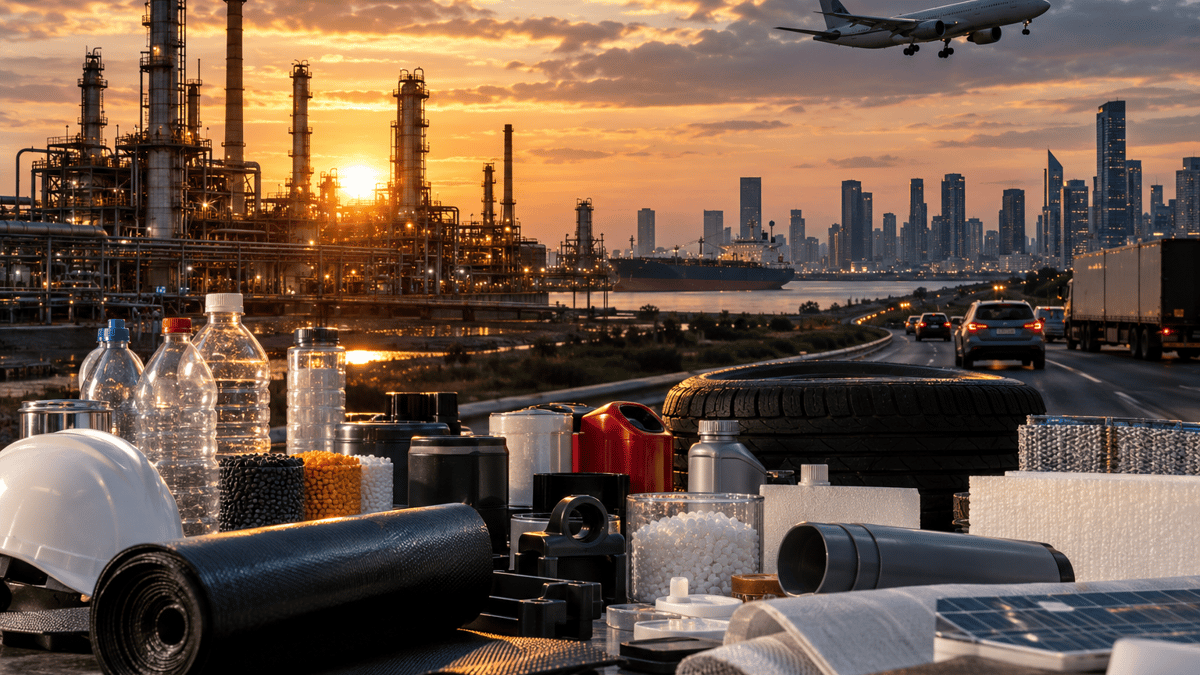 Image-creation R.E.News via IA chat GPT
Le jour où le pétrole disparaîtrait, ce ne sont pas seulement les moteurs qui s’arrêteraient.
L’humanité a vécu sans pétrole pendant l’immense majorité de son histoire. Mais notre civilisation industrielle, elle, a été construite autour de lui.
Si le pétrole disparaissait demain, les premières images seraient familières : voitures immobilisées, avions cloués au sol, navires privés de carburant, engins de chantier et machines agricoles à la recherche d’une nouvelle énergie.
Mais ce ne serait que le début.
LE PÉTROLE EST AUSSI UNE MATIÈRE
Le véritable défi se trouve dans tout ce que l’on ne voit pas dans un réservoir.
Plastiques, caoutchoucs synthétiques, lubrifiants, peintures, résines, adhésifs, fibres, solvants, isolants et bitumes sont intimement liés à la chimie des hydrocarbures.
Un véhicule électrique peut se passer d’essence. Il ne peut pas se passer de pneus, de polymères, d’isolants, de lubrifiants, de composants électroniques et de matériaux composites.
Un hôpital peut réduire certains usages du pétrole comme énergie. Mais seringues, tubulures, emballages stériles, équipements jetables, revêtements et nombreux composants reposent encore sur une chimie industrielle complexe.
Électrifier l’économie ne signifie donc pas la rendre immatérielle.
MÊME LA MACHINE QUI REMPLACE LE PÉTROLE EN A BESOIN
Le paradoxe devient vertigineux.
Une mine produisant le lithium d’une batterie fonctionne avec des engins, des convoyeurs, des pneus, des huiles, des câbles et des composants industriels.
Une ferme produit du blé grâce au soleil, à l’eau et au sol, mais la chaîne moderne implique tracteurs, irrigation, fertilisants, stockage, réfrigération et transport.
Une route est essentiellement constituée de pierres et de granulats, mais une petite quantité de bitume suffit à transformer cet assemblage minéral en infrastructure durable.
Changer l’énergie ne supprime jamais la matière.
LE NOUVEAU CARBONE
Et si le pétrole disparaissait, le carbone, lui, resterait indispensable à une multitude de produits.
Il pourrait provenir davantage de la biomasse, du recyclage, des déchets ou du CO₂ capté, tandis que l’hydrogène pourrait être produit par électrolyse de l’eau.
Des hydrocarbures synthétiques pourraient même être fabriqués artificiellement.
La question devient alors fascinante : un monde sans pétrole serait-il nécessairement un monde sans hydrocarbures ?
Pas forcément.
Il pourrait s'agir d'un monde où l'industrie continue à utiliser certaines molécules carbonées, mais les obtient autrement.
LE VRAI DÉFI : L’ÉCHELLE
Remplacer un plastique est possible.
Remplacer un carburant est possible.
Remplacer un lubrifiant est possible.
Remplacer le bitume est possible.
Remplacer simultanément des milliers de produits, partout sur la planète, avec les mêmes performances, les mêmes volumes, la même fiabilité et un coût acceptable est une autre histoire.
C’est là que réside le véritable défi.
Le pétrole n’est pas devenu incontournable uniquement parce qu’il brûle bien. Il est devenu stratégique parce que la géologie a concentré sous terre une extraordinaire réserve de molécules riches en carbone et en hydrogène, immédiatement exploitables par une civilisation industrielle.
APRÈS LE PÉTROLE
Le futur ne sera probablement pas une civilisation sans ressources, mais une civilisation qui devra apprendre à changer l’origine de ses ressources.
Plus d’électricité.
Plus de recyclage.
Plus de biomasse.
Plus de matériaux alternatifs.
Plus de carbone capté.
Plus d’efficacité.
Et surtout, une économie capable de faire circuler les matières beaucoup plus longtemps.
La question n’est donc peut-être pas : « Peut-on vivre sans pétrole ? »
La véritable question est beaucoup plus vaste :
« Comment faire fonctionner une civilisation industrielle lorsque le pétrole n’est plus son point de départ ? »
Car une chose ne changera jamais :
l’industrie peut changer son énergie, transformer ses matériaux et recycler ses ressources… mais elle ne pourra jamais devenir immatérielle.
NJC.© Info https://www.iea.org/reports/oil-2025/executive-summary https://www.eia.gov/energyexplained/oil-and-petroleum-products/refining-crude-oil.php
--------------------------------------------------------------------------------------------------------------
29/09/26-English
COULD WE SURVIVE WITHOUT OIL?
Image-creation R.E.News via IA chat GPT
The day oil disappears, it won't just be engines that stop running.
Humanity has lived without oil for the vast majority of its history. But our industrial civilization was built around it.
If oil were to disappear tomorrow, the first images would be familiar: cars immobilized, planes grounded, ships without fuel, construction equipment and agricultural machinery searching for a new energy source.
But that would only be the beginning.
OIL IS ALSO A MATERIAL
The real challenge lies in everything that isn't visible in a tank.
Plastics, synthetic rubbers, lubricants, paints, resins, adhesives, fibers, solvents, insulators, and bitumen are all intimately linked to hydrocarbon chemistry.
An electric vehicle can run without gasoline. It cannot do without tires, polymers, insulation, lubricants, electronic components, and composite materials.
A hospital can reduce some of its use of petroleum as an energy source. But syringes, tubing, sterile packaging, disposable equipment, coatings, and many other components still rely on complex industrial chemistry.
Electrifying the economy, therefore, does not mean making it immaterial.
EVEN THE MACHINE THAT REPLACES OIL NEEDS IT
The paradox becomes dizzying.
A mine producing the lithium for a battery operates with machinery, conveyors, tires, oils, cables, and industrial components.
A farm produces wheat thanks to the sun, water, and soil, but the modern supply chain involves tractors, irrigation, fertilizers, storage, refrigeration, and transportation.
A road is essentially made of stones and aggregates, but a small amount of bitumen is enough to transform this mineral mixture into a durable infrastructure.
Changing energy sources never eliminates matter.
THE NEW CARBON
And if oil were to disappear, carbon would still be essential to a multitude of products.
It could come more from biomass, recycling, waste, or captured CO₂, while hydrogen could be produced by water electrolysis.
Synthetic hydrocarbons could even be manufactured artificially.
The question then becomes fascinating: would a world without oil necessarily be a world without hydrocarbons?
Not necessarily.
It could be a world where industry continues to use certain carbon molecules, but obtains them differently.
THE REAL CHALLENGE: SCALE
Replacing a plastic is possible.
Replacing a fuel is possible.
Replacing a lubricant is possible.
Replacing bitumen is possible.
Replacing thousands of products simultaneously, all over the world, with the same performance, the same volumes, the same reliability, and at an acceptable cost is another story.
That's where the real challenge lies.
Oil didn't become indispensable simply because it burns well. It became strategic because geology has concentrated an extraordinary reserve of carbon- and hydrogen-rich molecules underground, immediately exploitable by an industrial civilization.
AFTER OIL
The future will probably not be a civilization without resources, but a civilization that will have to learn to change the origin of its resources.
More electricity.
More recycling.
More biomass.
More alternative materials.
More carbon captured.
More efficiency.
And above all, an economy capable of circulating materials for much longer.
So perhaps the question isn't: "Can we live without oil?" »
The real question is much broader:
“How can an industrial civilization function when oil is no longer its starting point?”
Because one thing will never change:
Industry can change its energy source, transform its materials, and recycle its resources… but it can never become immaterial.
NJC.© Info https://www.iea.org/reports/oil-2025/executive-summary https://www.eia.gov/energyexplained/oil-and-petroleum-products/refining-crude-oil.php
-----------------------------------------------------------------------------------------------------------------
29/09/26-NL
ZOUDEN WE ZONDER OLIE KUNNEN OVERLEVEN?
Image-creation R.E.News via IA chat GPT
De dag dat olie verdwijnt, zullen niet alleen de motoren stilvallen.
De mensheid heeft het grootste deel van haar geschiedenis zonder olie geleefd. Maar onze industriële beschaving is eromheen gebouwd.
Als olie morgen zou verdwijnen, zouden de eerste beelden bekend voorkomen: auto's die niet meer werken, vliegtuigen aan de grond, schepen zonder brandstof, bouwmachines en landbouwmachines die op zoek zijn naar een nieuwe energiebron.
Maar dat zou nog maar het begin zijn.
OLIE IS OOK EEN MATERIAAL
De echte uitdaging zit hem in alles wat niet zichtbaar is in een tank.
Kunststoffen, synthetisch rubber, smeermiddelen, verf, harsen, lijm, vezels, oplosmiddelen, isolatiematerialen en bitumen zijn allemaal nauw verbonden met de koolwaterstofchemie.
Een elektrische auto kan rijden zonder benzine. Maar hij kan niet zonder banden, polymeren, isolatie, smeermiddelen, elektronische componenten en composietmaterialen.
Een ziekenhuis kan zijn gebruik van aardolie als energiebron verminderen. Maar spuiten, slangen, steriele verpakkingen, wegwerpmateriaal, coatings en vele andere componenten zijn nog steeds afhankelijk van complexe industriële chemie.
Het elektrificeren van de economie betekent dus niet dat materie irrelevant wordt.
ZELFS DE MACHINE DIE OLIE VERVANGT, HEEFT HET NODIG
De paradox is duizelingwekkend.
Een mijn die lithium produceert voor een batterij werkt met machines, transportbanden, banden, oliën, kabels en industriële componenten.
Een boerderij produceert tarwe dankzij de zon, water en grond, maar de moderne toeleveringsketen omvat tractoren, irrigatie, meststoffen, opslag, koeling en transport.
Een weg bestaat in principe uit stenen en grind, maar een kleine hoeveelheid bitumen is voldoende om dit mineraalmengsel om te vormen tot een duurzame infrastructuur.
Het veranderen van energiebronnen elimineert nooit materie.
DE NIEUWE KOOLSTOF
En als olie zou verdwijnen, zou koolstof nog steeds essentieel zijn voor een veelheid aan producten.
Het zou meer uit biomassa, recycling, afval of afgevangen CO₂ kunnen komen, terwijl waterstof door elektrolyse van water geproduceerd zou kunnen worden.
Synthetische koolwaterstoffen zouden zelfs kunstmatig geproduceerd kunnen worden.
De vraag die dan opkomt is fascinerend: zou een wereld zonder olie noodzakelijkerwijs een wereld zonder koolwaterstoffen zijn?
Niet per se.
Het zou een wereld kunnen zijn waarin de industrie bepaalde koolstofmoleculen blijft gebruiken, maar ze op een andere manier verkrijgt.
DE ECHTE UITDAGING: SCHAALVERGROTING
Het vervangen van plastic is mogelijk.
Het vervangen van een brandstof is mogelijk.
Het vervangen van een smeermiddel is mogelijk.
Het vervangen van bitumen is mogelijk.
Het tegelijkertijd vervangen van duizenden producten, over de hele wereld, met dezelfde prestaties, dezelfde volumes, dezelfde betrouwbaarheid en tegen een acceptabele prijs, is een ander verhaal.
Daar ligt de echte uitdaging.
Olie is niet onmisbaar geworden simpelweg omdat het goed brandt. Het is strategisch geworden omdat de geologie een buitengewone reserve aan koolstof- en waterstofrijke moleculen onder de grond heeft geconcentreerd, die direct door een industriële beschaving kunnen worden geëxploiteerd.
NA OLIE
De toekomst zal waarschijnlijk geen beschaving zonder grondstoffen zijn, maar een beschaving die zal moeten leren de oorsprong van haar grondstoffen te veranderen.
Meer elektriciteit.
Meer recycling.
Meer biomassa.
Meer alternatieve materialen.
Meer koolstofafvang.
Meer efficiëntie.
En bovenal een economie die in staat is materialen veel langer te laten circuleren.
Dus misschien is de vraag niet: "Kunnen we zonder olie leven?" »
De echte vraag is veel breder:
"Hoe kan een industriële beschaving functioneren als olie niet langer haar uitgangspunt is?"
Want één ding zal nooit veranderen:
De industrie kan haar energiebron veranderen, haar materialen transformeren en haar grondstoffen recyclen... maar ze kan nooit immaterieel worden.
NJC.© Info https://www.iea.org/reports/oil-2025/executive-summary https://www.eia.gov/energyexplained/oil-and-petroleum-products/refining-crude-oil.php
------------------------------------------------------------------------------------------------------------
Date de dernière mise à jour : 28/09/2026