











R.E.News International-Doka advances construction of Denmark’s third-longest bridge
 03/03/26-FR-English-NL-footer
Doka fait avancer la construction du troisième plus long pont du Danemark
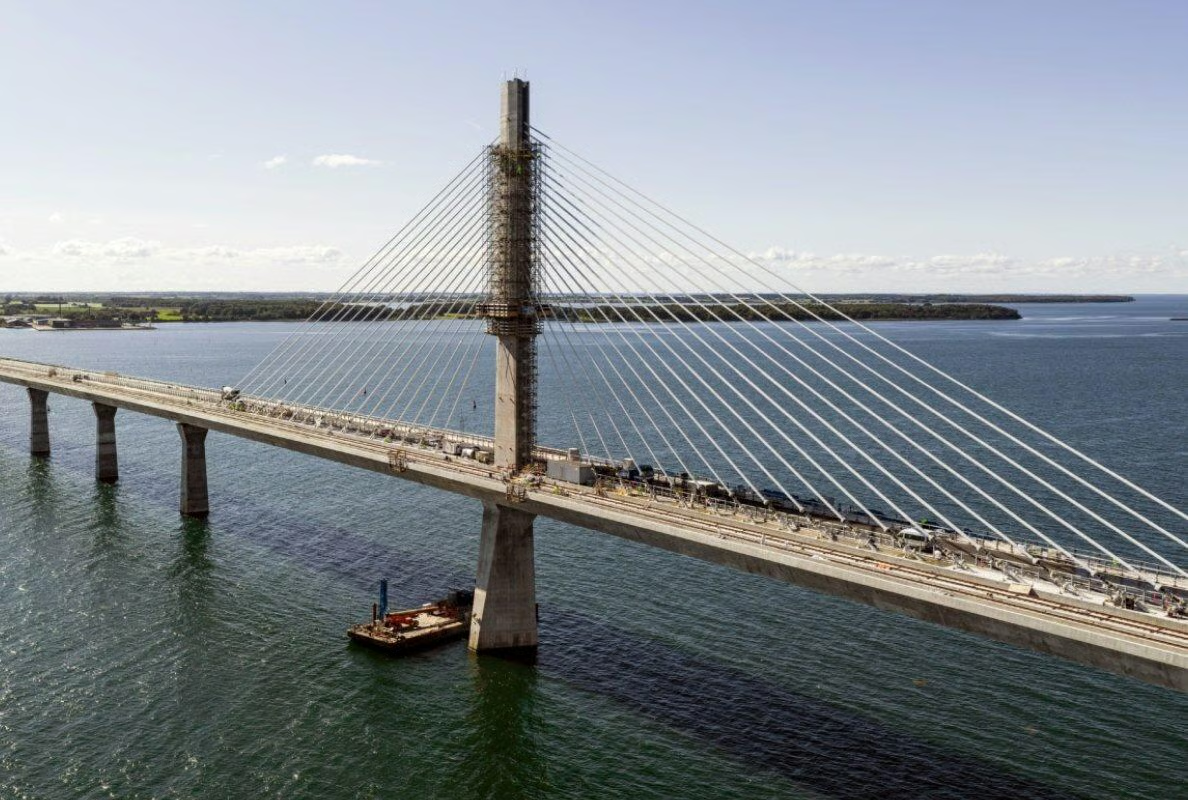
 With completion approaching, Denmark’s third-longest bridge strengthens the Fehmarnbelt corridor as a key traffic link between Scandinavia and Central Europe. IMAGE SOURCE: Doka GmbH
Au sud du Danemark, au-dessus des eaux du Storstrømmen, un ouvrage d’envergure prend forme. Avec ses 3,8 kilomètres de longueur, le futur Storstrøm Bridge deviendra le troisième plus long pont du pays — et bien plus qu’un simple record d’ingénierie. Il incarne une nouvelle colonne vertébrale pour la mobilité scandinave et européenne.
Aux côtés des maîtres d’œuvre, Doka joue un rôle clé dans cette transformation, en déployant un concept intégré de coffrage et d’étaiement capable d’accompagner chaque étape critique du chantier, malgré des géométries complexes et des conditions environnementales exigeantes.
Un maillon stratégique entre la Scandinavie et l’Europe centrale
Le Storstrøm Bridge ne se limite pas à relier deux rives : il s’inscrit dans un corridor nord–sud à haute capacité, destiné à fluidifier le transport routier et ferroviaire entre la Scandinavie et l’Europe centrale.
Associé au Fehmarnbelt Fixed Link, il contribuera à créer une liaison continue pour les passagers et le fret, renforçant durablement les échanges transfrontaliers.
Prévue pour une ouverture au trafic routier en 2026 — suivie ultérieurement par la mise en service ferroviaire — cette infrastructure marque une étape majeure dans la modernisation du réseau danois.
Une ingénierie pensée pour l’exigence
Dès 2019, Doka s’est engagée sur le projet à travers plusieurs phases :
Solutions pour les ponts d’accès d’environ 80 mètres de long
Têtes de piles préfabriquées en zone terrestre
Structures en porte-à-faux reliant les segments préfabriqués au pylône
Coffrage complet du pylône principal
Au cœur de l’ouvrage, le pylône de 102 mètres constitue l’élément central de ce pont à haubans. Véritable colonne vertébrale structurelle, il concentre et transmet toutes les forces vers les fondations. Sa géométrie variable, ses réservations intégrées et ses gaines pour câbles de haubanage en font une pièce d’une extrême complexité.
Pour relever ce défi, Doka a combiné des plateformes SKE100 plus, capables de supporter des charges élevées sur plusieurs niveaux de travail, avec des plateformes SKE50 plus adaptées aux zones plus restreintes. Ce système modulaire a permis d’assurer stabilité, flexibilité et efficacité, même sous des vents soutenus et des contraintes évolutives.
Une plateforme sur mesure pour les étapes finales
La phase de fermeture structurelle du pont à haubans a nécessité une solution spécifique : une plateforme de travail conçue sur mesure.
Montée progressivement à l’aide de la tour d’étaiement Staxo 100, elle reposait sur quatre consoles d’escalade fixes réutilisant les ancrages déjà éprouvés lors de la construction du pylône. Deux tours d’escalier intégrées ont garanti un accès sécurisé et confortable à tous les niveaux.
Solidement arrimée au pylône, la structure a offert des conditions de travail stables et fiables, même sous des charges et des vents exigeants — permettant d’achever une étape décisive du chantier.
La précision au service des grands projets
La contribution de Doka au Storstrøm Bridge illustre comment des solutions d’ingénierie orientées performance peuvent accompagner des projets d’infrastructure complexes, depuis les premiers travaux jusqu’aux jalons structurels majeurs.
Dans ce chantier emblématique, chaque élément — du coffrage aux plateformes d’accès — participe à un objectif commun : garantir des flux de travail prévisibles, sûrs et efficaces.
Lorsque le pont ouvrira à la circulation, il symbolisera non seulement une prouesse architecturale, mais aussi la réussite d’une collaboration technique où rigueur, innovation et anticipation auront été les véritables piliers.
NJC.© Info Doka GmbH
------------------------------------------------------------------------------------------------------------------
03/03/26-English
Doka Advances Construction of Denmark’s Third Longest Bridge
With completion approaching, Denmark’s third-longest bridge strengthens the Fehmarnbelt corridor as a key traffic link between Scandinavia and Central Europe. IMAGE SOURCE: Doka GmbH
In southern Denmark, spanning the waters of the Storstrøm River, a major project is taking shape. At 3.8 kilometers long, the future Storstrøm Bridge will become the third longest bridge in the country—and much more than just an engineering record. It represents a new backbone for Scandinavian and European mobility.
Alongside the general contractors, Doka is playing a key role in this transformation, deploying an integrated formwork and shoring concept capable of supporting every critical stage of the construction, despite complex geometries and demanding environmental conditions.
A Strategic Link Between Scandinavia and Central Europe
The Storstrøm Bridge is not simply a bridge connecting two riverbanks: it forms part of a high-capacity north-south corridor designed to streamline road and rail transport between Scandinavia and Central Europe.
Combined with the Fehmarnbelt Fixed Link, it will help create a continuous connection for passengers and freight, sustainably strengthening cross-border trade.
Scheduled to open to road traffic in 2026—followed later by rail service—this infrastructure marks a major milestone in the modernization of the Danish rail network.
Engineering Designed for Demanding Requirements
From 2019, Doka committed to the project through several phases:
Solutions for the approximately 80-meter-long approach bridges
Prefabricated pier heads in the land-based area
Cantilevered structures connecting the prefabricated segments to the pylon
Complete formwork for the main pylon
At the heart of the structure, the 102-meter pylon forms the central element of this cable-stayed bridge. A true structural backbone, it concentrates and transmits all the forces to the foundations. Its variable geometry, integrated recesses, and cable housings for guy wires make it an extremely complex component.
To meet this challenge, Doka combined SKE100 Plus platforms, capable of supporting high loads across multiple working levels, with SKE50 Plus platforms better suited to more confined areas. This modular system ensured stability, flexibility, and efficiency, even under sustained winds and changing conditions.
A custom-designed platform for the final stages
The structural closure phase of the cable-stayed bridge required a specific solution: a custom-designed working platform.
Erected progressively using the Staxo 100 shoring tower, it rested on four fixed climbing brackets reusing the anchors already proven during the pylon construction. Two integrated stair towers guaranteed safe and comfortable access to all levels.
Securely anchored to the pylon, the structure provided stable and reliable working conditions, even under demanding loads and winds—enabling the completion of a crucial phase of the project.
Precision in the service of major projects
Doka’s contribution to the Storstrøm Bridge illustrates how performance-oriented engineering solutions can support complex infrastructure projects, from the initial work to major structural milestones.
In this landmark project, every element—from the formwork to the access platforms—contributes to a common goal: ensuring predictable, safe, and efficient workflows.
When the bridge opens to traffic, it will symbolize not only an architectural feat but also the success of a technical collaboration where rigor, innovation, and foresight were the true cornerstones.
NJC.© Info Doka GmbH
---------------------------------------------------------------------------------------------------------------------
03/03/26-NL
Doka versnelt de bouw van Denemarkens op twee na langste brug
With completion approaching, Denmark’s third-longest bridge strengthens the Fehmarnbelt corridor as a key traffic link between Scandinavia and Central Europe. IMAGE SOURCE: Doka GmbH
In Zuid-Denemarken, over de rivier de Storstrøm, krijgt een groot project vorm. Met een lengte van 3,8 kilometer wordt de toekomstige Storstrømbrug de op twee na langste brug van het land – en veel meer dan alleen een technisch record. Het vormt een nieuwe ruggengraat voor de mobiliteit in Scandinavië en Europa.
Naast de hoofdaannemers speelt Doka een sleutelrol in deze transformatie door een geïntegreerd bekistings- en stutconcept in te zetten dat elke kritieke fase van de bouw kan ondersteunen, ondanks complexe geometrieën en veeleisende omgevingsomstandigheden.
Een strategische verbinding tussen Scandinavië en Centraal-Europa
De Storstrømbrug is niet zomaar een brug die twee rivieroevers verbindt: het maakt deel uit van een hoogwaardige noord-zuidcorridor die is ontworpen om het weg- en spoorvervoer tussen Scandinavië en Centraal-Europa te stroomlijnen.
In combinatie met de Fehmarnbelt-verbinding zal het een continue verbinding voor passagiers en goederen creëren en de grensoverschrijdende handel duurzaam versterken.
Deze infrastructuur, die naar verwachting in 2026 voor het wegverkeer wordt opengesteld – later gevolgd door het spoor – markeert een belangrijke mijlpaal in de modernisering van het Deense spoorwegnet.
Technisch ontwerp voor veeleisende eisen
Vanaf 2019 heeft Doka zich in verschillende fasen aan het project verbonden:
Oplossingen voor de circa 80 meter lange aanbruggen
Geprefabriceerde pijlerkoppen in het landgedeelte
Uitkragende constructies die de geprefabriceerde segmenten met de pyloon verbinden
Complete bekisting voor de hoofdpyloon
De 102 meter hoge pyloon vormt het hart van de constructie en is het centrale element van deze kabelbrug. Als een ware structurele ruggengraat concentreert en transporteert de pyloon alle krachten naar de fundering. De variabele geometrie, geïntegreerde uitsparingen en kabelbehuizingen voor de tuidraden maken het tot een uiterst complex onderdeel.
Om deze uitdaging aan te gaan, combineerde Doka SKE100 Plus-platforms, die hoge belastingen op meerdere werkniveaus aankunnen, met SKE50 Plus-platforms die beter geschikt zijn voor kleinere ruimtes. Dit modulaire systeem garandeerde stabiliteit, flexibiliteit en efficiëntie, zelfs bij aanhoudende wind en wisselende omstandigheden.
Een op maat ontworpen platform voor de laatste fase
De fase van de structurele afsluiting van de kabelbrug vereiste een specifieke oplossing: een op maat ontworpen werkplatform.
Dit platform werd stapsgewijs opgebouwd met behulp van de Staxo 100-stempeltoren en rustte op vier vaste klimbeugels, waarbij de ankers die zich al tijdens de pyloonconstructie hadden bewezen, werden hergebruikt. Twee geïntegreerde trappentorens garandeerden veilige en comfortabele toegang tot alle niveaus.
De constructie was stevig verankerd aan de pyloon en bood stabiele en betrouwbare werkomstandigheden, zelfs onder zware belastingen en wind, waardoor een cruciale fase van het project kon worden afgerond.
Precisie in dienst van grote projecten
Doka's bijdrage aan de Storstrømbrug illustreert hoe prestatiegerichte engineeringoplossingen complexe infrastructuurprojecten kunnen ondersteunen, van de eerste werkzaamheden tot belangrijke structurele mijlpalen.
In dit baanbrekende project draagt elk element – van de bekisting tot de toegangsplatformen – bij aan een gemeenschappelijk doel: het garanderen van voorspelbare, veilige en efficiënte werkprocessen.
Wanneer de brug voor het verkeer wordt opengesteld, zal dit niet alleen een architectonisch hoogstandje symboliseren, maar ook het succes van een technische samenwerking waarbij nauwkeurigheid, innovatie en vooruitziendheid de ware hoekstenen vormden.
NJC.© Info Doka GmbH
-------------------------------------------------------------------------------------------------------------------
Date de dernière mise à jour : 02/03/2026