



R.E.News International-Palfinger reports second quarter fall in demand
 31/07/26-FR-English-NL-footer
PALFINGER face aux turbulences mondiales : la résilience d'un leader du levage mise à l'épreuve
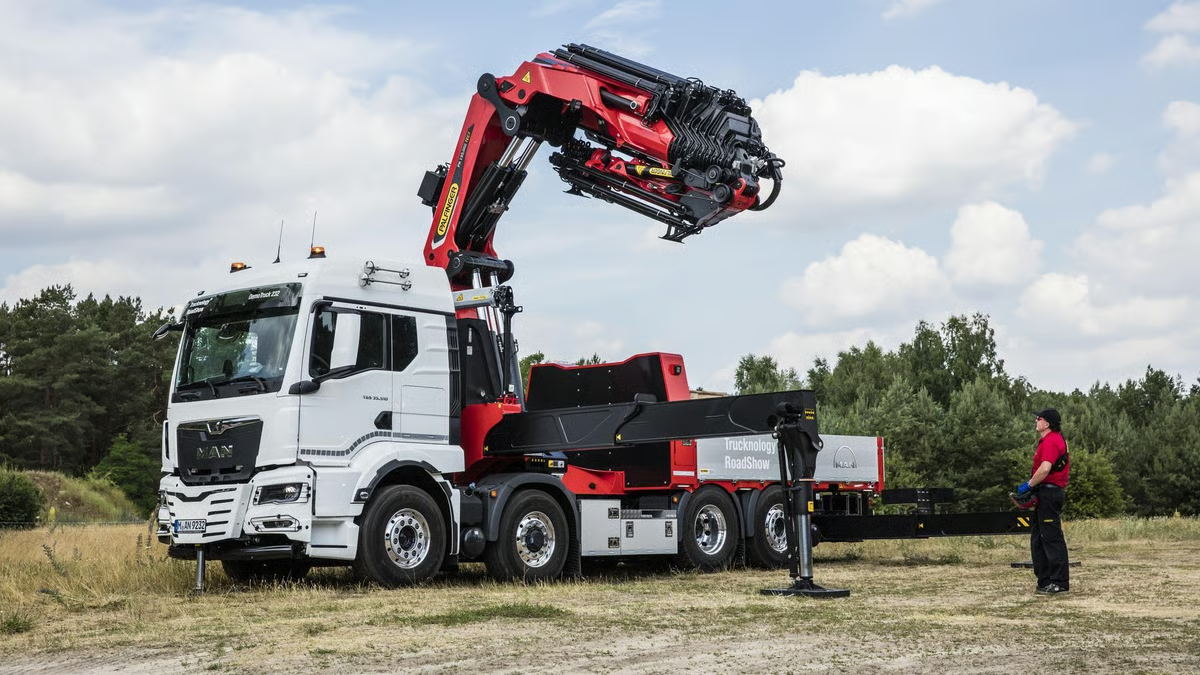 Image-PALFINGER
Après plusieurs années de croissance soutenue, PALFINGER aborde un nouveau cycle où l'agilité stratégique devient aussi importante que la performance industrielle. Si le spécialiste autrichien des grues, nacelles et solutions de levage affiche encore une légère progression de son activité au premier semestre 2026, l'environnement géopolitique mondial a brutalement rebattu les cartes, obligeant le groupe à accélérer sa transformation.
Avec un chiffre d'affaires de 1,165 milliard d'euros, en hausse de 2,3 %, PALFINGER conserve une trajectoire positive. Mais derrière ces résultats se cache une réalité plus contrastée. L'EBITDA recule de 2,5 %, tandis que le bénéfice net s'établit à 48 millions d'euros, conséquence directe d'un ralentissement de la demande plus marqué que prévu durant le deuxième trimestre.
Le conflit opposant l'Iran à ses adversaires régionaux a profondément affecté le climat économique international. Les tensions géopolitiques ont freiné la confiance des investisseurs et repoussé de nombreux projets d'équipement, notamment en Amérique du Nord, au Moyen-Orient et dans la région Asie-Pacifique, trois marchés stratégiques pour le constructeur.
L'Europe fait cependant figure d'exception. Les marchés du sud du continent continuent de soutenir l'activité, tandis que l'Europe du Nord montre des signes de reprise progressive. En Allemagne, PALFINGER attend encore que le vaste programme d'investissements publics dans les infrastructures produise ses premiers effets sur les commandes.
Pour Andreas Klauser, Directeur général du groupe, cette période exige avant tout une capacité d'adaptation. Selon lui, l'incertitude économique observée au deuxième trimestre a conduit de nombreux clients à reporter leurs décisions d'investissement, créant un environnement plus prudent que prévu. Face à cette situation, PALFINGER poursuit néanmoins le déploiement de sa stratégie « Strategy 2030+ », destinée à renforcer durablement sa compétitivité.
L'un des piliers de cette feuille de route repose sur une modernisation accélérée des processus industriels. Le groupe mise sur l'automatisation, l'intelligence artificielle et la digitalisation afin d'améliorer sa productivité tout en optimisant ses coûts de production. Cette démarche s'accompagne d'un vaste programme d'efficacité structurelle visant à générer 25 millions d'euros d'économies annuelles, sans remettre en cause les investissements destinés à préparer la prochaine phase de croissance.
Malgré un contexte international moins favorable, PALFINGER conserve son objectif d'améliorer son chiffre d'affaires et sa rentabilité sur l'ensemble de l'exercice 2026. En revanche, le ralentissement des principaux marchés, notamment les États-Unis et l'Allemagne, contraint le constructeur à revoir son calendrier stratégique. L'objectif de 2,7 milliards d'euros de chiffre d'affaires initialement envisagé pour 2027 ne sera vraisemblablement pas atteint dans les délais. Le groupe maintient toutefois son ambition de franchir le cap des 3 milliards d'euros de revenus, convaincu que les fondamentaux de son marché restent solides à moyen terme.
Pour PALFINGER, 2026 ne marque pas un recul stratégique, mais une phase de transition. Dans une industrie où les cycles économiques se succèdent rapidement, le constructeur autrichien choisit de transformer les incertitudes géopolitiques en accélérateur d'innovation. Plus que jamais, l'intelligence artificielle, l'automatisation et l'efficacité opérationnelle deviennent les nouveaux leviers qui façonneront le futur du levage mondial.
NJC.© Info PALFINGER, Andreas Klauser, the group's CEO
-------------------------------------------------------------------------------------------------------------------
31/07/26-English
PALFINGER Facing Global Turmoil: The Resilience of a Lifting Leader Put to the Test
Image-PALFINGER
After several years of sustained growth, PALFINGER is entering a new phase where strategic agility is becoming as important as industrial performance. While the Austrian specialist in cranes, aerial work platforms, and lifting solutions still posted slight growth in its business in the first half of 2026, the global geopolitical environment has drastically reshaped the landscape, forcing the group to accelerate its transformation.
With revenue of €1.165 billion, up 2.3%, PALFINGER remains on a positive trajectory. However, behind these results lies a more nuanced reality. EBITDA declined by 2.5%, while net profit reached €48 million, a direct consequence of a sharper-than-expected slowdown in demand during the second quarter.
The conflict between Iran and its regional adversaries has profoundly affected the international economic climate. Geopolitical tensions have dampened investor confidence and delayed numerous equipment projects, particularly in North America, the Middle East, and the Asia-Pacific region—three strategic markets for the manufacturer.
Europe, however, is an exception. Southern European markets continue to support business, while Northern Europe is showing signs of a gradual recovery. In Germany, Palfinger is still waiting for the extensive public infrastructure investment program to have its first impact on orders.
For Andreas Klauser, the group's CEO, this period demands above all adaptability. According to him, the economic uncertainty observed in the second quarter led many customers to postpone their investment decisions, creating a more cautious environment than anticipated. Despite this situation, Palfinger is continuing to roll out its "Strategy 2030+", designed to sustainably strengthen its competitiveness.
One of the pillars of this roadmap is the accelerated modernization of industrial processes. The group is focusing on automation, artificial intelligence, and digitalization to improve its productivity while optimizing production costs. This approach is accompanied by a comprehensive structural efficiency program aimed at generating €25 million in annual savings, without compromising investments intended to prepare for the next phase of growth.
Despite a less favorable international environment, PALFINGER maintains its objective of improving its revenue and profitability for the full year 2026. However, the slowdown in key markets, particularly the United States and Germany, is forcing the manufacturer to revise its strategic timeline. The initial revenue target of €2.7 billion for 2027 is unlikely to be met on schedule. The group nevertheless maintains its ambition to surpass €3 billion in revenue, confident that the fundamentals of its market remain strong in the medium term.
For PALFINGER, 2026 does not mark a strategic retreat, but rather a transition phase. In an industry characterized by rapid economic cycles, the Austrian manufacturer has chosen to transform geopolitical uncertainties into an accelerator of innovation. More than ever, artificial intelligence, automation, and operational efficiency are becoming the new drivers that will shape the future of global lifting.
NJC.© Info PALFINGER, Andreas Klauser, the group's CEO
-----------------------------------------------------------------------------------------------------------------
31/07/26-NL
PALFINGER in een turbulente wereld: de veerkracht van een toonaangevende hefspecialist op de proef gesteld
Image-PALFINGER
Na enkele jaren van aanhoudende groei betreedt PALFINGER een nieuwe fase waarin strategische wendbaarheid net zo belangrijk wordt als industriële prestaties. Hoewel de Oostenrijkse specialist in kranen, hoogwerkers en hefoplossingen in de eerste helft van 2026 nog een lichte groei liet zien, heeft de wereldwijde geopolitieke situatie het landschap drastisch veranderd, waardoor de groep gedwongen is haar transformatie te versnellen.
Met een omzet van € 1,165 miljard, een stijging van 2,3%, blijft PALFINGER op een positieve koers. Achter deze resultaten schuilt echter een meer genuanceerde realiteit. De EBITDA daalde met 2,5%, terwijl de nettowinst uitkwam op € 48 miljoen, een direct gevolg van een scherpere dan verwachte afname van de vraag in het tweede kwartaal.
Het conflict tussen Iran en zijn regionale tegenstanders heeft een diepgaande invloed gehad op het internationale economische klimaat. Geopolitieke spanningen hebben het vertrouwen van investeerders ondermijnd en talrijke projecten voor de bouw van apparatuur vertraagd, met name in Noord-Amerika, het Midden-Oosten en de regio Azië-Pacific – drie strategische markten voor de fabrikant.
Europa vormt echter een uitzondering. De Zuid-Europese markten blijven de activiteiten ondersteunen, terwijl Noord-Europa tekenen van een geleidelijk herstel vertoont. In Duitsland wacht Palfinger nog steeds op de eerste impact van het omvangrijke investeringsprogramma voor de publieke infrastructuur op de orderportefeuille.
Volgens Andreas Klauser, CEO van de groep, vereist deze periode vooral aanpassingsvermogen. De economische onzekerheid die in het tweede kwartaal werd waargenomen, heeft er volgens hem toe geleid dat veel klanten hun investeringsbeslissingen hebben uitgesteld, waardoor een voorzichtiger klimaat is ontstaan dan verwacht. Ondanks deze situatie blijft Palfinger zijn "Strategie 2030+" uitrollen, die is ontworpen om de concurrentiepositie duurzaam te versterken.
Een van de pijlers van deze routekaart is de versnelde modernisering van industriële processen. De groep richt zich op automatisering, kunstmatige intelligentie en digitalisering om de productiviteit te verhogen en tegelijkertijd de productiekosten te optimaliseren. Deze aanpak gaat gepaard met een uitgebreid structureel efficiëntieprogramma dat gericht is op het realiseren van een jaarlijkse besparing van € 25 miljoen, zonder afbreuk te doen aan investeringen die bedoeld zijn om de volgende groeifase voor te bereiden.
Ondanks een minder gunstig internationaal klimaat handhaaft PALFINGER zijn doelstelling om de omzet en winstgevendheid voor het volledige jaar 2026 te verbeteren. De vertraging in belangrijke markten, met name de Verenigde Staten en Duitsland, dwingt de fabrikant echter tot een herziening van de strategische planning. De oorspronkelijke omzetdoelstelling van € 2,7 miljard voor 2027 zal waarschijnlijk niet op tijd worden gehaald. De groep blijft desondanks de ambitie behouden om een omzet van meer dan € 3 miljard te behalen, in het vertrouwen dat de fundamenten van de markt op middellange termijn sterk blijven.
Voor PALFINGER is 2026 geen strategische terugtrekking, maar eerder een transitieperiode. In een sector die wordt gekenmerkt door snelle economische cycli, heeft de Oostenrijkse fabrikant ervoor gekozen om geopolitieke onzekerheden om te zetten in een versneller van innovatie. Kunstmatige intelligentie, automatisering en operationele efficiëntie worden meer dan ooit de nieuwe drijfveren die de toekomst van de wereldwijde hijsindustrie zullen vormgeven.
NJC.© Info PALFINGER, Andreas Klauser, CEO van de groep
-------------------------------------------------------------------------------------------------------------------
Date de dernière mise à jour : 30/07/2026