



R.E.News International-Rio Tinto’s procurement strategy sees Chinese tyres and conveyor belts head to Simandou
 13/01/26-FR-English-NL-footer
Quand Simandou devient le théâtre d’une nouvelle alliance sino-minière
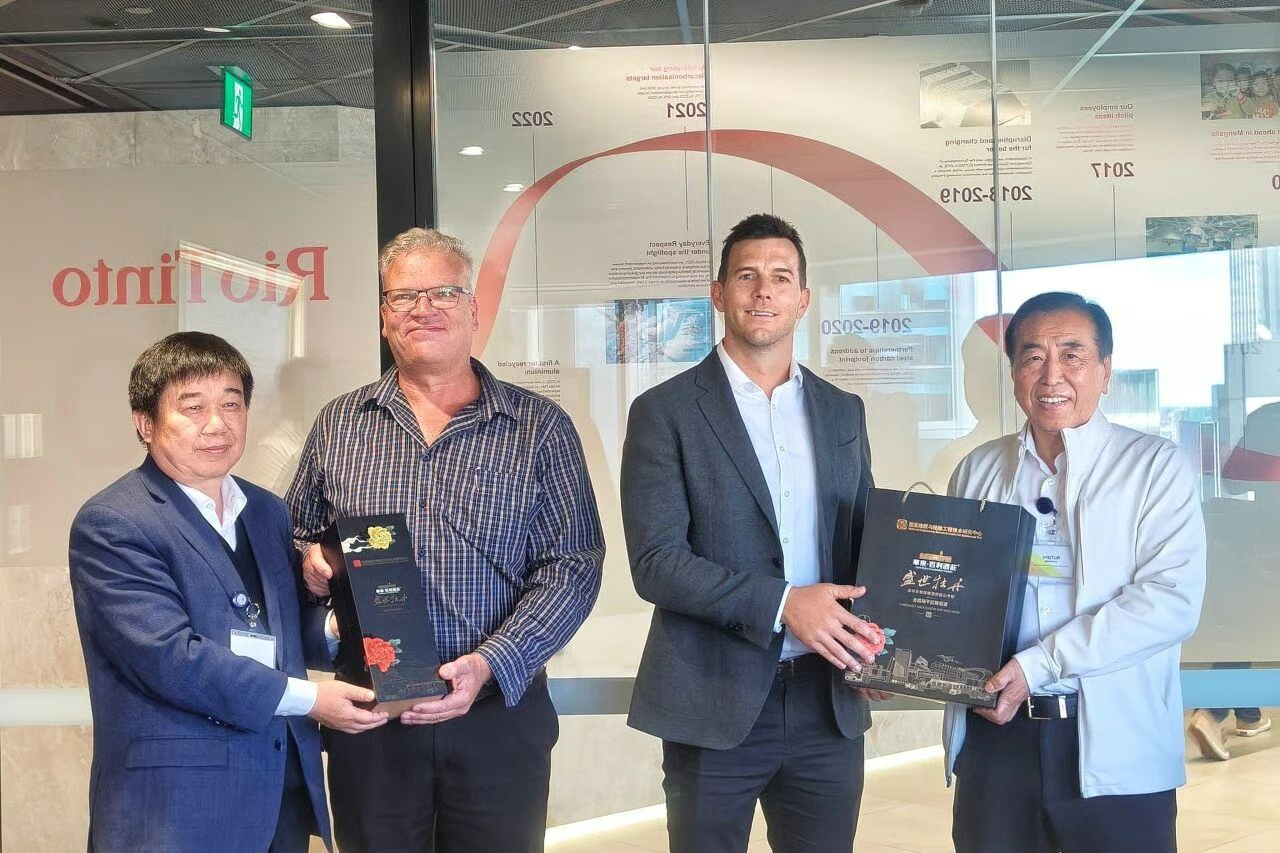 Image-RIO TINTO group
À Simandou, l’un des plus grands projets miniers au monde, les pneus et les convoyeurs venus de Chine ne sont plus de simples fournitures industrielles. Ils incarnent un changement profond dans la manière dont les grands groupes miniers occidentaux envisagent leurs partenariats stratégiques. La stratégie d’achats de Rio Tinto en est l’illustration la plus emblématique.
Longtemps perçus comme de simples fournisseurs à bas coût, les acteurs industriels chinois sont aujourd’hui de plus en plus considérés comme de véritables partenaires de long terme. Leur capacité à innover rapidement, à réduire les délais de mise sur le marché et à offrir une grande flexibilité logistique séduit désormais les géants du secteur. Mais au-delà de la performance et de l’agilité, ces entreprises apportent aussi des solutions concrètes en matière de durabilité, de circularité et de décarbonation. Les exemples des pneus miniers et des convoyeurs à bande, avec des groupes comme BOTON et Sailun, sont particulièrement révélateurs.
Chez Rio Tinto, la vision est claire : combiner la puissance industrielle, la capacité de montée en échelle et les investissements massifs en R&D des équipementiers chinois avec l’expertise opérationnelle et les standards mondiaux du groupe minier. L’objectif n’est plus seulement d’acheter, mais de co-créer des technologies et des équipements spécifiquement adaptés aux besoins futurs des opérations minières.
Cette ambition s’est matérialisée en juin 2024, lorsque BOTON, fournisseur chinois de premier plan de convoyeurs haut de gamme, et Rio Tinto ont célébré la reconduction solennelle de leur partenariat pour huit années supplémentaires. Ce renouvellement ne marquait pas seulement la reconnaissance de cinq années de collaboration fructueuse ; il ouvrait surtout un nouveau chapitre de développement conjoint. À cette date, BOTON avait déjà livré à Rio Tinto plus de 800 kilomètres de bandes transporteuses, un chiffre à la mesure de l’ampleur de la relation.
L’histoire avait commencé en 2018, avec l’installation d’un premier convoyeur d’essai au port de Dampier, en Australie. Depuis, les équipements BOTON ont accompagné les mines et les nouveaux projets de construction de Rio Tinto à travers le monde : Australie, Canada, États-Unis, Mongolie, Guinée et bien au-delà. Au fil des années, la coopération a évolué, passant de la simple fourniture de produits à un véritable partenariat technologique. En 2023, les deux entreprises ont ainsi co-développé une plateforme d’essais de convoyeurs, capable de reproduire les conditions réelles d’exploitation afin d’optimiser les conceptions et de résoudre, dès les phases amont, les problèmes de dégradation prématurée des bandes.
Fidèle à sa stratégie d’innovation, BOTON s’inscrit pleinement dans la transformation intelligente et automatisée de l’industrie minière. Lors des échanges de 2024, le groupe a présenté ses avancées en matière de convoyage intelligent, d’inspection sans personnel, de matériaux bas carbone et de recyclage circulaire. L’entreprise explore activement la réutilisation des bandes usées, contribuant ainsi à l’émergence d’une véritable économie circulaire dans le secteur minier.
Cette dynamique s’est concrétisée sur le terrain en mars 2024, lorsque BOTON a officiellement commencé à approvisionner SimFer, la coentreprise de Rio Tinto sur le projet de minerai de fer de Simandou, en Guinée, pour les blocs 3 et 4 du gisement. Pour sécuriser la chaîne d’approvisionnement et garantir la continuité des opérations, BOTON a créé BOTON Conveyor Services Guinea LLC ainsi qu’un centre technique africain basé en Guinée, offrant un support technique 24 heures sur 24, 7 jours sur 7. À noter que BOTON fournissait déjà avec succès les convoyeurs du Winning Consortium Simandou, opérateur des blocs 1 et 2.
La même logique de partenariat stratégique s’est récemment étendue aux pneus miniers. En 2025, le groupe chinois Sailun a signé avec Rio Tinto un accord-cadre mondial et un contrat d’approvisionnement de cinq ans pour le projet Simandou, couvrant la période 2025–2030. Sa marque MAXAM équipe désormais l’ensemble des camions miniers XCMG XDE260 de 230 tonnes – eux aussi d’origine chinoise – ainsi que plusieurs équipements auxiliaires du site, avec l’ambition d’étendre progressivement cette coopération à d’autres projets mondiaux de Rio Tinto.
Au-delà de la fourniture de pneus, Sailun et Rio Tinto ont engagé un dialogue approfondi sur les technologies de pointe et les applications du caoutchouc en environnement minier extrême. Fort de sa chaîne industrielle intégrée, de ses capacités de recherche et de sa puissance de production, Sailun entend garantir une fourniture sûre, stable et durable aux projets globaux de Rio Tinto. Les deux partenaires ont également rapproché leurs visions ESG, partageant des retours d’expérience concrets et jetant les bases d’une coopération mondiale dans le recyclage des pneus miniers usagés. Une initiative destinée à réduire l’empreinte carbone et environnementale des opérations, tout en inscrivant leur collaboration dans une contribution durable au développement de la société humaine.
NJC.© Info RIO TINTO group
--------------------------------------------------------------------------------------------------------------
13/01/26-English
When Simandou Becomes the Stage for a New Sino-Mining Alliance
Image- RIO TINTO group
At Simandou, one of the world’s largest mining projects, tires and conveyors from China are no longer simply industrial supplies. They embody a profound shift in how major Western mining groups approach their strategic partnerships. Rio Tinto’s procurement strategy is the most emblematic example.
Long perceived as mere low-cost suppliers, Chinese industrial players are now increasingly seen as true long-term partners. Their ability to innovate rapidly, reduce time to market, and offer significant logistical flexibility is now attracting industry giants. But beyond performance and agility, these companies also provide concrete solutions in terms of sustainability, circularity, and decarbonization. The examples of mining tires and conveyor belts, with groups like BOTON and Sailun, are particularly revealing.
At Rio Tinto, the vision is clear: to combine the industrial power, scalability, and massive R&D investments of Chinese equipment manufacturers with the mining group's operational expertise and global standards. The goal is no longer simply to purchase, but to co-create technologies and equipment specifically tailored to the future needs of mining operations.
This ambition materialized in June 2024, when BOTON, a leading Chinese supplier of high-end conveyors, and Rio Tinto formally renewed their partnership for another eight years. This renewal not only recognized five years of successful collaboration, but also opened a new chapter of joint development. By that time, BOTON had already delivered more than 800 kilometers of conveyor belts to Rio Tinto, a figure that reflects the scale of the relationship.
The story began in 2018 with the installation of the first test conveyor at the port of Dampier, Australia. Since then, BOTON equipment has supported Rio Tinto's mines and new construction projects worldwide: Australia, Canada, the United States, Mongolia, Guinea, and beyond. Over the years, the cooperation has evolved from simply supplying products to a true technological partnership. In 2023, the two companies co-developed a conveyor testing platform capable of replicating real-world operating conditions to optimize designs and address premature belt degradation issues from the earliest stages.
True to its innovation strategy, BOTON is fully committed to the smart and automated transformation of the mining industry. During the 2024 discussions, the group presented its advancements in intelligent conveying, unmanned inspection, low-carbon materials, and circular recycling. The company is actively exploring the reuse of worn belts, thus contributing to the emergence of a true circular economy in the mining sector.
This momentum materialized on the ground in March 2024, when BOTON officially began supplying SimFer, Rio Tinto’s joint venture on the Simandou iron ore project in Guinea, for blocks 3 and 4 of the deposit. To secure the supply chain and ensure business continuity, BOTON established BOTON Conveyor Services Guinea LLC and an African technical center based in Guinea, providing 24/7 technical support. It is worth noting that BOTON was already successfully supplying conveyors to the Winning Consortium Simandou, operator of blocks 1 and 2.
This same strategic partnership approach has recently been extended to mining tires. In 2025, the Chinese group Sailun signed a global framework agreement and a five-year supply contract with Rio Tinto for the Simandou project, covering the period 2025–2030. Its MAXAM brand now equips all of the XCMG XDE260 230-ton mining trucks – also of Chinese origin – as well as several auxiliary equipment on the site, with the ambition of gradually extending this cooperation to other global projects of Rio Tinto.
Beyond tire supply, Sailun and Rio Tinto have engaged in in-depth dialogue on cutting-edge technologies and the applications of rubber in extreme mining environments. Leveraging its integrated industrial chain, research capabilities, and production capacity, Sailun aims to guarantee a safe, stable, and sustainable supply for Rio Tinto's global projects. The two partners have also aligned their ESG (Environmental, Social, and Governance) visions, sharing concrete experiences and laying the groundwork for global cooperation in the recycling of used mining tires. This initiative is designed to reduce the carbon and environmental footprint of operations, while ensuring their collaboration contributes sustainably to the development of human society.
NJC.© Info RIO TINTO group
----------------------------------------------------------------------------------------------------------------
13/01/26-NL
Wanneer Simandou het toneel wordt voor een nieuwe Chinees-mijnbouwalliantie
Image-RIO TINTO group
In Simandou, een van 's werelds grootste mijnbouwprojecten, zijn banden en transportbanden uit China niet langer slechts industriële benodigdheden. Ze belichamen een fundamentele verschuiving in de manier waarop grote westerse mijnbouwconcerns hun strategische partnerschappen benaderen. De inkoopstrategie van Rio Tinto is hiervan het meest sprekende voorbeeld.
Chinese industriële spelers, die lange tijd werden gezien als louter goedkope leveranciers, worden nu steeds vaker beschouwd als echte partners voor de lange termijn. Hun vermogen om snel te innoveren, de time-to-market te verkorten en aanzienlijke logistieke flexibiliteit te bieden, trekt nu industriereuzen aan. Maar naast prestaties en wendbaarheid bieden deze bedrijven ook concrete oplossingen op het gebied van duurzaamheid, circulariteit en decarbonisatie. De voorbeelden van mijnbouwbanden en transportbanden, met groepen als BOTON en Sailun, zijn bijzonder veelzeggend.
Bij Rio Tinto is de visie duidelijk: de industriële kracht, schaalbaarheid en enorme R&D-investeringen van Chinese machinefabrikanten combineren met de operationele expertise en wereldwijde standaarden van het mijnbouwconcern. Het doel is niet langer alleen maar aankopen te doen, maar om samen technologieën en apparatuur te ontwikkelen die specifiek zijn afgestemd op de toekomstige behoeften van mijnbouwactiviteiten.
Deze ambitie werd werkelijkheid in juni 2024, toen BOTON, een toonaangevende Chinese leverancier van hoogwaardige transportbanden, en Rio Tinto hun partnerschap formeel verlengden met nog eens acht jaar. Deze verlenging erkende niet alleen vijf jaar succesvolle samenwerking, maar opende ook een nieuw hoofdstuk van gezamenlijke ontwikkeling. Tegen die tijd had BOTON al meer dan 800 kilometer aan transportbanden aan Rio Tinto geleverd, een cijfer dat de omvang van de relatie weerspiegelt.
Het verhaal begon in 2018 met de installatie van de eerste testtransportband in de haven van Dampier, Australië. Sindsdien heeft BOTON-apparatuur de mijnen en nieuwbouwprojecten van Rio Tinto wereldwijd ondersteund: Australië, Canada, de Verenigde Staten, Mongolië, Guinee en daarbuiten. In de loop der jaren is de samenwerking geëvolueerd van louter productlevering naar een echt technologisch partnerschap. In 2023 ontwikkelden de twee bedrijven gezamenlijk een testplatform voor transportbanden dat in staat is om de operationele omstandigheden in de praktijk na te bootsen. Dit platform optimaliseert ontwerpen en pakt problemen met vroegtijdige slijtage van transportbanden in een vroeg stadium aan.
Trouw aan haar innovatiestrategie zet BOTON zich volledig in voor de slimme en geautomatiseerde transformatie van de mijnbouwsector. Tijdens de besprekingen in 2024 presenteerde de groep haar vorderingen op het gebied van intelligent transport, onbemande inspectie, koolstofarme materialen en circulaire recycling. Het bedrijf onderzoekt actief de mogelijkheden voor hergebruik van versleten transportbanden en draagt zo bij aan de totstandkoming van een echte circulaire economie in de mijnbouwsector.
Deze ontwikkeling werd concreet in maart 2024, toen BOTON officieel begon met de levering aan SimFer, de joint venture van Rio Tinto voor het Simandou-ijzerertsproject in Guinee, voor blokken 3 en 4 van de afzetting. Om de toeleveringsketen te waarborgen en de bedrijfscontinuïteit te garanderen, richtte BOTON BOTON Conveyor Services Guinea LLC op, met een Afrikaans technisch centrum in Guinee dat 24/7 technische ondersteuning biedt. Het is belangrijk om te vermelden dat BOTON al succesvol transportbanden leverde aan het winnende consortium Simandou, de exploitant van blokken 1 en 2.
Deze strategische samenwerking is onlangs ook uitgebreid naar banden voor de mijnbouw. In 2025 tekende de Chinese groep Sailun een wereldwijde raamovereenkomst en een vijfjarig leveringscontract met Rio Tinto voor het Simandou-project, dat loopt van 2025 tot 2030. Alle XCMG XDE260 230-tons mijnbouwtrucks – eveneens van Chinese makelij – en diverse hulpapparatuur op de locatie zijn nu voorzien van banden van het merk MAXAM. De ambitie is om deze samenwerking geleidelijk uit te breiden naar andere wereldwijde projecten van Rio Tinto.
Naast de levering van banden hebben Sailun en Rio Tinto een diepgaande dialoog gevoerd over geavanceerde technologieën en de toepassingen van rubber in extreme mijnbouwomgevingen. Door gebruik te maken van haar geïntegreerde industriële keten, onderzoeksfaciliteiten en productiecapaciteit, streeft Sailun ernaar een veilige, stabiele en duurzame levering te garanderen voor de wereldwijde projecten van Rio Tinto. De twee partners hebben ook hun ESG-visie (Milieu, Sociaal en Bestuur) op elkaar afgestemd, concrete ervaringen gedeeld en de basis gelegd voor wereldwijde samenwerking op het gebied van de recycling van gebruikte mijnbouwbanden. Dit initiatief is erop gericht de CO2-uitstoot en de milieubelasting van de activiteiten te verminderen, terwijl hun samenwerking tegelijkertijd een duurzame bijdrage levert aan de ontwikkeling van de menselijke samenleving.
NJC.© Info RIO TINTO group
-----------------------------------------------------------------------------------------------------------------
Date de dernière mise à jour : 12/01/2026