



R.E.News International-Volvo Targets Japan’s Urban Construction Boom with a Smarter Compact Excavator
 01/08/26-FR-English-NL-footer
Volvo ECR355 : au Japon, la machine qui doit faire le travail de deux
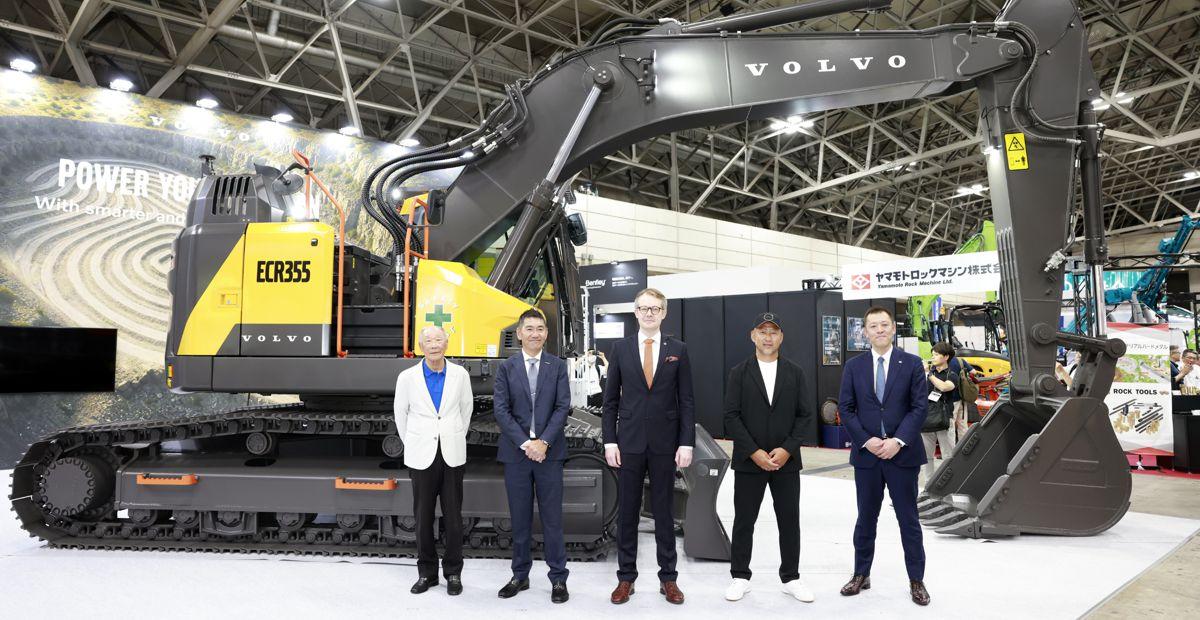 Image- The ECR355 excavator displayed at the Volvo Group Japan booth during CSPI-EXPO alongside representatives from Volvo CE, Volvo Group Japan, Takayama Kenzai Kogyo, Nishio T&M Co., Ltd., and Daiichi Toyo Co., Ltd.
Au Japon, le chantier de demain ne manque pas forcément de projets.
Il manque de bras.
Alors que près de 70 % des grands et moyens entrepreneurs japonais estiment ne pas pouvoir accepter de nouveaux projets majeurs en 2026 faute de main-d’œuvre, une nouvelle génération de machines commence à répondre à une question devenue stratégique : comment produire davantage avec moins d’opérateurs ?
C’est dans ce contexte que Volvo Construction Equipment a dévoilé au Japon sa nouvelle ECR355, une pelle compacte à rayon arrière court de 36 tonnes.
Présentée au CSPI-EXPO et remise symboliquement à Takayama Kenzai Kogyo, la machine n’arrive pas simplement avec une nouvelle fiche technique. Elle arrive avec une promesse beaucoup plus ambitieuse : concentrer plusieurs fonctions sur un seul équipement.
Une grande pelle dans un espace réduit
Sur les chantiers résidentiels escarpés de la préfecture de Nara, la génération précédente ECR355E avait déjà démontré le potentiel du concept.
Grâce à son rayon arrière compact et à sa configuration adaptée au levage, une seule machine pouvait effectuer simultanément des opérations qui auraient normalement nécessité plusieurs équipements.
Creuser. Soulever. Charger. Manœuvrer.
Et tout cela dans des espaces où chaque mètre compte.
Le résultat est une équation inhabituelle : une machine plus imposante peut finalement coûter moins cher à exploiter qu’une machine plus petite, lorsqu’elle permet d’éliminer un second engin, son transport et surtout son opérateur.
C’est précisément cette logique que Volvo veut pousser plus loin.
L’intelligence devient une partie de la machine
Sous le capot, le nouvel ECR355 reçoit le moteur Volvo D8M, une nouvelle architecture électro-hydraulique et une vanne principale redessinée.
À la clé : jusqu’à 7 % de réduction de consommation de carburant, tandis que les intervalles de remplacement de l’huile hydraulique et du filtre de retour atteignent désormais 3 000 heures.
Mais la transformation la plus intéressante se trouve autour de la cabine.
Le système Volvo Smart View with People and Obstacle Classification combine caméras à 360°, radar haute précision et reconnaissance d’objets par intelligence artificielle.
La machine ne se contente plus de « voir ».
Elle cherche à comprendre ce qui se trouve autour d’elle.
Un homme. Un obstacle. Un danger.
Dans un secteur où les systèmes de détection sont souvent ajoutés après coup, cette intégration directement en usine change la philosophie : la sécurité n’est plus un accessoire installé sur la machine, elle devient une composante de son architecture.
Le confort devient une arme contre la pénurie
Volvo a également agrandi l’espace de travail de l’opérateur, amélioré la climatisation et installé un écran Volvo Co-Pilot de 12,8 pouces.
Cela peut sembler secondaire.
Au Japon, ce ne l’est pas.
Avec une population active vieillissante et une proportion importante de travailleurs de plus de 55 ans dans la construction, conserver les opérateurs expérimentés devient aussi important que recruter les nouveaux.
Une cabine plus confortable réduit la fatigue.
Une assistance automatisée facilite certaines opérations.
Et un système comme Volvo Active Control peut aider un opérateur moins expérimenté à atteindre un niveau de précision plus proche de celui d’un professionnel chevronné.
La technologie devient ainsi une forme de transmission du savoir-faire.
Le vrai pari de Volvo
Le choix du Japon est particulièrement révélateur.
Komatsu, Hitachi et Kobelco disposent ici d’un avantage historique, industriel et commercial considérable. Volvo ne peut donc difficilement gagner une bataille de prix.
Il choisit une autre arme : l’intégration technologique.
Une pelle compacte capable de travailler dans des environnements urbains contraints, de lever et creuser avec une seule machine, de réduire sa consommation, d’assister son opérateur et de surveiller intelligemment son environnement.
Ce n’est plus seulement une pelle.
C’est une tentative de transformer chaque opérateur en unité de production plus performante.
Le Japon montre peut-être le chantier de demain
Ce qui se joue autour de l’ECR355 dépasse finalement le marché japonais.
Le vieillissement de la main-d’œuvre touche déjà de nombreuses économies développées. Royaume-Uni, Europe, Amérique du Nord : partout, les entrepreneurs commencent à rencontrer la même équation.
Moins de travailleurs disponibles.
Des projets toujours plus complexes.
Des coûts de main-d’œuvre en hausse.
Et une pression permanente sur la productivité.
Le Japon est simplement en avance sur cette courbe.
C’est pourquoi l’ECR355 mérite d’être observée.
Car la prochaine génération d’engins de chantier ne sera peut-être pas définie par leur puissance maximale, mais par une question beaucoup plus simple :
Combien de travail une seule machine peut-elle accomplir lorsqu’elle devient intelligente ?
Au Japon, Volvo vient de donner sa réponse.
Et elle pèse 36 tonnes.
NJC.© Info VOLVO CE
--------------------------------------------------------------------------------------------------------------------
01/09/26-English
Volvo ECR355: In Japan, the machine that can do the work of two
Image- The ECR355 excavator displayed at the Volvo Group Japan booth during CSPI-EXPO alongside representatives from Volvo CE, Volvo Group Japan, Takayama Kenzai Kogyo, Nishio T&M Co., Ltd., and Daiichi Toyo Co., Ltd.
In Japan, the construction sites of tomorrow aren't necessarily lacking in projects.
They're lacking in manpower.
While nearly 70% of large and medium-sized Japanese contractors believe they won't be able to take on any major new projects in 2026 due to a labor shortage, a new generation of machines is beginning to address a question that has become strategic: how to produce more with fewer operators?
It is in this context that Volvo Construction Equipment unveiled its new ECR355 in Japan, a 36-ton compact excavator with a short tail swing.
Presented at CSPI-EXPO and symbolically handed over to Takayama Kenzai Kogyo, the machine doesn't just come with a new spec sheet. It comes with a much more ambitious promise: to concentrate several functions into a single piece of equipment.
A large excavator in a confined space
On the steep residential construction sites of Nara Prefecture, the previous generation ECR355E had already demonstrated the potential of the concept.
Thanks to its compact tail swing and lifting-friendly configuration, a single machine could simultaneously perform operations that would normally require multiple pieces of equipment.
Digging. Lifting. Loading. Maneuvering.
And all this in spaces where every meter counts.
The result is an unusual equation: a larger machine can ultimately be less expensive to operate than a smaller one, when it eliminates the need for a second machine, its transport, and, most importantly, its operator.
It is precisely this logic that Volvo wants to take further.
Intelligence becomes part of the machine
Under the hood, the new ECR355 features the Volvo D8M engine, a new electro-hydraulic architecture, and a redesigned main valve.
The result: up to 7% fuel consumption reduction, while hydraulic oil and return filter replacement intervals are now extended to 3,000 hours.
But the most significant transformation is in the cab.
The Volvo Smart View with People and Obstacle Classification system combines 360° cameras, high-precision radar, and artificial intelligence-powered object recognition.
The machine no longer simply "sees."
It seeks to understand its surroundings.
A person. An obstacle. A hazard.
In an industry where detection systems are often added as an afterthought, this factory-integrated system changes the philosophy: safety is no longer an accessory installed on the machine; it becomes an integral part of its design.
Comfort becomes a weapon against shortages.
Volvo has also enlarged the operator's workspace, improved the air conditioning, and installed a 12.8-inch Volvo Co-Pilot display.
This may seem secondary.
In Japan, it's not the case.
With an aging workforce and a significant proportion of construction workers over 55, retaining experienced operators is becoming just as important as recruiting new ones.
A more comfortable cab reduces fatigue.
Automated assistance facilitates certain operations.
And a system like Volvo Active Control can help a less experienced operator achieve a level of precision closer to that of a seasoned professional.
Technology thus becomes a form of knowledge transfer.
Volvo's real gamble
The choice of Japan is particularly revealing.
Komatsu, Hitachi, and Kobelco have a considerable historical, industrial, and commercial advantage here. Volvo can therefore hardly win a price war.
It chooses another weapon: technological integration.
A compact excavator capable of working in constrained urban environments, lifting and digging with a single machine, reducing fuel consumption, assisting its operator, and intelligently monitoring its surroundings.
It's no longer just an excavator.
It's an attempt to transform each operator into a more efficient production unit.
Japan may be showing us the construction site of tomorrow.
What's happening with the ECR355 ultimately extends beyond the Japanese market.
The aging workforce is already affecting many developed economies. The UK, Europe, North America: everywhere, contractors are beginning to encounter the same equation.
Fewer workers available.
Increasingly complex projects.
Rising labor costs.
And constant pressure on productivity.
Japan is simply ahead of the curve.
That's why the ECR355 deserves attention.
Because the next generation of construction equipment may not be defined by its maximum power, but by a much simpler question:
Volvo ECR355: In Japan, the machine that can do the work of two
In Japan, the construction sites of tomorrow aren't necessarily lacking in projects.
They're lacking in manpower.
While nearly 70% of large and medium-sized Japanese contractors believe they won't be able to take on any major new projects in 2026 due to a labor shortage, a new generation of machines is beginning to address a question that has become strategic: how to produce more with fewer operators?
It is in this context that Volvo Construction Equipment unveiled its new ECR355 in Japan, a 36-ton compact excavator with a short tail swing.
Presented at CSPI-EXPO and symbolically handed over to Takayama Kenzai Kogyo, the machine doesn't just come with a new spec sheet. It comes with a much more ambitious promise: to concentrate several functions into a single piece of equipment.
A large excavator in a confined space
On the steep residential construction sites of Nara Prefecture, the previous generation ECR355E had already demonstrated the potential of the concept.
Thanks to its compact tail swing and lifting-friendly configuration, a single machine could simultaneously perform operations that would normally require multiple pieces of equipment.
Digging. Lifting. Loading. Maneuvering.
And all this in spaces where every meter counts.
The result is an unusual equation: a larger machine can ultimately be less expensive to operate than a smaller one, when it eliminates the need for a second machine, its transport, and, most importantly, its operator.
It is precisely this logic that Volvo wants to take further.
Intelligence becomes part of the machine
Under the hood, the new ECR355 features the Volvo D8M engine, a new electro-hydraulic architecture, and a redesigned main valve.
The result: up to 7% fuel consumption reduction, while hydraulic oil and return filter replacement intervals are now extended to 3,000 hours.
But the most significant transformation is in the cab.
The Volvo Smart View with People and Obstacle Classification system combines 360° cameras, high-precision radar, and artificial intelligence-powered object recognition.
The machine no longer simply "sees."
It seeks to understand its surroundings.
A person. An obstacle. A hazard.
In an industry where detection systems are often added as an afterthought, this factory-integrated system changes the philosophy: safety is no longer an accessory installed on the machine; it becomes an integral part of its design.
Comfort becomes a weapon against shortages.
Volvo has also enlarged the operator's workspace, improved the air conditioning, and installed a 12.8-inch Volvo Co-Pilot display.
This may seem secondary.
In Japan, it's not the case.
With an aging workforce and a significant proportion of construction workers over 55, retaining experienced operators is becoming just as important as recruiting new ones.
A more comfortable cab reduces fatigue.
Automated assistance facilitates certain operations.
And a system like Volvo Active Control can help a less experienced operator achieve a level of precision closer to that of a seasoned professional.
Technology thus becomes a form of knowledge transfer.
Volvo's real gamble
The choice of Japan is particularly revealing.
Komatsu, Hitachi, and Kobelco have a considerable historical, industrial, and commercial advantage here. Volvo can therefore hardly win a price war.
It chooses another weapon: technological integration.
A compact excavator capable of working in constrained urban environments, lifting and digging with a single machine, reducing fuel consumption, assisting its operator, and intelligently monitoring its surroundings.
It's no longer just an excavator.
It's an attempt to transform each operator into a more efficient production unit.
Japan may be showing us the construction site of tomorrow.
What's happening with the ECR355 ultimately extends beyond the Japanese market.
The aging workforce is already affecting many developed economies. The UK, Europe, North America: everywhere, contractors are beginning to encounter the same equation.
Fewer workers available.
Increasingly complex projects.
Rising labor costs.
And constant pressure on productivity.
Japan is simply ahead of the curve.
That's why the ECR355 deserves attention.
Because the next generation of construction equipment may not be defined by its maximum power, but by a much simpler question:
NJC.© Info VOLVO CE
------------------------------------------------------------------------------------------------------------------
01/09/26-NL
Volvo ECR355: In Japan, de machine die het werk van twee kan doen
Image- The ECR355 excavator displayed at the Volvo Group Japan booth during CSPI-EXPO alongside representatives from Volvo CE, Volvo Group Japan, Takayama Kenzai Kogyo, Nishio T&M Co., Ltd., and Daiichi Toyo Co., Ltd.
In Japan ontbreekt het de bouwplaatsen van de toekomst niet per se aan projecten.
Het probleem is het gebrek aan mankracht.
Terwijl bijna 70% van de grote en middelgrote Japanse aannemers verwacht dat ze in 2026 geen grote nieuwe projecten kunnen aannemen vanwege een tekort aan arbeidskrachten, begint een nieuwe generatie machines een strategische vraag te beantwoorden: hoe kun je meer produceren met minder operators?
In deze context onthulde Volvo Construction Equipment in Japan de nieuwe ECR355, een compacte graafmachine van 36 ton met een korte draaicirkel.
De machine, die werd gepresenteerd op CSPI-EXPO en symbolisch werd overhandigd aan Takayama Kenzai Kogyo, komt niet alleen met nieuwe specificaties. Hij komt met een veel ambitieuzere belofte: meerdere functies concentreren in één machine.
Een grote graafmachine in een krappe ruimte
Op de steile bouwterreinen van woonwijken in de prefectuur Nara had de vorige generatie ECR355E het potentieel van dit concept al bewezen.
Dankzij de compacte draaicirkel en de hefvriendelijke configuratie kon één machine gelijktijdig werkzaamheden uitvoeren waarvoor normaal gesproken meerdere machines nodig zijn.
Graven. Heffen. Laden. Manoeuvreren.
En dat alles in ruimtes waar elke meter telt.
Het resultaat is een ongebruikelijke vergelijking: een grotere machine kan uiteindelijk goedkoper in gebruik zijn dan een kleinere, omdat er geen tweede machine, transport en, belangrijker nog, geen machinist nodig is.
Precies deze logica wil Volvo verder ontwikkelen.
Intelligentie wordt onderdeel van de machine
Onder de motorkap beschikt de nieuwe ECR355 over de Volvo D8M-motor, een nieuwe elektrohydraulische architectuur en een opnieuw ontworpen hoofdklep.
Het resultaat: tot wel 7% minder brandstofverbruik, terwijl de intervallen voor het vervangen van de hydraulische olie en het retourfilter zijn verlengd tot 3.000 uur.
Maar de meest significante verandering vindt plaats in de cabine.
Het Volvo Smart View-systeem met personen- en obstakelclassificatie combineert 360°-camera's, uiterst nauwkeurige radar en door kunstmatige intelligentie aangedreven objectherkenning.
De machine "ziet" niet langer alleen maar.
Hij probeert zijn omgeving te begrijpen.
Een persoon. Een obstakel. Een gevaar.
In een industrie waar detectiesystemen vaak achteraf worden toegevoegd, verandert dit in de fabriek geïntegreerde systeem de filosofie: veiligheid is niet langer een accessoire dat op de machine wordt gemonteerd; het wordt een integraal onderdeel van het ontwerp.
Comfort wordt een wapen tegen tekorten.
Volvo heeft ook de werkruimte van de bestuurder vergroot, de airconditioning verbeterd en een 12,8-inch Volvo Co-Pilot-display geïnstalleerd.
Dit lijkt misschien bijzaak.
In Japan is dat echter niet het geval.
Met een vergrijzende beroepsbevolking en een aanzienlijk deel van de bouwvakkers boven de 55, wordt het behouden van ervaren machinisten net zo belangrijk als het werven van nieuwe.
Een comfortabelere cabine vermindert vermoeidheid.
Geautomatiseerde assistentie vergemakkelijkt bepaalde werkzaamheden.
En een systeem zoals Volvo Active Control kan een minder ervaren machinist helpen een precisieniveau te bereiken dat dichter bij dat van een doorgewinterde professional ligt.
Technologie wordt zo een vorm van kennisoverdracht.
Volvo's echte gok
De keuze voor Japan is bijzonder veelzeggend.
Komatsu, Hitachi en Kobelco hebben hier een aanzienlijk historisch, industrieel en commercieel voordeel. Volvo kan daarom nauwelijks een prijsoorlog winnen.
Het kiest voor een ander wapen: technologische integratie.
Een compacte graafmachine die geschikt is voor gebruik in krappe stedelijke omgevingen, die met één machine kan heffen en graven, het brandstofverbruik verlaagt, de machinist ondersteunt en de omgeving intelligent monitort.
Het is niet langer zomaar een graafmachine.
Het is een poging om van elke machinist een efficiëntere productie-eenheid te maken.
Japan laat ons misschien wel de bouwplaats van de toekomst zien.
Wat er met de ECR355 gebeurt, reikt uiteindelijk verder dan de Japanse markt.
De vergrijzende beroepsbevolking treft al veel ontwikkelde economieën. Het Verenigd Koninkrijk, Europa, Noord-Amerika: overal beginnen aannemers met dezelfde situatie te kampen.
Minder beschikbare werknemers.
Steeds complexere projecten.
Stijgende arbeidskosten.
En constante druk op de productiviteit.
Japan loopt simpelweg voorop.
Daarom verdient de ECR355 aandacht.
Want de volgende generatie bouwmachines wordt misschien niet bepaald door maximaal vermogen, maar door een veel eenvoudigere vraag:
Volvo ECR355: In Japan, de machine die het werk van twee kan doen
In Japan ontbreekt het de bouwplaatsen van de toekomst niet per se aan projecten.
Het probleem is het gebrek aan mankracht.
Terwijl bijna 70% van de grote en middelgrote Japanse aannemers verwacht dat ze in 2026 geen grote nieuwe projecten kunnen aannemen vanwege een tekort aan arbeidskrachten, begint een nieuwe generatie machines een strategische vraag te beantwoorden: hoe kun je meer produceren met minder operators?
In deze context onthulde Volvo Construction Equipment in Japan de nieuwe ECR355, een compacte graafmachine van 36 ton met een korte draaicirkel.
De machine, die werd gepresenteerd op CSPI-EXPO en symbolisch werd overhandigd aan Takayama Kenzai Kogyo, komt niet alleen met nieuwe specificaties. Hij komt met een veel ambitieuzere belofte: meerdere functies concentreren in één machine.
Een grote graafmachine in een krappe ruimte
Op de steile bouwterreinen van woonwijken in de prefectuur Nara had de vorige generatie ECR355E het potentieel van dit concept al bewezen.
Dankzij de compacte draaicirkel en de hefvriendelijke configuratie kon één machine gelijktijdig werkzaamheden uitvoeren waarvoor normaal gesproken meerdere machines nodig zijn.
Graven. Heffen. Laden. Manoeuvreren.
En dat alles in ruimtes waar elke meter telt.
Het resultaat is een ongebruikelijke vergelijking: een grotere machine kan uiteindelijk goedkoper in gebruik zijn dan een kleinere, omdat er geen tweede machine, transport en, belangrijker nog, geen machinist nodig is.
Precies deze logica wil Volvo verder ontwikkelen.
Intelligentie wordt onderdeel van de machine
Onder de motorkap beschikt de nieuwe ECR355 over de Volvo D8M-motor, een nieuwe elektrohydraulische architectuur en een opnieuw ontworpen hoofdklep.
Het resultaat: tot wel 7% minder brandstofverbruik, terwijl de intervallen voor het vervangen van de hydraulische olie en het retourfilter zijn verlengd tot 3.000 uur.
Maar de meest significante verandering vindt plaats in de cabine.
Het Volvo Smart View-systeem met personen- en obstakelclassificatie combineert 360°-camera's, uiterst nauwkeurige radar en door kunstmatige intelligentie aangedreven objectherkenning.
De machine "ziet" niet langer alleen maar.
Hij probeert zijn omgeving te begrijpen.
Een persoon. Een obstakel. Een gevaar.
In een industrie waar detectiesystemen vaak achteraf worden toegevoegd, verandert dit in de fabriek geïntegreerde systeem de filosofie: veiligheid is niet langer een accessoire dat op de machine wordt gemonteerd; het wordt een integraal onderdeel van het ontwerp.
Comfort wordt een wapen tegen tekorten.
Volvo heeft ook de werkruimte van de bestuurder vergroot, de airconditioning verbeterd en een 12,8-inch Volvo Co-Pilot-display geïnstalleerd.
Dit lijkt misschien bijzaak.
In Japan is dat echter niet het geval.
Met een vergrijzende beroepsbevolking en een aanzienlijk deel van de bouwvakkers boven de 55, wordt het behouden van ervaren machinisten net zo belangrijk als het werven van nieuwe.
Een comfortabelere cabine vermindert vermoeidheid.
Geautomatiseerde assistentie vergemakkelijkt bepaalde werkzaamheden.
En een systeem zoals Volvo Active Control kan een minder ervaren machinist helpen een precisieniveau te bereiken dat dichter bij dat van een doorgewinterde professional ligt.
Technologie wordt zo een vorm van kennisoverdracht.
Volvo's echte gok
De keuze voor Japan is bijzonder veelzeggend.
Komatsu, Hitachi en Kobelco hebben hier een aanzienlijk historisch, industrieel en commercieel voordeel. Volvo kan daarom nauwelijks een prijsoorlog winnen.
Het kiest voor een ander wapen: technologische integratie.
Een compacte graafmachine die geschikt is voor gebruik in krappe stedelijke omgevingen, die met één machine kan heffen en graven, het brandstofverbruik verlaagt, de machinist ondersteunt en de omgeving intelligent monitort.
Het is niet langer zomaar een graafmachine.
Het is een poging om van elke machinist een efficiëntere productie-eenheid te maken.
Japan laat ons misschien wel de bouwplaats van de toekomst zien.
Wat er met de ECR355 gebeurt, reikt uiteindelijk verder dan de Japanse markt.
De vergrijzende beroepsbevolking treft al veel ontwikkelde economieën. Het Verenigd Koninkrijk, Europa, Noord-Amerika: overal beginnen aannemers met dezelfde situatie te kampen.
Minder beschikbare werknemers.
Steeds complexere projecten.
Stijgende arbeidskosten.
En constante druk op de productiviteit.
Japan loopt simpelweg voorop.
Daarom verdient de ECR355 aandacht.
Want de volgende generatie bouwmachines wordt misschien niet bepaald door maximaal vermogen, maar door een veel eenvoudigere vraag:
NJC.© Info VOLVO CE
---------------------------------------------------------------------------------------------------------------
Date de dernière mise à jour : 31/08/2026